
 Buy me a coffee
Nibiru, The Twelfth Planet
“Nibiru, the Twelfth Planet: Ancient Harbinger of Cosmic Cataclysms and the Anunnaki’s Forbidden Secrets”
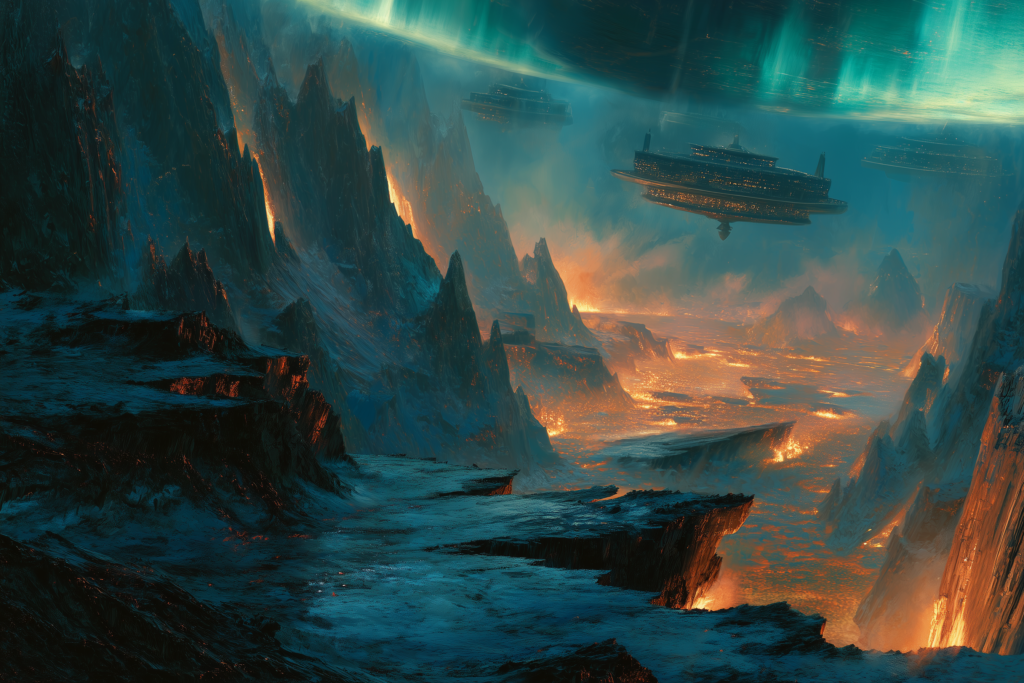
(Formerly known as “The Planet of Crossing” in ancient mythic astronomy)
Nibiru is a chaotic–mystic planet embodying cosmic cataclysm, cyclical destiny, and engineered evolution. Its long, elliptical 3,600-year orbit brings it periodically into the inner solar system, where it interacts gravitationally and mythically with Earth. This wandering planet is said to be the home of the Anunnaki, whose influence shaped early human civilization, and the site of Tiamat’s destruction, giving rise to Earth, the asteroid belt, and other cosmic debris. Nibiru pulses with inescapable inevitability, and all who dwell near or study it are drawn into cycles of creation, rebellion, and transformation.
TRAITS
Nibiru exhibits the following planetary traits:
- Morphic: Divinely and technologically morphic, shaped by the Anunnaki.
- Gravity: Slightly stronger than Earth, enhancing muscle density in natives.
- Time: Flows normally, but cosmic cycles create epochs of isolation and active influence.
- Size: Massive, larger than Earth, with thick, storm-laden atmosphere.
- Structure: Ancient and cyclical, alternating between decay and renewal.
- Essence: Mixed and anomalous, combining geothermal, cosmic, and artificial energies.
- Alignment: Neutral with chaotic tendencies, unpredictable due to orbital and societal forces.
- Magic: Enhanced, especially for technomantic, celestial, or metallurgical rituals.
DIVINITIES
Nibiru is ruled by the Anunnaki, whose domains shape the planet and influence Earth:
- Enlil, Lord of Command: governance, storms, and enforcement.
- Enki, Keeper of the Deep: creation, knowledge, water, and genetics.
- Inanna, Radiant Queen: conflict, beauty, and cosmic ascension.
- Ninurta, Hunter of the Outer Dark: warcraft, guardianship, and cosmic discipline.
These beings manipulate both planetary and earthly systems, creating civilizations, technologies, and lifeforms to suit their agendas.
OUTSIDERS AND DENIZENS
- Anunnaki Highborn: Rulers, scientists, and warriors.
- Igigi Sky-Servants: Orbital and aerial operatives, engineers of cosmic infrastructure.
- Ur-Titans of the Deep Crust: Pre-Anunnaki colossal entities beneath the planet’s mantle.
- Engineered Beings & Tiamat-Fragments: Hybrid species, crystalline entities, and proto-humanoids designed for experimentation or labor.
PETITIONERS
Souls or consciousness fragments drawn to Nibiru are typically:
- Visionaries obsessed with cosmic cycles or forbidden knowledge.
- Rebels seeking power or escape from imposed hierarchy.
- Those involved in creation, engineering, or magical experimentation.
Petitioners often act as record-keepers, attendants, or experimental subjects, reflecting the planet’s core themes of creation, refinement, and struggle for dominance.
INFUSIONS
- Basic: Resistance to radiation, magnetism, and psychic stress; enhanced endurance.
- Improved: Celestial awareness and structural perception of planets or constructs.
- Greater: Shapeshifting or technomantic control over metals, magnetism, or hybrid lifeforms.
SPECIFIC LOCATIONS
- The Citadel of Crossing: Central seat of power, alignment rituals, and starborn governance.
- Tiamat’s Scar: Shattered continent exposing Tiamat’s remnants; distorts magic and memory.
- The Golden Depths: Deep mines where Anunnaki perfected genetic engineering and metallurgy.
- Outer Dark Rings: Abandoned orbital stations with rogue constructs and drifting titans.
LORE & COSMIC HISTORY
Nibiru’s influence on Earth according to mythic timelines:
- ~450,000 years ago: Nibiru enters the inner solar system; Anunnaki arrive on Earth to mine gold. They establish early outposts in Africa and observe human ancestors.
- ~300,000 years ago: Dissatisfaction among the Igigi and Anunnaki laborers leads to genetic experiments to create the Nephilim, proto-human hybrids to assist with labor.
- ~100,000 years ago: Human civilizations begin forming under Anunnaki guidance. Early Sumerian sites reflect knowledge, metallurgy, and governance taught by Nibiru’s emissaries.
- ~3,600-year orbital cycles (recurring): Nibiru periodically approaches the inner solar system. Myth and prophecy describe cataclysmic effects on Earth, often recorded as floods, upheavals, or solar/planetary anomalies.
- Historical Interactions: Mesopotamian myths, ziggurats, and depictions of gods with alien characteristics are interpreted as remnants of Anunnaki influence.
TIMELINE RELATIVE TO EARTH
| Year (Approx.) | Event |
|---|---|
| 450,000 BCE | Nibiru enters inner solar system; Anunnaki arrive to mine gold. |
| 300,000 BCE | Creation of the Nephilim to ease Anunnaki labor mutiny. |
| 100,000 BCE | Early human civilizations shaped; proto-Sumerian cultures emerge. |
| 10,000 BCE | Last recorded orbital approach influencing human mythology (flood myths). |
| 3600 BCE | Estimated minor orbital return; possible cultural memory of Nibiru in Mesopotamian legends. |
| 0 CE | Nibiru remains distant, influencing myth and secret knowledge through intermediaries (temples, kingship). |
| Future | Cycle predicts return of Nibiru to inner solar system; potential for cosmic upheaval, technological rediscovery, or mythic reinterpretation. |
FINAL OVERVIEW
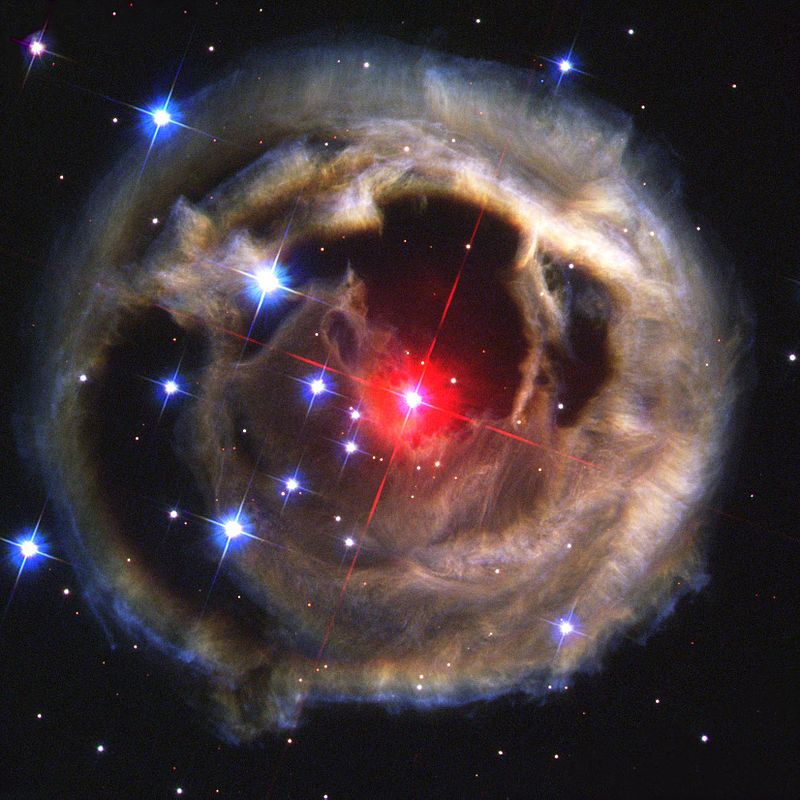
Nibiru is a planet of cosmic cycles, rebellion, and engineered evolution, where celestial forces, divine intelligences, and mortal ambitions intersect. Its history with Earth weaves a narrative of catastrophe, creation, and cultural shaping. Those who study or encounter Nibiru—mythic scholars, adventurers, or RPG players—are forever influenced by its energies, either gaining insight, power, or becoming lost in the echoes of its eternal orbit.
Nibiru, the Twelfth Planet, drifts along a lonely, elliptical orbit at the edge of the solar system, returning to the inner worlds once every 3,600 years. Its surface is a tapestry of extremes: jagged mountains streaked with veins of copper, gold, and rare alloys rise above vast volcanic plateaus, while molten rivers carve glowing paths across fractured plains. Frozen deserts stretch toward magnetic poles, lit by auroras that shimmer with strange, shifting colors.
Crystalline canyons—remnants of the shattered planet Tiamat—slice the landscape with jagged corridors that distort both light and magic. Above these lands float colossal cities and orbital platforms, held aloft by magnetic fields and technomantic forces, where the Anunnaki weave their civilizations in harmony with the planet’s rhythms.
Life on Nibiru is as extraordinary as it is exacting. The Anunnaki Highborn, tall and imposing, rule with a fusion of divine authority, technological mastery, and ritual precision. They oversee sprawling cities, orbital laboratories, and deep mines that plunge into the planet’s molten heart, extracting metals and minerals that fuel both technology and sorcery.
Beneath them, Igigi laborers and engineered servitor races maintain infrastructure, conduct experiments, and patrol the volcanic plains, while hybrid beings—part flesh, part crystal, part machine—perform tasks too perilous for ordinary workers. Knowledge is sacred: observatories track celestial alignments, libraries catalog cosmic phenomena, and ceremonial sites channel the energies of the planet to sustain harmony between science, magic, and governance. The culture of Nibiru mirrors the planet itself—powerful, precise, and perpetually in flux.
The planet’s history is etched in scars and fragments. When Nibiru collided with Tiamat, the impact reshaped the solar system: Earth emerged from the remnants, the asteroid belt was born, and cosmic debris scattered across space. These ancient events are embedded in Nibiru’s surface, where crystalline shards pulse with latent energies, lava rivers flow alongside veins of precious metals, and subterranean tunnels resonate with primordial vibrations. Each orbital return brings upheaval: cities shift, experiments restart, and ceremonial rites renew. Nibiru is both cradle and crucible, a world of creation and destruction, where knowledge, power, and survival are inseparably entwined.
Nibiru’s influence extends far beyond its surface. Its passages near the inner solar system subtly affect Earth, inspiring myths, floods, celestial omens, and the rise of early civilizations. Anunnaki expeditions shaped human history, introducing governance, knowledge, and even genetic modifications that would seed humanity. To study Nibiru is to witness both past and future: it is a planet of cosmic memory, of cycles that echo through time, and of secrets that have molded worlds. Its landscapes, its civilizations, and its energies stand as a testament to the eternal interplay of creation and cataclysm, a living reminder that destiny, knowledge, and power are bound to the movements of the cosmos.