
The One-Eyed Horde: Orc Steppe Empire of the Eastern Roads
The One-Eyed Horde: Orc Steppe Empire of the Eastern Roads
The Orc Steppe Empire of the Eastern Roads
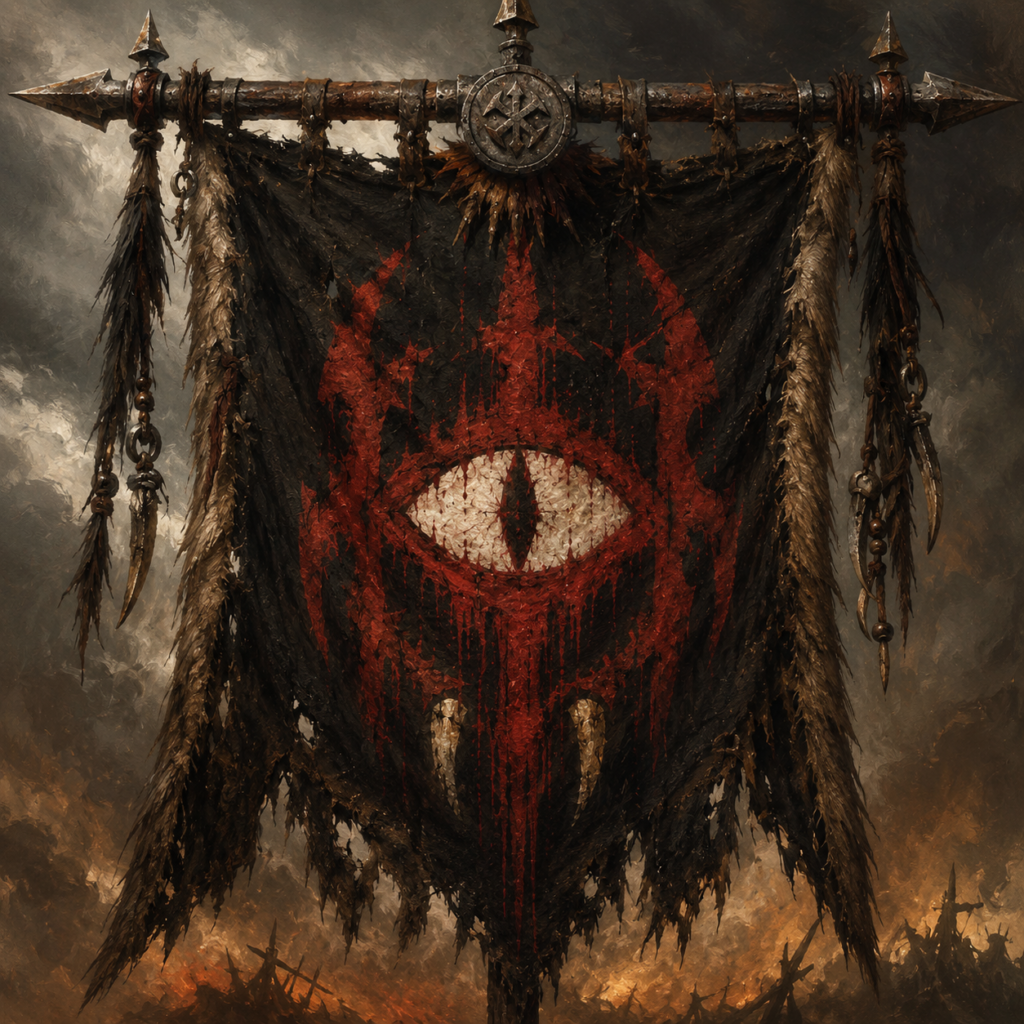
Status: Historical conquest confederation founded in 1206; divided into four successor powers before 1454
Region: Eastern Steppe, northern China frontier, Central Asian roads, former Koryo/Joseon vassal territories, Volga routes, Russian marches, Muscovy frontier
Historical Government: Great Muster commanded by Mhurak Stone-Blood; successor chiefdoms now independent
Historical Court: The Moving Throne, Mhurak’s vast mobile war-camp
Dominant People: Orcs
Subject Peoples: Humans, ogres, half-orcs, conquered clans, enslaved captives, tribute villages, captured craftsmen, and subject frontier peoples
Primary Cults: First-Scar ancestors, the wounded earth, clan oaths and regional war spirits
Common Themes: steppe conquest, black-tusk tribute, slave roads, broken vassals, mobile war-camps, First-Scar banners, eastern war roads
The One-Eyed Horde is a name remembered for Mhurak Stone-Blood’s Great Muster, forged in 1206. This account describes the confederation at the height of its conquests. It is not a united empire in 1454: its inheritance belongs to the rival Eastern Fang Host, Ash-Standard Host, Red Fang Reach and Black Anvil Realm.
At its height it was no settled courtly kingdom. It was a moving dominion of war-clans, horse herds, worg packs, tribute camps, slave roads, black-tusk banners, mobile shrines, subject towns, captured smiths, hostage enclosures and scarred chiefs bound together by conquest, the authority of Mhurak and the ancestral oaths of the First Scar.
The Horde’s strength lies in motion. Its ruler’s camp is its capital: a travelling city of hide tents, iron wagons, chained captives, priestly standards, war drums, counted tribute, and war-chiefs gathered beneath the eye of their god. Where the Great Warlord camps, law gathers. Chiefs kneel. Hostages are inspected. Captives are divided. First-Scar Seers proclaim which roads and strongholds their ancestors commanded and which chiefs have the right to reclaim them.
This is not a peaceful empire with rough manners.
It is conquest given a moving throne.
Geography and Reach
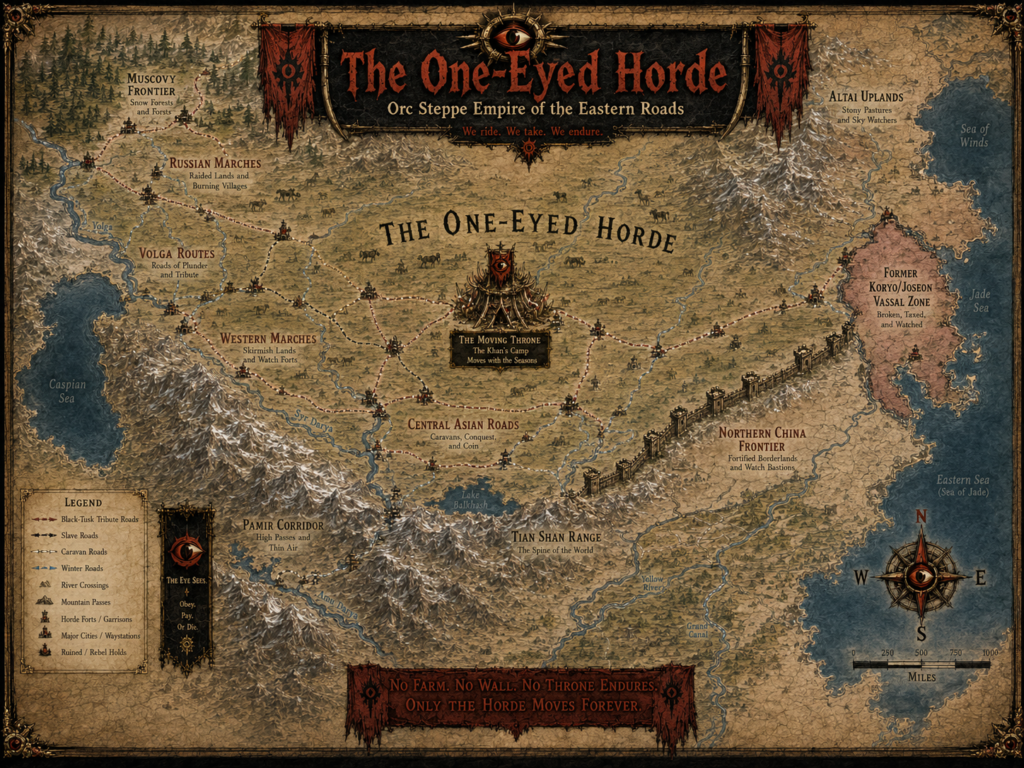
The heartland of the One-Eyed Horde lies across the broad eastern steppe: grasslands, uplands, river crossings, horse plains, winter roads, and highland corridors between the northern China frontier, the Central Asian routes, the former Koryo/Joseon vassal zone, and the western roads leading toward the Volga and Russian marches.
Its borders are rarely fixed in the manner of a walled kingdom. The Horde’s true geography is marked by submission, passage, memory, and return.
A settlement belongs to the Horde if it pays when called.
A road belongs to the Horde if its riders can cross it unchallenged.
A tribe belongs to the Horde if its sons ride beneath the black-tusk banner.
A kingdom belongs to the Horde if its ruler sends hostages before winter.
The One-Eyed Horde does not need to occupy every village every day. It rules by the certainty that refusal will be remembered.
This makes its empire difficult for settled courts to understand. A city may believe itself free because no orc garrison stands inside its walls. The Horde may believe otherwise because payment was once made there, a hostage was once taken there, or a black-tusk rider was once allowed through its gate without challenge.
The Horde’s reach is vast, but its control is uneven. Distance, winter, rebellion, rival chiefs, resistant kingdoms, broken roads, difficult terrain, and the need for constant victory keep it from becoming a single settled world empire.
The Moving Throne
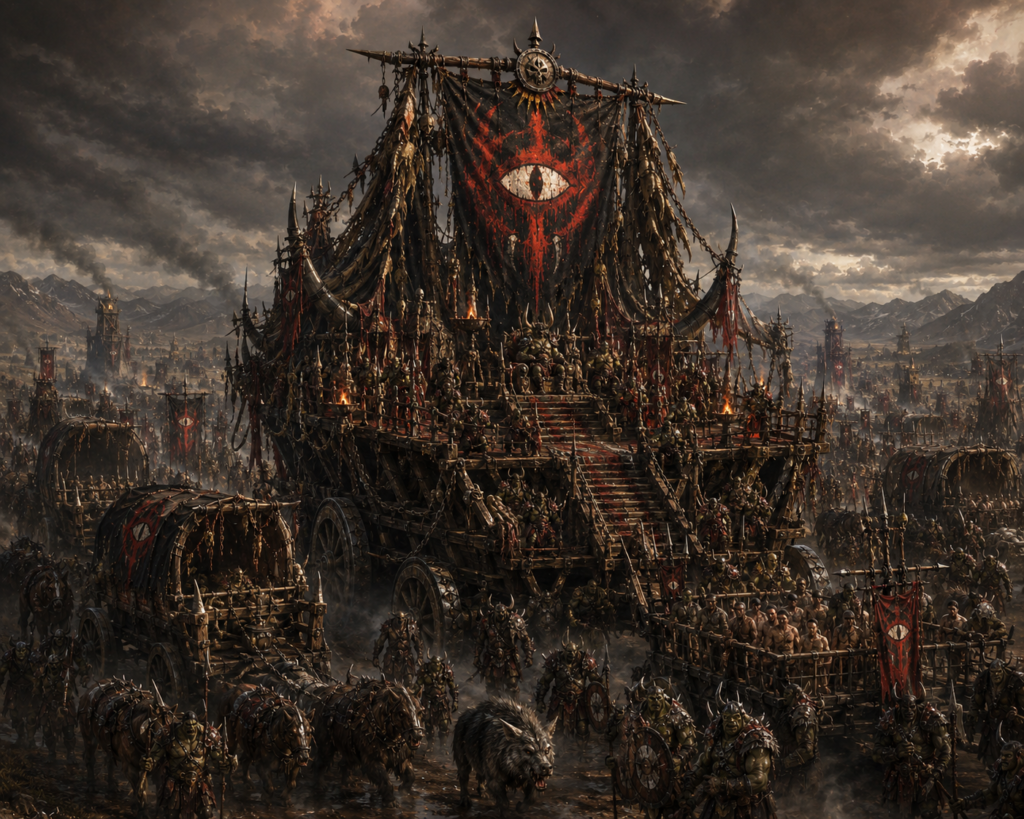
The Horde’s capital is not a city of stone.
It is the Moving Throne, the vast mobile war-camp of the Great Warlord. It shifts with season, war, pasture, tribute, and omen. It may appear as a black line of wagons across the grassland, a sea of hide tents around a frozen river, or a fortified camp of wheels, stakes, slave pens, horse lines, spear racks, and war shrines stretching farther than a man can walk before sunset.
Within the Moving Throne are the Horde’s true institutions:
the warlord’s tent,
the First-Scar Seers,
the hostage enclosures,
the slave divisions,
the tribute counters,
the scar judges,
the captured smiths,
the war drums,
the wolf and warg handlers,
the oath fires,
the execution posts,
and the black-tusk standards of the submitted clans.
When the camp moves, the empire moves.
A captured court clerk once described the Moving Throne as “a city that eats roads.” That is close to the truth. It consumes grain, horses, iron, hides, sons, daughters, tools, weapons, captives, and rumours. It leaves hoof-mud, ash, broken fences, emptied granaries, and new tribute marks behind it.
Rule and Law
The One-Eyed Horde has law, but it is not justice in the soft sense.
Its law protects conquest.
The Horde recognises strength, obedience, scars, war success, hostages, clan submission, and victory. A tribe that submits may keep its chief, but that chief’s sons may be taken as surety. A town that yields may keep its market, but its grain stores and smiths are counted. A conquered village may survive, but survival means labour, payment, sons, daughters, horses, iron, and silence.
Mercy exists, but usually as calculation.
A useful captive may live.
A skilled smith may be spared.
A surrendered chief may be mutilated instead of killed.
A subject village may be protected because dead farmers produce nothing.
A defeated tribe may be absorbed if its warriors are still useful.
The Horde is brutal, but not mindless. It records obligations, remembers insult, uses messengers, demands hostages, rewards successful raiders, and punishes failure. Its unity lasts only while victory lasts. When the Horde wins, tribes gather to it. When it fails, old rivalries return.
The Horde’s law is therefore not weak because it is violent. It is weak because it depends upon continued victory. The moment the Great Warlord appears unable to punish rebellion, the empire begins to hear the old voices of clan, feud, priestly challenge, and rival blood.
The Orc Steppe Empire
Mhurak’s Great Muster was built from conquest, charisma, fear, clan submission and sacred war, under a conqueror strong enough to keep other warlords kneeling.
The Great Muster drew strength from expansionist, scar-marked orc clans, with laws and beliefs shaped by First-Scar tradition, ancestral grievances and loyalty to victorious chiefs. Its subjects retained many cultures of their own.
It can use law, but it is not legalistic at heart.
It can use administrators, but it is not bureaucratic at heart.
It can use cities, but it is not city-born.
It can make treaties, but it regards treaties as useful only while strength stands behind them.
Mhurak’s Great Muster was an empire of conquest whose continental shadow remains visible in its four successors.
That is what makes it dangerous. A local orc band can burn a farm. A tribe can empty a valley. The One-Eyed Horde can change the routes by which kingdoms trade, the taxes by which courts survive, the borders by which maps are drawn, and the memories by which whole peoples fear the east.
Tribute, Slavery, and Subject Peoples
The Horde’s dominion is held together by tribute roads and slave corridors.
Tribute may be demanded in grain, horses, iron, hides, weapons, gold, smith-work, livestock, wagons, women, sons, soldiers, and hostages. Payment does not mean friendship. It means the Horde has chosen not to burn the settlement yet.
Slavery is central to the Horde’s power. Captives repair roads, herd animals, mine ore, dig ditches, carry loads, build siege works, serve warriors, and labour in captured forges. Dwarven prisoners are prized where the Horde can seize them, not because dwarves have one homeland to conquer, but because dwarf craft, mine knowledge, stonework, and metalwork are valuable wherever the Horde’s roads reach. Human scribes and accountants may be forced to count obligations. Half-orcs often serve as interpreters, overseers, border captains, or envoys between the Horde and subject peoples.
A subject people is not equal under the Horde. It is useful, taxable, and punishable.
This is one of the great horrors of the One-Eyed Horde: it does not merely raid and vanish. It turns conquest into a system.
Broken Vassals and Freed Kingdoms
At its height, the Horde cast its shadow across northern China and Korea. The kings of Koryo were reduced to vassals beneath orc overlordship, and only after the orcs were driven from China did Korea regain independence and the Joseon dynasty rise.
That history still shapes the eastern kingdoms.
Border forts remain watchful.
Court factions remember collaboration.
Peasants remember forced payment.
Soldiers remember the riders.
Old roads still bear Horde names.
Some families hide orc blood in their ancestry.
Some frontier clans still keep black-tusk tokens in locked chests.
Some former garrisons never fully left.
Joseon’s independence is therefore not merely political. It is civilisational recovery after domination by a brutal orc empire.
That loss still makes the Eastern Fang heirs dangerous in 1454. Rival chiefs compete to recover former roads, tribute and hostages. First-Scar Seers preserve accounts of past victories while captive scribes record withheld payments. No single surviving claimant possesses Mhurak’s old authority.
The four successor powers’ past defeats do not make them harmless.
They make it hungry.
Successor Wars and Pressures in 1454
Mhurak’s successor powers have not made peace with one another or their neighbours.
The Eastern Fang, Ash-Standard, Red Fang and Black Anvil chiefs fight separate frontier conflicts while disputing Mhurak’s legacy. Their authority depends on clan allegiance, tribute, protected roads and victory. A defeated chief faces desertion; a claimant who loses his envoys or fails to secure supplies can see a confederation collapse.
The Horde is currently shaped by several pressures.
- Former Eastern Vassals: Freed kingdoms, border lords, rebel towns, and old subject peoples resist renewed orc domination.
- Steppe Rivals: Breakaway orc clans, rival warlords, beast-riders, and subject tribes test the Great Warlord’s authority.
- Western Tribute Roads: Raids, demands, slave routes, and military probes push through caravan corridors toward the Volga routes, Russian marches, Muscovy frontier, and Central Asian roads.
- Mountain, Mine, and Forge Communities: Wherever the Horde’s roads reach valuable iron, smiths, engineers, tunnel workers, or fortified workshops, conflict follows. These are local wars and raids, not a single war against one dwarven homeland.
- Slave-Road Resistance: Escaped captives, rebel villages, hidden shrines, and frontier rescuers attack the machinery that carries people into Horde labour.
The Horde’s hatred of elves remains old and theological, but if elves are chiefly rooted in Britain and Scandinavia, that hatred is a distant pressure rather than a major eastern front. It appears through travellers, northern sea-road rumours, captured elves, saga memory, and any place where orc expansion eventually touches elven territory.
The Western Marches
The Horde’s western pressure is felt most sharply along the Volga routes, Russian marches, Muscovy frontier, caravan towns, and border principalities that stand between the steppe and the deeper west.
Here, the divided Ash-Standard Host and neighbouring orc claimants are no tavern story. Their power is felt in burned road posts, missing caravans, captured villages, escaped slaves, tribute tokens and black-tusk marks nailed to gates.
Muscovy and the Russian marches are not necessarily under the Horde’s rule, but they live close enough to understand its habits. A village may prepare for winter by counting grain twice: once for itself, and once in case riders come demanding payment. A frontier lord may fortify a river crossing not because an army is visible, but because tribute riders were seen three valleys away. A caravan master may hire guards not against ordinary bandits, but against scouts measuring road strength for a future raid.
This is where the Horde’s geography becomes immediate.
A black-tusk envoy can start a war.
A missing tribute caravan can expose a rebellion.
An escaped hostage can destabilise a border court.
A captured orc noble can become ransom, bait, or diplomatic poison.
A slave-road outbreak can carry plague, panic, and Red Death rumours westward.
The western marches are where the Horde’s distant empire becomes a local problem.
The Far Western Rumour
Farther west, in the Empire, the orc successor hosts are known chiefly through rumour, report and diplomatic anxiety.
Its name travels with disrupted caravans, escaped captives, black-tusk tokens, eastern plague rumours, slave-road stories, and letters from frontier courts. Few western lords have seen these rival chiefs’ riders, but many fear what would happen if the eastern roads failed.
In the west, the Horde may appear through consequences rather than armies:
an eastern merchant carrying a black-tusk trade token,
a road-warden recognising Horde-style saddle nails,
a freed captive seeking legal recognition,
a court scribe copying an eastern hostage clause into local law,
an orc prisoner claiming envoy status under Horde custom,
a Hellfire agent seeking to fuse Horde tribute law with infernal contract law,
or a plague rumour claiming the Red Death has followed a slave road west.
The Horde is far away until it is not.
The One-Eyed Horde in Play
Use the One-Eyed Horde when orcs need to become more than a local raiding threat.
A cave of orcs threatens a village.
A war-band threatens a road.
A tribe threatens a valley.
The One-Eyed Horde threatens geography.
It can enter a campaign as a rumour, a tribute demand, an escaped slave, a border war, a captured envoy, a black-tusk seal, a Red Death road, a mine crisis, or a diplomatic panic.
The divided orc hosts remain a state-level danger: cruel, mobile, capable of bargaining or conquest, and ready to reshape a frontier when rival claimants unexpectedly unite.
It also complicates law. A lone orc trader may be a suspicious but lawful market visitor. An orc raider with captives may be a public-defence target. An orc envoy under black-tusk safe-conduct may be dangerous to harm, not because the Horde is morally right, but because killing an envoy may bring war. An orc slave-taker may be hated by everyone and still useful to someone’s court. An orc rebel may oppose a successor khan without becoming good.
The Horde gives orcs political weight without making them safe.
Adventure and Worldbuilding Hooks
- The Black-Tusk Letter: A frontier court receives a tribute demand written in several hands: orc command marks, human clerk-script, and infernal annotations added later by someone else.
- The Escaped Hostage: A noble child taken years ago by the Horde returns speaking Orc, bearing scars of status, and refusing to say whether they escaped or were sent.
- The Slave Road: A chain of captives is being moved west by brokers connected to Horde tribute networks. Among them is an engineer who knows the location of a sealed road beneath the mountains.
- The False Envoy: An orc arrives under black-tusk safe-conduct claiming to represent the Horde. If he is genuine, killing him could bring war. If he is false, someone is trying to provoke one.
- The Joseon Ledger: A record from the old Koryo vassal years names collaborators, stolen heirs, tribute routes, and one surviving Horde garrison hidden beyond the frontier.
- The First-Scar Prophet: A seer declares that the Eastern Fang chiefs have lost the ancestors’ favour because they take payment instead of reclaiming the old roads. He calls for a new confederation under one banner.
- The Broken Khan: A defeated orc warlord seeks western allies against an Ash-Standard rival who claims Mhurak’s inheritance. His offer is useful, dishonourable and almost certainly temporary.
- The Red Road Rumour: Plague has appeared along a slave route used by Horde brokers. The disease is ordinary plague, but some deaths fail to complete properly, and the Red Death follows in its wake.
- The Bought Smith: A celebrated captured smith is offered back for ransom, but the price is not coin. The Horde demands tools, hostages, and recognition of a disputed road.
Why the One-Eyed Horde Matters
The One-Eyed Horde gives the world a major orc power without softening orcs into misunderstood neighbours or flattening them into cave monsters.
It preserves the classic orc identity: aggression, raiding, conquest, slavery, patriarchal rule, hatred of elves and dwarves, scars, brutal faith, and violent expansion.
But it also gives them scale.
The Horde can make treaties and break them. It can send envoys and burn envoys. It can demand payment, hold hostages, enslave towns, use subject scribes, absorb tribes, and terrify kingdoms. It creates diplomatic problems as well as battlefield ones.
That is its value.
The One-Eyed Horde makes orcs politically real while keeping them dangerous.
Historical and Campaign Context
The One-Eyed Horde draws broad structural inspiration from steppe conquest empires: their mobility, tribute systems, hostage-taking, slave routes, raiding pressure, frontier terror, and ability to dominate vast spaces without occupying every settlement in the manner of a settled kingdom. For historical background on the scale and political reach of the Mongol Empire, see Encyclopaedia Britannica: Mongol Empire. For the later western and Russian frontier memory associated with Tatar peoples and the Golden Horde, see Encyclopaedia Britannica: Tatar.
The setting’s Great Muster inherits the historical geography of steppe conquest but follows Mhurak’s independent orc chronology, First-Scar traditions, clan oaths, slave roads, tribute law and successor wars. The four successor powers are not interchangeable with real-world dynastic states.
The Horde should feel familiar enough to give the reader a clear geopolitical shape, but strange and brutal enough to remain fully orcish.
Keep this reference growing
If this page helped with your reading or game, you can support its upkeep or explore the curated books.
Explore the Bookshop — epics, classics and stories behind imagined worlds.