
Eon XXXVIII – The Dawning Age — First Settlements After the Ice
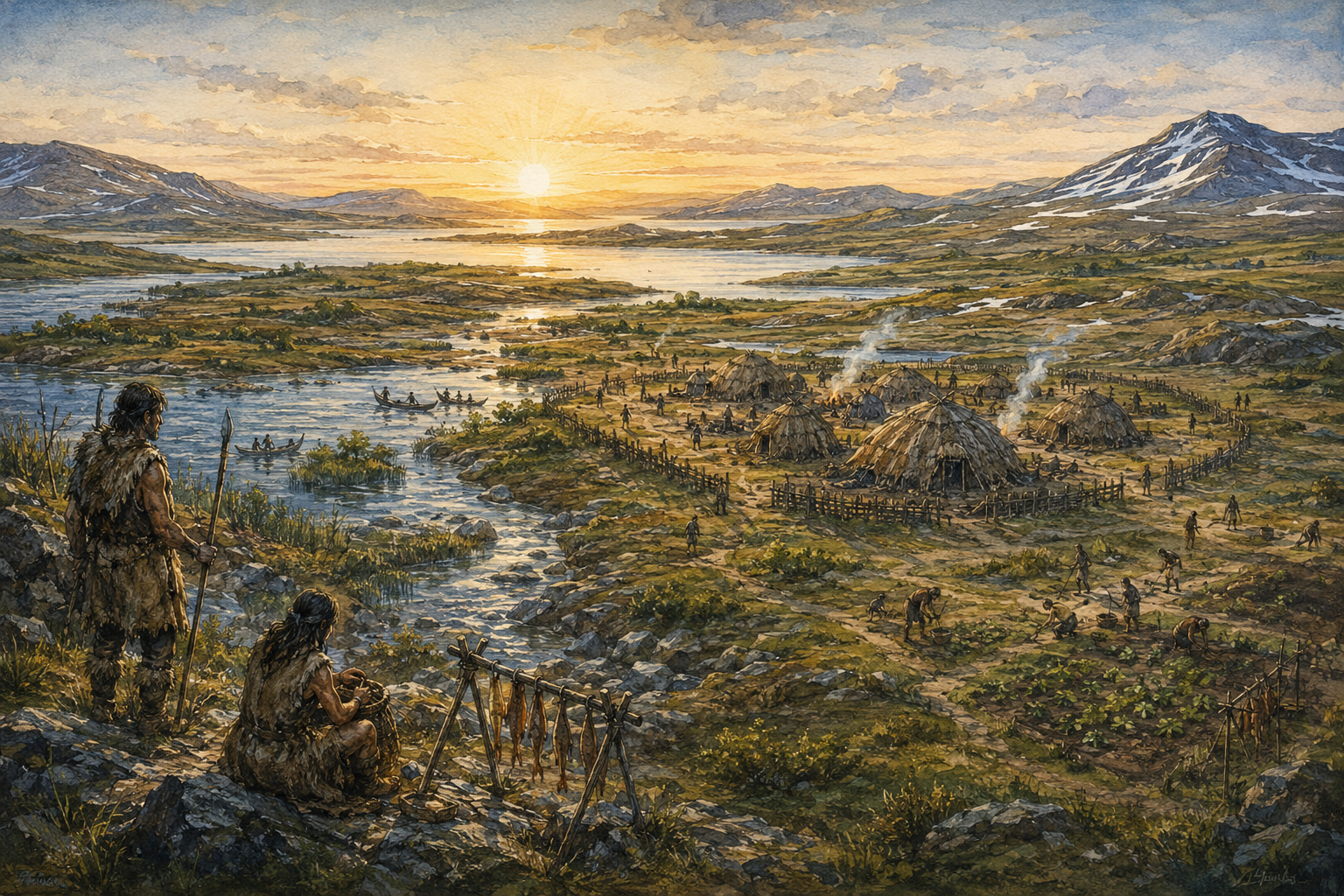
The Dawning Age begins as the last great cold withdraws and peoples across the world establish new lives among rising seas, spreading forests, growing lakes, inherited territories and the ruins of elder powers.
Time Frame: c. 9700–7000 BCE
Common Name: The Early Holocene
Theme: A warming world, rising seas, repeated settlement, local abundance, inherited land and the long aftermath of broken dominions.
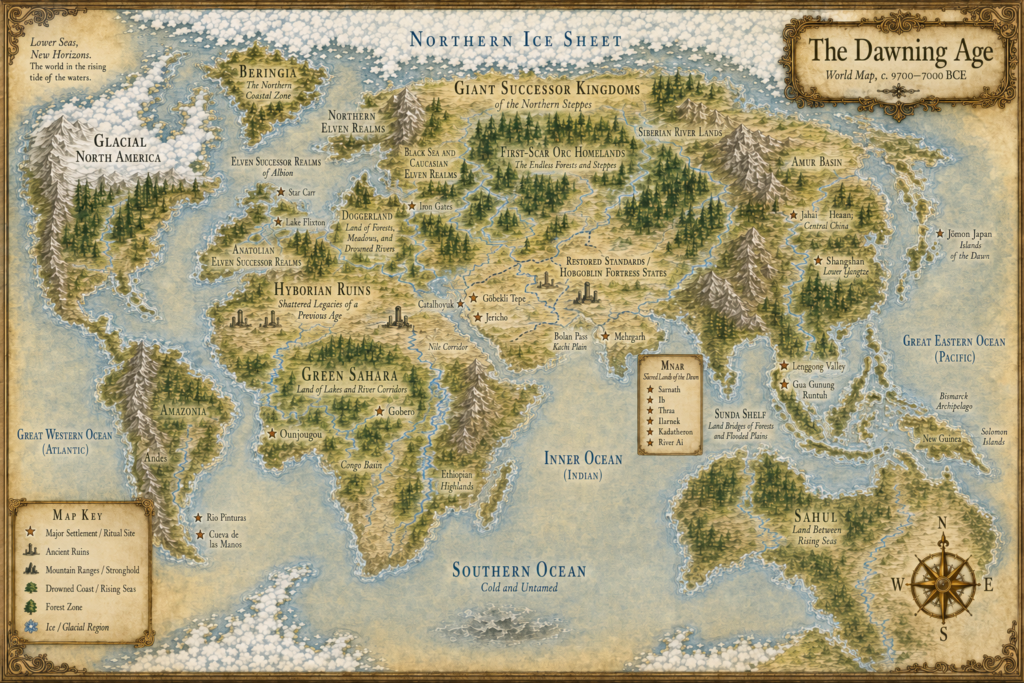
The Dawning Age is a worldwide transformation. Northern ice sheets retreat. Rain returns to much of the Sahara. Forests spread into former tundra and grassland. Rivers cut new courses through thawed valleys. Seas advance across continental shelves, drowning plains, dividing islands and remaking coastlines.
Peoples respond through many successful ways of life. Hunters follow game across extensive territories. Fishing communities establish enduring homes beside lakes, rivers and tidal waters. Forest peoples return to the same groves and gathering grounds. Pottery flourishes among communities whose food still comes largely from fishing, hunting and wild plants. Useful species are protected, selected, transplanted and cultivated through many independent traditions.
Rooted life takes many forms. A community may be bound to a walled spring, a salmon river, a shellfish bay, a lakeside cemetery, a painted canyon, a managed forest, a seasonal camp or an ancestral country travelled according to inherited law.
The age also inherits the broken powers of the Shattered Crown. Giant successor kingdoms, elven realms, dwarven slave populations, orc clans, hobgoblin fortress states, serpentfolk refuges and the remnants of the Hyborian world continue shaping particular regions.
The First-Scar orc homelands, the principal giant successor kingdoms and the earliest hobgoblin dominions exert their greatest influence across northern, central and western Eurasia. Dwarves, elves, giants, goblinoids, spirits and other nonhuman peoples also possess independent histories elsewhere in the world.
Africa, East Asia, South Asia, Southeast Asia, the Americas, Australia and Oceania follow historical paths rooted in their own peoples, ancestors, gods, spirits and nonhuman powers. The fall of a western kingdom does not begin their history, and no single region creates settlement, pottery, cultivation or organised religion for the rest of the world.
The World at the Beginning of the Age
- The final severe cold interval ends and temperatures rise rapidly across much of the Northern Hemisphere.
- Great ice sheets retreat, although glaciers remain powerful across northern lands and high mountain ranges.
- Sea levels rise and consume inhabited coastal plains, river mouths, islands and former land bridges.
- Stronger seasonal rains create lakes, rivers, wetlands and grasslands across much of the Sahara.
- Forests expand through Europe, temperate Asia and eastern North America.
- Many great Ice Age animals decline or retreat while other species flourish in the changing forests, rivers and wetlands.
- Human communities inhabit Africa, Eurasia, Australia, the Americas and many islands.
- Boats, dogs, controlled fire, fibre-working, burial, stone tools and long-distance exchange are already ancient.
- Permanent residence, seasonal movement and repeated return remain equally viable responses to local conditions.
- Gods, ancestors, spirits and monsters possess established territories and agreements with local peoples.
- The Hyborian political world has collapsed across parts of western Eurasia and northern Africa.
- Giant, elven, dwarven, orc and hobgoblin powers survive unevenly within mountains, forests, uplands, fortresses and former imperial roads.
- Dwarven communities exist throughout the world, from underworld strongholds and mountain citadels to rocky coasts and tropical redoubts.
- Giants and giant-descended peoples possess regional histories far beyond the principal Eurasian successor kingdoms.
- Serpentfolk, dragons, Deep Ones, Elder Things and other older beings survive in concealed, fortified or inaccessible domains.
- The Plane of Dreams, Oneirion, lies unusually close to waking Earth in remote lands such as Mnar.
The Dawning Age does not begin civilisation from nothing. It begins with experienced peoples adapting inherited knowledge to a rapidly changing world while living among older settlements, ancestral territories, ruined kingdoms and powers that never departed.
Global Timeline
c. 9700–9000 BCE — The World Warms
The opening phase of the Dawning Age is marked by rapid changes in rainfall, vegetation, rivers, coastlines and animal ranges. Communities respond through knowledge accumulated over generations and through close relationships with particular landscapes.
Africa — Rain, Lakes and Early African Pottery
Seasonal rains strengthen across northern Africa. Grasslands, wooded savannahs, rivers and wetlands spread into country that will later become desert. Lakes draw fish, crocodiles, hippopotamuses, antelope, birds and human communities into newly productive landscapes.
Along the Yamé Valley at Ounjougou, people make fired clay vessels during the first half of the tenth millennium BCE. These containers support cooking, storage and the preparation of foods gathered from river, grassland and woodland environments.
Pottery becomes part of a mobile and adaptable way of life. Hunting, gathering, fishing and movement through extensive territories continue alongside the use of clay vessels and grinding tools.
The Nile, the eastern African lakes, the Ethiopian highlands, the Atlantic river systems, the Congo basin and the southern savannahs support distinct communities with their own territories, ritual obligations and seasonal cycles. The Nile is one important African corridor within a continent of many centres.
Regional gods, ancestors and spirits govern rain, animals, rivers, mountains, disease, healing, fertility, hunting and the proper use of land. Their powers belong to living communities rather than to one continental priesthood.
Europe and the Mediterranean — Forests and Drowned Plains
Birch, pine, hazel and other trees advance across former tundra and open grassland. Red deer, elk, aurochs, wild boar and smaller forest animals become increasingly important to communities adapting to woodland environments.
Britain remains connected to continental Europe by a broad inhabited plain of rivers, marshes, lakes, woodland and low hills. Families move between lands that the rising North Sea will eventually divide.
Along Atlantic, Baltic and Mediterranean coasts, fishing, shellfish gathering, seal hunting and boat travel become increasingly important. Rising waters destroy some coastal camps while forming new estuaries, marshes and sheltered fisheries.
The western Hyborian kingdoms have collapsed. Refugees move through lands already held by local human peoples, elves, giants, dwarves and other inhabitants. Surviving weapons, cult objects and royal claims carry regional influence, but the states that created them have disappeared.
Elven communities retain territories in Britain, Scandinavia and other forested and coastal regions. Forest expansion strengthens some domains while rising waters destroy sacred shores, settlements and crossings elsewhere.
West, Central and South Asia — Monument, Spring and Mountain Road
Communities across the Levant, Anatolia and the upper valleys of the Tigris and Euphrates gather wild cereals, hunt gazelle and other animals, tend useful plants and maintain increasingly durable settlements.
At Göbekli Tepe, communities begin raising monumental stone enclosures around 9600 BCE. Great carved pillars depict animals, symbols and powerful beings. Their construction requires skilled stoneworking, shared labour, feasting and agreements between groups from across the surrounding region.
Jericho grows beside the abundant spring of ‘Ain es-Sultan. Houses, burials, food stores and communal works bind its inhabitants to the oasis across generations.
Across the Indian subcontinent, communities adapt to monsoon forests, grasslands, river valleys, coasts, plateaux and mountain margins. Hunting, fishing, plant gathering, woodland burning and repeated seasonal occupation produce distinct regional traditions.
Glacial retreat exposes valleys and ancient routes through Central Asia and the great mountain chains. Giant roads, Titan-built passes and abandoned fortresses become accessible to human travellers, dwarven refugees, orc clans and surviving giant households.
No road is truly abandoned merely because its builders have lost command of it. Guardian constructs, bound spirits, giant toll-keepers and military wards continue obeying orders issued by vanished rulers.
East Asia — Shangshan, Pottery and River Worlds
Communities across China, Korea, the Amur basin and neighbouring regions combine fishing, hunting, plant gathering, pottery-making and repeated residence beside rivers, forests and wetlands.
Along the Yangtze and its surrounding waters, people gather wild rice, fish, waterfowl, nuts, roots and other plants. In northern regions, grass seeds, nuts, river foods and game sustain communities living among forest and open country.
During the tenth millennium BCE, communities of the Shangshan tradition establish settlements in the Lower Yangtze region. They build houses, dig pits, make pottery and stone tools and process a broad range of plants.
Rice becomes increasingly connected with repeated settlement. People gather, cook, store and select it while continuing to depend upon fish, hunted animals, nuts, roots and other wetland foods.
Pottery is already established in several East Asian regions. Clay vessels allow fish, plants, nuts, roots and shellfish to be boiled, stored and combined in new ways.
Japan — The Jōmon World
Jōmon communities occupy rivers, inland bays, forests, hills and coasts throughout Japan. Many live in durable settlements and return to the same houses, graves, storage places and gathering grounds over generations.
Fishing, shellfish gathering, hunting and the collection of nuts, roots and berries provide stable abundance. Pottery allows fish, plants and nuts to be boiled and combined. Boats connect coastal communities and nearby islands.
Rising seas reshape Japan’s shores, creating bays, tidal flats and islands while drowning older paths and camps. Communities move and rebuild while preserving obligations to local mountains, waters, forests, ancestors and spirits.
Settled Jōmon life demonstrates that enduring communities do not require dependence upon fields, herds or territorial farming states.
Southeast Asia — Forest Valleys and the Breaking of Sunda
Across mainland and island Southeast Asia, communities inhabit rainforests, limestone valleys, caves, river terraces, mangroves and changing coasts.
The Lenggong Valley supports repeated habitation through its rivers, forest foods, game, stone and sheltered caves. Communities maintain established routes, gathering places and burial traditions within the valley.
Rising seas flood the lowlands of Sunda. Inland hills become coastal ridges and islands. Communities increasingly rely upon boats, estuaries and maritime knowledge as old overland routes narrow or disappear.
Forest spirits, river powers and ancestral beings govern places already shaped by generations of burning, gathering, hunting, burial and travel.
Northern Asia and Beringia — The Northern World Narrows
Forests and wetlands spread through parts of Siberia while tundra shifts northward. Reindeer, elk, fish, waterfowl and smaller game sustain communities linked by rivers and seasonal movement.
Beringia remains an inhabited northern world of river valleys, coasts and uplands. Families maintain ties extending east and west across territories joined by land, ice and water.
Rising seas cover much of the low country connecting Asia and North America by about 9000 BCE. Coastal travel, island movement and seasonal crossings preserve contact after the broad land connection contracts.
Ancient giant and spirit territories also change with the climate. Ice-bound powers retreat northward, withdraw into mountains or contest newly exposed valleys with mortal communities.
North America — New Forests and Regional Lifeways
Across North America, communities develop increasingly regional ways of life. Forests spread in the east, while plains, western basins, mountain valleys, Arctic coasts and Pacific shores support distinct combinations of hunting, fishing and gathering.
The decline of several great animals changes hunting traditions without creating one continent-wide collapse. Deer, bison, elk, fish, shellfish, nuts, roots, seeds and smaller game become central to many regional economies.
Rising waters flood Atlantic and Pacific coastal lands. Families abandon some settlements, follow changing rivers or adapt to newly formed estuaries and fisheries.
The gods, animal powers, ancestors and spirits of North America are already active within their own territories. Their histories are not later additions to an otherwise empty continent.
Central and South America — Coast, Forest, Mountain and Painted Stone
Communities inhabit the highlands, tropical forests, grasslands, deserts, river basins and long coastlines of Central and South America.
People manage useful plants, gather shellfish, fish coastal waters and hunt animals suited to each landscape. Mountain routes connect coast, valley and highland while tropical rivers provide roads through forested regions.
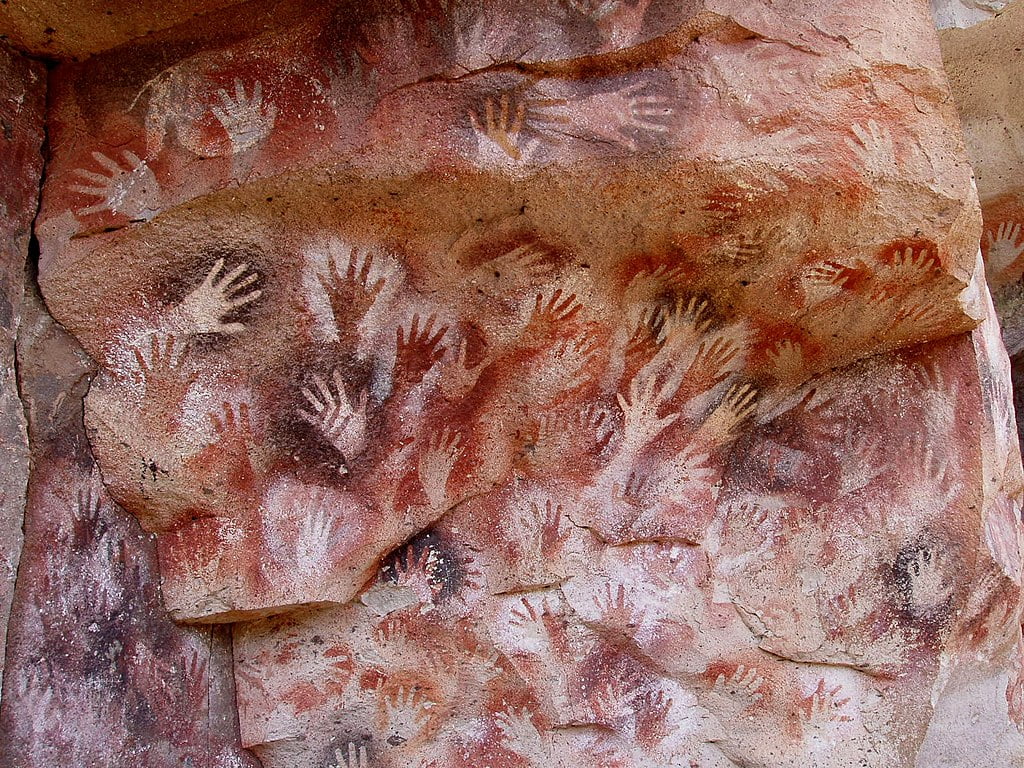
In Patagonia, communities follow guanaco herds through open country and the canyons of the Río Pinturas. At Cueva de las Manos, people begin painting hand stencils, animals and hunting scenes, joining living hunters, ancestors and place through repeated acts of image-making.
Across Amazonia, communities shape forest clearings, riverbanks and useful plant populations through burning, protection, transplantation and repeated harvesting.
In the Andes and Mesoamerica, mountain, rain, animal and plant powers govern territories that later cultures will remember under many different names.
Australia, New Guinea and Near Oceania — Ancient Countries Change Shape
Aboriginal Australian communities continue ancient systems of kinship, law, controlled burning, hunting, gathering and responsibility to particular countries.
Rising seas consume coastal plains, freshwater sources, paths, camps and sacred places. Families move inland or adapt to newly created marine environments while preserving the names and obligations of drowned country through oral memory.
Australia and New Guinea remain connected through shrinking lowlands and islands across the Sahul shelf during the opening centuries of the age. Movement becomes increasingly maritime as water divides former land routes.
Across Near Oceania, communities inhabit New Guinea, the Bismarck Archipelago and the Solomon Islands. Boats carry people, stone, shell and knowledge between changing shores.
Ancestral beings, sea powers, volcano spirits, animal guardians and local gods remain inseparable from law, travel, subsistence and identity.
c. 9000–8000 BCE — The Age of Repeated Return
During the middle phase of the Dawning Age, communities in many regions return more frequently to dependable waters, forests, hunting grounds and ritual places. Houses, graves, storage pits, platforms and paths accumulate memory.
Mobility remains central across much of the world. Repeated return binds people to places while allowing seasonal movement between them.
Africa — Pottery and the Waters of the Green Sahara
Pottery traditions spread through northern and eastern Africa as lakes, rivers and grasslands support fishing, wild-grain gathering and hunting.
Some communities occupy lakeshores for long seasons or repeated generations. Cemeteries and ritual places strengthen ancestral claims even where families continue moving across broad territories.
Aquatic abundance supports durable communities without requiring dependence upon crops or domestic herds. Fish, water plants, wild grain and game sustain complex lakeside societies.
Different African peoples maintain different relationships with cattle, wild animals, rainfall, disease, healing and the dead. No single settlement, river or pantheon governs the continent.
Europe and the Mediterranean — Star Carr and the River Settlements
Around 9000 BCE, people repeatedly occupy Star Carr beside Lake Flixton in northern Britain. They build timber structures and lakeside platforms, work wood with stone tools, hunt red deer and make barbed points, antler tools and distinctive headdresses.
Star Carr is used seasonally across many generations. Its inhabitants return because the lake, forest and surrounding wetlands provide dependable food, raw materials and places of ritual importance.
The lowlands between Britain and continental Europe remain inhabited while the sea advances around their edges. Rivers crossing the plain connect inland forests with marshes, estuaries and coastal waters.
Along the Danube’s Iron Gates, communities deepen their relationship with powerful river channels, fish migrations and narrow gorge landscapes. Houses, burials and repeated gathering places bind people to the river.
Elven territories follow the spreading forests. Some courts accept human neighbours under old agreements; others close crossings, mark boundaries or retaliate against settlement within managed woodland.
West and Central Asia — Walls, Enclosures and Managed Herds
Göbekli Tepe continues drawing communities together for ceremony, labour, exchange and feasting. New enclosures are built while older structures are altered, filled or closed.
Jericho becomes a substantial settlement. Its inhabitants build major communal works, including a wall, ditch and stone tower, to protect and organise the spring, houses, food stores and burial places upon which the community depends.
Across the Levant, Anatolia and Upper Mesopotamia, wild cereals and pulses are tended and selected more intensively. Sheep, goats and other animals enter increasingly managed relationships with nearby communities.
Surviving elven realms, giant strongholds, dwarven refuges, orc clans and hobgoblin fortress states continue contesting roads, mountain approaches and defensible uplands beyond the principal human settlements.
South Asia — Rivers, Forests and Seasonal Territories
Across South Asia, river valleys, monsoon forests, coastal plains and highland routes support regional communities whose lives combine fishing, hunting, plant gathering, controlled burning and repeated occupation.
Communities return to dependable stone sources, river crossings, springs and sheltered camps. Kinship and seasonal knowledge determine access more often than permanent territorial government.
Contacts between the Iranian plateau, Central Asia and the Indus borderlands carry stone, shell, pigments, cultivated plants and animal-management practices between regions without producing one uniform culture.
Mnar — Sarnath and the Destruction of Ib
In remote Mnar, where waking Earth lies unusually close to the Plane of Dreams, the human cities of Thraa, Ilarnek and Kadatheron stand along the river Ai. Sarnath rises beside the still lake near the older grey city of Ib.
Ib belongs to the Thuum’ha, a voiceless nonhuman people devoted to Bokrug, the Great Water-Lizard. They possess houses, rites, sacred objects, memory and an inherited relationship with the lake.
The people of Sarnath deny the Thuum’ha recognition as neighbours or persons. Sarnath’s warriors destroy Ib, kill its inhabitants, cast their bodies and carved stones into the lake and carry away Bokrug’s green idol.
The priest Taran-Ish leaves a warning before his death. Sarnath turns the massacre into a founding victory and establishes an annual festival celebrating the destruction of Ib.
East Asia — Shangshan and the River Settlements
Shangshan communities continue building houses, digging storage pits and making pottery and stone tools in the Lower Yangtze region.
Rice becomes increasingly connected with settlement, cooking, storage, fermentation and communal gatherings. People gather and manage it alongside acorns, water chestnuts, roots, fish and hunted animals.
Across northern China, communities process grasses, nuts and seeds while maintaining relationships with river valleys and forest margins.
Regional differences deepen between northern grass-and-river traditions and southern wetland traditions. Neither develops through one royal command or divine decree.
Japan — Settlements across Forest and Sea
Jōmon settlements become increasingly specialised around local resources. Some centre upon salmon rivers, others upon shellfish bays, nut forests or mixed coastal and inland territories.
Graves, ritual deposits and shared gathering places strengthen bonds between households and neighbouring settlements.
Boats carry stone, shell, pigments, food and marriage partners between communities. Exchange strengthens regional identity without creating one central Jōmon kingdom.
Southeast Asia — Burial and Maritime Passage
A community in the Lenggong Valley buries one of its members in Gua Gunung Runtuh. The burial reflects established obligations toward the dead and a people with deep knowledge of the valley’s caves, rivers and forests.
The community belongs to a wider network of hunters, gatherers and forest peoples living across mainland Southeast Asia. Stone, stories, kinship and ritual connect neighbouring valleys and coasts.
As seas rise across Sunda, watercraft become increasingly important for maintaining exchange between lands formerly joined by footpaths.
Northern Asia and North America — Regional Traditions Deepen
Siberian communities continue moving along great rivers, forest margins and northern coasts. Boats and winter travel connect territories divided by water, woodland and tundra.
From about 8500 BCE, many North American communities develop increasingly varied regional toolkits and seasonal rounds.
Smaller projectile points, spear-throwers, woodworking tools and grinding implements support hunting, fishing, gathering and plant processing.
Families return to river valleys, stone sources, wetlands and seasonal gathering places. Detailed local knowledge becomes a foundation of territorial identity.
Central America — Plant Selection Deepens
Communities in Mexico and neighbouring regions gather, protect and replant useful plants. Squash, gourds and wild grasses enter increasingly close relationships with households and seasonal camps.
In the Balsas region, people select teosinte plants for useful traits. This long process eventually produces maize.
Plant management supplements rather than replaces hunting, gathering and fishing. Useful seeds travel between families, valleys and seasonal gathering places.
South America — Coastal, Highland and Forest Worlds
Along the Pacific coast, fishing communities depend upon rich marine waters, shellfish beds and coastal gathering places. In the Andes, people move between coast, valley and highland environments.
At Cueva de las Manos, new hands and hunting scenes join older images. Each generation adds its presence to a shared canyon landscape.
Amazonian peoples continue shaping riverbanks, clearings and useful plant populations through burning, planting, protection and repeated harvesting.
Australia, New Guinea and Near Oceania — Drowned Country and New Passage
Sea levels continue rising. The lowlands between Australia and New Guinea contract into straits, shallow seas and islands.
Coastal communities shift camps, fishing places and freshwater access inland. Existing law and ecological knowledge absorb the new shorelines into older ancestral geographies.
Changes in water, vegetation and animal distribution require revised seasonal schedules. Controlled burning, hunting and plant gathering continue shaping inhabited environments.
Island communities maintain kinship and exchange across routes that become longer and more dangerous as the sea advances.
c. 8000–7000 BCE — Rooted Worlds
During the final phase of the Dawning Age, rooted life becomes more deeply inherited. Houses, graves, fisheries, gardens, paths, sacred places and defended waters pass between generations.
Regional societies continue following different paths. Some invest heavily in cultivated plants and managed herds. Others sustain enduring settlements through fishing, hunting, forest produce or the abundance of lakes and coasts.
Africa — The Lakeside Communities of Gobero
By about 7700 BCE, communities live beside the great lake at Gobero in the central Sahara. They fish, hunt and gather within a green landscape of water, grassland and large animals.
They bury their dead near the lake, creating an enduring cemetery used by a largely settled hunter-fisher-gatherer population.
Graves bind descendants to the water, the surrounding land and the people who lived there before them. The lakeside becomes home, burial ground and inherited territory.
Elsewhere in Africa, river, lake, forest, savannah and coastal communities continue developing their own combinations of pottery, fishing, hunting, gathering and plant management.
Europe and the Mediterranean — Land Shrinks before the Sea
The low country between Britain and continental Europe narrows as water floods its plains. Communities move towards remaining high ground, riverbanks and coastal margins while older paths disappear beneath marsh or sea.
Across Europe, forests support increasingly specialised hunting, nut gathering, fishing and woodworking. Rivers and coastlines carry stone, amber, shell, stories and marriage ties between communities.
Fragments of Hyborian roads, giant causeways and elven crossings become local routes. Most travellers know only the sections maintained by their own communities and neighbours.
Elven woodland territories expand with the forests in some regions while rising seas destroy elven coasts elsewhere. Human settlement increasingly encounters boundaries established by agreements whose long-lived witnesses may still survive.
West and Central Asia — Settlements Become Inheritance
Jericho, Göbekli Tepe and neighbouring communities continue shaping regional life. Some monumental enclosures are deliberately filled or closed as ritual and social organisation change.
Households become more dependent upon stored grain, managed animals, inherited buildings and access to particular springs or fields.
By about 7400 BCE, communities establish the settlement later known as Çatalhöyük in central Anatolia. Houses stand close together and are rebuilt repeatedly, creating a dense landscape of household memory, burial and ritual.
Across the mountains and northern interior, giant roads and former imperial works become prizes contested by dwarven holds, orc clans, human communities, elven patrols and surviving giant rulers.
South Asia — Mehrgarh at the Threshold
Communities moving through the Bolan Pass and the Kachi plain deepen their relationships with water, grazing land, cereals and seasonal settlement.
Contacts with the Iranian plateau and Central Asia carry crops, herding practices and technical knowledge into the Indus borderlands.
Around 7000 BCE, mud-brick settlement, cultivation and managed herds begin developing at Mehrgarh. This community stands at the threshold between the Dawning Age and the more deeply rooted village worlds of the following age.
East Asia — Rice, Storage and Durable Settlement
Shangshan communities continue building houses, making pottery and managing rice alongside hunting, fishing and the gathering of many wild plants.
Rice becomes increasingly shaped by repeated harvesting, selection and cultivation. Its transformation unfolds through generations of interaction between people, plants and wetlands.
Near the end of the age, new settlements arise in the Yellow and Yangtze river regions. Jiahu begins around 7000 BCE, joining cultivated plants, fishing, hunting, craft and ritual within a durable village tradition.
Different pathways develop in the Yellow River and Yangtze regions. Millet management, rice management, fishing, hunting and plant gathering create several centres of rooted life rather than one beginning.
Japan — Durable Life without Farming Kingdoms
Jōmon communities maintain permanent and semi-permanent settlements through forest and maritime abundance. Pottery, houses, graves, storage and ritual practice bind people to place without requiring farming kingdoms.
Local identity strengthens around particular bays, rivers, forests and mountains. Exchange carries stone, shell, pigments and kinship ties between communities separated by mountains, straits and changing coastlines.
Southeast Asia — Island Worlds Expand
Much of the former Sunda lowland becomes sea. Communities adapt to peninsulas, islands, mangroves and marine passages.
Watercraft sustain kinship and exchange between places once joined by land. Knowledge of tides, currents, reefs and seasonal winds becomes an inherited source of authority.
Forest communities continue managing useful plants and moving between caves, rivers and coastal camps according to seasonal abundance.
Northern Asia and North America — Forest, Plain and Desert Territories
Northern Asian communities maintain extensive river and forest networks while adapting to changing coastlines and animal ranges.
Across North America, regional traditions become increasingly distinct. Eastern communities draw upon forest and river resources. Southwestern peoples adapt to warmer and drier conditions. Plains communities continue hunting bison, while coastal peoples develop around newly formed estuaries and fisheries.
Burials, stone sources, fishing stations and seasonal camps establish inherited relationships with local territories.
Mesoamerica — The Long Making of Maize
People continue selecting teosinte and other useful plants. Seeds pass between households and valleys, preserving traits chosen for accessibility, taste, size and reliability.
By about 7000 BCE, the transformation of teosinte into maize is under way in the Balsas region. Early plants remain close to their wild ancestors, and hunting, gathering and other plant foods continue providing most nourishment.
Squash, gourds and other useful plants become increasingly integrated into household movement, cooking and storage.
South America — Painted Canyons, Coasts and Forests
Patagonian communities continue painting hand stencils, guanacos and hunting scenes at Cueva de las Manos. Repeated hands turn the shelter into a communal statement of ancestry and presence.
Andean communities move between coast, highland and valley environments, carrying stone, plants and marine products along mountain routes.
Amazonian peoples continue shaping riverbanks, clearings and useful plant populations through burning, planting, protection and repeated harvesting.
Australia, New Guinea and Near Oceania — New Coasts Become Ancestral Coasts
New shorelines slowly become established places of camp, fishing, ceremony and law. Bays and islands formed during living memory acquire ancestral significance.
Fire, hunting, plant gathering and seasonal movement continue shaping Australian environments.
In New Guinea and Near Oceania, communities maintain exchange across mountain valleys, river systems and island passages. Regional plant management deepens within tropical highlands and lowlands.
A Thousand Years after the Destruction of Ib — The Doom of Sarnath
A thousand years after the destruction of Ib, Sarnath has become the richest and most powerful city of Mnar. Its rulers govern neighbouring lands, and its annual festival continues celebrating the extermination of the Thuum’ha.
At the thousandth festival, shadows descend from the moon and green mist rises from the lake. Terror spreads through the city. Those who escape report that beings resembling the murdered people of Ib have appeared within Sarnath.
When travellers return, Sarnath has vanished. Its walls, mines, palaces and temples are gone. Bokrug’s green idol remains among the reeds and is carried to Ilarnek, where the Great Water-Lizard receives worship throughout Mnar.
Sarnath’s scale and fate remain exceptional. Mnar stands unusually close to Oneirion, and its cities do not represent the ordinary settlement pattern of the wider Early Holocene.
The Inheritance of the Elder Powers
The Last Hyborian Inheritance
The Hyborian kingdoms had collapsed near the threshold of the age. Aquilonia, Stygia, Nemedia, Cimmeria and neighbouring realms no longer functioned as coherent states.
Their survivors scattered through western Eurasia and northern Africa carrying metal objects, cultivated plants, royal claims, cults and fragments of sorcerous knowledge.
A surviving sword becomes an ancestral treasure. A written fragment becomes a sacred object. A grimoire outlives the school that produced it. A cultivated plant survives in one valley after the kingdom that spread it has vanished.
These survivals remain regionally powerful. They do not establish the first settlements or provide the origin of African, East Asian, American, Australian or Oceanic societies whose histories already extend far deeper.
Conan survives in regional memory as a warrior, thief, mercenary, sea-raider and king of the final Hyborian generations. His deeds become legend while the political world in which he acted disappears.
The Giant Successor Kingdoms
The principal giant successor kingdoms had descended from powers that once served, inherited from or rebelled against the Primal Titans. Their roads, fortresses, mines and slave systems crossed parts of northern Eurasia and the great mountain belts.
By the Dawning Age, their power has contracted into isolated courts, fortified valleys, glacial citadels and mining districts.
A giant king may control one mountain chain while claiming abandoned roads and provinces stretching far beyond his actual reach. Some giant households continue demanding tribute and slave labour. Others negotiate with neighbouring peoples because they lack the forces to restore their former dominions.
Giants elsewhere in the world possess separate histories rooted in their own mountains, islands, forests, deserts and divine traditions. They do not all descend from one Eurasian throne.
Ruined giant works remain dangerous. Their workshops contain oversized tools, bound elementals, dormant constructs, enslaved dead and mechanisms built for hands far larger than those of most travellers.
Dwarves after Giant Bondage
Large dwarven populations had laboured within giant mines, quarries, forges and fortress systems. The collapse of giant authority allowed many captive households to revolt, escape or seize sections of the works they had maintained.
Dwarves possess no single homeland. Their enclaves range from underworld halls and high mountain citadels to rocky coastal fortresses and tropical redoubts.
The great giant slave systems affected many dwarves across Eurasia, but they did not define the history of every dwarven people. Some distant enclaves had remained independent, while others endured unrelated wars, migrations and catastrophes.
Other dwarves remain enslaved within surviving giant territories or hobgoblin fortress states. Liberation proceeds unevenly through siege, starvation, betrayal, negotiation and revolt.
The first newly independent holds concentrate upon defensible entrances, reliable water, ventilation, food storage, recovery of tools and the burial of ancestors who died in bondage.
The Elven Successor Realms
Elves survive as many peoples, courts and regional traditions.
Ancient realms remain around Anatolia, the Caucasus, Upper Mesopotamia, western Iran, the Black Sea, Britain, Scandinavia and other forested or coastal territories.
Forest expansion strengthens some elven lands while rising seas destroy others. Sacred crossings move, coastal courts retreat and woodland boundaries spread into country increasingly used by human communities.
Long-lived elven witnesses remember giant rule, the War of the Broken Standards, Varkesh, Orzhal and the Hyborian collapse as lived history. Their accounts preserve precise details while reflecting ancient loyalties and rivalries.
Other elven communities beyond these successor realms possess their own histories and relationships with local forests, waters, Fey crossings and mortal neighbours.
The Orcs and the First Scar
Orcs are an ancient nonhuman people whose origin predates the Dawning Age.
The First Scar is their defining ancestral rupture: a wound, birthplace and political memory connected to giant mining, the collapse of giant power and the seizure of roads, weapons and forges.
Orc hostility towards dwarves begins within the giant slave system. Captive peoples compete over food, tools, workshops, tunnels and escape routes. Revolts produce temporary alliances, betrayals and massacres remembered by both peoples.
During the Dawning Age, First-Scar orc clans occupy former giant roads, uplands, forest margins and broken fortresses. They raid neighbouring settlements, seize captives and fight dwarves, elves, giants and rival orcs over inherited strongholds.
These ancient clans belong chiefly to northern and central Eurasian history. Other orc populations and later migrations develop through their own regional circumstances.
Varkesh and the First Black Dominion
Varkesh, the First Standard, had united ancient hobgoblin clans through hierarchy, census, military slavery, permanent rank and compulsory service.
The transformation of scattered clans into an organised imperial culture became known as the First Muster.
Varkesh’s commanders established the First Black Dominion across western Iran, Upper Mesopotamia, the Caucasian approaches and Anatolia. The Dominion attempted to seize Titan-built roads, bridges, fortresses and mountain approaches.
Its law classified conquered peoples according to their value as subjects, slaves, soldiers, specialists, tributaries or enemies. Useful populations were registered, exploited and preserved. Peoples judged permanently dangerous faced destruction.
The War of the Broken Standards shattered the Dominion. Eastern elven successor realms, rebellious subject peoples, goblin and bugbear defectors, dwarven slaves and surviving giant powers broke its roads, stores and command system.
Varkesh was killed during the final struggle for a principal eastern pass. The standards were destroyed, captured or cut apart, and no surviving commander could restore the chain of command.
Orzhal and the Restored Standards
Orzhal, the Reclaimer, arose long after Varkesh’s death but before the final Hyborian kingdoms. He recovered fragments of Varkesh’s law and began the Second Muster.
Orzhal restored written Goblin, permanent military ranks, communal granaries, standard weights and measures, census-taking, hostage law, regulated slavery, slave-soldier institutions, military engineering and formal worship of Varkesh.
He did not recreate the First Black Dominion as one empire. His followers established competing fortress states united by common military law, measurements, command terms and Varkeshite priesthoods.
These states became known as the Restored Standards. They seized fortresses and water sources, enslaved weaker clans, rebuilt fortified towns and competed to absorb one another.
By the Hyborian Age, descendants of the Restored Standards controlled fortified kingdoms, military estates, slave populations, mercenary houses and regional conquest states.
The final convulsions ending the Hyborian political world, followed by rising seas and altered rivers, destroyed lowland capitals, ports, archives, armouries and agricultural estates. Hobgoblins remember these connected disasters as the Great Flood and the Drowned Muster.
Surviving hobgoblins retreat into upland fortresses, wandering cohorts and hereditary military households.
They preserve fragments of census records, military ranks, slave classifications, legal codes and territorial claims over peoples who have overthrown or outlived their former masters.
Each surviving fortress regards itself as a fragment of lawful authority and a possible foundation for renewed conquest.
Older and Hidden Peoples
Serpentfolk preserve hidden chambers beneath former Stygian and prehuman territories. Voormis survive in remote northern refuges. Dragons retain domains extending across many mortal generations.
Goblin clans occupy abandoned fortresses, forests and caves. Their relationships with hobgoblins range from forced service to rebellion and inherited hatred.
Gnomes, halflings and other peoples maintain dispersed histories in woodland, river, hill, grassland and hidden communities throughout the world.
Deep Ones retain coastal and submerged settlements. Elder Things remain beneath Antarctic ice, remote seas and deep earth.
Fey crossings continue linking particular forests, islands, hills and waters with other realms. Rising seas close some crossings and open others.
None of these peoples waits for human settlement to give it history. Their territories, wars, migrations and agreements already form part of the world inherited by the Dawning Age.
Gods, Ancestors and Spirits
The supernatural world of the Dawning Age is regional, immediate and deeply connected to place.
- African lake, rain and river powers govern fisheries, seasonal water and the movement of animals.
- European forest and river spirits expand their territories as trees and wetlands spread.
- Asian mountain gods reclaim valleys released from ice, while river and field powers become increasingly connected to settlement.
- Jōmon communities maintain relationships with ancestral, animal, mountain, forest and maritime powers.
- North American animal, river, mountain and plant powers govern hunting, fertility, weather and proper use of the land.
- Mesoamerican and South American rain, mountain, animal and plant powers guide communities through local environments.
- Australian ancestral beings remain active through country, law, story, water, animals and ceremonial obligation.
- Island and ocean powers govern currents, reefs, storms, navigation and the boundaries between living and drowned lands.
- Household spirits become attached to enduring hearths, thresholds, roofs and food stores.
- Ancestors buried beside homes, lakes and gathering places remain members of the community.
- Gods hostile to the fallen Hobgoblin Dominions continue attacking their standards, temples, slave systems and surviving institutions.
The divine histories of the age belong to many regional traditions, including the African pantheons, the Chinese, Japanese and Indian pantheons, North American pantheons, Mesoamerican pantheons and the gods and ancestral powers of Oceania.
The names, relationships and institutions preserved by later worshippers develop across long periods, but the powers, places and encounters behind those traditions are already real during the Dawning Age.
Pottery, cultivation, settlement and animal management emerge through mortal labour, inherited knowledge and relationships with local powers. Different gods teach, protect, oppose or exploit these developments according to their own interests.
A spring power may demand offerings in exchange for reliable water. A forest spirit may permit controlled burning while punishing careless destruction. An ancestor may reveal a forgotten path or drowned settlement in a dream. A sea god may grant rich fishing while requiring a season in which no boat enters sacred waters.
No universal divine council grants agriculture, pottery or permanent settlement to the whole world. Similar practices arise through different peoples, environments and divine relationships.
Magic and Technology
Pottery
Fired clay vessels flourish independently in Africa, East Asia, Japan and other regions. They support boiling, storage, fermentation and the combining of foods prepared from fish, plants, nuts, roots and grain.
Pottery does not belong only to farmers. Mobile, seasonal and settled hunter-fisher-gatherer communities use clay vessels according to their own needs.
Wood, Bone and Fibre
Timber, bark, reeds, hide, antler, bone, shell and woven fibre shape daily life. Houses, boats, platforms, baskets, nets, traps, clothing and containers depend upon materials as important as stone.
Watercraft
Boats become increasingly important as seas rise and rivers expand. Coastal and island communities preserve routes through currents, tides, reefs, lakes and seasonal winds.
Rising water destroys some routes while creating others. Communities divided by the sea may remain connected more effectively by boat than neighbouring inland peoples separated by mountains or forests.
Plant Management
Communities protect, burn, transplant, harvest and select useful plants. Rice, teosinte, squash, wild cereals, nuts, roots and many regional species enter increasingly close relationships with human settlement.
These relationships develop gradually. Cultivation supplements hunting, gathering and fishing long before it becomes the main food source in many regions.
Animal Management
Dogs remain widespread partners in hunting, protection and transport. In parts of West Asia, sheep and goats become increasingly dependent upon human management.
Elsewhere, communities manage animal populations through selective hunting, controlled burning, protection of breeding grounds and seasonal restrictions.
Storage
Pits, baskets, pottery, drying racks and sealed rooms allow food to survive beyond immediate consumption.
Stored food supports larger gatherings and more durable residence while creating new dangers: theft, vermin, spoilage, fire, unequal access and deliberate destruction during conflict.
Metal and Elder Craft
Metal objects remain rare among most human communities. Hyborian weapons, giant tools, dwarven craft objects and serpentfolk relics possess extraordinary value.
Dwarven communities retain knowledge of ore, heat and stone, although many newly liberated holds lack secure mines, fuel, furnaces or the labour required for sustained production.
A surviving steel weapon does not recreate a Hyborian army. An ancient forge does not become productive merely because a new people occupies it. Elder technology depends upon lost workshops, specialists, supply systems and magical obligations.
Magic
Most magic remains personal, communal and place-bound. It is worked through song, image, dream, burial, oath, dance, carved signs, sympathetic objects and negotiation with spirits.
Hyborian, giant, elven, hobgoblin and prehuman sorcery survives in rare relics and ruins. Such magic often recognises vanished bloodlines, offices and legal systems rather than the current holder of an object.
Dream magic grows especially powerful in regions close to Oneirion. Prophecy, memory, nightmare and symbolic truth may alter waking decisions without following ordinary distance or chronology.
Settlement, Claim and Conflict
Repeated residence begins creating rights and obligations extending beyond the living generation.
A community may defend a place because its dead are buried there, because its families maintain a spring, because it returns for a seasonal fish run or because its gods and ancestors recognise an agreement with the land.
Several claims may apply to the same place. Fishers may hold seasonal rights to a river also guarded by a spirit and crossed by a giant road. Dwarves may claim a mine through the labour of enslaved ancestors while orcs claim it through the revolt that killed its giant master.
Houses, stores, wells and fishing places create targets for raiding. Attackers can destroy a community’s future by burning food, contaminating water, killing animals or driving inhabitants from a productive location.
Captives may be adopted, exchanged, ransomed, forced into labour, incorporated through marriage or enslaved. Customs differ between peoples and regions, and no worldwide authority regulates war or guarantees equal recognition.
Fully developed systems of inherited fields, herd law, water administration, household property and territorial government belong chiefly to the following Rooting Age. During the Dawning Age, these institutions remain local, uneven and still forming.
Sarnath, Ib and the Law of Persons
The destruction of Ib becomes one of the age’s clearest examples of conquest justified through the denial of personhood.
The Thuum’ha possess a city, religious rites, a divine patron, tools, memory, community and inherited territory. Their bodies, silence and nonhuman ancestry allow Sarnath’s rulers to classify them as creatures without rights.
Sarnath takes their land, destroys their sacred places, seizes their wealth and turns the massacre into a public celebration.
Bokrug’s vengeance falls upon the city after a thousand years of continued benefit, pride and refusal of restitution. The doom binds later generations to the institutions, lands and festivals through which the original crime remains active.
The destruction of Sarnath demonstrates the reach of divine memory. It does not establish one universal law governing inherited guilt or lawful punishment.
What Changes during the Dawning Age
- Rapid warming transforms climate, coastlines and ecosystems across the world.
- Rising seas consume inhabited plains and divide former land connections.
- The Sahara becomes a region of lakes, grasslands, rivers and fishing communities.
- Forests spread through Europe, North America and temperate Asia.
- Pottery flourishes among African, East Asian, Jōmon and other communities.
- Durable settlements develop through fishing, gathering, hunting, cultivation and mixed economies.
- Göbekli Tepe becomes a centre of communal monument-building.
- Jericho becomes a large spring settlement with major communal works.
- Star Carr becomes an enduring place of repeated seasonal occupation.
- Jōmon communities sustain settled hunter-fisher-gatherer life across Japan.
- Gobero becomes a lakeside settlement and burial ground within the Green Sahara.
- Shangshan communities deepen the relationship between rice and settlement.
- Mehrgarh emerges at the threshold of the Rooting Age.
- Regional traditions become increasingly distinct across North America.
- Plant management intensifies in Mesoamerica, Amazonia and other independent centres.
- Patagonian communities mark Cueva de las Manos with hands, animals and hunting scenes.
- Australian and Oceanic communities rebuild inherited worlds around changing coasts.
- Giant successor kingdoms contract into regional strongholds.
- Many dwarven households escape bondage and establish independent holds.
- Elven successor realms preserve reduced but powerful territories.
- First-Scar orc clans seize former giant roads, forges and fortresses.
- The Restored Standards and Hyborian hobgoblin states suffer the Drowned Muster.
- Hobgoblin power fragments into upland fortresses, military households and isolated conquest states.
- Sarnath destroys Ib and is later erased by the vengeance of Bokrug.
What Survives from the Dawning Age
- drowned settlements beneath continental shelves and enclosed seas;
- ancestral routes beneath the North Sea, Sunda shelf and Sahul waters;
- oral histories preserving the loss of inhabited coasts;
- pottery traditions independent of agriculture;
- monumental enclosures raised by communities without kings;
- wetland platforms, boats and timber structures;
- cemeteries anchoring mobile and settled peoples to particular places;
- Jōmon houses, graves, shell deposits and ritual places;
- painted hands and hunting scenes in Patagonia;
- giant roads reused as trade, migration and invasion routes;
- dwarven holds founded by escaped slave households;
- independent dwarven enclaves whose histories never belonged to the giant slave system;
- orc claims to the forges and fortresses of the First Scar;
- broken hobgoblin standards and military registers;
- upland fortresses claiming descent from the Restored Standards;
- elven records of peoples absent from human memory;
- Hyborian relics preserved as heirlooms, regalia and forbidden objects;
- springs and fishing grounds governed by agreements older than written law;
- regional pantheons preserving memories of powers already active during the age;
- the idol of Bokrug and the inherited guilt of Sarnath.
Adventure Hooks
The Road beneath the Sea
An earthquake raises part of a drowned coastal plain, exposing houses, graves and a giant road. Three neighbouring peoples claim the land through ancestral memory, while the road’s guardians resume enforcing the commands of a dead empire.
The Forge of the First Scar
A retreating glacier reveals a giant forge claimed by both a dwarven hold and an orc clan. The dwarves possess records showing that their enslaved ancestors built it. The orcs possess the weapon used to kill its giant master during the revolt.
The Green Idol Returns
Bokrug’s idol disappears from Ilarnek and appears beside another lakeside settlement. Its inhabitants begin dreaming of Ib, while descendants of Sarnath demand the idol as proof of their ancient royal inheritance.
Ending State and Transition
By c. 7000 BCE, the world contains many forms of rooted life.
Some communities live permanently beside springs, rivers, forests, lakes or coasts. Others remain mobile while returning to the same graves, fishing stations, hunting grounds and gathering places.
Pottery, storage, cultivation, animal management, boats, timber construction and communal ritual develop through different combinations in different regions.
No single civilisation commands the world. No one people creates settlement, religion, law, pottery or agriculture for everyone else.
The elder powers remain active. Giants hold mountain fortresses. Dwarves consolidate liberated holds and distant independent enclaves. Elves guard forests and ancient crossings. Orcs fight for roads and forges. Hobgoblin officers preserve fragments of the Restored Standards. Regional gods, spirits and ancestors continue governing land and memory.
The following age begins as repeated residence deepens into more binding systems of field, herd, village, shrine, labour and inheritance. Settlements grow denser, cultivated plants become more dependent upon human care and communities invest more heavily in land they cannot easily abandon.
The Dawning Age passes into Eon XXXIX — The Rooting Age.
Continue the Timeline
- Spiral Worlds Master Timeline
- Previous Age — Eon XXXVII, The Shattered Crown
- Next Age — Eon XXXIX, The Rooting Age
- Dwarves
- Elves
- Orcs
- Hobgoblins
- Giants
- Bokrug
- Plane of Dreams — Oneirion
- Gods and Pantheons
- African Pantheons
- Chinese Pantheon
- Japanese Pantheon
- Indian Pantheon
- North American Pantheons
- Mesoamerican Pantheons
- Polynesian Pantheon
- The Planes
Sources and Further Reading
- UNESCO — Göbekli Tepe
- UNESCO — Ancient Jericho/Tell es-Sultan
- UNESCO — Neolithic Site of Çatalhöyük
- Historic England — Star Carr
- UNESCO — Jōmon Prehistoric Sites in Northern Japan
- UNESCO — Lenggong Valley
- Ounjougou Project — The Beginning of the Holocene at Ounjougou
- PLOS ONE — Early Holocene Communities at Gobero
- Antiquity — Shangshan, Sedentism and Rice
- Metropolitan Museum of Art — Jiahu
- UNESCO — Mehrgarh
- US National Park Service — North American Archaic Lifeways
- Smithsonian Institution — The Early History of Maize
- UNESCO — Cueva de las Manos
- Australian Museum — The Holocene in Australia
- H. P. Lovecraft — The Doom That Came to Sarnath
- Robert E. Howard — The Hyborian Age
Keep this reference growing
If this page helped with your reading or game, you can support its upkeep or explore the curated books.
Explore the Bookshop — epics, classics and stories behind imagined worlds.