
 Buy me a coffee
Stringy Demodand (Farastu): The Living Tar Warden That Turns Escape Into a Death Sentence
A tar-born jailer that drags the living into suffocating bondage and leaves nothing free but despair.
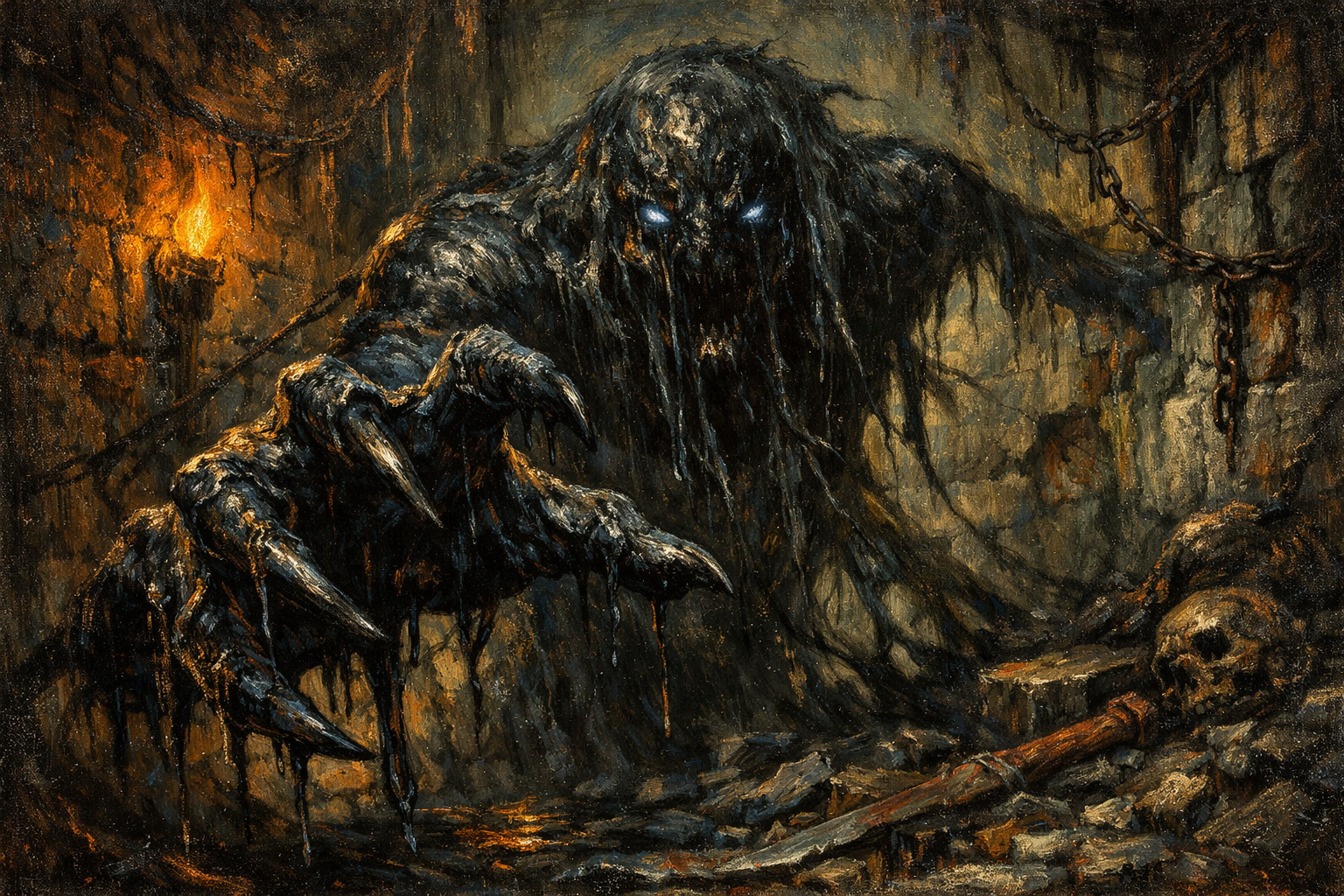
The stringy demodand, or farastu, is the lowest and most numerous of Carceri’s gehreleths—fiends of adhesive, tar-like flesh that bind limbs, foul weapons, and turn the battlefield into a prison. They do not merely kill; they capture, immobilize, and consume, ensuring that escape is slow and final.
Lore
“Once it touches you, you’re already caught—everything after is just how long you take to stop fighting.”
In the choking layers of Carceri, where betrayal festers and freedom is a forgotten myth, stringy demodands crawl through muck and ruin as living extensions of the plane’s will. They are wardens as much as hunters, ensuring that those who fall into their reach do not leave.
Crude and tireless, farastus serve higher demodands without question. Where their masters command, they enforce. Where prey resists, they reduce it to stillness.
Appearance
A stringy demodand resembles a warped humanoid formed from pitch-black tar. Its body stretches in viscous strands that cling, snap, and recoil. Limbs hang unevenly, trailing adhesive filaments that bind to anything they touch.
Its surface shifts with slow, oily motion. At times, half-formed faces press outward beneath the tar—mouths opening, eyes straining—before sinking back into the mass. Dim points of light mark where its eyes should be. Wherever it moves, residue remains.
Behaviour
Stringy demodands are brutally direct, closing to grapple without hesitation. Once engaged, they do not release. Though simple-minded, they pursue with tireless patience, harrying prey until exhaustion makes resistance futile.
In groups, they overwhelm by proximity alone, piling onto targets until movement ceases.
Habitat
Native to the fetid layers of Carceri, stringy demodands favor terrain that impedes escape—tar pits, bogs, narrow tunnels, and ruined prisons. These environments reflect their nature: clinging, suffocating, and inescapable.
When brought to other planes, they foul their surroundings. Surfaces grow tacky, passageways narrow, and even open ground seems to resist movement.
Modus Operandi
A stringy demodand attacks by closing distance and making contact. It lashes out with adhesive limbs, grappling and dragging prey into its mass. Weapons that strike it may stick fast, forcing attackers to wrench them free or abandon them.
Once it makes contact, escape is no longer a matter of strength—only time. It tightens its grip, pinning and smothering while others join, layering bodies until the victim is immobilized.
Motivation
The stringy demodand exists to bind and confine. It is an instrument of Carceri’s nature: nothing escapes. It does not seek swift death, but restraint, degradation, and the denial of freedom.
Ecology
Stringy demodands absorb organic matter directly into their bodies, dissolving it slowly. Their feeding grounds become coated in hardened residue, forming adhesive nests where prey is trapped and consumed over time.
These areas attract scavengers, which in turn become trapped, expanding the creature’s domain.
Signs of Presence
- Black, adhesive residue coating surfaces
- Filament-like strands stretched between walls or debris
- Weapons, bones, or armor fused in place
- Wet dragging sounds in confined spaces
Scholars & Rumours
Some scholars claim stringy demodands are fragments of Carceri itself, given form to enforce its endless imprisonment. Others believe they are the remnants of prisoners reshaped into wardens. A darker theory holds that those consumed are not destroyed, but changed—drawn into the mass until they rise again as something that clings.
Stringy Demodand 2024 5.5e
Stringy Demodand. Pathfinder
Stringy Demodand (Farastu)
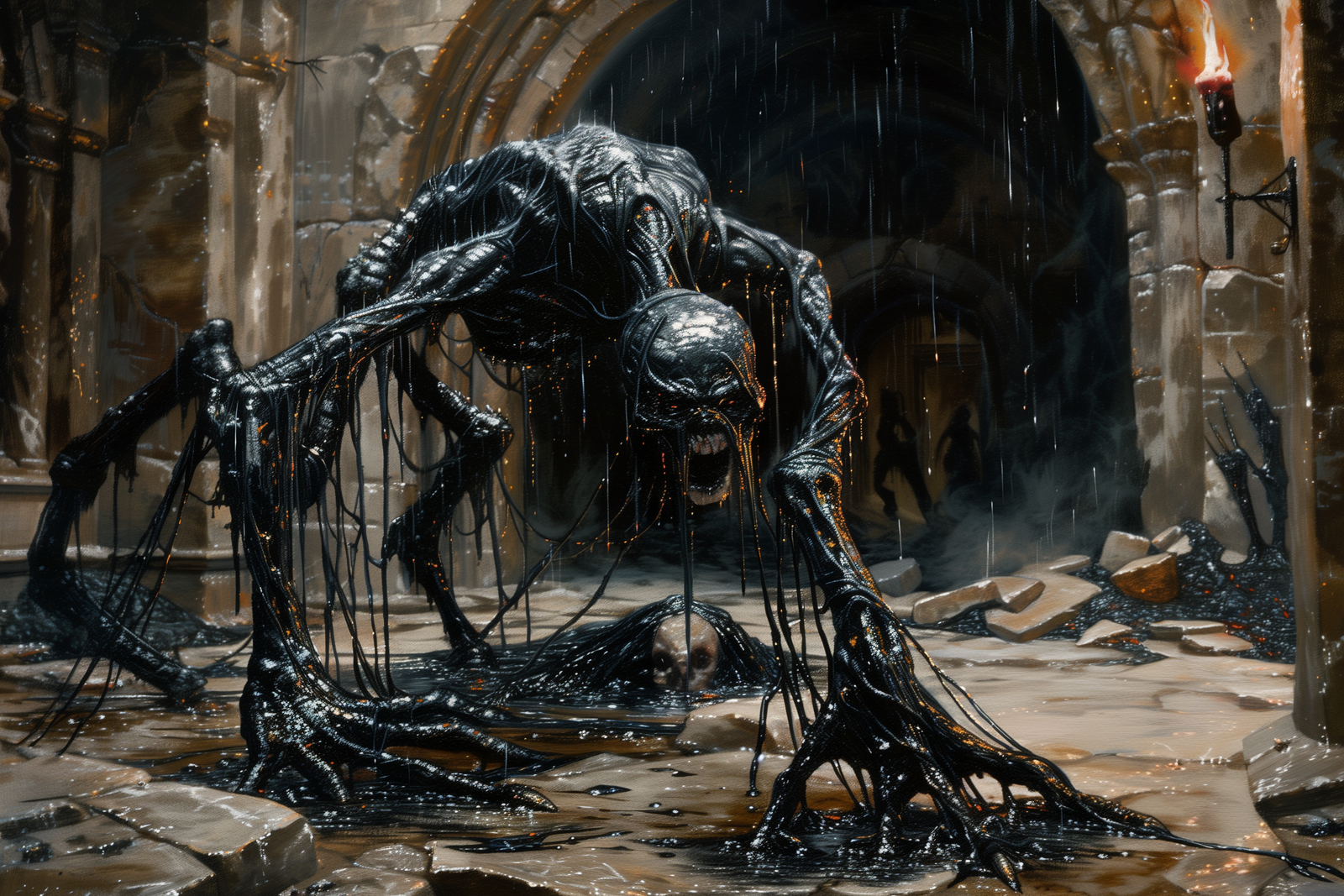
Medium Fiend (Gehreleth), Chaotic Evil
Armor Class 17 (natural armor)
Hit Points 189 (18d8 + 108)
Speed 40 ft., climb 30 ft.
Initiative +2
| STR | DEX | CON | INT | WIS | CHA |
|---|---|---|---|---|---|
| 20 (+5) | 14 (+2) | 22 (+6) | 8 (−1) | 14 (+2) | 11 (+0) |
Saving Throws Str +9, Con +10, Wis +6
Skills Athletics +9, Perception +6, Stealth +6
Damage Resistances cold, fire
Damage Immunities poison
Condition Immunities poisoned
Senses darkvision 120 ft., passive Perception 16
Languages Abyssal, Infernal
Challenge 11 (7,200 XP)
Proficiency Bonus +4
Traits
Adhesive Tar
A creature that hits the demodand with a melee weapon attack while within 5 feet must succeed on a DC 17 Strength saving throw or the weapon becomes stuck. A stuck weapon can be freed with a successful DC 17 Strength (Athletics) check as an action, or automatically if released.
Improved Grab
When the demodand hits a creature with a Claw, the target is grappled (escape DC 17). The demodand can grapple up to two creatures at a time.
Clinging Ground
The ground within 10 feet of the demodand is difficult terrain for hostile creatures.
Relentless Pursuer
The demodand ignores difficult terrain and can move at full speed while dragging a grappled creature.
Magic Resistance
The demodand has advantage on saving throws against spells and other magical effects.
Actions
Multiattack
The demodand makes three attacks: two with its claws and one with its bite.
Claw
Melee Weapon Attack: +9 to hit, reach 5 ft., one target
Hit: 16 (2d8 + 6) slashing damage.
The target is grappled (escape DC 17).
Bite
Melee Weapon Attack: +9 to hit, reach 5 ft., one target
Hit: 18 (2d10 + 5) piercing damage plus 7 (2d6) necrotic damage.
If the target is grappled by the demodand, the attack deals an extra 9 (2d8) necrotic damage.
Smothering Engulf (Recharge 5–6)
The demodand attempts to pull a creature it is grappling into its tar-like body. The creature must succeed on a DC 17 Strength saving throw or be restrained and blinded, and it cannot breathe.
The creature takes 27 (6d8) necrotic damage at the start of each of its turns while engulfed. The creature can repeat the saving throw at the end of each of its turns, escaping on a success and ending the effect.
If a creature dies while engulfed, the demodand gains 30 temporary hit points.
Bonus Actions
Drag Prey
The demodand moves up to its speed, dragging creatures it is grappling without penalty.
Reactions
Clinging Retaliation
When a creature within 5 feet hits the demodand with a melee attack, that creature must succeed on a DC 17 Strength saving throw or be grappled (escape DC 17), provided the demodand isn’t already grappling two creatures.
Tactics
The stringy demodand ambushes from concealment or elevation, using its speed and climbing ability to close quickly. It opens with claw attacks to grapple multiple targets, then focuses its bite on restrained prey.
Once it secures a victim, it drags them away from allies and attempts to engulf them, isolating and eliminating targets one at a time. It avoids prolonged exposure to ranged attackers, instead turning terrain and proximity into its greatest weapons.
Stringy Demodand
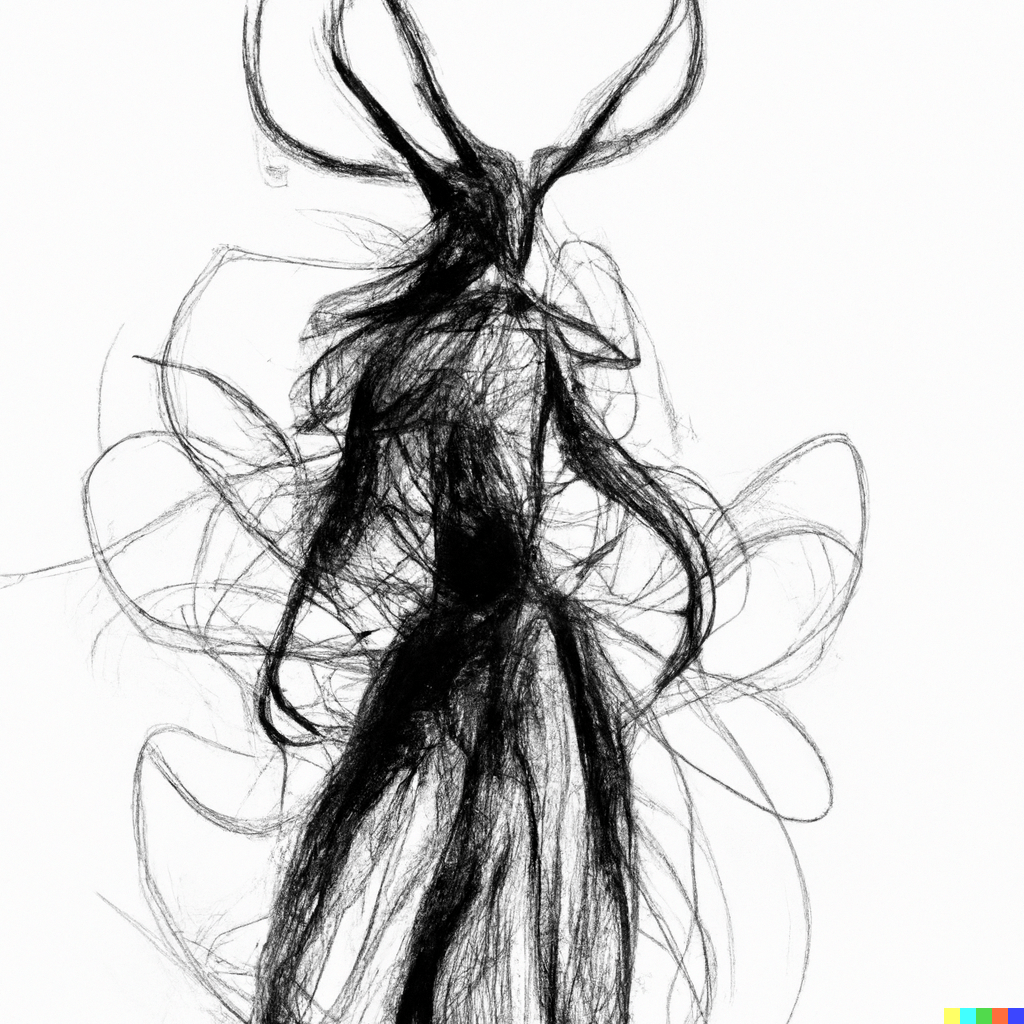
This lanky, winged humanoid is covered in layers of long, ropy skin growths.
Like all demodands, stringy demodands are devoted to serving their thanatotic titan masters in the Abyss. Stringy demodands fulfill this duty by serving as kidnappers, slavers, and slave masters throughout the Abyssal realms.
Stringy demodands are physically well suited to this charge, being lankier, scrappier, and more agile than other demodands. Such agility allows a stringy demodand to quickly snatch up slaves-to-be and prevent slave revolts before they start. Taut muscles, wicked teeth, and sharp claws also make a stringy demodand a formidable fighter in the event of a struggle, and it should go without saying that a stringy demodand’s defining feature—its hundreds of long, obscene ropes of skin—are ideal tools for easily binding and restricting its quarry.
It’s the stringy demodands’ long, obsidian-colored skin growths that give the abhorrent outsiders their name.
These growths resemble nothing so much as elongated skin tags the girth of a human finger and roughly 4 feet in length. The fibrous outgrowths stretch from stringy demodands‘ heads to the tips of their batlike wings to their shins. These ropy villi bob and sway wildly as a stringy demodand moves, creating a truly disturbing image for those victims who dare to look back at their Abyssal pursuer.
Because these rubbery growths cover most of the creatures’ bodies, they provide greater natural protection than the hides of other kinds of demodands and allow stringy demodands to eschew armor. Stringy demodands are typically 6 feet tall and weigh almost 300 pounds.
Stringy Demodand CR 15
XP 51,200
CE Medium outsider (chaotic, demodand, evil, extraplanar)
Init +8; Senses darkvision 120 ft., detect good, detect magic; Perception +24
DEFENSE
AC 30, touch 18, flat-footed 22 (+8 Dex, +12 natural)
hp 230 (20d10+120)
Fort +18, Ref +14, Will +13; +4 vs. divine spells
DR 10/good and magic; Immune acid, poison; Resist cold 10, fire 10; SR 26
OFFENSE
Speed 40 ft., fly 40 ft. (average)
Melee bite +29 (2d6+9 plus 2d6 nonlethal/19–20), 2 claws +29 (1d10+9 plus 2d6 nonlethal/19–20)
Special Attacks entangling folds, faith-stealing strike (DC 24)
Spell-Like Abilities (CL 15th; concentration +19)
Constant—detect good, detect magic
At will—detect thoughts (DC 16)
3/day—fear (DC 18), greater dispel magic
1/day—hold monster (DC 19), summon (level 6, 1d4 tarry demodands or 1d2 stringy demodands 40%)
STATISTICS
Str 28, Dex 27, Con 23, Int 12, Wis 13, Cha 18
Base Atk +20; CMB +29; CMD 47
Feats Blind-Fight, Cleave, Combat Reflexes, Flyby Attack, Improved Critical (bite), Improved Critical (claw), Improved Vital Strike, Intimidating Prowess, Power Attack, Vital Strike
Skills Acrobatics +26, Bluff +27, Climb +22, Fly +21, Intimidate +36, Knowledge (planes) +14, Perception +24, Sense Motive +14, Stealth +26, Survival +14
Languages Abyssal, Celestial, Common
SQ heretical soul
SPECIAL ABILITIES
Entangling Folds (Ex)
Although the disgusting growths on a stringy demodand are technically part of its skin, the demodand has a small measure of control over these ropy appendages. As a swift action, a stringy demodand can use its growths to entangle any adjacent creatures of its size or smaller. To resist being entangled, a target must succeed at a DC 25 Reflex save. As long as the stringy demodand is entangling one or more creatures, any creature that moves adjacent to the demodand must successfully save or likewise be entangled.
Entangled creatures can’t move farther than 5 feet from the stringy demodand until they break free from its growths. An entangled creature can break free as a move action by succeeding at a DC 25 Strength or Escape Artist check. The save DCs are Constitution-based.
ECOLOGY
Environment any (Abyss)
Organization solitary, pair, or tangle (3–8)
Treasure standard
Ecology Expanded
Although all demodands are disgusting creatures, stringy demodands are among the most unnerving in terms of appearance. It’s thought that when the thanatotic titans were sculpting the first stringy demodand, its waxen image drooped and melted from head to toe, forming the foul, stringy growths that now define these misbegotten monsters. Like the hairs of a human, these growths don’t contain nerves yet grow at an incredible rate. When a stringy demodand loses these growths through carelessness or from wounds in battle, the fleshy strands rapidly regenerate.
When at rest, stringy demodands wrap their ropy growths around their bodies like grotesque shawls. Some twist them around their lean torsos and intertwine the growths to produce elaborate headdresses of braided black skin.
Stringy demodands arise from fertilized demodand eggs just like all others of their kind. Since a given demodand’s clutch produces a random distribution of different types of demodands, a stringy demodand’s emergence cannot be planned. When a stringy demodand does happen to hatch from a demodand egg, it quickly savages the other eggs in the clutch to eliminate its competition. If it cannot ruin or consume the other eggs in its clutch before they hatch, a stringy demodand swiftly bullies its brethren into submission and proves itself to be the dominant sibling, establishing from birth its natural instinct to coerce and enslave.
A stringy demodand’s horrific appearance is often cause enough for potential victims to quake in their boots, but its unsightly aspect is far from the only feature that makes this being a formidable intimidator. In addition to its grotesque appendages and distasteful visage, a stringy demodand has a grating, alien voice that is simultaneously guttural and nasal. So terrible is its call that when it roars, a stringy demodand sends humans and demons alike scurrying for safety.
Some say that when the thanatotic titans accidentally created the demodands and beheld their monstrous progeny for the first time, one of the titans let out a cry of anger and shock that shook the whole of the Abyssal realm. It’s said that the stringy demodand heard his creator’s shout and swallowed it hungrily, learning to scream like a god in so doing.
Habitat & Society
Though they prefer to work alone, stringy demodands grudgingly accept the company of other demodands when their thanatotic titan masters demand it. Stringy demodands‘ devotion to the titans is as fervent as that of any other among their kind, but these beings have the unusual tendency to take their masters’ orders to the extreme, justifying any and all obscenities and collateral damage in the name of their Abyssal overlords. Such devotion can sometimes even lead stringy demodands to obliterate their demodand kin during missions should they see their brethren’s efforts as lacking. Only shaggy demodands can deter stringy demodands‘ bloodlust with any consistency, as the latter realize that to attack their commanding brethren would be very foolish.
Always striving to please their masters, stringy demodands can be found on nearly every Abyssal realm capturing and enslaving future minions and playthings for thanatotic titans. When at rest, stringy demodands gather alongside other demodands to form enclaves of like-minded fiends so they can plot their next moves and calculate the most prime specimens to subjugate. In the Abyss, these victims are typically demons, the enslaved prisoners of these demons, and wandering mortals who happened into the Abyss at the wrong time. Though rarely encountered on the Material Plane, stringy demodands can sometimes be found as part of larger hunting parties tasked with capturing valuable mortals to bring back to their Abyssal realm.
Stringy demodands‘ loyalty and rashness make them well suited to serving as solitary slave masters, roles the thanatotic titans delight in having them serve.
The demodands embrace this task with their typical overzealous fervor and happily bully, abuse, and torture their charges, often shattering slaves’ minds as well as their bodies in the process. Although they understand that their thanatotic titan masters want as many mortal recruits as possible, it’s sometimes difficult for the reckless stringy demodands to bring slaves to the titans without irreversibly breaking them first. Stringy demodands kill or violently maim more slaves than they successfully convert into the titans’ faithful. This predilection for violence explains why, when stringy demodands take part in Abyssal slaving parties, they are usually accompanied by enough slimy and tarry demodands to keep their violent urges in check.
Section 15: Copyright Notice
Pathfinder Adventure Path #77: Herald of the Ivory Labyrinth © 2013, Paizo Publishing, LLC; Author: Wolfgang Baur.
Pathfinder Roleplaying Game Bestiary 5 © 2015, Paizo Inc.; Authors: Dennis Baker, Jesse Benner, John Bennett, Logan Bonner, Creighton Broadhurst, Robert Brookes, Benjamin Bruck, Jason Bulmahn, Adam Daigle, Thurston Hillman, Eric Hindley, Joe Homes, James Jacobs, Amanda Hamon Kunz, Ben McFarland, Jason Nelson, Thom Phillips, Stephen Radney-MacFarland, Alistair Rigg, Alex Riggs, David N. Ross, Wes Schneider, David Schwartz, Mark Seifter, Mike Shel, James L. Sutter, and Linda Zayas-Palmer.