
 Buy me a coffee
Moor Giant: Tyrant of the Black Causeway
Moor Giants are ancient lowland giants of peat, heath, black water, and broken causeway, vast road-reavers who know every false crossing and every place where the earth itself can be turned against the living.
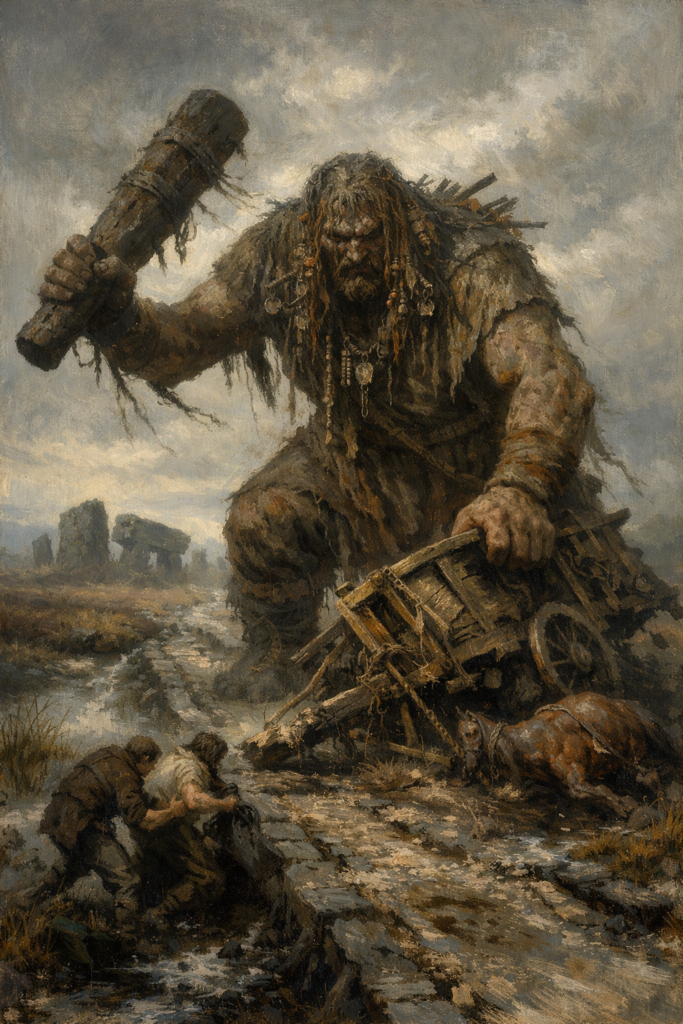
Moor Giants are a distinct giant species of wet frontier lands: peat moors, open heath, drowned roads, burial fields, marsh margins, and wind-scoured border country where safe ground is narrow and every journey depends on paths that can be broken, flooded, or denied. They are not mountain tyrants, frost marauders, or forest colossi. They belong to the low country, where mist lies close to the earth, wagons sink to the axle, and ancient graves stand beside the road like silent witnesses.
A Moor Giant does not rule through size alone. It rules through terrain. It waits until a caravan commits to narrow ground, until rain deepens the ruts, until dusk shortens sight, until the safest road becomes a trap. It breaks carts before guards, collapses causeways before lines can hold, and drives prey from firm footing into mire, ditch, bog, and black water. Its violence is not reckless. It is positional, deliberate, and cruel.
In Drenthe, the most infamous of these giants are Ellert and Brammert, remembered as legendary reavers of the old moors and the deadliest named exemplars of their kind.
Appearance
A Moor Giant stands between 14 and 18 feet tall, stooped at rest but immense when fully risen. Its body is built for lowland force rather than mountain bulk: long arms, powerful shoulders, deep chest, broad hands, and a frame hardened by constant movement through unstable ground.
Its skin ranges from peat-brown to drowned grey, stained with old mud, bog water, soot, and the red smear of iron-rich wet soil. Its hair grows in coarse cords or reed-like mats, black, iron-red, or grave-grey, often tangled with rope, bone charms, harness fittings, toll chains, broken shrine tokens, or ornaments torn from ancient graves.
Moor Giants dress in scavenged layers of hide, rough wool, patched leather, wagon canvas, grave cloth, and rope-bound cloaks. Many carry the marks of road and burial ground upon them: wheel iron at the belt, shrine plaques worn as trophies, burial torcs twisted into hair, or chips of old boundary stone worked into crude charms.
Temperament
Moor Giants are patient, territorial, and coldly cruel. They are not witless brutes. They understand routes, tribute, weather, fear, and the value of controlling passage through hard country. Most do not need to rule villages openly. It is enough that nearby people know what happens when toll is refused, when warnings are ignored, or when old ground is crossed without proper offering.
A Moor Giant prefers to watch before it strikes. It attacks in fog, rain, dusk, or failing light, cripples transport before killing defenders, isolates strong prey from weak, and uses bad footing as readily as club or stone. It will retreat from a poor fight if it must, then return later from better ground.
Its greed is practical rather than courtly. It values silver, iron, tools, livestock, road goods, hostages, burial wealth, and shrine valuables: anything that proves the road no longer belongs to those who made it.
Habitat
Moor Giants dwell where dry ground is narrow and uncertain:
- peat bogs
- open heath
- marsh-edge ridges
- drowned roads
- raised causeways
- black pools
- old boundary wastes
- burial landscapes
- abandoned toll routes
- wind-beaten frontier country
Their lairs are rarely grand. A Moor Giant prefers practical strongholds hidden within bad terrain: turf-roofed dugouts, dry hollows cut into peat banks, old toll houses claimed by force, ruined watch-posts, chambers beneath ancient mounds, or rough timber shelters hidden along ridge lines and broken roads.
Hunting and Warfare
A Moor Giant hunts as a road predator. It listens for bells, axle-creak, hoofbeats, prayer, and argument on the road. It lets prey commit fully to narrow ground before attacking. It knows that one broken wheel can kill more surely than one dead guard.
Its common methods include:
- smashing causeway edges
- hurling peatstone or barrow stone
- sweeping prey into ditch or mire
- overturning carts to block retreat
- separating outriders from baggage
- circling through fog and rain
- forcing tribute by controlling the only safe road
In war, a Moor Giant is most dangerous in broken country, low visibility, and collapsing lines. On firm open ground it is deadly. On bad moorland roads it becomes a calamity.
Society
Moor Giants are usually solitary, paired, or bound in small kin-lines rather than broad tribes. Their society is territorial and memory-bound. A giant remembers where its mother hunted, where its kin drowned, what mound was once claimed, and what road once passed under giant toll before later rulers marked it on parchment.
Some Moor Giants are grave-plunderers, tearing wealth from ancient burials and wearing sacred goods as trophies. Others treat burial land as ancestral domain and punish trespass with brutal certainty. To outsiders, the difference often matters very little until the dead begin to answer.
They may bargain with desperate villagers, smugglers, outlaws, corrupt officials, grave robbers, or lords foolish enough to think a giant can be employed like a mercenary. Such bargains rarely end without extortion, betrayal, or blood.
Sacred Associations
Moor Giants are not temple builders, but they are not godless. Their spirituality is old, territorial, and heavy with fear. Many leave offerings to storm powers, grave keepers, black-water presences, earth mothers, and unnamed land spirits. Some hang silver from dead trees. Some cast captives into bog pools. Some leave certain bones untouched because they know better than to wake what lies beneath them.
A Moor Giant does not usually think of itself as an intruder in the land. It thinks of itself as one of the land’s rightful claimants.
Ellert and Brammert
Among all Moor Giants, the most infamous are Ellert and Brammert, the legendary giant pair of Drenthe.
Ellert is the elder: broader, slower, and more deliberate. He is a tyrant of old roads, burial slopes, and territorial memory. He chooses the ground, sets the trap, and crushes resistance by making escape impossible.
Brammert is the younger: quicker, harsher, and more openly violent. He is the panic after the ambush begins, the breaker of carts, the runner-down of stragglers, and the first shape seen through fog when flight has already failed.
Together they are not merely stronger than one giant. They are complementary horrors. Ellert controls the ground. Brammert feeds on the collapse.
Adventure Use
Moor Giants are especially strong in:
- broken causeway encounters
- missing caravan investigations
- peat-road disappearances
- tribute plots
- burial-ground desecration
- village extortion
- shrine conflicts
- bad-road survival scenarios
- regional folklore hunts
- paired boss encounters using Ellert and Brammert
They work best in landscapes where ground matters as much as strength, and where the players feel that the land itself has turned against easy passage.
Summary
Moor Giants are lowland giant predators of road, bog, barrow, and heath: territorial, cunning, and wholly shaped by the hard open country they haunt. They are not generic giants set in wet ground. Their bodies, habits, and terror belong to the moor itself. In Drenthe, their most feared names are Ellert and Brammert, and the sound of wheels on a fog-bound road is warning enough that one of their kind may already be near.
Moor Giant 2024 5.5e
Moor Giant, Pathfinder
Moor Giant
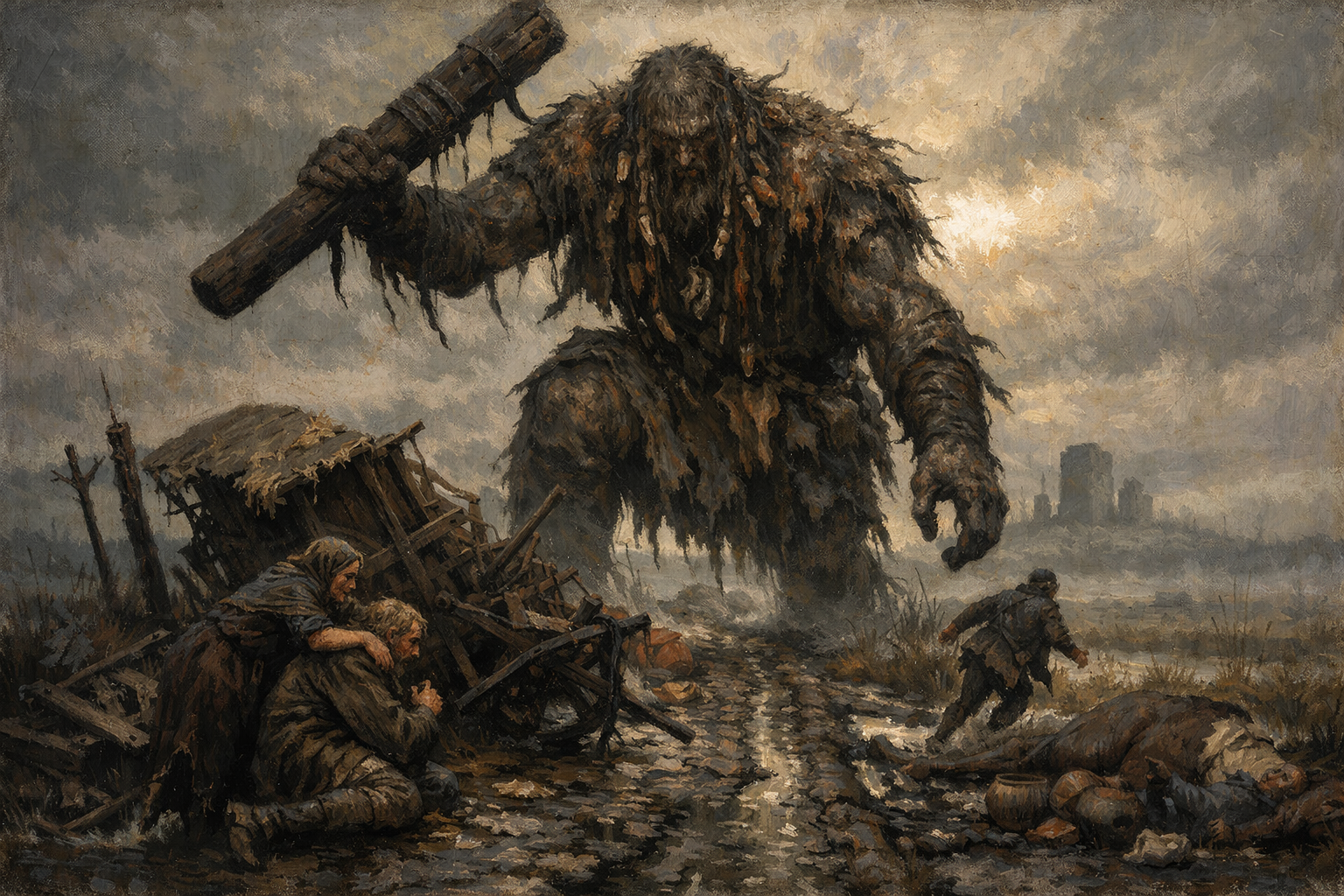
Huge Giant, usually chaotic evil
Armor Class 16 (hide armor)
Hit Points 168 (16d12 + 64)
Speed 40 ft.
| STR | DEX | CON | INT | WIS | CHA |
|---|---|---|---|---|---|
| 23 (+6) | 11 (+0) | 19 (+4) | 10 (+0) | 14 (+2) | 12 (+1) |
Saving Throws Str +10, Con +8, Wis +6
Skills Athletics +10, Intimidation +5, Perception +6, Survival +6
Senses passive Perception 16
Languages Giant, one regional tongue
Challenge 10 (5,900 XP)
Proficiency Bonus +4
Traits
Bogwise Stride. The moor giant ignores difficult terrain caused by bog, marsh, shallow water, peat cuts, mud, heath scrub, and unstable lowland ground.
Causeway Tyrant. While the moor giant stands on a road, raised track, bridge, ridge path, or other narrow crossing, it has advantage on Strength checks and Strength saving throws. In addition, when it hits a creature with a melee attack on such terrain, that creature must succeed on a DC 18 Strength saving throw or be pushed up to 10 feet and knocked prone.
Moor Ambusher. The moor giant has advantage on Dexterity (Stealth) checks made in fog, rain, dusk, peat smoke, or broken heath terrain.
Siegebreaker. The moor giant deals double damage to objects and structures.
Actions
Multiattack. The moor giant makes two attacks: two with its greatclub, or one with its greatclub and one with its peatstone.
Greatclub. Melee Weapon Attack: +10 to hit, reach 10 ft., one target.
Hit: 19 (3d8 + 6) bludgeoning damage.
Peatstone. Ranged Weapon Attack: +10 to hit, range 60/180 ft., one target.
Hit: 22 (3d10 + 6) bludgeoning damage. The ground in a 10-foot-radius sphere centered on the target becomes sucking mire until the start of the moor giant’s next turn. That area is difficult terrain for creatures other than moor giants. A creature other than a moor giant that starts its turn there must succeed on a DC 16 Strength saving throw or have its speed reduced to 0 until the end of that turn.
Bog Drag. Melee Weapon Attack: +10 to hit, reach 10 ft., one Large or smaller creature.
Hit: 17 (2d10 + 6) bludgeoning damage, and the target is grappled (escape DC 18). Until this grapple ends, the target is restrained while in difficult terrain, shallow water, mud, bog, or sucking mire.
Trample the Causeway (Recharge 5–6). The moor giant moves up to its speed in a straight line and can move through the spaces of Large or smaller creatures during this movement. Each creature whose space it enters must make a DC 18 Dexterity saving throw. On a failed save, a creature takes 27 (5d8 + 5) bludgeoning damage, is knocked prone, and is pushed 10 feet to an unoccupied space adjacent to the giant’s path. On a successful save, a creature takes half as much damage only.
Bonus Actions
Break the Track. The moor giant smashes the ground, causeway edge, plankway, or bog crust in a 10-foot square within 5 feet of it. That area becomes difficult terrain. If it is already difficult terrain, each creature standing there must succeed on a DC 16 Dexterity saving throw or fall prone.
Reactions
Roadside Sweep. When a creature within 10 feet of the moor giant moves without taking the Disengage action, the moor giant makes one greatclub attack against it. On a hit, the target’s speed becomes 0 for the rest of the turn.
Combat Tactics
A Moor Giant fights best on narrow, unstable ground: raised roads, bridge approaches, ridge tracks, burial slopes, and peat causeways. It opens by damaging carts, mounts, or formation integrity before closing to melee. If possible, it begins with Peatstone to turn safe footing into mire, then uses Causeway Tyrant, Bog Drag, and Break the Track to force enemies off balance and hold them in bad ground.
It prefers:
- dusk, rain, mist, and reduced visibility
- wounded or isolated targets
- enemies carrying visible wealth, supplies, or sacred goods
- battlefields where retreat is difficult
A Moor Giant withdraws only when heavily wounded, denied terrain advantage, or met by disciplined resistance on firm dry ground. If it escapes, it usually circles and attacks again from a better angle.
Habitat and Ecology
Moor Giants dwell in peat moors, open heath, drowned roads, marsh margins, burial landscapes, black pools, and neglected frontier country. Their lairs are practical hidden strongholds: turf-roofed dugouts, dry peat chambers, ruined toll houses, broken watch-posts, or old mound chambers overlooking the only safe route through dangerous land.
They prey on travelers, extort villages, plunder graves, raid livestock, and sometimes exact tribute from communities too weak to resist. Most are solitary or paired, though old tales speak of kin-lines that once dominated whole tracts of bad country.
Signs of a Moor Giant’s territory include:
- broken wheels and shattered wagons
- smashed boundary stones
- looted burial sites
- stretches of road abandoned after dusk
- tribute left at marked posts or black pools
- causeways deliberately damaged, then made passable again after payment
Treasure
Treasure
Personal: 3d10 gp in mixed coin, iron toll chain worth 25 gp, 1d4 grave trinkets worth 20 gp each, bone-and-bronze charm necklace worth 35 gp
Lair: 4d6 × 100 sp, 3d6 × 50 gp, wagon iron and tool salvage worth 400 gp, burial ornaments worth 600 gp, 1d3 shrine objects worth 100 gp each
Special: ancient oath-ring worth 250 gp; peat-sealed reliquary, barrow brooch, or regional charter chest worth 300–500 gp depending on buyer
A Moor Giant’s wealth is coarse, stolen, and practical: toll silver, grave goods, smashed caravan cargo, shrine valuables, and iron hidden in dry peat chambers rather than neat coin hoards.
Hooks and Uses
- A Moor Giant has broken the only raised road between two villages, cutting off grain and winter salt.
- A reeve hires the party to escort toll silver through bog country where three previous escorts vanished.
- Barrow robbers have awakened both the dead and the giant that claims the burial field as its own.
- A village pays livestock tribute to something in the heath and swears the payments keep worse things away.
- A causeway collapses only beneath armed men; shrine-keepers say the giant is enforcing an older right of passage.
- A drowned caravan lies visible in black water, but the giant that wrecked it uses the site as bait.
- Ellert and Brammert have been seen together again, and no merchant dares cross the moor after sunset.
- A local lord wants the roads cleared, but the old stones suggest the giant is punishing unlawful trespass on burial land.
Named Variants
Ellert, Elder Moor Giant
Huge Giant, unique exemplar, usually chaotic evil
Use the Moor Giant stat block with the following changes:
Hit Points 210
Wisdom 16 (+3)
Charisma 14 (+2)
Skills Insight +7, Perception +8
Challenge 11 (7,200 XP)
Additional Trait
Lord of the Old Ground. While Ellert stands within 60 feet of a barrow, standing stone, grave field, hunebed, or other ancient funerary site, enemies of his choice treat all difficult terrain as costing 3 feet of movement for every 1 foot moved.
Enhanced Trait
Causeway Tyrant (Ellert). Ellert also has advantage on attack rolls against prone creatures standing on roads, causeways, burial slopes, barrow approaches, or other narrow ground.
Replace Peatstone with:
Barrow Stone. Ranged Weapon Attack: +11 to hit, range 60/180 ft., one target.
Hit: 28 (4d10 + 6) bludgeoning damage. If the target is within 20 feet of a burial site, standing stone, or old grave marker, it must succeed on a DC 18 Wisdom saving throw or become frightened of Ellert until the end of its next turn.
Treasure
Treasure
Personal: 6d10 gp, iron authority chains worth 60 gp, 1d4 burial torcs worth 75 gp each
Lair: 6d6 × 100 sp, 5d6 × 100 gp, grave goods worth 1,200 gp, shrine silver worth 500 gp
Special: barrow-king arm ring worth 500 gp; ancient funerary seal or stone-key of regional significance
Ellert is the tyrant of old roads, burial slopes, and territorial memory.
Brammert, Younger Moor Giant
Huge Giant, unique exemplar, usually chaotic evil
Use the Moor Giant stat block with the following changes:
Hit Points 185
Speed 50 ft.
Dexterity 13 (+1)
Skills Athletics +11
Challenge 11 (7,200 XP)
Remove
Moor Ambusher
Additional Trait
Relentless Pursuit. Brammert can take the Dash action as a bonus action. If he ends that movement adjacent to a frightened, prone, or wounded creature, he has advantage on his next melee attack against that creature before the end of the turn.
Modified Recharge
Trample the Causeway recharges on 4–6.
Additional Action
Crushing Charge. If Brammert moves at least 20 feet straight toward a creature and then hits it with a greatclub attack on the same turn, the target takes an extra 13 (3d8) bludgeoning damage and must succeed on a DC 18 Strength saving throw or be knocked prone.
Treasure
Treasure
Personal: 4d10 gp, broken gold fittings worth 40 gp, 1d6 looted silver brooches worth 25 gp each
Lair: 4d6 × 100 sp, 4d6 × 50 gp, smashed cargo salvage worth 500 gp, hostage goods worth 250 gp
Special: blood-marked wagon seal worth 150 gp; noble travel chest containing mixed valuables worth 400 gp
Brammert is the pursuit killer, cart-breaker, and panic predator.
Moor Giant — Pathfinder 1st Edition
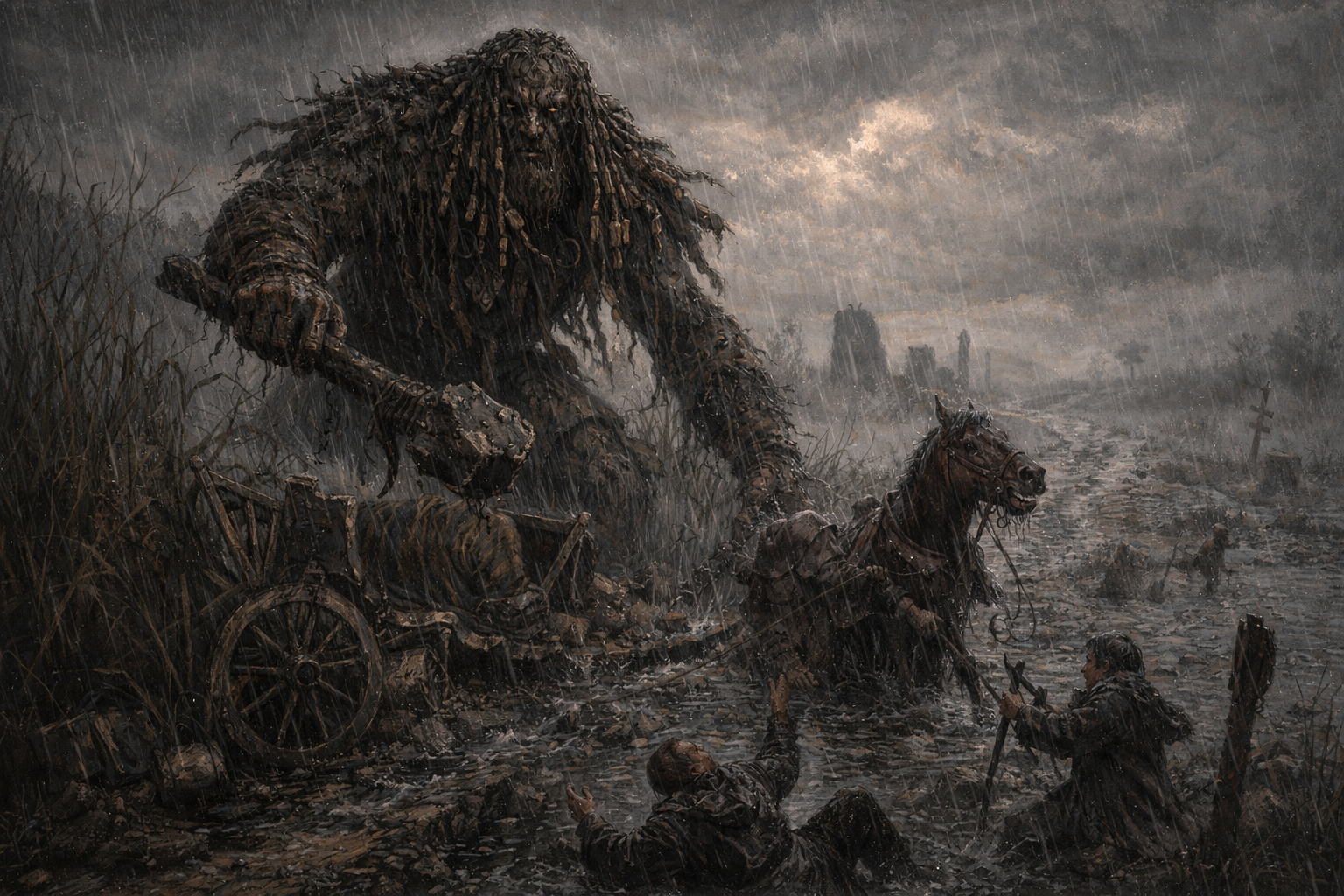
Moor Giant CR 10
XP 9,600
CE Huge humanoid (giant)
Init +1; Senses low-light vision; Perception +18
Defense
AC 23, touch 9, flat-footed 22 (+1 Dex, +14 natural, –2 size)
hp 161 (14d8+98)
Fort +16, Ref +5, Will +8
Defensive Abilities bogwise stride
Offense
Speed 40 ft.
Melee greatclub +22/+17 (2d8+13) or slam +21 (1d8+9)
Ranged peatstone +11 (2d10+13)
Space 15 ft.; Reach 15 ft.
Special Attacks bog drag, peatstone mire, trample the causeway
Statistics
| Str | Dex | Con | Int | Wis | Cha |
|---|---|---|---|---|---|
| 29 | 13 | 24 | 10 | 15 | 12 |
Base Atk +10; CMB +21 (+25 grapple, +23 bull rush or overrun on narrow ground); CMD 32 (36 vs. bull rush or trip on narrow ground)
Feats Awesome Blow, Great Fortitude, Improved Bull Rush, Improved Overrun, Intimidating Prowess, Power Attack, Skill Focus (Survival)
Skills Climb +17, Intimidate +18, Perception +18, Stealth +1 (+9 in fog, rain, dusk, peat smoke, or heath terrain), Survival +20
Languages Giant, one regional tongue
Ecology
Environment cold or temperate moors, peat bogs, open heath, drowned roads, barrow fields, marsh margins
Organization solitary, pair, or legendary pair (Ellert and Brammert)
Treasure standard plus personal, lair, and special treasure (see below)
Special Abilities
Bog Drag (Ex)
When a moor giant hits a Large or smaller creature with its slam or greatclub, it can attempt a grapple combat maneuver against that creature as a free action that does not provoke attacks of opportunity. If the grapple succeeds and the target is standing in difficult terrain, shallow water, mud, bog, or a square affected by peatstone mire, the target is also entangled. A creature grappled by a moor giant that begins its turn in such terrain must succeed at a DC 24 Reflex save or become pinned until the start of its next turn. The save DC is Strength-based.
Bogwise Stride (Ex)
A moor giant ignores movement penalties from bog, marsh, peat cuts, shallow water, mud, heath scrub, and similar unstable lowland terrain. It can charge across such terrain so long as the path is otherwise traversable.
Break the Track (Ex)
As a standard action, a moor giant can smash a contiguous 10-foot-square section of road edge, plankway, bog crust, ridge path, or causeway within its reach. That square becomes difficult terrain. If the square is already difficult terrain, each creature standing in it must succeed at a DC 22 Reflex save or fall prone. Fragile structures in the square, such as planks, narrow bridgework, or peat road surfacing, take 20 points of damage. The save DC is Strength-based.
Causeway Tyrant (Ex)
While standing on a road, raised track, bridge, ridge path, burial slope, or similar narrow crossing, a moor giant gains a +4 bonus on bull rush and overrun combat maneuver checks and to CMD against bull rush and trip attempts. In addition, whenever it hits a creature with a melee attack while both it and its target are on such terrain, it can attempt a free bull rush combat maneuver against that target that does not provoke attacks of opportunity. This bull rush attempt does not move the moor giant.
Peatstone Mire (Ex)
A creature struck by a moor giant’s peatstone takes normal damage, and the impact square plus all squares within 10 feet become sucking mire for 1 round. These squares are difficult terrain for all creatures except moor giants. A creature that begins its turn in the mire must succeed at a DC 22 Reflex save or have its speed reduced to 0 until the end of its turn. The save DC is Strength-based.
Siegebreaker (Ex)
A moor giant deals double damage to unattended objects and structures, including wagons, gates, causeways, bridges, and similar constructions.
Trample the Causeway (Ex)
As a full-round action, a moor giant can move up to its speed in a straight line across a road, raised track, bridge, ridge path, or similar narrow ground and move through the spaces of creatures of Large size or smaller. Each creature whose space the giant enters takes 2d8+13 points of bludgeoning damage and can attempt a DC 24 Reflex save for half damage. A creature that fails this save is also knocked prone and pushed 10 feet to an adjacent square of the moor giant’s choice. The save DC is Strength-based.
Combat Tactics
A moor giant prefers to fight on narrow, unstable ground where lines break easily and retreat is dangerous. It opens by targeting carts, mounts, outriders, and bridge approaches rather than the strongest melee opponent. If possible, it begins with peatstone to create mire, then uses causeway tyrant, bog drag, and break the track to throw enemies from safe footing and hold them in bad ground.
On firm, open terrain it fights brutally but directly. On roads, causeways, and burial slopes it becomes markedly more dangerous, relying on bull rushes, overruns, and terrain damage to collapse the battlefield around its enemies.
A moor giant withdraws only when badly wounded, denied terrain advantage, or met by disciplined missile fire from stable ground. If it escapes, it usually circles back under cover of mist, dusk, or poor weather.
Habitat and Ecology
Moor giants dwell in peat moors, open heath, black-water crossings, burial landscapes, neglected road systems, and old frontier wastes. Their lairs are practical and hidden: turf-roofed dugouts, ruined toll houses, broken watch-posts, peat chambers, or ancient mound interiors overlooking the only safe passage through dangerous land.
They prey on travelers, extort villages, plunder graves, raid livestock, and dominate local movement by force. Most are solitary or paired. Old traditions remember kin-lines that once ruled entire tracts of moor through toll, terror, and control of the roads.
Signs of a moor giant’s territory include shattered wagons, broken boundary stones, looted burial sites, tribute left at marked posts, and stretches of road abandoned after dusk.
Treasure
Personal 3d10 gp in mixed coin, iron toll chain worth 25 gp, 1d4 grave trinkets worth 20 gp each, bone-and-bronze charm necklace worth 35 gp
Lair 4d6 × 100 sp, 3d6 × 50 gp, wagon iron and tool salvage worth 400 gp, burial ornaments worth 600 gp, 1d3 shrine objects worth 100 gp each
Special ancient oath-ring worth 250 gp; peat-sealed reliquary, barrow brooch, or regional charter chest worth 300–500 gp depending on buyer
A moor giant’s wealth is coarse, stolen, and practical: toll silver, grave goods, smashed caravan cargo, shrine valuables, and iron hidden in dry peat chambers.
Hooks and Uses
- A moor giant has broken the only raised road between two villages, cutting off grain and winter salt.
- A reeve hires the PCs to escort toll silver through bog country where earlier escorts vanished.
- Barrow robbers have awakened both the dead and the giant that claims the burial field.
- A village pays livestock tribute to something in the heath and swears the offerings keep worse things away.
- A causeway collapses only beneath armed men, and shrine-keepers insist the giant is enforcing an older right of passage.
- A drowned caravan lies visible in black water, but the giant that wrecked it uses the site as bait.
Ellert, Elder Moor Giant
Ellert, Elder Moor Giant CR 11
XP 12,800
CE Huge humanoid (giant)
Use the moor giant stat block with the following changes.
Statistics Changes
hp 189
Wis 17, Cha 14
Will +9
CMB +21 (+25 grapple, +23 bull rush or overrun on narrow ground)
CMD 32 (36 vs. bull rush or trip on narrow ground)
Skills Climb +17, Intimidate +20, Perception +21, Sense Motive +18, Stealth +1 (+9 in fog, rain, dusk, peat smoke, or heath terrain), Survival +21
Additional Special Abilities
Lord of the Old Ground (Ex)
While Ellert is within 60 feet of a barrow, standing stone, grave field, hunebed, or other ancient funerary site, all difficult terrain in that area costs Ellert’s enemies 3 squares of movement for every 1 square moved.
Barrow Stone (Ex)
Ellert’s peatstone attack becomes barrow stone: ranged +12 (2d12+13). A creature struck by this attack while within 20 feet of a burial site, standing stone, or grave marker must also succeed at a DC 20 Will save or become shaken for 1 round. A creature already shaken instead becomes frightened for 1 round. This is a mind-affecting fear effect. The save DC is Charisma-based.
Causeway Tyrant (Ellert) (Ex)
Ellert gains the normal benefits of causeway tyrant. In addition, he gains a +2 bonus on attack rolls against prone creatures standing on roads, causeways, burial slopes, barrow approaches, or similar narrow ground.
Treasure
Personal 6d10 gp, iron authority chains worth 60 gp, 1d4 burial torcs worth 75 gp each
Lair 6d6 × 100 sp, 5d6 × 100 gp, grave goods worth 1,200 gp, shrine silver worth 500 gp
Special barrow-king arm ring worth 500 gp; ancient funerary seal or stone-key of regional significance
Ellert is the tyrant of old roads, burial slopes, and territorial memory.
Brammert, Younger Moor Giant
Brammert, Younger Moor Giant CR 11
XP 12,800
CE Huge humanoid (giant)
Use the moor giant stat block with the following changes.
Statistics Changes
hp 176
Speed 50 ft.
Dex 15
Init +2
AC 24, touch 10, flat-footed 22 (+2 Dex, +14 natural, –2 size)
Ref +6
CMB +21 (+25 grapple, +23 bull rush or overrun on narrow ground)
CMD 33 (37 vs. bull rush or trip on narrow ground)
Skills Climb +18, Intimidate +19, Perception +18, Stealth –1 (+7 in fog, rain, dusk, peat smoke, or heath terrain), Survival +20
Remove
Brammert loses the racial stealth emphasis of moor ambusher as a defining feature; he is a predator of pursuit rather than concealment.
Additional Special Abilities
Relentless Pursuit (Ex)
As a swift action, Brammert can move up to his speed toward a frightened, prone, or wounded foe. This movement does not provoke attacks of opportunity from that target. If Brammert ends this movement adjacent to such a creature, he gains a +2 bonus on his next melee attack roll against that creature before the end of his turn.
Crushing Charge (Ex)
If Brammert moves at least 20 feet in a straight line and then hits a creature with a greatclub attack in the same round, the target takes an additional 3d8 points of bludgeoning damage and must succeed at a DC 24 Fortitude save or be knocked prone. The save DC is Strength-based.
Treasure
Personal 4d10 gp, broken gold fittings worth 40 gp, 1d6 looted silver brooches worth 25 gp each
Lair 4d6 × 100 sp, 4d6 × 50 gp, smashed cargo salvage worth 500 gp, hostage goods worth 250 gp
Special blood-marked wagon seal worth 150 gp; noble travel chest containing mixed valuables worth 400 gp
Brammert is the pursuit killer, cart-breaker, and panic predator.