
Porpoise — Coastal Animal, Druidic Ally, and Sea Guide
A small, watchful sea-mammal of harbours, fjords, estuaries, and cold coastal waters, most useful in play when its behaviour hints that something has changed beneath the tide.
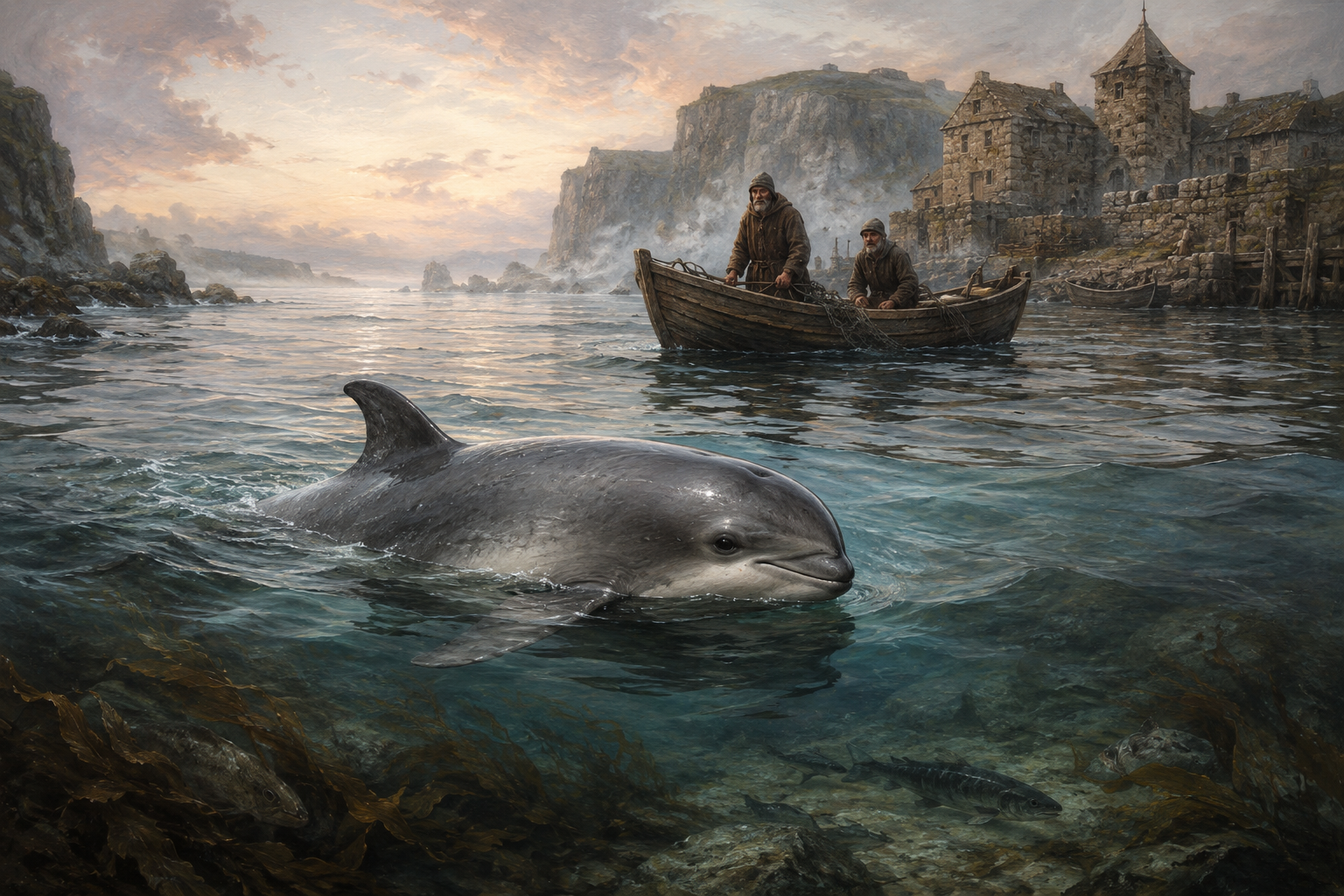
A porpoise breaks the surface like a thought half-seen: a grey back in harbour water, a short breath in cold air, a triangular fin, and then nothing but widening rings. Coastal folk notice such moments. They notice them even more when they stop.
The porpoise is a small, compact sea-mammal of cold and temperate waters. It is blunter and more secretive than the dolphin, less given to display, and better suited to quiet scenes of travel, fishing, warning, and hidden danger. It does not need to be inflated into a sea monster to be useful. Its value lies in place, behaviour, and the life of the coast around it.
In a campaign, porpoises make the sea feel inhabited. They surface near boats, vanish from troubled waters, follow fish, avoid predators, flee noise, protect calves, and sometimes draw attention to something below. A porpoise circling near a reef may simply be feeding. It may also be the first sign of a wreck, a trapped swimmer, a net-line, a drowned shrine, or a predator passing through the bay.
Fishers, ferrymen, seal-hunters, pearl-divers, harbour wardens, druids, island children, and sea-priests may all know porpoise behaviour as part of ordinary coastal life. Some read it practically. Some read it superstitiously. In a mythic world, both readings may be true.
Appearance
A porpoise has a compact, muscular body, smooth grey skin, a pale underside, a short triangular dorsal fin, and a blunt, rounded head. It lacks the long beak and fixed smile commonly associated with dolphins. Its face is harder to read: alert, animal, watchful, and unsentimental.
When it surfaces, the moment is brief. A dark curve breaks the water. A breath ghosts into the air. A small fin cuts the harbour chop. Then the animal is gone, leaving only rings on the surface and the question of why it appeared there.
A porpoise should feel like a real sea-mammal first. Its mystery comes from restraint, not obvious magic.
Habitat
Porpoises favour cold and temperate coastal waters, especially places where land, trade, fishing, and danger meet. They may be found near harbour mouths, river mouths, estuaries, fjords, island channels, tidal mills, kelp beds, sea-cliffs, drowned roads, fishing grounds, and wreck-strewn reefs.
Because they live close to shore, porpoises are often affected by human and supernatural trouble before people understand what has changed. Nets, poisoned water, corpse-drift, cursed wreckage, harbour building, underwater noise, predatory monsters, plague ships, and unnatural storms may disturb them.
A village may not know a sea serpent has entered the bay. It may only know that the porpoises no longer come.
Ecology
Porpoises feed on small fish, squid, and other marine prey. They are air-breathing mammals and must surface regularly, but most of their lives are spent beneath the visible world, where sound, pressure, echo, and movement matter more than sight.
They are not aggressive creatures. A porpoise may bite if trapped, wounded, magically compelled, or defending a calf, but its first defence is escape. Its strength lies in awareness, speed, breath, and familiarity with waters most land-dwellers can only enter briefly.
This makes porpoises useful in coastal adventures. They may have seen the thing that sank a boat, fled from sahuagin nets, avoided a drowned plague-cart, or learned that one stretch of water has become unsafe long before any sailor admits there is a pattern.
Behaviour
Porpoises are shy, fast, and observant. They may appear alone, in pairs, or in small groups. They rarely linger around noisy vessels unless fish, danger, injury, magic, or curiosity draws them close.
Use their behaviour as a clue only when it feels natural. A porpoise does not explain the mystery. It may simply point toward it.
A porpoise circling the same patch of water suggests something below. A group refusing to enter a channel suggests danger, noise, poison, or a predator route. A mother and calf trapped close to shore suggests something outside the bay is worse than the people on land. A wounded porpoise carrying strange cord, hook, wax, wire, or shellwork may be the first sign that a larger problem exists.
Coastal folk may call them grey watchers, tide-pigs, harbour ghosts, breathers, or little sea-pigs, depending on local tongue and superstition.
Mechanics Tabs
The rules below are mechanics tabs for different game editions.
Porpoise 5.5e / 2024
Porpoise, Pathfinder 1e
Porpoise, 3.0e
Porpoise 5.5e / 2024
Medium Beast, Unaligned
Armor Class: 12
Initiative: +2
Hit Points: 11 (2d8 + 2)
Speed: 0 ft., Swim 60 ft.
Proficiency Bonus: +2
| STR | DEX | CON | INT | WIS | CHA |
|---|---|---|---|---|---|
| 12 (+1) | 15 (+2) | 12 (+1) | 4 (-3) | 13 (+1) | 7 (-2) |
Skills: Perception +3
Senses: Blindsight 60 ft. while underwater, Passive Perception 13
Languages: —
Challenge: 1/8
Traits
Aquatic Echolocation. While underwater, the porpoise has Blindsight out to 60 feet. This sense does not function while the porpoise has the Deafened condition.
Hold Breath. The porpoise can hold its breath for 15 minutes.
Waterborne Agility. The porpoise doesn’t provoke Opportunity Attacks when it swims out of an enemy’s reach.
Actions
Bite. Melee Attack Roll: +4, reach 5 ft., one target. Hit: 4 (1d4 + 2) Piercing damage.
Porpoise Companions
For D&D 5e / 5.5e play, a normal porpoise is a noncombat animal ally, a magically befriended creature, or a narrative companion tied to a coast, ship, reef, harbour, or druidic place.
Use the ordinary porpoise stat block when the animal is simply present in the world. It may help because of training, trust, magic, food, habit, or local bond, but it does not scale with the character.
When a character gains a scaling beast companion and chooses a porpoise-shaped sea companion, use the stat block below. Do not use the ordinary porpoise monster stat block for a scaling companion.
Porpoise-Shaped Sea Companion
Medium Beast, Unaligned
Armor Class: 13 + the character’s Proficiency Bonus
Hit Points: 5 + five times the character’s level
Speed: 5 ft., Swim 60 ft.
Proficiency Bonus: Equal to the character’s Proficiency Bonus
| STR | DEX | CON | INT | WIS | CHA |
|---|---|---|---|---|---|
| 14 (+2) | 15 (+2) | 15 (+2) | 8 (-1) | 14 (+2) | 11 (+0) |
Skills: Perception +2 plus the character’s Proficiency Bonus, Stealth +2 plus the character’s Proficiency Bonus while underwater
Senses: Blindsight 60 ft. while underwater, Passive Perception 12 plus the character’s Proficiency Bonus
Languages: Understands the languages the character uses to command or bond with it, but cannot speak unless awakened or magically altered
Challenge: —
Traits
Aquatic Companion. The companion is built for aquatic play. It can move, scout, fight, and guide effectively in water, but it is severely limited on land. It cannot serve as a mount for a Medium creature and cannot accompany the party through ordinary land-based dungeons without magic or special circumstances.
Aquatic Echolocation. While underwater, the companion has Blindsight out to 60 feet. This sense does not function while the companion has the Deafened condition.
Bonded Companion. The companion obeys the character who gained it. In combat, it takes the Dodge action unless the character commands it to take another action.
Hold Breath. The companion can hold its breath for 15 minutes.
Sea-Bound Agility. The companion doesn’t provoke Opportunity Attacks when it swims out of an enemy’s reach.
Actions
Bite. Melee Attack Roll: +2 plus the character’s Proficiency Bonus, reach 5 ft., one target. Hit: 1d6 + 2 + the character’s Proficiency Bonus Piercing damage.
Companion Use
A porpoise-shaped sea companion is best used for scouting, warning, guiding, underwater awareness, and limited aquatic combat. It can scout harbour mouths, reefs, estuaries, wrecks, and submerged caves. It can warn of large underwater movement, locate nets or trapped swimmers, recognise familiar boats and voices, guide a boat through known shoals, and draw attention to danger by circling, refusing passage, or fleeing.
It does not gain a land role, mounted-combat role, object-manipulation role, or extra attack tricks.
A fey-touched, awakened, sacred, or druid-bonded porpoise may understand one language such as Common, Druidic, Sylvan, Aquan, or a local coastal tongue. It need not speak. It may communicate through repeated paths, clicks, dreams, reflected moonlight, circling behaviour, or by leading boats through fog.
Porpoise, Pathfinder 1e
CR 1/4
XP 100
N Medium animal
Init +2; Senses blindsight 60 ft. underwater, low-light vision; Perception +6
Defense
AC 13, touch 12, flat-footed 11 (+2 Dex, +1 natural)
hp 11 (2d8+2)
Fort +4, Ref +5, Will +1
Offense
Speed swim 60 ft.
Melee bite +3 (1d4+1)
Space 5 ft.; Reach 5 ft.
Statistics
Str 12, Dex 15, Con 12, Int 2, Wis 13, Cha 7
Base Atk +1; CMB +2; CMD 14
Feats Skill Focus (Perception)
Skills Perception +6, Swim +9; Racial Modifiers +8 Swim
Languages —
Ecology
Environment cold or temperate coastal waters, bays, estuaries, harbours, fjords
Organization solitary, pair, or small group (3–6)
Treasure none
Special Abilities
Aquatic Echolocation (Ex). A porpoise has blindsight 60 feet while underwater. This sense does not function while the porpoise is deafened.
Hold Breath (Ex). A porpoise can hold its breath for 15 minutes.
Waterborne Agility (Ex). A porpoise gains a +4 dodge bonus to AC against attacks of opportunity provoked by movement while swimming.
Notes
This stat block represents an ordinary porpoise. It is best used for coastal encounters, druidic scenes, underwater clues, shipwreck investigations, and environmental warnings.
For a fey-touched or awakened porpoise, increase Intelligence and Charisma, allow it to understand one or more languages, and give it a story function rather than combat upgrades. It might guide boats through fog, avoid cursed currents, appear only at dusk, or lead swimmers toward submerged thresholds.
Porpoise Companions
In Pathfinder 1e, a porpoise may be selected as an animal companion in aquatic, coastal, island, river-mouth, fjord, harbour, or underwater campaigns. It is a poor choice for a mostly landbound campaign unless the character regularly returns to waters where the porpoise can live and act.
Pathfinder 1e animal companions use the normal animal companion advancement rules: effective druid level, bonus Hit Dice, natural armor adjustment, Strength/Dexterity adjustment, bonus tricks, feats, skill ranks, ability score increases, and special abilities such as Link, Share Spells, Evasion, Devotion, and Multiattack when gained.
The porpoise below is a standalone aquatic animal companion option. It is built for scouting, warning, guiding, and underwater movement rather than heavy combat.
Animal Companion Starting Statistics
Size: Medium
Speed: Swim 60 ft.
AC: +1 natural armor
Attack: Bite (1d4)
Ability Scores: Str 12, Dex 15, Con 12, Int 2, Wis 13, Cha 7
Special Qualities: Low-light vision, hold breath, aquatic echolocation
Skill Emphasis: Perception and Swim
Aquatic Echolocation (Ex): A porpoise has blindsight 60 feet while underwater. This sense does not function while the porpoise is deafened.
Hold Breath (Ex): A porpoise can hold its breath for 15 minutes.
4th-Level Companion Advancement
At 4th level, a porpoise companion becomes stronger, hardier, and more responsive without changing its basic role.
Ability Scores: Str +2, Dex +2, Con +2
Special Qualities: The porpoise’s aquatic echolocation improves to blindsight 120 feet while underwater.
The porpoise remains Medium. It does not gain land speed, mount suitability, or heavy combat functions from this advancement.
Role in Play
A Pathfinder 1e porpoise companion is best used as an aquatic scout, reef-guide, warning animal, wreck-finder, harbour ally, or underwater search companion. It is not a primary combat animal.
Animal Companion Role: Aquatic scout, guide, warning animal, wreck-finder, reef-runner
Primary Skills: Perception and Swim
Appropriate Tricks: Come, defend, down, fetch, seek, stay, track, guide, and warn
Poor Tricks: Attack, guard, heel overland, perform, work, or any trick requiring land movement
The porpoise may learn guide and warn as custom animal tricks. Guide teaches the porpoise to lead a swimmer or boat through familiar waters, around reefs, toward a known place, or away from a recognised hazard. Warn teaches the porpoise to surface, circle, slap water, flee, or otherwise signal danger.
A porpoise animal companion should not be expected to accompany the party into land-based dungeons, city streets, forests, mountains, castles, or ordinary overland journeys. In exchange, it can be extremely useful around ships, reefs, underwater ruins, wrecks, islands, drowned caves, harbour mouths, estuaries, and coastal investigations.
A porpoise companion may carry a tiny waterproof token, cord, shell, or message tube, but it cannot carry heavy objects, serve as a mount, open complex objects, or replace player exploration. It may learn repeated signals, familiar routes, danger cues, names, objects, and simple commands.
For an awakened or fey-touched porpoise in Pathfinder 1e, increase Intelligence and Charisma as appropriate, allow it to understand one or more languages, and give it a story role rather than simply increasing bite damage.
Porpoise, 3.0e
Porpoises are mammals that tend to be playful, friendly, and helpful.
A typical porpoise is 4 to 6 feet long and weighs 110 to 160 pounds. The statistics presented here can describe any small whale of similar size.
| Porpoise | |
| Medium animal | |
| Hit Dice | 2d8+2 (11 hp) |
| Initiative | +3 |
| Speed | Swim 80 ft. (16 squares) |
| Armor Class | 15 (+3 Dexterity, +2 natural), touch 13, flat-footed 12 |
| Base Attack/Grapple | +1/+1 |
| Attack | Slam +4 melee (2d4) |
| Full Attack | Slam +4 melee (2d4) |
| Space/Reach | 5 ft./5 ft. |
| Special Attacks | – |
| Special Qualities | Blindsight 120 ft., hold breath, Low-Light Vision |
| Saves | Fort +4, Ref +6, Will +1 |
| Abilities | Strength 11, Dexterity 17, Constitution 13, Intelligence 2, Wisdom 12, Charisma 6 |
| Skills | Listen +8*, Spot +7*, Swim +8 |
| Feats | Weapon Finesse |
| Environment | Temperate aquatic |
| Organization | Solitary, pair, or school (3-20) |
| Challenge Rating | 1/2 |
| Advancement | 3-4 HD (Medium); 5-6 HD (Large) |
| Level Adjustment | – |
Combat
Blindsight (Ex) Porpoises can “see” by emitting high-frequency sounds, inaudible to most other creatures, that allow them to locate objects and creatures within 120 feet. A silence spell negates this and forces the porpoise to rely on its vision, which is approximately as good as a human’s.
Hold Breath (Ex) A porpoise can hold its breath for a number of rounds equal to 6 x ?its Constitution score before it risks drowning.
Skills A porpoise has a +8 racial bonus on any Swim check to perform some special action or avoid a hazard. It can always choose to take 10 on a Swim check, even if distracted or endangered. It can use the run action while swimming, provided it swims in a straight line. *A porpoise has a +4 racial bonus on Spot and Listen checks. These bonuses are lost if its Blindsight is negated.
Combat Tactics
A porpoise should not fight unless it has no good way to flee. If forced into combat, it bites once, twists away, dives, and tries to escape into deeper or darker water.
It does not ram armoured warriors, duel sahuagin, or throw itself at sea monsters unless awakened, trained, fey-touched, or magically compelled. Its normal tactics are simple: avoid contact, stay below the surface, turn sharply, defend calves, and flee from overwhelming danger.
A porpoise encounter becomes more interesting when the animal is endangered by the real threat: a net, predator, poisoned current, magical disturbance, or wounded calf.
Adventure Hooks
The Harbour Falls Silent
The old fishers claim porpoises used to surface every morning near the harbour mouth. For seven days, none have appeared. Nets come up torn, the bell-buoy rings when there is no wind, and something has scratched symbols into the underside of anchored boats.
The harbour council wants the matter dismissed as weather. The fishers know better. Something has settled below the tide-line, and the first warning was not a scream, but silence.
The Net of Black Knots
A porpoise is found tangled in a black cord-net that resists ordinary knives and leaves stains like old seawater on anyone who touches it. The same knotwork appears around the wrists of drowned sailors recovered from a wreck two miles offshore.
Cutting the porpoise free may save it. Preserving the knots may reveal the hand behind them: smugglers, hag-craft, sahuagin binding, fey debt, or a drowned execution rite.
The Grey Guide
A lone porpoise keeps surfacing ahead of the party’s boat and vanishing whenever they turn away from a certain reef. Beneath that reef lies a collapsed sea-cave, a trapped child, a drowned shrine, a wrecked tax-ship, or the entrance to a tunnel that opens only at low tide.
The tide is falling. If the party follows too late, the porpoise’s route becomes a wall of rock and black water.
Natural History and Myth Context
Porpoises are small toothed whales in the family Phocoenidae. They are often confused with dolphins, but they are generally more compact, smaller, blunter-snouted, and less conspicuous at the surface. Their teeth are spatulate rather than conical, and many species have a short, rounded head rather than the long beak associated with familiar dolphins. For a general zoological overview, see Encyclopaedia Britannica on porpoises.
The harbour porpoise, Phocoena phocoena, is one of the best-known species and is strongly associated with coastal waters, bays, estuaries, harbours, fjords, and other near-shore environments. NOAA Fisheries describes the harbour porpoise as shy, commonly seen in small groups, and especially vulnerable to gillnets, pollution, underwater noise, and other forms of human disturbance because of its coastal habits. See NOAA Fisheries: Harbor Porpoise.
Porpoises also differ from dolphins in ways that matter visually at the game table. NOAA Ocean Service notes that dolphins usually have more prominent beaks and cone-shaped teeth, while porpoises have smaller mouths and spade-shaped teeth; dolphins also tend to have leaner bodies, while porpoises are more compact. Whale and Dolphin Conservation gives a useful accessible comparison of whales, dolphins, and porpoises.
In mythic and late medieval coastal play, the porpoise works best when treated as living natural history rather than as a disguised monster. It belongs to harbours, tidal mouths, fishing grounds, reefs, wreck-waters, and cold grey seas. Fishers, ferrymen, seal-hunters, pearl-divers, islanders, druids, and sea-priests may read its behaviour as practical seamanship, superstition, divine warning, or fey communication. In a world where myth is real, those interpretations can overlap without making the porpoise itself unnatural.
At the table, a porpoise should preserve the natural tone of the scene. It can make the water feel healthy, disturbed, watched, hunted, poisoned, or haunted without becoming a combat spectacle. A porpoise that circles a reef, avoids a harbour mouth, vanishes from familiar waters, or returns with a strange cord caught around its jaw can give players a clue while still feeling like an animal first.
Keep this reference growing
If this page helped with your reading or game, you can support its upkeep or explore the curated books.
Explore the Bookshop — epics, classics and stories behind imagined worlds.