
Giant Hanzaki – Huge Japanese River Salamander Monster
Giant Hanzaki – Huge Japanese River Salamander Monster
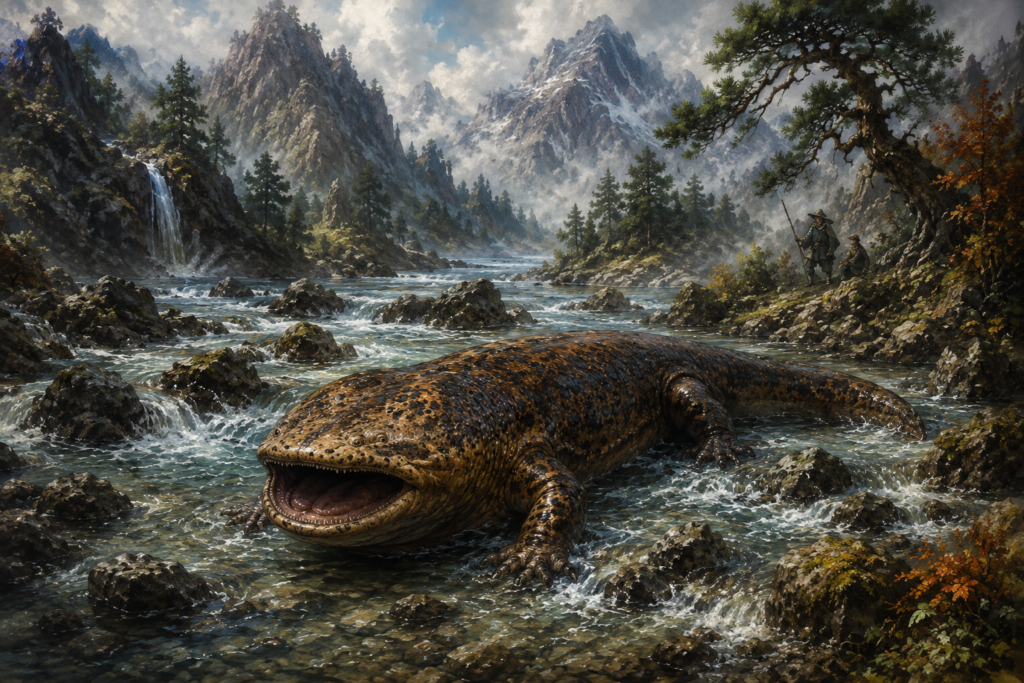
“Beneath the broken current, a vast mottled shape rises from the riverbed. Its blunt head opens into a cavernous mouth filled with hundreds of tiny teeth.”
This enormous salamander-like creature surges forward on short, thick legs. Its heavy tail is as broad as a tree trunk, while its flattened head opens into a mouth lined with row after row of small, sharp teeth.
The giant hanzaki is an ancient river salamander that has continued growing for centuries. A mature specimen can reach nearly thirty feet from its blunt snout to the end of its muscular tail and weigh as much as ten tons. Despite its extraordinary length, it remains a Huge creature rather than a landscape-sized kaiju, occupying approximately fifteen feet of battlefield space when it coils, lunges and turns.
These old river beasts inhabit the coldest and clearest mountain streams. Although they seldom pursue surface-dwellers far beyond the water, fishermen, swimmers and travellers crossing their territories sometimes disappear into their enormous mouths. Communities that poison, dam or foul a hanzaki’s river may provoke a far more deliberate response.
The giant hanzaki belongs among the creatures of the SpiralWorlds Asian Mythology Bestiary, alongside the animals, spirits and monsters associated with the rivers and mountains of Japan.
Appearance
A giant hanzaki resembles an immensely enlarged Japanese giant salamander. Its body is broad, elongated and carried close to the ground on four short but immensely powerful legs. Its heavy tail is laterally compressed for swimming and almost as thick as its torso near the base.
The creature’s moist, folded skin is mottled in irregular patterns of brown, black, ochre and river-stone grey. This natural camouflage makes a resting hanzaki difficult to distinguish from submerged logs, shadowed boulders and shelves of dark rock. Loose folds along its flanks increase the surface area through which it absorbs oxygen from the water.
Its head is broad and flattened, with tiny eyes positioned near the front of the skull. The jaws open across almost the entire width of the head and are lined with hundreds of small, pointed teeth. These teeth grip slippery prey while the hanzaki’s powerful jaws prevent escape, allowing the animal to swallow victims whole.
When frightened, injured or enraged, a giant hanzaki secretes a sticky, milky fluid with a sharp, pungent smell. The secretion clings to exposed skin, clothing and equipment long after the animal has retreated.
Behaviour
Giant hanzaki are solitary, patient and strongly territorial. They spend much of their lives beneath riverbank overhangs, inside flooded caverns or among great boulders where the current conceals their outlines. A hanzaki may remain motionless for hours before exploding into action when prey comes within reach.
Although their eyesight is poor, giant hanzaki possess an acute sense of smell and can detect minute vibrations passing through water. A careless footstep on a submerged stone, the struggling of a hooked fish or the movement of a swimmer may reveal prey that the hanzaki cannot clearly see.
Giant hanzaki are unusually vocal for salamanders. Their calls include deep barks that echo between river cliffs, wet grunts, throaty warnings, long mournful whines and an eerie cry resembling that of a human infant.
These cries have inspired stories of abandoned children, drowned spirits and shapechanging monsters haunting isolated valleys. A hanzaki may call repeatedly from beneath the water, drawing concerned travellers dangerously close to its resting place.
Most encounters with surface-dwellers occur because the hanzaki mistakes someone for prey, defends a nesting cavern or reacts to the degradation of its river. It does not possess human intelligence, but it can associate repeated pain, disturbance or pollution with a nearby settlement.
Habitat and Ecology
Giant hanzaki inhabit cold rivers, fast mountain streams, deep highland pools and water-filled caverns. They require clean, oxygen-rich water and usually avoid stagnant lakes, warm lowland rivers and heavily populated waterways.
A suitable territory normally contains a gravel or stone riverbed, deep pools connected by swift currents, submerged ledges, riverbank cavities and abundant aquatic prey. Flooded caverns provide shelter from winter weather and safe nesting sites during the breeding season.
A giant hanzaki eats fish, crustaceans, turtles, waterfowl, river mammals and almost any other animal it can overpower. Particularly old specimens may take deer, horses, cattle and humanoids crossing their rivers.
During the breeding season, a dominant male occupies a submerged nesting chamber and guards the eggs and newly hatched young. A normally reclusive hanzaki becomes exceptionally aggressive when strangers approach such a den.
Because hanzaki absorb oxygen and other substances through their skin, they are highly sensitive to contaminated water. Mining waste, tannery effluent, alchemical runoff, salt and magical corruption can drive one from its accustomed territory. A displaced hanzaki may move downstream into inhabited country, where its arrival is mistaken for an unprovoked attack.
Mechanics
Giant Hanzaki: D&D 5E 2024
Giant Hanzaki: Pathfinder 1E
Giant Hanzaki: Pathfinder 1E (Homebrew)
Giant Hanzaki: D&D 5E 2024
Huge Beast, Unaligned
Armor Class 16 (natural armor)
Initiative +0 (10)
Hit Points 147 (14d12 + 56)
Speed 20 ft., swim 40 ft.
| STR | DEX | CON | INT | WIS | CHA |
|---|---|---|---|---|---|
| 23 (+6) | 10 (+0) | 19 (+4) | 2 (−4) | 14 (+2) | 5 (−3) |
Saving Throws Con +7, Wis +5
Skills Perception +5, Stealth +3
Senses blindsight 30 ft. while underwater, passive Perception 15
Languages None
Challenge 6 (2,300 XP; PB +3)
Traits
Amphibious. The hanzaki can breathe air and water.
Keen Smell. The hanzaki has Advantage on Wisdom (Perception) checks that rely on smell.
Near-Sighted. The hanzaki can’t see creatures or objects more than 30 feet away. This limitation doesn’t affect its Blindsight.
Riverbed Camouflage. The hanzaki has Advantage on Dexterity (Stealth) checks while submerged in a natural river, stream or lake.
Water-Vibration Sense. The hanzaki’s Blindsight functions only while it and the creature or object it is detecting are within the same body of water.
Pungent Secretion. A creature other than a hanzaki that starts its turn within 10 feet of the hanzaki must succeed on a DC 15 Constitution saving throw or have the Poisoned condition until the start of its next turn. On a successful save, the creature is immune to this hanzaki’s Pungent Secretion for 24 hours.
Actions
Multiattack. The hanzaki makes one Bite attack and one Tail Slap attack. It can replace its Bite attack with Swallow.
Bite. Melee Attack Roll: +9, reach 10 ft. Hit: 19 (2d12 + 6) Piercing damage. If the target is a Large or smaller creature, it has the Grappled condition (escape DC 17). Until this grapple ends, the hanzaki can’t use Bite against another target.
Tail Slap. Melee Attack Roll: +9, reach 15 ft. Hit: 17 (2d10 + 6) Bludgeoning damage. If the target is Huge or smaller, it must succeed on a DC 17 Strength saving throw or have the Prone condition.
Swallow. The hanzaki swallows one Large or smaller creature it is grappling with its Bite. The grapple ends, and the swallowed creature has the Blinded and Restrained conditions. It also has Total Cover against attacks and other effects originating outside the hanzaki. The hanzaki can have only one creature swallowed at a time.
At the start of each of the hanzaki’s turns, the swallowed creature takes 17 (5d6) Acid damage. If the hanzaki takes 20 or more damage during a single turn from the creature inside it, the hanzaki must succeed on a DC 15 Constitution saving throw at the end of that turn or regurgitate the swallowed creature. The creature falls Prone in an unoccupied space within 10 feet of the hanzaki.
If the hanzaki dies, a swallowed creature can escape by using 10 feet of movement and exits Prone.
Bonus Actions
Surging Lunge (Recharge 5–6). While in water, the hanzaki moves up to half its Swim Speed without provoking Opportunity Attacks.
Giant Hanzaki: Pathfinder 1E
CR 6
XP 2,400
N Huge animal (aquatic)
Init +0; Senses limited blindsense 30 ft., low-light vision, scent; Perception +7
Aura stench (10 ft., DC 18)
Defense
AC 18, touch 8, flat-footed 18 (−2 size, +10 natural)
hp 76 (9d8+36)
Fort +10, Ref +6, Will +6
Weaknesses near-sighted
Offense
Speed 20 ft., swim 40 ft.
Melee bite +12 (2d6+7 plus grab) and tail slap +6 (2d8+3)
Space 15 ft.; Reach 10 ft. (15 ft. with tail slap)
Special Attacks swallow whole (2d6+7 bludgeoning damage, AC 15, 7 hp)
Statistics
Str 25, Dex 11, Con 18, Int 1, Wis 12, Cha 4
Base Atk +6; CMB +15 (+19 grapple); CMD 25 (29 vs. trip)
Feats Improved Bull Rush, Iron Will, Power Attack, Vital Strike, Weapon Focus (bite)
Skills Perception +7, Stealth +2, Swim +21; Racial Modifiers +4 Stealth
SQ amphibious
Ecology
Environment cold rivers and mountain streams
Organization solitary
Treasure incidental
Special Abilities
Limited Blindsense (Ex). A giant hanzaki’s blindsense functions only while it is underwater.
Near-Sighted (Ex). Creatures more than 30 feet from a giant hanzaki have total concealment against it.
Stench (Ex). A giant hanzaki exudes a milky fluid with a sharp, pungent smell when threatened. A living creature that enters or begins its turn within 10 feet of the hanzaki must succeed on a DC 18 Fortitude save or become sickened for 10 rounds. A creature that succeeds on this saving throw is immune to that giant hanzaki’s stench for 24 hours. The save DC is Constitution-based.
Giant Hanzaki as an Animal Companion
The following is a legacy custom animal companion option preserved from the original Giant Hanzaki creature. Pathfinder also provides an official giant salamander animal companion with different statistics.
Starting Statistics
Size Medium;
Speed 20 ft., swim 40 ft.;
AC +5 natural armor;
Attack bite (1d6), tail slap (1d8);
Ability Scores Str 9, Dex 15, Con 10, Int 1, Wis 12, Cha 4;
Special Qualities amphibious.
7th-Level Advancement
Size Large;
AC natural armor increases by +3;
Attack bite (1d8), tail slap (2d6);
Ability Scores Str +8, Dex −2, Con +4;
Special Qualities grab, stench.
A character seeking such a companion must normally locate an egg or young hanzaki and earn the approval of anyone who controls or protects its river. The animal requires abundant clean water and can’t be maintained responsibly in an ordinary stable or urban residence. Characters associated with the Druid class are the most likely to understand its needs.
Combat
A giant hanzaki is an ambush predator rather than a calculating combatant. It conceals itself beneath the current, lunges at the nearest vulnerable creature and attempts to drag its victim into deeper water.
Once it has secured prey in its jaws, it tries to swallow the creature while using its heavy tail to keep rescuers at a distance. The hanzaki rarely pursues enemies far onto dry land unless it is defending eggs, driven by starvation or maddened by injury and pollution.
The creature is most dangerous among rapids, submerged ledges and deep pools. Slippery rocks, strong currents and poor visibility should affect the encounter. Fighting a giant hanzaki on a featureless dry battlefield removes many of its natural advantages.
Giant Hanzaki: Pathfinder 1E
This enormous salamander-like creature trots forth on short, thick legs. Its tail is as thick as a tree trunk, and its mouth gapes open to reveal row after row of tiny, sharp teeth.
Source Demiurge113
Originally posted on Probing the Membrane of Science
The large river salamanders known as hanzaki continue to grow throughout their lifetime. Already the size of a male human at the stage most consider to be their adulthood, they can reach titanic proportions if left undisturbed for centuries. These giant hanzaki continue to live much as their smaller brethren do, preferring only the coldest, clearest mountain streams. Although they rarely interfere in the lives of surface-dwellers, careless fishermen on these rivers sometimes end up inside a giant hanzaki’s stomach. Hanzaki of all sizes are sensitive to pollution, and a giant hanzaki might lash out at communities dumping toxins into their rivers.
Giant hanzakis are oddly vocal for salamanders, communicating with barks, grunts, whines and a call that sounds much like the cry of a baby. When angry or threatened, they exude a milky fluid with a sharp pungent smell. They have a keen sense of smell and the ability to pick up vibrations in the water, which compensates for their very poor eyesight. A giant hanzaki is thirty feet tall and weighs 10 tons. Rumors indicate that they can grow even larger still, but few giant hanzaki live the thousand years needed to reach a truly immense size.
| Giant Hanzaki CR 6 |
| XP 2,400 N Huge animal (aquatic) Init +0; Senses limited blindsense 30 ft., Perception +7, Scent Aura stench (10 ft., DC 18) |
| DEFENSE |
| AC 18, touch 9, flat-footed 18 (-2 size, +10 natural) hp 75 (9d8+36) Fort +9, Ref +6, Will +6 Weakness near-sighted |
| OFFENSE |
| Speed 20 ft., Swim 40 ft. Melee bite +12 (2d6+7 plus grab), tail slap +6 (2d8+3) Space 15 ft.; Reach 10 ft. (15 ft. with tail slap) Special Attacks swallow whole (2d6+7 bludgeoning damage, AC 15, 7 hp) |
| STATISTICS |
| Strength 25, Dexterity 11, Constitution 18, Intelligence 1, Wisdom 12, Charisma 4 Base Atk +6; CMB +15 (+19 grapple); CMD 25 (29 vs. trip) Feats Improved Bull’s Rush, Iron Will, Power Attack, Vital Strike, Weapon Focus (bite) Skills Perception +7, Stealth +2, Swim +21; Racial Modifiers +4 Stealth SQ amphibious |
| ECOLOGY |
| Environment cold rivers Organization solitary Treasure incidental |
| SPECIAL ABILITIES |
| Limited Blindsense (Ex) A giant hanzaki’s blindsense only functions underwater Near-Sighted (Ex) All creatures more than 30 feet away from a giant hanzaki are treated as having total concealment against it. |
Giant Hanzaki as Animal Companions
Starting Statistics: Size Medium; Speed 20 ft, Swim 40 ft.; AC +5 natural armor; Attack bite (1d6), tail slap (1d8); Ability Scores Strength 9, Dexterity 15, Constitution 10, Intelligence 1, Wisdom 12, Charisma 4; Special Qualities amphibious 7th-Level
Advancement: Size Large, AC +3 natural armor; Attack bite (1d8), tail slap (2d6); Ability Scores Strength +8, Dexterity -2, Constitution +4; Special Qualities grab, stench.
Running a Giant Hanzaki Encounter
The hanzaki normally begins hidden beneath dark water or among boulders. It waits until a creature enters Bite range, then uses Surging Lunge to close any remaining distance. It attempts to grapple and swallow an isolated target while using Tail Slap against anyone approaching to help.
A giant hanzaki defending only its territory retreats once reduced to approximately one-third of its Hit Points. A nesting parent, starving specimen or pollution-maddened hanzaki may fight until slain.
The encounter does not have to end with the creature’s death. Characters may drive it away, lure it into another channel, withdraw from its nesting territory or remove the disturbance that provoked it.
Encounter Scaling
Lower-level party: Reduce the hanzaki to 110 Hit Points and remove Pungent Secretion. Place the encounter in shallow water with several accessible areas of dry ground.
Standard encounter: Use the statistics above and include slippery stones, waist-deep water and one or two deeper channels.
Stronger party: Increase the hanzaki to 180 Hit Points and place its den beyond fast rapids or a submerged passage. A nesting hanzaki may also be accompanied by harmless young that complicate indiscriminate attacks.
Giant Hanzaki in the Campaign
During the Age of Severed Crowns, giant hanzaki survive in remote Japanese mountain rivers that remain cold, clean and largely undisturbed. Most villagers know them through inherited warnings, river customs and the occasional enormous track left beside a stream.
Local communities interpret individual hanzaki in different ways. One valley may regard its hanzaki as dangerous game, while another protects the same creature as a guardian of the watershed. A shrine may receive offerings intended to keep a hanzaki within its ancestral pool, particularly where its presence prevents loggers, miners or soldiers from entering sacred headwaters.
A giant hanzaki remains a non-sapient animal. It is not automatically a legal person, spirit or deity. Killing one may nevertheless violate a lord’s hunting rights, a village water agreement or a recognised shrine prohibition. The consequences depend upon local law and custom rather than a universal rule.
Reports of a violent hanzaki often indicate a wider problem. The monster may be the first visible sign that something upstream has poisoned the water, disturbed a sacred cavern or driven predators into unfamiliar territory.
Signs of a Giant Hanzaki
- Broad, five-toed tracks pressed into mud beside the river.
- Fish and waterfowl vanishing from a previously abundant stream.
- A pungent pepper-like smell clinging to rocks and vegetation.
- Deep scrapes where a heavy body has passed between boulders.
- Infant-like cries heard from the water after sunset.
- Livestock refusing to drink from a particular pool.
- Large clouds of disturbed silt moving against the current.
- A sudden increase in attacks after pollution or construction upstream.
Adventure Hooks
The Cry in the Gorge
Travellers hear an infant crying beneath a mountain bridge, but anyone climbing down to investigate disappears. The sound comes from a giant hanzaki nesting beneath the bridge supports.
Poisoned Waters
A village offers a reward for the death of a river monster that has begun attacking fishermen. The hanzaki became violent only after an upstream mine started dumping poisoned water into its breeding pools.
The Shrine Pool
A remote shrine has protected a giant hanzaki for generations. Treasure hunters steal its offerings and remove the stones marking the forbidden pool, after which the enraged animal begins taking livestock.
The Stolen Spawn
An alchemist purchases several enormous translucent eggs from poachers. Their parent follows the scent downstream and attacks every boat, fishery and riverside settlement along the route.
The Beast Beneath the Ford
An army intends to use a mountain ford during its advance. Local villagers know that disturbing the enormous hanzaki beneath the crossing could close the route for weeks, but they disagree over whether to warn the soldiers.
The River’s Warning
A hanzaki abandons a pool it has occupied for centuries and begins travelling downstream. Something far more dangerous has entered the river’s headwaters.
Historical and Mythic Context
Hanzaki is a traditional name for the Japanese giant salamander, Andrias japonicus. In standard modern Japanese, the animal is called ōsanshōuo, commonly translated as “giant pepper fish” because of the pungent defensive secretion released when the animal is threatened.
The name hanzaki has two closely related traditional explanations. The Japan Tourism Agency records that the name means “torn in half” and refers to the salamander’s regenerative ability, which supported the belief that it could survive even after being cut in two. The Hanzaki Research Institute of Japan also connects the name with the animal’s immense mouth, which makes its broad face appear split in half when opened.
The real Japanese giant salamander is a fully aquatic amphibian with small eyes, loose folded skin, widely hinged jaws and numerous small, sharp teeth. It inhabits clear, fast-flowing rivers and shelters in holes or caverns along the banks. These natural characteristics provide the foundation for the monstrous giant hanzaki rather than being replaced by unrelated supernatural powers.
A local folktale describes a hanzaki ten metres long that devours livestock and people who venture too near its river. A man named Hikoshirō volunteers to kill the monster, entering the water with a knife clenched between his teeth. The hanzaki swallows him whole, but Hikoshirō cuts his way free from inside its body.
After the monster’s death, strange noises haunt Hikoshirō’s home, and he and his family die mysteriously. The villagers build a shrine to pacify the vengeful creature and honour it as Hanzaki Daimyōjin. The annual Hanzaki Festival in Yubara preserves this tradition with salamander floats, dancing, music and fireworks.
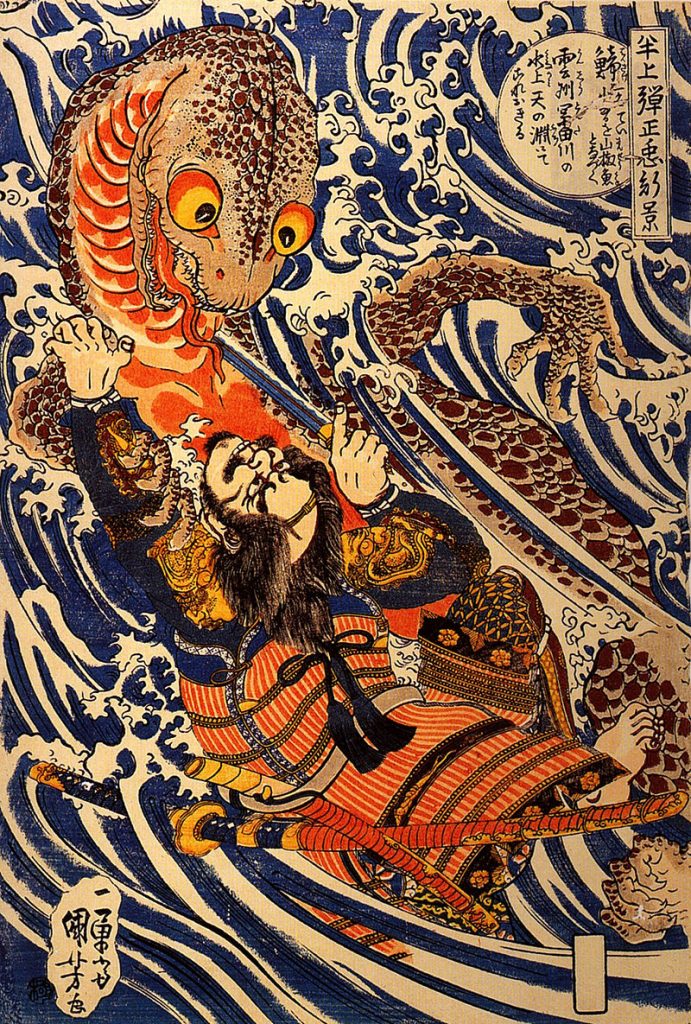
Utagawa Kuniyoshi depicts the warrior Arakage killing a giant salamander at Ama-no-fuchi, at the headwaters of the Tondagawa River in Izumo. The British Museum collection record identifies the work as a mid-nineteenth-century Edo-period colour woodblock print.
A public-domain reproduction of Kuniyoshi’s print is available through Wikimedia Commons. The print postdates the 1454 campaign present of SpiralWorlds and serves as real-world artistic context rather than an in-world historical object.
Related Creatures
- Asian Mythology Monsters — the wider SpiralWorlds collection of creatures from Asian folklore and mythology.
Sources and Attribution
- Original Pathfinder creature design by demiurge1138, preserved in The Creature Codex: Giant Hanzaki.
- Smithsonian’s National Zoo: Japanese Giant Salamander.
- Japan Tourism Agency: Encounter a Rare Species—The Japanese Giant Salamander.
- Hanzaki Research Institute of Japan.
- Maniwa Tourism Bureau: Hanzaki Giant Salamander Festival.
- British Museum: Utagawa Kuniyoshi Giant Salamander Print.
- Wikimedia Commons: Public-Domain Kuniyoshi Artwork.
- Archives of Nethys: Giant Salamander Animal Companion.
- D&D Beyond: How to Use a Monster.
Keep this reference growing
If this page helped with your reading or game, you can support its upkeep or explore the curated books.
Explore the Bookshop — epics, classics and stories behind imagined worlds.