
 Buy me a coffee
Animal · Primeval Bear
Agriotherium the Primeval Bonecrusher
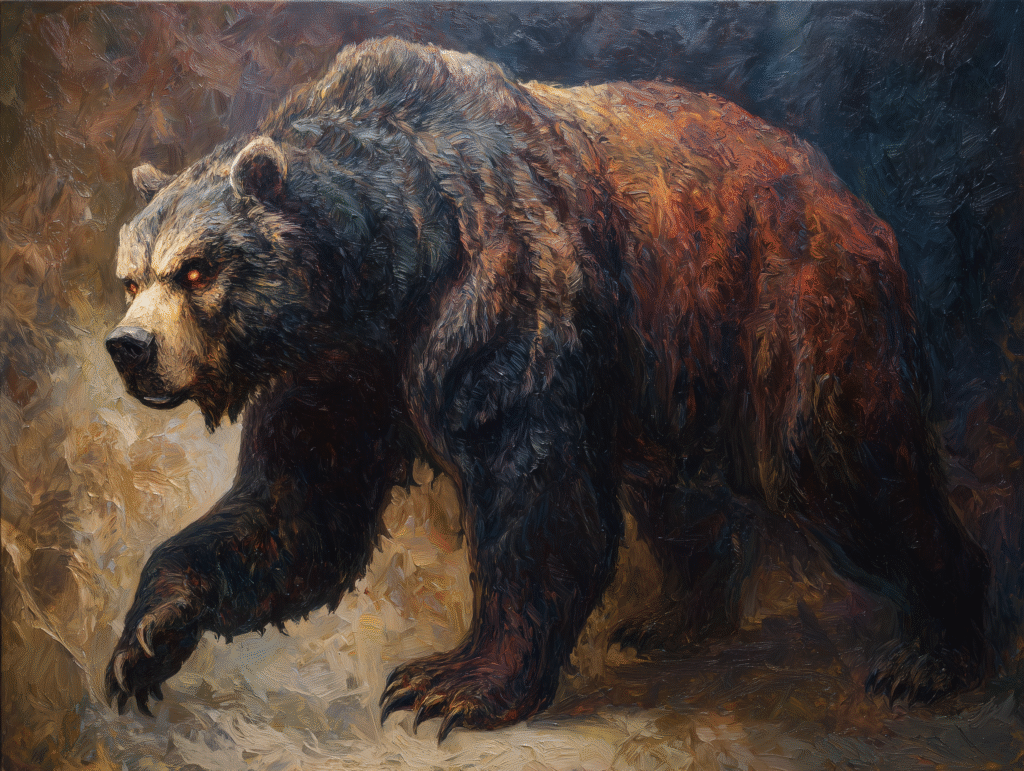
A great bear of an ancient lineage, Agriotherium follows the scent of food across open country, challenges lesser carnivores at carcasses and cracks heavy bones beneath immensely powerful jaws. It prefers intimidation and easy meals to needless injury, but an enemy caught between its forepaws can be torn apart with frightening speed.
Quick Rules Reference
Agriotherium is one creature presented for three rules systems. “Primeval Bonecrusher” is its name and epithet, not a separate form, subspecies, template or legendary specimen.
- Encounter role
- Fast melee grappler
- Preferred target
- An isolated creature at the edge of the group
- Signature sequence
- Claw, seize, rend and bite
- Temperament
- Wary, food-driven and dangerous when pressed
- Habitat
- Grassland, scrub, open woodland and river valleys
- Treasure
- None carried; valuable hunting trophies
- D&D 2024
- Large Beast · CR 9
- Pathfinder / 3.5e
- Large Animal · CR 10 / CR 9
Agriotherium in the Wild
Appearance
Agriotherium is an immense bear with a broad chest, powerful shoulders, strong limbs and a short, deep muzzle. Its heavy skull supports jaws capable of inflicting devastating wounds and breaking substantial bones.
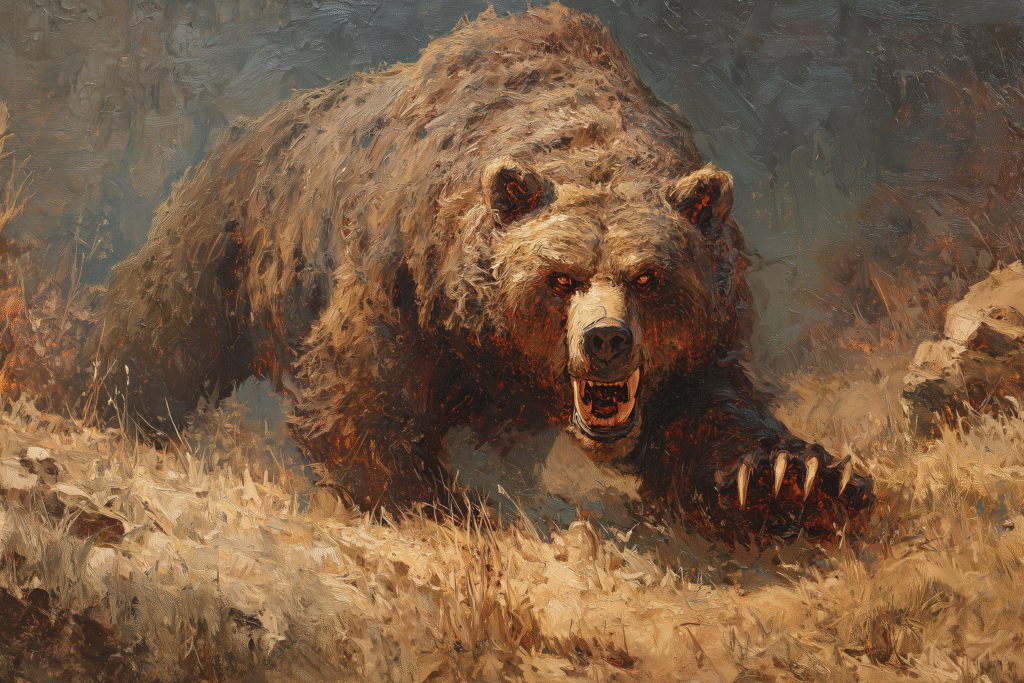
Hunters recognise the Primeval Bonecrusher by its broad head, rolling shoulders, long powerful stride and the extraordinary damage its jaws can inflict on heavy bone. Old animals often bear extensive scars around the muzzle and shoulders from contests over food and territory.
Behaviour
Most Agriotherium are solitary outside mating and the rearing of young. They range widely between feeding areas, water sources and seasonal concentrations of prey.
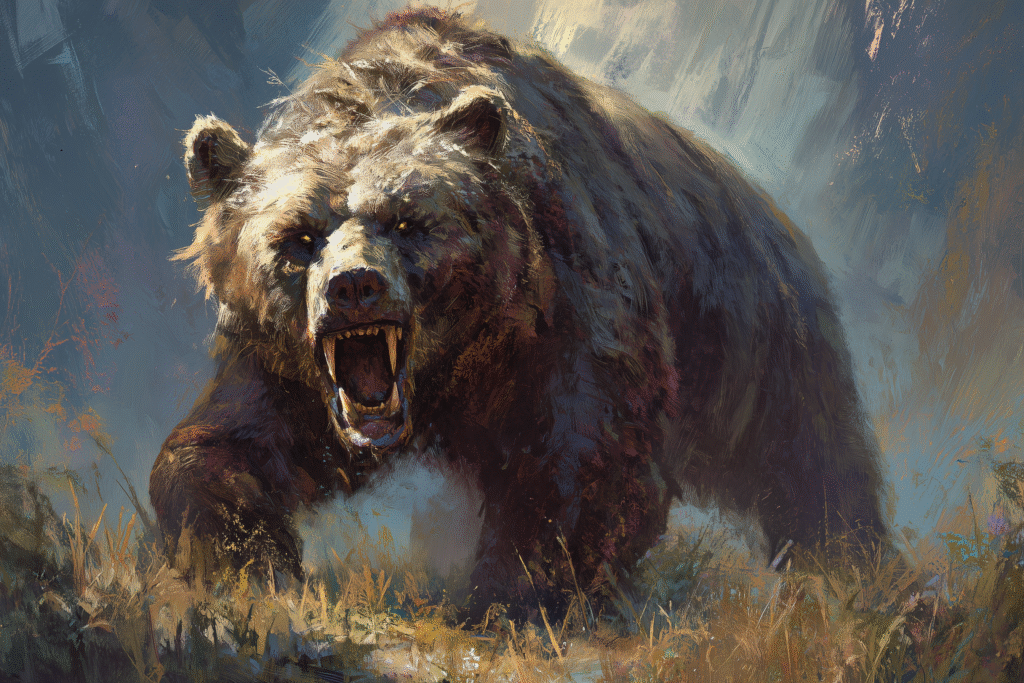
They generally prefer to settle disputes without suffering injury. Roaring, jaw-clacking, pawing, bluff charges and sheer physical presence are often enough to make smaller competitors surrender food.
Diet
Agriotherium is an opportunistic omnivore with a strong appetite for meat. It feeds on roots, fruit, insects, eggs and smaller animals, while its great size also allows it to take substantial prey and seize carcasses from lesser predators.
The Primeval Bonecrusher rarely wastes strength on a difficult kill when an easier meal is available. Wolves, great cats and other carnivores may abandon a carcass at its approach, leaving Agriotherium to tear apart the remains and crack the heaviest bones for marrow.
Habitat
Agriotherium ranges across grasslands, scrub country, open woodland and broad river valleys. It favours country where it can travel considerable distances between water, feeding grounds and seasonal sources of food.
Populations occur across suitable regions of Africa, Eurasia and North America. The animal is uncommon across much of its range, but it is not restricted to hidden valleys, isolated refuges or Lost World regions.
Game Statistics
Each rules panel is calculated independently. Edition terminology, action economy and monster mathematics are kept separate. If JavaScript is unavailable or delayed, all three panels remain visible.
Agriotherium
Large Beast, Unaligned
AC 16
Initiative +2 (12)
HP 168 (16d10 + 80)
Speed 50 ft.
| Ability | Score | Mod | Save | Ability | Score | Mod | Save |
|---|---|---|---|---|---|---|---|
| STR | 23 | +6 | +10 | DEX | 14 | +2 | +2 |
| CON | 20 | +5 | +9 | INT | 2 | −4 | −4 |
| WIS | 15 | +2 | +6 | CHA | 8 | −1 | −1 |
Skills Perception +6, Survival +6
Senses Passive Perception 16
Languages None
CR 9 (XP 5,000; PB +4)
Traits
Keen Smell. Agriotherium has Advantage on Wisdom (Perception) checks that rely on smell.
Relentless (1/Day). If damage reduces Agriotherium to 0 Hit Points, it drops to 1 Hit Point instead.
Rending Claws. Once on each of its turns, when Agriotherium hits the same creature with both Claw attacks, that creature takes an extra 10 (3d6) Slashing damage.
Actions
Multiattack. Agriotherium makes two Claw attacks and one Bone-Crushing Bite attack.
Claw. Melee Attack Roll: +10, reach 5 ft. Hit: 13 (2d6 + 6) Slashing damage. If the target is a Large or smaller creature, the target has the Grappled condition (escape DC 18). Agriotherium can grapple only one creature in this way at a time.
Bone-Crushing Bite. Melee Attack Roll: +10, reach 5 ft. Hit: 17 (2d10 + 6) Piercing damage, plus 7 (2d6) Bludgeoning damage if the target is Grappled by Agriotherium.
Tactics
Agriotherium closes rapidly and tries to seize an exposed creature with its first Claw. It then concentrates its remaining attacks on the captive, combining Rending Claws with its more dangerous Bone-Crushing Bite.
Unless cornered or defending young, it attempts to retreat once badly wounded if its opponents remain organised and dangerous.
Agriotherium
CR 10 · XP 9,600 · N Large animal
Init +6; Senses low-light vision, scent; Perception +20
Defense
AC 22, touch 11, flat-footed 20 (−1 size, +2 Dex, +11 natural)
hp 157 (15d8 + 90)
Fort +14, Ref +11, Will +9
Defensive Abilities ferocity
Offense
Speed 50 ft.
Melee 2 claws +20 (1d10 + 10 plus grab), bite +18 (1d12 + 5)
Space 10 ft.; Reach 5 ft.
Special Attacks gnaw, grab, rend (2 claws, 2d10 + 15)
Statistics
Str 31, Dex 15, Con 21, Int 2, Wis 14, Cha 10
Base Atk +11; CMB +22 (+24 bull rush, +26 grapple); CMD 34 (36 vs. bull rush)
Feats Awesome Blow, Improved Bull Rush, Improved Initiative, Iron Will, Multiattack, Power Attack, Run, Toughness
Skills Perception +20
Ecology
Environment temperate or warm plains, scrublands and open woodland
Organization solitary, pair, or female with 1–2 young
Treasure none
Special Abilities
Ferocity (Ex). Agriotherium remains conscious and can continue fighting even if its hit point total is below 0. It remains staggered and continues losing hit points as normal.
Gnaw (Ex). Whenever Agriotherium succeeds at a combat maneuver check to maintain a grapple and chooses to deal damage, it deals its bite damage instead of the claw damage that established the hold.
Grab (Ex). When Agriotherium hits a Large or smaller creature with a claw, it can attempt to start a grapple as a free action without provoking an attack of opportunity. It gains a +4 bonus on combat maneuver checks made to start and maintain that grapple.
Rend (Ex). If Agriotherium hits one creature with both claw attacks in the same round, it deals an additional 2d10 + 15 points of damage. It can deal rend damage no more than once per round.
Before Combat
Agriotherium approaches from downwind where possible and tests a group before committing itself. It is much more willing to challenge smaller carnivores at a carcass than an alert armed formation.
During Combat
It charges an exposed opponent and uses grab to establish a grapple before concentrating its claws, rend and gnaw against that target. Awesome Blow is useful against an enemy blocking food, young or its escape route.
Morale
It attempts to retreat when severely wounded unless cornered or defending its young.
Agriotherium
Large Animal
| Hit Dice | 15d8 + 75 (142 hp) |
|---|---|
| Initiative | +2 |
| Speed | 50 ft. (10 squares) |
| Armor Class | 18 (−1 size, +2 Dex, +7 natural), touch 11, flat-footed 16 |
| Base Attack/Grapple | +11/+25 |
| Attack | Claw +20 melee (1d10 + 10) |
| Full Attack | 2 claws +20 melee (1d10 + 10) and bite +18 melee (1d12 + 5) |
| Space/Reach | 10 ft./5 ft. |
| Special Attacks | Ferocity, gnaw, improved grab, rend 2d10 + 15 |
| Special Qualities | Dire, low-light vision, scent |
| Saves | Fort +14, Ref +11, Will +10 |
| Abilities | Str 31, Dex 15, Con 21, Int 2, Wis 12, Cha 10 |
| Skills | Listen +14, Spot +14 |
| Feats | Alertness, Awesome Blow, Improved Bull Rush, Multiattack, Power Attack, Run |
| Environment | Warm plains |
| Organization | Solitary, pair, or female with 1–2 young |
| Challenge Rating | 9 |
| Treasure | None |
| Alignment | Always neutral |
| Advancement | 16–24 HD (Large); 25–30 HD (Huge) |
| Level Adjustment | — |
Combat
Agriotherium uses its speed to reach an exposed opponent, strikes with both forepaws and then closes its jaws on anything caught between them. Its unusual tenacity makes it dangerous even after it has suffered severe wounds.
Dire (Ex). Agriotherium is treated as a dire animal for the purpose of determining its saving throws. Fortitude, Reflex and Will are good saves for its racial Hit Dice.
Ferocity (Ex). Agriotherium continues to fight without penalty while disabled or dying.
Gnaw (Ex). If Agriotherium hits the same opponent with both claw attacks, it can immediately make one bite attack against that opponent as a free action. During a grapple, a successful grapple check made to damage its opponent deals its bite damage.
Improved Grab (Ex). To use this ability, Agriotherium must hit a Medium or smaller opponent with a claw attack. It can then attempt to start a grapple as a free action without provoking an attack of opportunity.
Rend (Ex). If Agriotherium hits one opponent with both claw attacks, it tears into the target for an additional 2d10 + 15 points of damage.
Skills. Agriotherium has a +2 racial bonus on Listen and Spot checks.
Tactics
Agriotherium attempts to lock a dangerous opponent into a grapple and tear it apart with claws, rend and gnaw. It retreats from a costly fight unless defending young or unable to escape.
Modus Operandi
Agriotherium often encounters travellers while following the scent of carrion, investigating pack animals or returning to a feeding site. When it believes itself dominant, it approaches openly rather than wasting energy on elaborate stalking.
If violence begins, the animal rushes the weakest edge of a formation and tries to pin a single opponent beneath its forepaws. Once it has a secure hold, its bite becomes far more dangerous.
An Agriotherium defending cubs is unusually difficult to deter. One interested only in food is much more likely to retreat when resistance becomes costly.
- Very large bear-like tracks crossing open ground.
- Heavy limb bones split or crushed after feeding.
- Carcasses moved away from their original killing site.
- Coarse hair caught on bark, thorns or rough stone.
- Deep warning roars before the animal closes to attack.
Motivation and Reactions
| Situation | Likely response | What may end the encounter |
|---|---|---|
| Claiming a carcass | Approaches openly, threatens competitors and attacks whichever creature refuses to yield. | Abandoning the carcass, distracting it with another food source or seriously injuring it. |
| Defending young | Charges quickly and attempts to drive intruders away from the cubs. | Retreating well beyond the immediate denning area. |
| Investigating food | Follows pack animals, butchered meat or wounded travellers without necessarily attacking immediately. | Removing the food, surrendering it or proving that the group is too dangerous. |
| Cornered | Fights violently against whichever enemy blocks the clearest route to safety. | Opening an escape route and ceasing pursuit. |
Feeding Sites, Trophies and Treasure
Agriotherium carries no deliberate treasure, but a successful hunt can yield valuable trophies, while its feeding grounds may contain weapons, jewellery and other possessions taken from previous victims.
Victims’ Property
A carcass may retain saddlebags, weapons, jewellery, letters or other belongings. Recovering them without fighting the feeding animal can become an encounter of its own.
Teeth and Claws
The great teeth and claws of an Agriotherium are prized trophies. Hunters may mount them, wear them as pendants or have them worked into ceremonial fittings, weapon ornaments and badges of status.
Skull and Hide
The skull of a mature Agriotherium is a prestigious hunting trophy. Nobles, monster hunters, frontier lords and wealthy collectors may display one above a gate, in a great hall or among the trophies of a famous hunt.
A well-preserved hide is equally impressive. Particularly large examples can command substantial prices from those who wish to advertise wealth, courage or hunting prowess.
Changing the Territory
Removing a dominant Agriotherium can allow wolves, great cats, other scavengers or another large bear to move into the feeding range it once controlled.
Encounter Hooks
The Missing Caravan
The Agriotherium feeding among a wrecked caravan did not kill the travellers. Bandits struck first, and evidence identifying them remains beneath the animal’s newly claimed meal.
Bone Orchard
A dry ravine is scattered with old shattered bones. The newest remains belong to a messenger whose sealed documents must be recovered before anyone else finds them.
The Lord’s Trophy
A powerful noble offers a rich reward for the skull and hide of an enormous old Agriotherium that has repeatedly raided hunting grounds and driven retainers from their kills. Several rival hunting parties are already pursuing it.
The Empty Hunting Ground
Wolves and great cats have abandoned an unusually productive valley. A scarred old Agriotherium has learned to associate travellers and pack animals with easy meals.
Rumours and Field Reports
| Report | Assessment |
|---|---|
| “The Bonecrusher hunts everything it sees and eats nothing but flesh.” | False. Agriotherium eats a broad range of foods and usually avoids unnecessary risk. |
| “It will follow a wounded animal until something else kills it.” | Plausible. It is patient enough to wait for an easier meal rather than commit to a difficult chase. |
| “Once it tastes blood, it cannot be frightened away.” | False. Agriotherium is tenacious, not suicidal. |
| “You know one is near when you find the bones broken open.” | Often true, although other large scavengers can leave similar evidence. |
Range and Natural History
A Widespread Great Bear
Agriotherium has inhabited Africa, Eurasia and North America for millions of years. Its present distribution is uneven, with populations strongest where broad territories, dependable water and varied sources of food remain available.
The animal is uncommon rather than mysterious. Shepherds, hunters, caravan masters and rural communities within its range recognise its tracks, feeding sites and warning calls and treat a large individual with the same caution given to any other powerful predator.
Particularly large animals may dominate a feeding range for years. Such individuals often acquire local names and reputations, especially after taking livestock, driving hunters from kills or surviving repeated attempts to destroy them.
Palaeontological Record
Fossil remains demonstrate that Agriotherium has an exceptionally ancient history. Specimens have been found across Africa, Eurasia and North America and show that members of the genus were already widespread during the late Miocene and Pliocene.
The skull is short and robust, with jaws capable of generating great force. The cheek teeth and their wear indicate that plant material formed an important part of the diet, supporting the picture of a powerful omnivore rather than a specialised pursuit predator.
The old bones also demonstrate variation between species and populations. Agriotherium should therefore be understood as a successful, adaptable lineage rather than a single uniform giant animal unchanged across every region and age.
Selected Research
- Boris Sorkin, “Ecomorphology of the Giant Short-Faced Bears Agriotherium and Arctodus,” Historical Biology 18(1).
- Shintaro Ogino, Naoko Egi and colleagues, “New Species of Agriotherium (Mammalia, Carnivora) from the Late Miocene to Early Pliocene of Central Myanmar,” Journal of Asian Earth Sciences.
- Joshua X. Samuels, Julie A. Meachen-Samuels and Philip A. Gensler, “The First Mid-Blancan Occurrence of Agriotherium (Ursidae) in North America,” Journal of Paleontology 83(4).
Publication History
Agriotherium appeared under the name savannah bear in David Howery’s “Back to the Age of Mammals,” published in Dragon Magazine #167 in March 1991, beginning on page 15.
The article presented a collection of Cenozoic mammals for fantasy roleplaying, including Agriotherium, Amphicyon, Anancus and Andrewsarchus.
A later D&D 3.5e fan conversion was attributed to Shade of the EN World forums. The 3.5e statistics on this page retain the encounter identity of that conversion while applying corrected rules calculations.
The D&D 2024 and Pathfinder 1e statistics are independent SpiralWorlds adaptations of Agriotherium. All three rules panels describe the same creature.