
Megalania
A giant monitor lizard that waits in cover, opens prey with serrated teeth, and lets blood loss and venom turn flight into a losing race.
It does not need to overpower prey immediately. It only needs the first good bite.
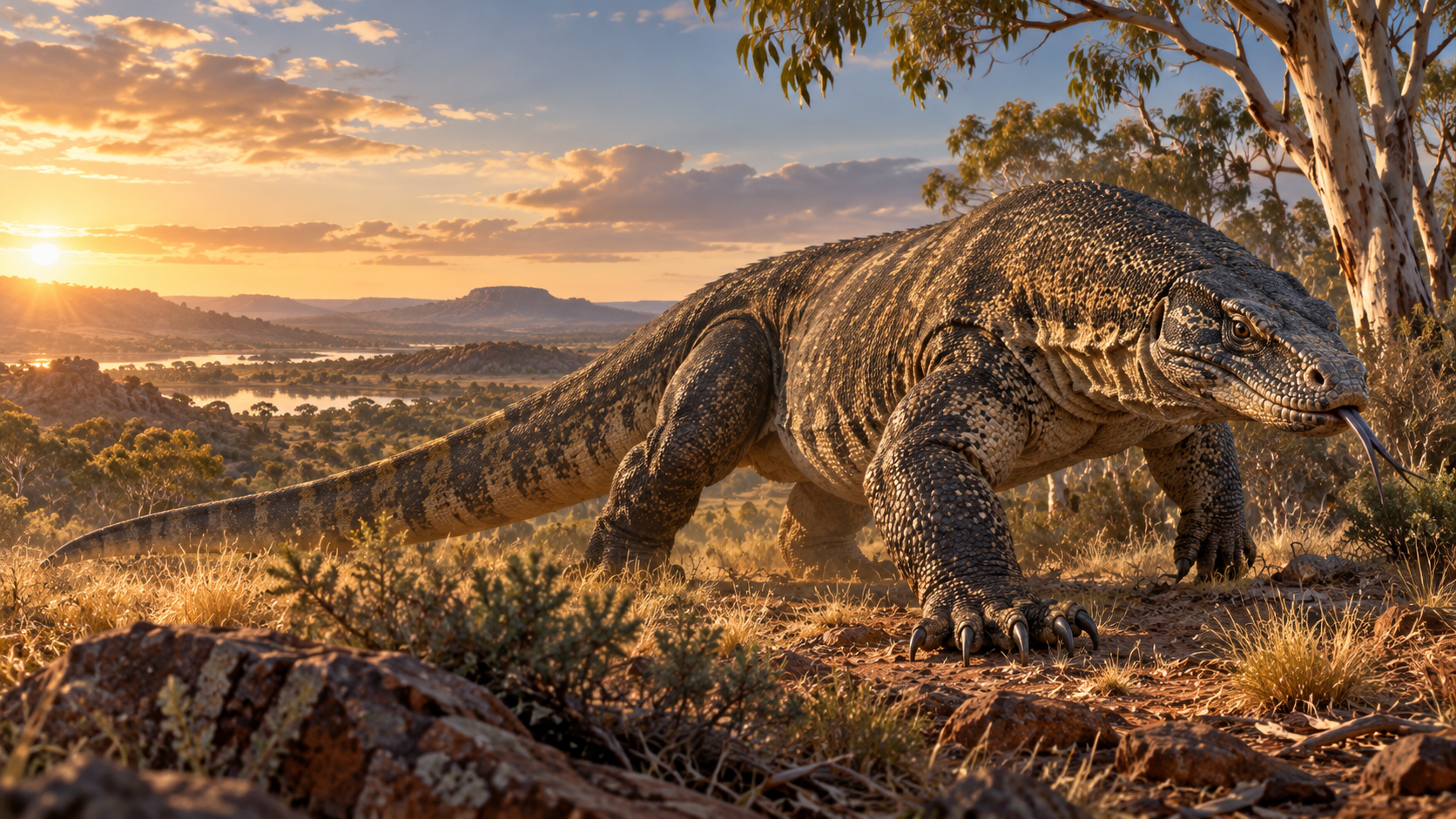
Megalania, Varanus priscus, was the largest terrestrial lizard known. Fossils are incomplete, but current Australian Museum estimates place it around 3.5–5 metres long. It ranged through Pleistocene eastern Australia in open forest, woodland and perhaps grassland, where it shared the landscape with giant marsupials and other megafauna.
Its teeth were sharp, recurved and serrated. Like other monitor lizards, it was probably both predator and scavenger. A 2009 study of monitor-lizard venom systems argued that Megalania belonged to the same venom-assisted predatory lineage as the Komodo dragon, making a slashing bite more dangerous than simple jaw strength alone suggests.
Living Megalania still survive in remote, little-mapped parts of Australia and Oceania, especially where broken woodland, dry interior country and difficult approaches keep outside travellers rare. Local peoples may know the animals and their ranges even where foreign maps do not. Additional populations survive in prehistoric refuges and the deep ecosystems of Hollow Earth. They remain rare apex predators rather than common wandering monsters: any region that supports one also has to support enough large prey to feed it.
Game Statistics
Each tab uses its own edition’s structure. Pathfinder 1e uses Paizo’s published Bestiary 3 Megalania. The 5e-era and 3.5e versions are campaign conversions of the same giant monitor rather than claims of official statblocks.
Megalania — 5.5e / 2024
Huge Beast, Unaligned • CR 6
Skills Perception +5, Stealth +7, Survival +5
Senses Darkvision 60 ft.; Passive Perception 15
Languages None
CR 6 (2,300 XP; PB +3)
Traits
Keen Smell. The Megalania has Advantage on Wisdom (Perception) checks that rely on smell.
Ambush Hunter. The Megalania has Advantage on Dexterity (Stealth) checks while motionless in rocks, scrub or undergrowth.
Actions
Multiattack. The Megalania makes one Bite attack and one Claw attack.
Bite. Melee Attack Roll: +8, reach 10 ft. Hit: 16 (2d10 + 5) Piercing damage plus 7 (2d6) Poison damage. If the target is Large or smaller, it has the Grappled condition (escape DC 16). The Megalania can grapple only one creature this way at a time.
Claw. Melee Attack Roll: +8, reach 5 ft. Hit: 12 (2d6 + 5) Slashing damage.
Tail Sweep (Recharge 5–6). Dexterity Saving Throw: DC 16, each creature in a 15-foot cone. Failure: 16 (2d10 + 5) Bludgeoning damage, and the target has the Prone condition. Success: Half damage only.
Bonus Actions
Worry the Wound. One creature Grappled by the Megalania takes 10 (3d6) Slashing damage, and the Megalania can move up to half its Speed while dragging the target.
Megalania — 5e / 2014
Huge beast, unaligned
Armor Class 15 (natural armor)
Hit Points 126 (12d12 + 48)
Speed 40 ft., swim 30 ft.
Saving Throws Dex +4, Con +7, Wis +5
Skills Perception +5, Stealth +7, Survival +5
Senses darkvision 60 ft., passive Perception 15
Languages —
Challenge 6 (2,300 XP)
Traits
Keen Smell. The Megalania has advantage on Wisdom (Perception) checks that rely on smell.
Ambush Hunter. The Megalania has advantage on Dexterity (Stealth) checks while motionless in rocks, scrub or undergrowth.
Actions
Multiattack. The Megalania makes two attacks: one with its Bite and one with its Claw.
Bite. Melee Weapon Attack: +8 to hit, reach 10 ft., one target. Hit: 16 (2d10 + 5) piercing damage plus 7 (2d6) poison damage. If the target is Large or smaller, it is grappled (escape DC 16). Until this grapple ends, the target is restrained and the Megalania can’t bite another target.
Claw. Melee Weapon Attack: +8 to hit, reach 5 ft., one target. Hit: 12 (2d6 + 5) slashing damage.
Tail Sweep (Recharge 5–6). Each creature in a 15-foot cone must make a DC 16 Dexterity saving throw, taking 16 (2d10 + 5) bludgeoning damage and falling prone on a failed save, or half as much damage without falling prone on a success.
Megalania — Pathfinder 1e
CR 7 XP 3,200
N Huge animal
Init +1; Senses low-light vision, scent; Perception +10
Defense
AC 21, touch 9, flat-footed 20 (+1 Dex, +12 natural, −2 size)
hp 85 (10d8+40)
Fort +11, Ref +8, Will +7
Offense
Speed 30 ft., swim 30 ft.
Melee bite +14 (2d8+12 plus grab and poison)
Space 15 ft.; Reach 10 ft.
Special Attacks swallow whole (2d8+12 bludgeoning damage, AC 16, 8 hp)
Statistics
Str 27, Dex 13, Con 19, Int 2, Wis 14, Cha 6
Base Atk +7; CMB +17; CMD 28 (32 vs. trip)
Feats Iron Will, Lunge, Skill Focus (Perception), Skill Focus (Stealth), Weapon Focus (bite)
Skills Climb +12, Perception +10, Stealth +10 (+14 in rocks or undergrowth), Swim +16; Racial Modifiers +4 Stealth (+8 in rocks or undergrowth)
Ecology
Environment warm forests or plains
Organization solitary, pair, or pack (3–12)
Treasure none
Special Abilities
Poison (Ex). Bite; Fortitude DC 19; frequency 1/round for 6 rounds; effect 1d4 Dexterity damage; cure 2 consecutive saves.
Megalania — D&D 3.5e
| Size/Type | Huge Animal |
|---|---|
| Hit Dice | 12d8+84 (138 hp) |
| Initiative | +0 |
| Speed | 40 ft. (8 squares), swim 30 ft. |
| Armor Class | 16 (−2 size, +8 natural), touch 8, flat-footed 16 |
| Base Attack/Grapple | +9/+28 |
| Attack | Bite +18 melee (3d6+11/18–20×3 plus venom) |
| Full Attack | Bite +18 melee (3d6+11/18–20×3 plus venom) or tail slap +18 melee (2d6+16) |
| Space/Reach | 15 ft./15 ft. |
| Special Attacks | Augmented critical, tail sweep, venom |
| Special Qualities | Low-light vision, scent |
| Saves | Fort +17, Ref +8, Will +5 |
| Abilities | Str 33, Dex 11, Con 25, Int 1, Wis 12, Cha 2 |
| Skills | Climb +14, Hide +5, Listen +4, Move Silently +4, Spot +4, Swim +19 |
| Feats | Alertness, Awesome Blow, Great Fortitude, Improved Bull Rush, Improved Trip, Power Attack |
| Environment | Warm plains and open woodland |
| Organization | Solitary |
| Challenge Rating | 8 |
| Treasure | None |
| Alignment | Always neutral |
| Advancement | 13–24 HD (Huge); 25–36 HD (Gargantuan) |
| Level Adjustment | — |
Special Abilities
Augmented Critical (Ex). A Megalania’s bite threatens a critical hit on an 18–20 and deals ×3 damage on a successful critical hit.
Venom (Ex). Injury, bite; Fortitude DC 23; initial and secondary damage 1d4 Dexterity. The save DC is Constitution-based.
Tail Sweep (Ex). As a standard action the Megalania sweeps a half-circle within 15 feet. Creatures at least one size category smaller take tail-slap damage and must succeed on a DC 27 Reflex save or fall prone.
Behaviour
Megalania is a solitary ambush predator and scavenger. It uses cover, stillness and scent rather than constant pursuit. A well-fed animal has little reason to attack something dangerous when carrion or easier prey is available; a hungry individual near a water source, game trail or carcass is another matter.
Like a giant monitor, it investigates the world with its forked tongue and follows chemical trails with patience. A wounded animal that escapes the first attack may discover that the lizard is still following hours later, conserving energy while venom and blood loss do the work.
Its territory is defined more by food and shelter than by theatrical displays. It may repeatedly use the same shaded overhang, fallen trees, scrub-choked gullies or rocky basking sites, but it does not need a treasure-filled fantasy lair.
If Violence Starts
It wants the first bite. The ideal attack comes from cover against a target that has not recognised the lizard as a threat.
It isolates wounded prey. Once one creature is bleeding, poisoned or grappled, the Megalania focuses on that target rather than spreading damage evenly across a group.
It drags rather than duels. If it can pull a victim behind rocks or scrub, it does. Open ground full of armed opponents is a poor hunting position.
It breaks off bad fights. Megalania is an animal, not a fanatic. Serious injury, fire, concentrated missile fire or prey that proves too dangerous can make it withdraw and circle back later.
Habitat & Hunting Ground
Fossil evidence places Megalania across a broad range of eastern Australian environments, including open forest, woodland and perhaps grassland. Remains occur in river deposits and caves, but that does not mean the animal was principally a cave-dweller or river-bank specialist.
Good hunting ground combines concealment with traffic: game trails, scrub around water, broken woodland, rocky edges and places where large herbivores are forced through narrow approaches. The largest surviving surface populations are found in remote Australian regions that remain poorly mapped by outsiders, where huge territories, difficult access and sparse settlements allow an apex reptile to persist. In Hollow Earth, other populations occupy the same routes used by surviving Australian megafauna.
Natural History
Varanus priscus, historically called Megalania prisca, was the largest terrestrial lizard known. The Australian Museum gives an estimated length of about 3.5–5 metres. Because no complete skeleton or intact skull has been found, extreme seven-metre reconstructions should be treated cautiously rather than as the default animal.
The skull carried sharp, recurved, serrated teeth suited to opening large wounds. Small osteoderms protected parts of the snout and neck. Comparisons with living monitor lizards suggest a predator capable of taking large vertebrate prey while also scavenging when the opportunity arose.
A 2009 study of monitor-lizard predation found a sophisticated venom system in Komodo dragons and inferred a comparable venom-assisted killing apparatus for Varanus priscus. That makes the monster’s game venom a better natural-history fit than the old “infected bite” explanation once common in Komodo-dragon popular accounts.
Encounter Ideas
The Carcass
A dead Diprotodon lies beside the trail. The Megalania feeding behind it is almost invisible until the wind changes.
The Wounded Scout
A missing traveller returns with a deep slashing bite. The party has hours to realise the animal that attacked him is still following his scent.
The Waterhole
Several herbivores refuse to approach the only water for miles. Something large is hidden in the scrub where the track narrows.
The Unmapped Interior
Fresh monitor tracks cross a remote Australian route that appears empty on foreign maps. Local guides know exactly what made them—and refuse to camp near the watercourse ahead.
The False Dragon
A frightened settlement reports a ground-dragon. What they have actually found is a Megalania feeding regularly on livestock at the woodland edge.
Predator and Prey
A Megalania shadows a group of Procoptodon. Interfering saves one animal but gives the giant monitor a new target to assess.
Watch: Megalania — Australia’s Giant Lizard
This museum video is a useful companion to the entry because it works from actual fossil material and explains how palaeontologists reconstruct the size and hunting ecology of an animal known from fragmentary remains.
Megalania: Australia’s giant lizard — Australian Age of Dinosaurs Museum of Natural History.
Explore Further
Sources & Licensing
Natural history: Australian Museum material on Megalania prisca / Varanus priscus informs the size, habitat, fossil record and feeding discussion. The venom discussion follows published research on the predatory system of Komodo dragons and Varanus priscus.
5.5e / 2024 and 5e / 2014: original campaign conversions of the giant monitor for those rulesets.
Pathfinder 1e: Megalania from Pathfinder Roleplaying Game Bestiary 3, CR 7.
D&D 3.5e: revised campaign conversion descended from the older Megalania material formerly reproduced on this page, updated to use venom rather than disease.
Keep this reference growing
If this page helped with your reading or game, you can support its upkeep or explore the curated books.
Explore the Bookshop — epics, classics and stories behind imagined worlds.