
Drider — Silk-Crowned Horror of the Deep
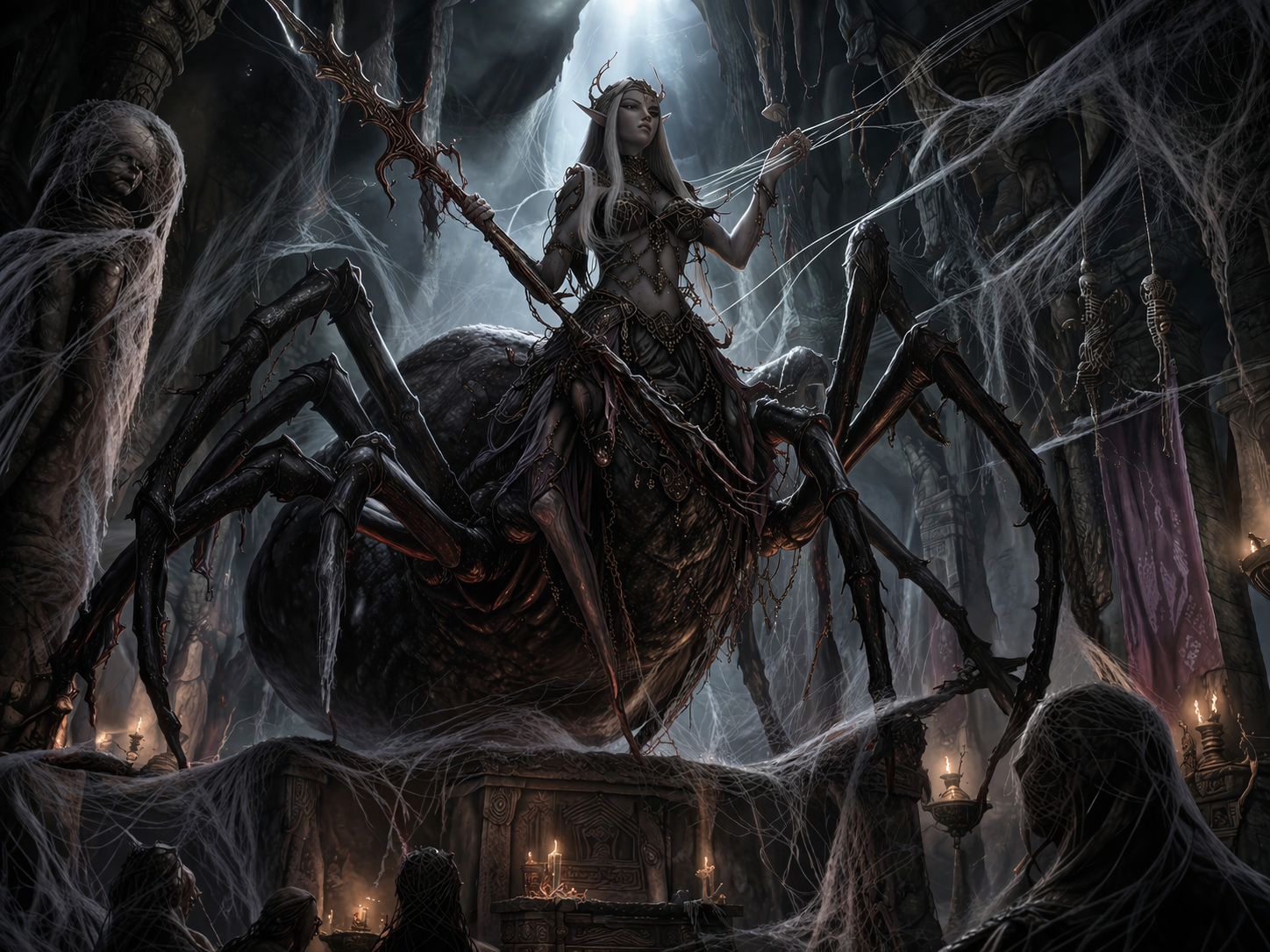
An intelligent spider-bodied hunter that turns darkness, webbing, poison and vertical terrain into a deliberate killing ground.
A drider combines the upper body and mind of an elf with the immense abdomen and eight legs of a monstrous spider. It is not a mindless hybrid. Driders speak, remember, plan, cast magic and use weapons. In the deep realms, that intelligence makes them far more dangerous than giant spiders: a drider can prepare an ambush, cut off retreat, fight from a ceiling and understand exactly why its prey is afraid.
At a Glance
Run It Tonight
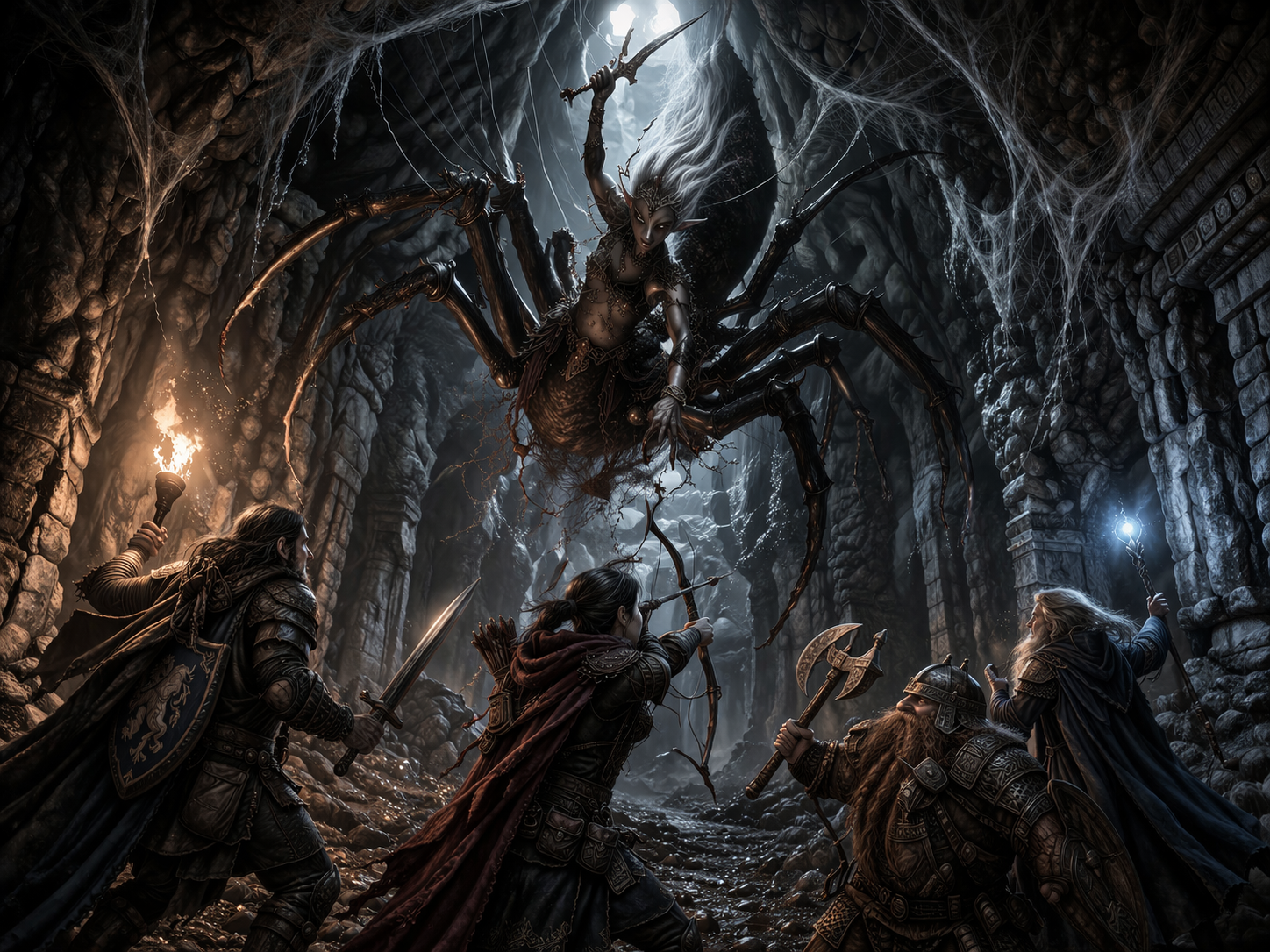
Start above the characters. A drider should have a ceiling route, a prepared web line and somewhere darkness matters. It attacks from elevation, forces the party to look in more than one direction, and only enters a straightforward melee when a target is already isolated or restrained.
Rules by Edition
Drider
Large Monstrosity, Chaotic Evil
AC 19; Initiative +4 (14)
HP 123 (13d10 + 52)
Speed 30 ft., Climb 30 ft.
16 (+3)
19 (+4)
18 (+4)
13 (+1)
16 (+3)
12 (+1)
Skills Perception +6, Stealth +10
Senses Darkvision 120 ft.; Passive Perception 16
Languages Elvish, Undercommon
CR 6 (2,300 XP); PB +3
Traits
Spider Climb. The drider can climb difficult surfaces, including ceilings, without an ability check.
Sunlight Sensitivity. While in sunlight, the drider has Disadvantage on ability checks and attack rolls.
Web Walker. The drider ignores movement restrictions caused by webs and knows the location of other creatures touching the same web.
Actions
Multiattack. The drider makes three attacks, using Foreleg or Poison Burst in any combination.
Foreleg. Melee Attack Roll: +7, reach 10 ft. Hit: 13 (2d8 + 4) Piercing damage.
Poison Burst. Ranged Attack Roll: +6, range 120 ft. Hit: 13 (3d6 + 3) Poison damage.
Bonus Action
Magic of the Spider Queen (Recharge 5–6). The drider casts darkness, faerie fire or web without Material components, using Wisdom as the spellcasting ability (spell save DC 14).
Drider
Large monstrosity, chaotic evil
Armor Class 19 (natural armor)
Hit Points 123 (13d10 + 52)
Speed 30 ft., climb 30 ft.
16 (+3)
16 (+3)
18 (+4)
13 (+1)
14 (+2)
12 (+1)
Skills Perception +5, Stealth +9
Senses darkvision 120 ft., passive Perception 15
Languages Elvish, Undercommon
Challenge 6 (2,300 XP)
Traits
Fey Ancestry. The drider has advantage on saving throws against being charmed, and magic can’t put it to sleep.
Innate Spellcasting. Wisdom is the drider’s innate spellcasting ability (spell save DC 13). It can cast dancing lights at will and darkness or faerie fire once per day each.
Spider Climb. The drider can climb difficult surfaces, including ceilings, without an ability check.
Sunlight Sensitivity. In sunlight, it has disadvantage on attack rolls and Wisdom (Perception) checks that rely on sight.
Web Walker. Webbing does not restrict the drider’s movement.
Actions
Multiattack. The drider makes three attacks with its longsword or longbow and can replace one of those attacks with Bite.
Bite. Melee Weapon Attack: +6 to hit, reach 5 ft., one creature. Hit: 2 (1d4) piercing damage plus 9 (2d8) poison damage.
Longsword. Melee Weapon Attack: +6 to hit, reach 5 ft., one target. Hit: 7 (1d8 + 3) slashing damage, or 8 (1d10 + 3) if used with two hands.
Longbow. Ranged Weapon Attack: +6 to hit, range 150/600 ft., one target. Hit: 7 (1d8 + 3) piercing damage plus 4 (1d8) poison damage.
Drider CR 7
XP 3,200
CE Large aberration
Init +2; Senses darkvision 120 ft., detect good, detect law, detect magic; Perception +15
Defense
AC 20, touch 12, flat-footed 17 (+2 Dex, +1 dodge, +8 natural, −1 size)
hp 76 (9d8+36)
Fort +7, Ref +5, Will +9
Immune sleep; SR 18
Offense
Speed 30 ft., climb 20 ft.
Melee masterwork heavy mace +9/+4 (1d8+3), bite +3 (1d4+1 plus poison)
Ranged masterwork composite longbow +8/+3 (1d8+2/×3)
Space 10 ft.; Reach 5 ft.
Special Attacks web (+7 ranged, DC 18, hp 9)
Spell-Like Abilities CL 9th
Constant—detect good, detect law, detect magic
At will—dancing lights, darkness, faerie fire
1/day—clairaudience/clairvoyance, deeper darkness, dispel magic, levitate, suggestion
Sorcerer Spells Known CL 6th
3rd—lightning bolt
2nd—invisibility, web
1st—mage armor, magic missile, ray of enfeeblement, silent image
Statistics
Str 15, Dex 15, Con 18, Int 15, Wis 16, Cha 16
Base Atk +6; CMB +9; CMD 21 (33 vs. trip)
Feats Blind-Fight, Combat Casting, Dodge, Weapon Focus (bite, mace)
Skills Climb +22, Intimidate +15, Knowledge (arcana) +14, Perception +15, Spellcraft +14, Stealth +14
Languages Common, Elven, Undercommon
SQ undersized weapons
Special Abilities
Poison (Ex). Bite—injury; Fort DC 18; frequency 1/round for 6 rounds; effect 1d2 Str; cure 1 save.
Spells. A drider casts spells as a 6th-level cleric, sorcerer or wizard, but gains no other class abilities.
Undersized Weapons (Ex). The drider is Large, but its humanoid torso uses weapons sized for a Medium creature.
Ecology
Environment any underground
Organization solitary, pair or group (3–8)
Treasure double
Drider
Large Aberration
Hit Dice 6d8+18 (45 hp)
Initiative +2
Speed 30 ft. (6 squares), climb 15 ft.
Armor Class 17 (−1 size, +2 Dex, +6 natural), touch 11, flat-footed 15
Base Attack/Grapple +4/+10
Attack dagger +5 melee (1d6+2/19–20), bite +6 melee (1d4+1 plus poison), or shortbow +5 ranged (1d8/×3)
Full Attack 2 daggers +3 melee and bite +1 melee, or shortbow +5 ranged
Space/Reach 10 ft./5 ft.
Special Attacks poison, spells, spell-like abilities
Special Qualities darkvision 60 ft., SR 17
Saves Fort +5, Ref +4, Will +8
Abilities Str 15, Dex 15, Con 16, Int 15, Wis 16, Cha 16
Skills Climb +14, Concentration +9, Hide +10, Listen +9, Move Silently +12, Spot +9
Feats Combat Casting, Two-Weapon Fighting, Weapon Focus (bite)
Environment underground
Organization solitary, pair or troupe
Challenge Rating 7
Treasure double standard
Alignment always chaotic evil
Poison (Ex)
Injury, Fortitude DC 16; initial and secondary damage 1d6 Strength.
Spell-Like Abilities
Once per day each, a drider can use dancing lights, clairaudience/clairvoyance, darkness, detect good, detect law, detect magic, dispel magic, faerie fire, levitate and suggestion. Caster level 6th.
Spells
Driders cast as 6th-level clerics, wizards or sorcerers. A typical arcane drider favours illusion, webbing, mobility and ranged damage.
Behaviour
A drider is intelligent enough to make a dungeon behave like a hunting ground. It chooses ceiling routes, places web where retreat matters, watches intruders before attacking and uses darkness to decide when the fight begins.
Individual driders vary sharply. Some are isolated predators, some retain ties to Svartalfar and Drow societies, and others become shrine guardians, executioners or independent rulers of small underworld domains.
Signs Before Initiative
- Webbing blocks the way back rather than the way forward.
- Suspended corpses are arranged deliberately instead of randomly wrapped.
- Arrows have been recovered from ledges no humanoid could reach without climbing.
- Old Elven or Undercommon writing appears beside feeding sites.
- One section of ceiling has been polished smooth by repeated passage.
- Venom-treated weapons are stored separately from ordinary prey remains.
If Violence Starts
The drider avoids fighting on a flat floor if walls, webs and ceilings are available. In 5.5e it combines ranged poison pressure with spider magic; in 2014 it mixes poisoned archery with darkness and melee; PF1e and 3.5e driders can be substantially more spell-heavy depending on their casting tradition.
It concentrates pressure on restrained or isolated creatures but retreats vertically when surrounded.
Counterplay
Control the vertical battlefield. Flight, climbing, ranged attacks and effects that remove webbing prevent the drider from deciding where every engagement occurs. Light can also matter: both fifth-edition versions suffer under direct sunlight.
Poison protection reduces the threat of bites and poisoned ranged attacks, while anti-magic or counterspelling becomes increasingly important in PF1e and 3.5e.
Transformation and Identity
Drider traditions differ by world and edition, but the recurring idea is transformation: an elf or dark elf is remade into a spider-bodied being through magic, ritual, divine judgement or deliberate alteration. That origin should affect behaviour without forcing every drider into the same personality.
A transformed outcast may obsess over revenge. A temple drider may see its form as sacred advancement. A drider that has survived for generations may care more about its own territory than the culture from which it came.
The Silken Court
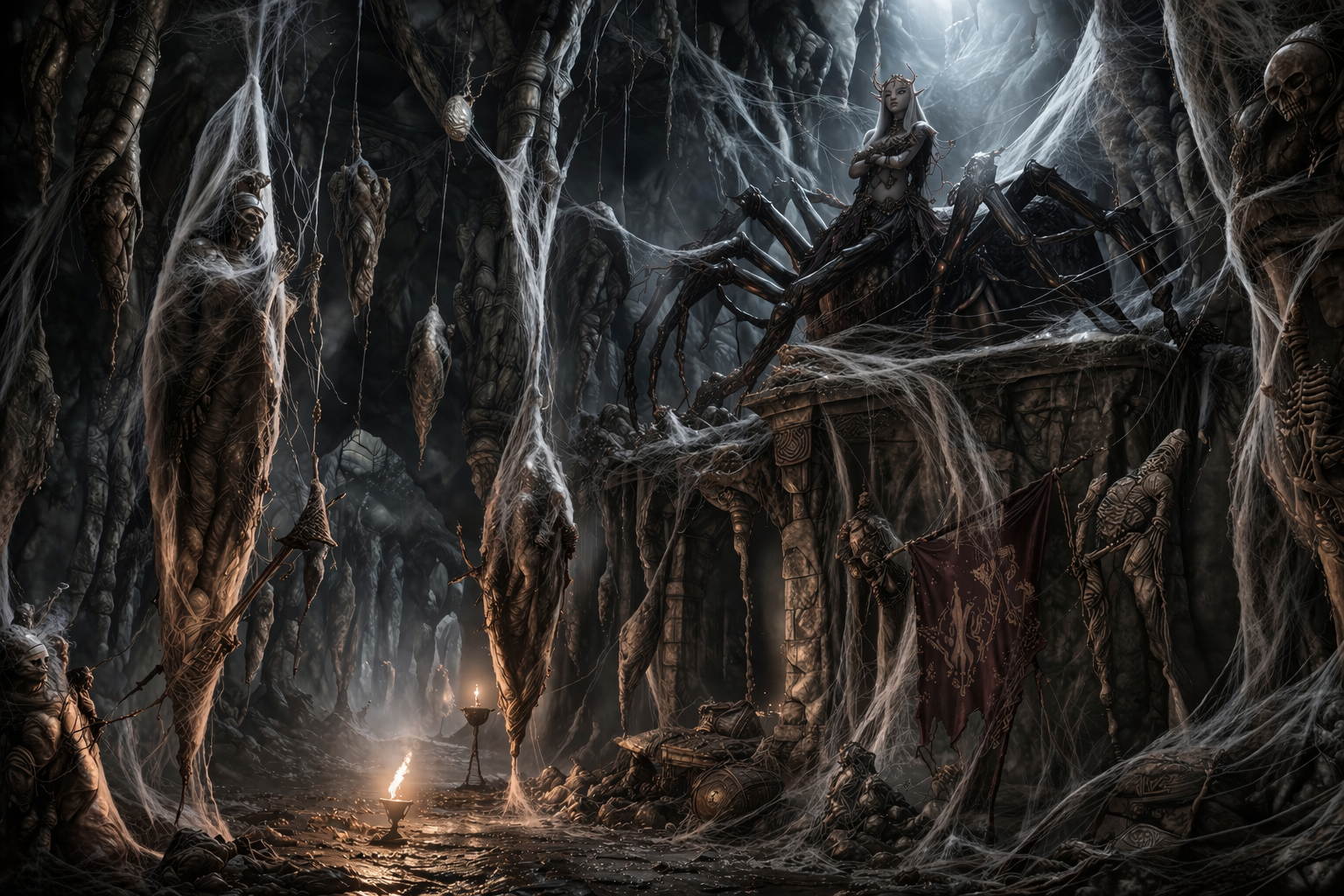
Particularly intelligent driders sometimes build more than a lair. Servants, giant spiders, captives, exiles and worshippers can gather around a silk-draped court where the drider rules from walls and ceilings as easily as from the floor.
Such a site contains more than treasure. Letters, genealogies, poison stores, ritual objects and records of old grievances may be worth more than coin because the drider remembers the politics of the deep realms.
Using a Drider in an Encounter
The blocked return. The party discovers the web wall only after travelling several chambers beyond it.
The disgraced heir. A vanished noble returns as a drider and begins killing the people responsible for their transformation.
The ceiling court. A supposedly abandoned shrine is governed by a drider that receives petitioners from a webbed gallery overhead.
The under-road toll. Caravans can pass safely through one cavern if they surrender a prisoner, a secret or a specific piece of treasure.
Related Creatures
Explore the Svartalfar and Drow, other deep-earth threats in the Aberration Bestiary, or return to the World Bestiary.
Rules Sources and Licensing
The 5.5e/2024 Drider appears in SRD 5.2.1 and the 5e/2014 Drider appears in SRD 5.1; both SRDs are available under Creative Commons Attribution 4.0 International.
The Pathfinder 1e block derives from open Pathfinder rules material. The D&D 3.5e Drider is Open Game Content from the Revised d20 System Reference Document.