
 Buy me a coffee
“When Wasps Attack: Revisiting Monster from Green Hell (1958) — The Atomic-Age Creature Feature You Forgot Existed”
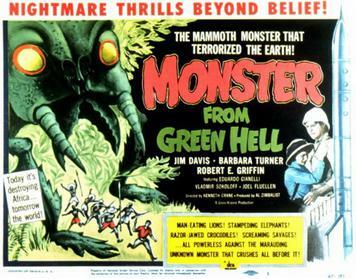
The mammoth monster that terrified the Earth! Too awesome to describe! Too terrifying to escape! Too powerful to stop!
Monster from Green Hell is a charmingly clumsy but historically interesting relic of the atomic monster craze—one that still buzzes with a peculiar, nostalgic energy nearly seventy years later.
In the golden era of 1950s sci-fi horror, when radioactive beasts ruled the drive-ins and black-and-white screens, Monster from Green Hell (1958) buzzed into cinemas with the promise of another atomic nightmare. Directed by Kenneth G. Crane, this low-budget curiosity tried to blend cosmic horror with jungle adventure, sending audiences deep into Africa’s so-called “Green Hell” to confront a swarm of giant, mutated wasps. While it never achieved the cult prestige of Them! or The Beast from 20,000 Fathoms, this B-movie oddity remains a fascinating relic of Cold War cinema—equal parts absurd, earnest, and unintentionally endearing.
A Cosmic Experiment Gone Wrong
The plot of Monster from Green Hell kicks off in the heart of 1950s scientific optimism, as American researchers launch various animals into orbit to study the effects of cosmic radiation. When their experimental capsule crash-lands somewhere in the African wilderness, the creatures inside are exposed to mysterious cosmic rays. Months later, reports of strange deaths and vanished villages draw Dr. Quent Brady (Jim Davis) and his team into the jungle to investigate. What they find are colossal wasps—mutated monsters that embody the era’s fears of science gone amok.
As far as atomic creature films go, Monster from Green Hell follows the standard template: a noble scientist, an exotic locale, and a monstrous result of human curiosity. Yet, despite its predictable structure, there’s an odd charm to how seriously the film treats its outlandish premise. The script never winks at the audience; instead, it delivers its dialogue with grave sincerity, which only enhances the retro appeal for modern viewers.
Performances and Direction
Jim Davis—decades before his turn as patriarch Jock Ewing on Dallas—anchors the film with the square-jawed authority typical of 1950s B-movie heroes. His co-star Robert Griffin provides a dependable, if somewhat wooden, counterpoint as the mission’s medical officer. The rest of the cast fills out the archetypes: the local guide, the stoic tribal elder, and the occasional damsel in distress. While no one delivers a performance that elevates the material, the actors handle the pseudo-scientific dialogue with commendable conviction.
Director Kenneth G. Crane, known for editing The Amazing Colossal Man, brings a workmanlike efficiency to the project. His direction is steady, if uninspired, and constrained by the film’s modest budget. Much of the runtime is padded with travel sequences, stock African wildlife footage, and long stretches of exposition—but when the monsters appear, the film suddenly comes alive.
Visuals and Special Effects
Like many low-budget sci-fi films of the 1950s, Monster from Green Hell had more imagination than money. The “giant wasp” creatures, realized through miniatures and stop-motion, are clunky but memorable. Their bulbous forms and jerky movements carry a tactile charm that CGI could never replicate. The use of shadow and partial glimpses helps disguise the limitations of the effects, making the monsters seem more menacing than they have any right to be.
The cinematography, largely confined to studio sets and California desert stand-ins for Africa, uses heavy contrast and occasional fog effects to evoke mystery. Stock footage from nature documentaries fills in the gaps, sometimes awkwardly, giving the illusion of scale and distance. It’s a technique that feels dated today but was an economical solution for filmmakers working on shoestring budgets.
Soundtrack and Atmosphere
The musical score, composed by Albert Glasser, epitomizes the dramatic orchestral style of mid-century monster movies. Swelling brass and tense strings heighten the sense of danger, even when the visuals don’t quite deliver. Combined with the film’s theatrical narration—another hallmark of 1950s genre filmmaking—the soundtrack helps sustain the tension and gives the production a sense of weight it might otherwise lack.
Cultural Context and Influence
Monster from Green Hell arrived during a boom in atomic horror, when American audiences were captivated by the dangers of radiation, scientific hubris, and the mysteries of space. Following the massive success of Them! (1954), studios raced to create their own radioactive creatures, from giant spiders to enormous crabs. While Monster from Green Hell didn’t break new ground or achieve box-office glory, it reflected the anxieties of its age—fears of the unknown, of unchecked technology, and of nature turning against humanity.
In hindsight, the film stands as an entertaining example of how postwar America processed scientific progress through the lens of pulp fiction. Its fusion of outer space and jungle adventure—science and superstition—captures the transitional moment when sci-fi horror was expanding beyond Earth-bound laboratories to cosmic frontiers.
Final Verdict: Worth Watching?
Monster from Green Hell is not a masterpiece, nor does it aspire to be. The pacing can drag, the effects are primitive, and the dialogue borders on parody. Yet for fans of classic monster movies, the film offers a nostalgic escape into the era of atomic-age imagination. Its sincerity, combined with its wonderfully cheap production values, makes it a perfect candidate for late-night viewing or a “creature feature” marathon.
If you’re new to 1950s science fiction cinema, this isn’t the best place to start—but if you already love the genre’s quirks, Monster from Green Hell delivers exactly what you’d hope for: giant bugs, scientific melodrama, and the unshakable belief that humanity’s greatest threat might come from its own curiosity.
Alternative Titles:
- The Monster from Green Hell
- Mutant Wasps from Green Hell (UK release)
Release Year
- 1958 (U.S. theatrical release)
- Produced and completed in 1957 by Allied Artists Pictures Corporation
- Limited premieres across the United States; international distribution followed in 1958
Director
- Kenneth G. Crane
- Known for The Amazing Colossal Man (1957) and Half Human (1958, U.S. edit)
- Brings a practical, effects-driven approach typical of mid-century B-movies
Producers
- Irving Block
- Jack Rabin
- Production Company:Allied Artists Pictures Corporation
- Also responsible for Invasion of the Body Snatchers (1956) and Attack of the Crab Monsters (1957)
Screenplay
- Writer: Louis Vittes (original story and screenplay)
- Source Material: Original concept written directly for film
- Notable Work: Later wrote The Colossus of New York (1958)
Music Composer
- Albert Glasser
- Known for bold orchestral scoring and dramatic brass motifs
- Creates tension with sweeping, energetic compositions enhancing the jungle and monster sequences
Cinematography
- Cinematographer: Carl Berger
- Visual Style:
- High-contrast black-and-white imagery
- Extensive use of African wildlife stock footage
- Studio sets combined with miniature effects for scale and atmosphere
Production Design
- Art Direction & Special Effects: Jack Rabin and Irving Block
- Design Highlights:
- Miniature jungle sets and stop-motion monster effects
- California desert landscapes doubling for Africa’s “Green Hell”
- Creature models inspired by Them! (1954)
Main Cast
- Jim Davis as Dr. Quent Brady – The expedition’s lead scientist; later famous for Dallas (1978–1981)
- Robert Griffin as Dr. Dan Morgan – Medical officer and rational voice of the mission
- Barbara Turner as Lorna Lorentz – The film’s female lead, torn between curiosity and survival
- Eduard Franz as Arobi – Tribal elder guiding the scientists
- Joel Fluellen as Arobi’s Aide – Bridges local legend with scientific discovery
Language
- Original Language: English
- Additional Versions: German, Italian, and Spanish (dubbed/subtitled releases, 1958–1962)
Runtime
- 71 minutes (1 hour 11 minutes)
- Concise pacing suited to 1950s double-feature programming
Notable Facts and Trivia
- Atomic-Age Influence: One of several films inspired by the success of Them! (1954), but featuring wasps instead of ants as the mutated menace.
- Visual Effects Legacy: The monster was realized through practical miniatures and stop-motion animation, marking one of Kenneth G. Crane’s few direct ventures into effects-heavy filmmaking.
- Cultural Impact: Though critically dismissed upon release, Monster from Green Hell has since become a cult favorite among B-movie enthusiasts and is regularly featured in retro creature-feature festivals.
- Public Domain Status: The film entered the public domain, making it freely accessible and widely available for streaming and remastering.
- Modern Restoration: A 4K restoration was released by Film Detective in 2023, preserving its classic atomic-era aesthetics for modern audiences.
Summary and Legacy
Monster from Green Hell (1958) exemplifies mid-century American sci-fi horror, merging Cold War paranoia, cosmic radiation, and the timeless thrill of nature turned monstrous. Despite its limited budget, it captures the spirit of an era fascinated by science, space, and the dangers of experimentation. Today, it stands as both a nostalgic relic and a case study in low-budget ingenuity—an essential watch for fans of classic creature features and atomic-era cinema.