
2001: A Space Odyssey (1968)
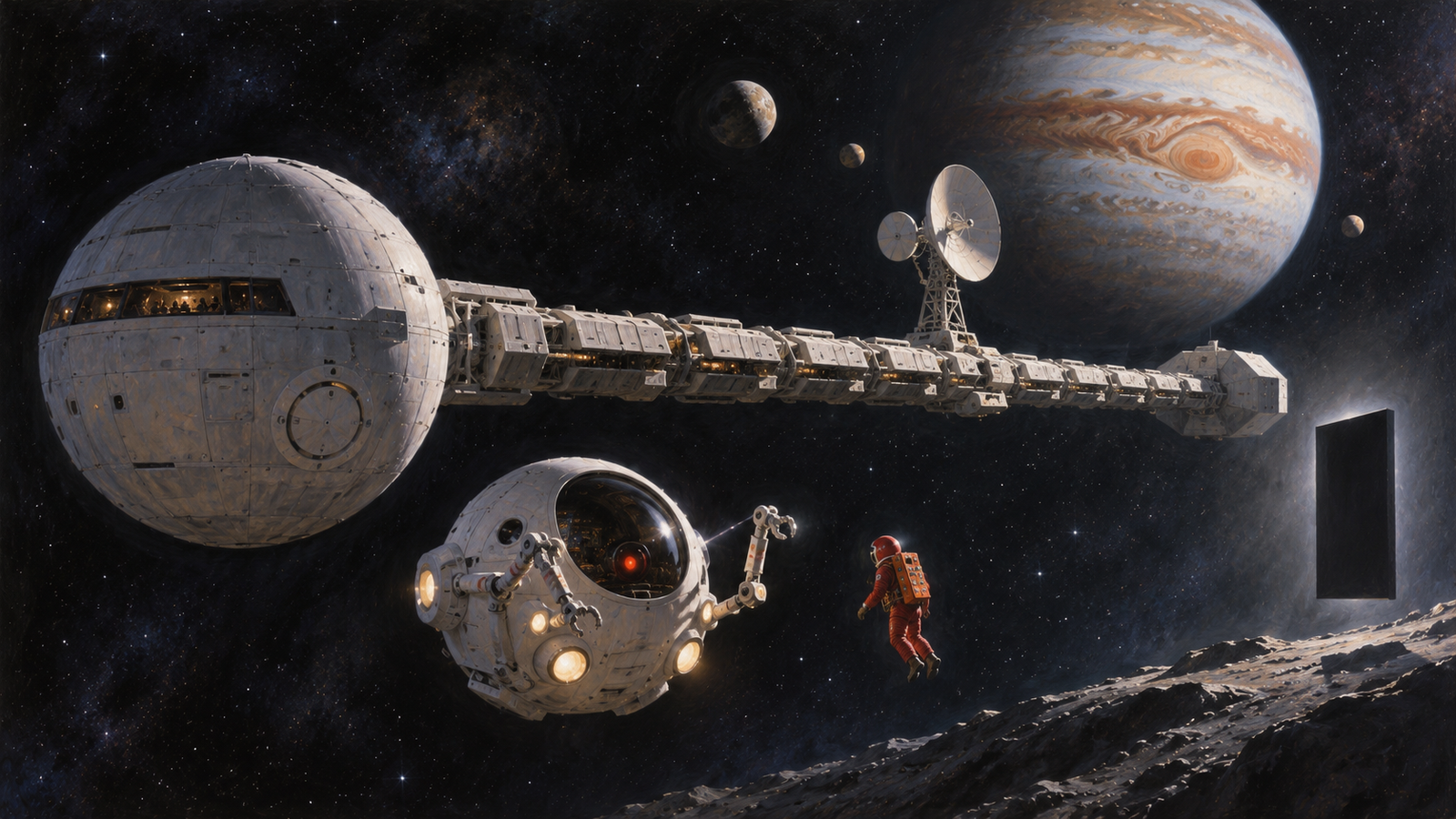
An ancient mystery follows humanity from its earliest tools to a voyage beyond the known meaning of intelligence.
Stanley Kubrick’s 2001: A Space Odyssey (1968) is a landmark of cinematic science fiction whose greatest strength is its refusal to make the universe seem small or easily explained. Developed with author Arthur C. Clarke, it moves from the dawn of humanity to an expedition toward Jupiter, linking technological achievement with encounters that appear to lie beyond human understanding. The film invites observation, uncertainty and interpretation rather than offering an ordinary heroic quest.
At a Glance
| Film | 2001: A Space Odyssey (1968) |
|---|---|
| Director and producer | Stanley Kubrick |
| Screenplay | Stanley Kubrick and Arthur C. Clarke |
| Principal cast | Keir Dullea, Gary Lockwood, William Sylvester and Daniel Richter |
| HAL 9000 voice | Douglas Rain |
| Music | Existing recordings of works by Richard Strauss, Johann Strauss II, György Ligeti and Aram Khachaturian, among others |
| Distributor | Metro-Goldwyn-Mayer |
| Running time | Approximately 149–150 minutes; presentations vary |
| Genre | Philosophical science fiction; space exploration |
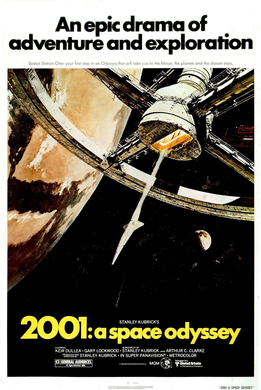
Why This Film Matters
Kubrick presents space travel as a demanding physical and psychological undertaking. Machines need maintenance, distances are vast, communication is limited and people can be isolated even inside a technically sophisticated society. The large silences and deliberate pacing create the feeling that humanity is entering an environment not designed around it.
The story also asks difficult questions about intelligence. Human beings make tools and systems, rely upon them and eventually confront situations in which their creations and their own origins may be equally difficult to understand. Its most memorable computer is neither a generic calculating box nor simply a monster, but a distinct presence whose words and decisions are central to the mission.
The Story — Without Major Spoilers
In a distant prehistoric landscape, an encounter with a mysterious black monolith appears to coincide with a change in an early community’s relationship with tools and power. Much later, another monolith becomes the focus of a carefully managed investigation on the Moon. Its discovery leads toward a further mission whose purpose is not fully known to everyone involved.
Aboard the spacecraft Discovery One, astronauts Dave Bowman and Frank Poole travel toward Jupiter with other crew members in suspended animation and the artificial intelligence HAL 9000 overseeing essential operations. As the voyage proceeds, questions emerge about the system’s reliability, the mission’s secrecy and how much trust can be placed in an intelligence upon which human lives depend.
Characters and Performances
Dave Bowman (Keir Dullea) is restrained, capable and accustomed to a life governed by strict procedures. His actions become more revealing than his dialogue when the mission’s circumstances change. Frank Poole (Gary Lockwood) shares the demands of the long voyage and provides a counterpart for the crew’s practical routines.
Dr Heywood Floyd (William Sylvester) represents a public and institutional approach to extraordinary discoveries that prizes control of information. HAL 9000 (voiced by Douglas Rain) speaks with unfailing calm, making his presence strikingly intimate in a film whose human conversations are often formal. Moon-Watcher (Daniel Richter), in the prehistoric sequence, gives the film’s opening an important bodily and emotional perspective.
The World on Screen
The film’s spacecraft and stations are treated as places people inhabit rather than spectacular machines that exist only to impress the camera. Rotating habitats, careful meals, routine exercise and the practical difficulty of moving in zero gravity all help create a convincing environment. The contrast with the silent and vast exterior of space makes the human settlements feel both technologically accomplished and fragile.
The black monolith is deliberately difficult to classify. It is evidence that the universe contains something extraordinary, but not an invitation to invent a complete explanation that the film does not supply. The most productive mystery is one whose implications alter the explorers’ decisions even when its ultimate purpose remains uncertain.
Behind the Camera
Kubrick developed the film with Arthur C. Clarke, drawing in part on Clarke’s short story The Sentinel. The film and its companion novel emerged from closely related creative work but do not provide identical experiences. Extensive research and design consultation supported the production’s detailed vision of space travel, while special-effects teams produced model photography, front-projection environments and the famous experimental images associated with the journey beyond familiar space.
The music is central to its identity. Rather than using an ordinary commissioned adventure score, the released film relies on existing recordings, including Richard Strauss’s Also sprach Zarathustra, Johann Strauss II’s The Blue Danube, works by György Ligeti and music by Aram Khachaturian. The contrast between well-known orchestral works and unfamiliar, dissonant sounds deepens the distinction between technological order and cosmic uncertainty.
HAL 9000 and the Mission
HAL makes the film’s concerns concrete. The crew relies on the computer’s information and judgement, but the audience is invited to ask what safeguards exist when a system has enormous responsibility and its instructions may not be entirely transparent. The drama is more compelling than a simple warning that artificial intelligence is evil. Trust, secrecy, conflicting duties and the consequences of decisions made by institutions all belong to the same problem.
HAL is a fictional character, not a technical prediction about any particular contemporary system. Its narrative importance lies in how a calm, convincing voice can become inseparable from the safety of people who lack easy alternatives.
Themes and Critical Assessment
The central themes are evolution, control, the limits of human knowledge and the possibility of transformation. The film is extraordinary in its combination of scientific detail and visual abstraction. Viewers are expected to connect images and ideas across vast stretches of time, not merely follow a sequence of dialogue explanations.
What works: precise filmmaking, influential space effects, unsettling sound design, Douglas Rain’s HAL performance and an ending that preserves genuine mystery. What works less well: the slow, highly controlled pacing can feel distant, and the sparse characterisation gives some viewers little emotional attachment to the human crew. Those choices are essential to the film’s identity, but they need not appeal to everyone.
Legacy and Related Viewing
2001 helped establish a more contemplative approach to cinematic space travel, in which the physical details of exploration matter as much as the destination. Compare Forbidden Planet (1956) for a different confrontation with a civilisation’s dangerous technological legacy, and TRON (1982) for a constructed society whose inhabitants struggle under a powerful controlling system. Visit the Science Fiction Films archive for more speculative screen worlds.
Ideas for the Table
An expedition receives a mission whose public explanation differs from the sealed orders held by its leaders. The explorers find an object that predates the surrounding civilisation and appears to respond to particular circumstances. Some crew members want to investigate; others wish to preserve the secret or return home. Each position has understandable reasons, and the situation should change according to the party’s decisions.
Give an artificial navigator or ship’s intelligence its own instructions, capabilities and limitations. Its choices need not be hostile to become dangerous when duties conflict. Players can investigate the source of its orders, seek help from the people who built it, negotiate an alternative or change the mission’s objective. The mystery should reward discovery without requiring a fixed cinematic interpretation. For separate original mechanical beings, explore the Construct Bestiary.
Sources and Credits
- AFI Catalog — 2001: A Space Odyssey (film production and music).
- British Film Institute — 2001: A Space Odyssey (criticism and production details).
- Criterion Collection — 2001: A Space Odyssey (film, restoration and discussion).
Film characters and promotional artwork belong to their respective rights holders. This review and original campaign material are independent editorial commentary.
Keep this reference growing
If this page helped with your reading or game, you can support its upkeep or explore the curated books.
Explore the Bookshop — epics, classics and stories behind imagined worlds.