
Necromancy
The school of life force, death, spirits, corpses, resurrection and undeath
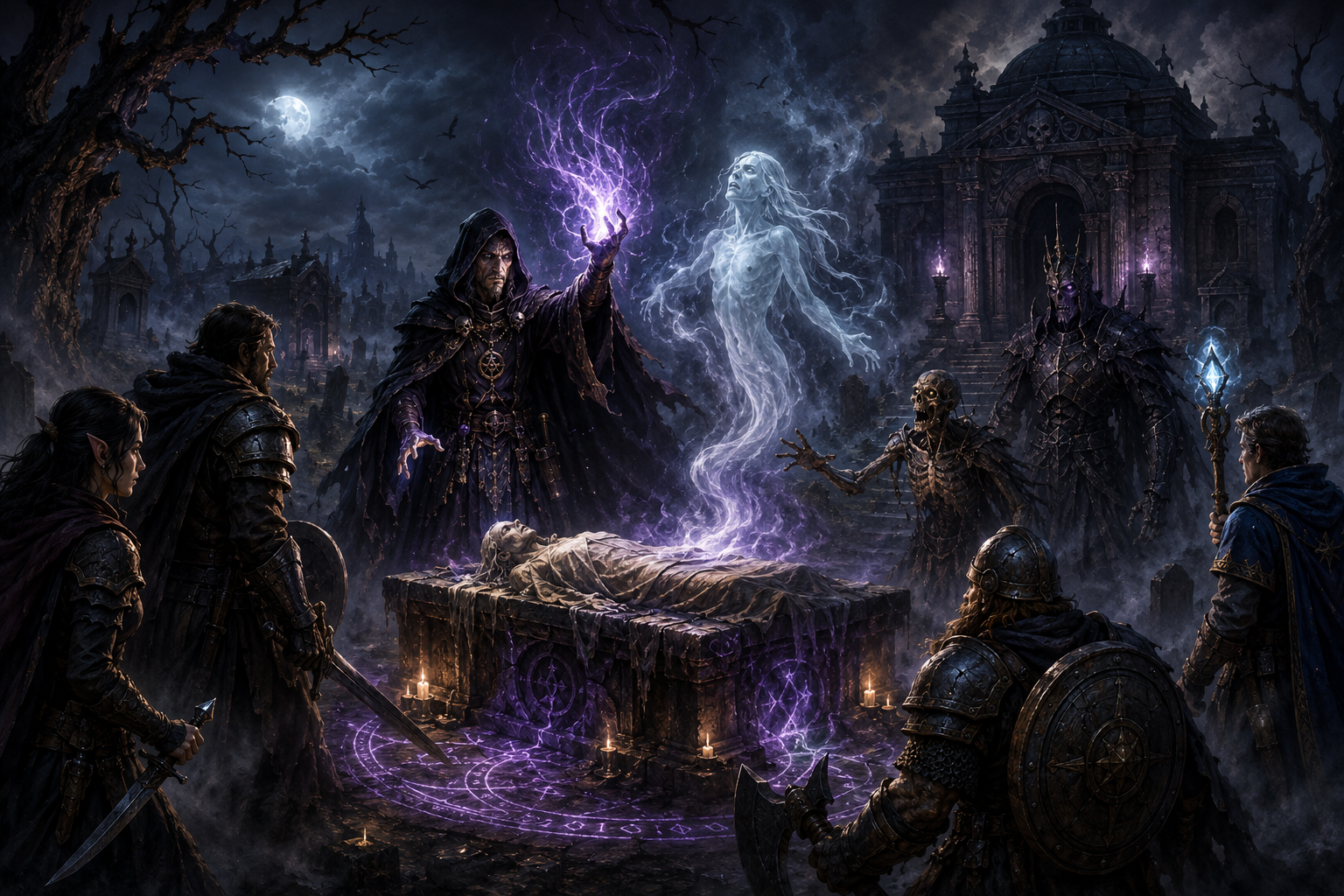
Necromancy commands the uncertain boundary between life and death. Its spells drain or preserve vitality, question the dead, disturb or protect remains, create or command undead and, in some rules systems, restore a departed soul to living flesh.
The school is feared because it reaches into matters that societies protect through law, taboo, burial custom and grief. A necromantic working may save a dying creature, expose a murderer, hold a restless spirit at bay or prevent a corpse from rising. The same knowledge can turn bodies into property, the dead into servants and mourning into leverage.
Necromancy is therefore much broader than a skeleton army. Its central subject is the relationship between body, life force, memory, spirit, identity and whatever remains after death.
What Necromancy Does
Necromancy alters the conditions that allow life, death and undeath to exist. Individual spells may operate on the body, its animating vitality, a lingering spirit, a departed soul or a supernatural force associated with mortality.
Some workings are immediate and violent: a ray weakens muscle, a curse wastes flesh or a death effect severs life. Others are slow, protective or investigative: a corpse is preserved, a dying creature is held at the threshold, a murder victim is questioned or a tomb is sealed against disturbance.
The school becomes most useful when those subjects remain distinct. Moving a corpse does not necessarily restore the person who occupied it. Calling a spirit does not automatically produce a complete or truthful soul. Granting motion to bones is not the same as returning a creature to life.
- Is the spell affecting a living creature, a corpse, a spirit, a soul or an undead creature?
- Does it create a new state or control something that already exists?
- Is the effect temporary, sustained or instantaneous?
- Does the original person remain present in any meaningful sense?
- What does the spell require from the body or remains?
- Who has authority to consent on behalf of the dead?
The Major Forms of Necromancy
A single spell may combine several of these practices, and particular games may classify an effect under another school.
Life Force and Vitality
These workings drain, transfer, preserve, reinforce or corrupt the force that sustains a living creature. Their effects may appear as weakness, temporary vigour, stolen years, exhaustion or supernatural resilience.
Death and Dying
This branch hastens death, delays it or interferes with the moment when life leaves the body. It includes death effects, suspended dying, fatal wasting and magic that holds someone at the final threshold.
Bodies and Preservation
Corpse magic prevents decay, reads signs of death, disguises remains, guards a body or prepares it for another working. Preserving a corpse does not by itself preserve consciousness or restore life.
Undead Creation
Creation magic gives supernatural animation to dead matter or transforms a dead creature into an undead being. The resulting creature’s identity, intelligence and relationship to the corpse depend on its rules and setting.
Undead Command
Command, rebuke, binding and control effects impose obedience on undead that already exist. Creation and control are separate operations: producing an undead creature does not imply permanent mastery over it.
Spirits and the Dead
These workings contact shades, question corpses, call ancestors or address entities associated with the deceased. The spell determines what answers, what it knows and whether it can refuse or deceive.
Curses, Wasting and Doom
Necromantic curses attack health, strength, blood, breath, courage or remaining years. In some editions, fear and disease effects occupy a substantial part of the school.
Return and Protection
Some rules systems place resurrection within Necromancy. Protective applications may also ward against death, prevent animation, shelter the soul or sever an undead creature’s sustaining power.
Necromancy should make death less certain, not less important.
The Body Is Not the Soul
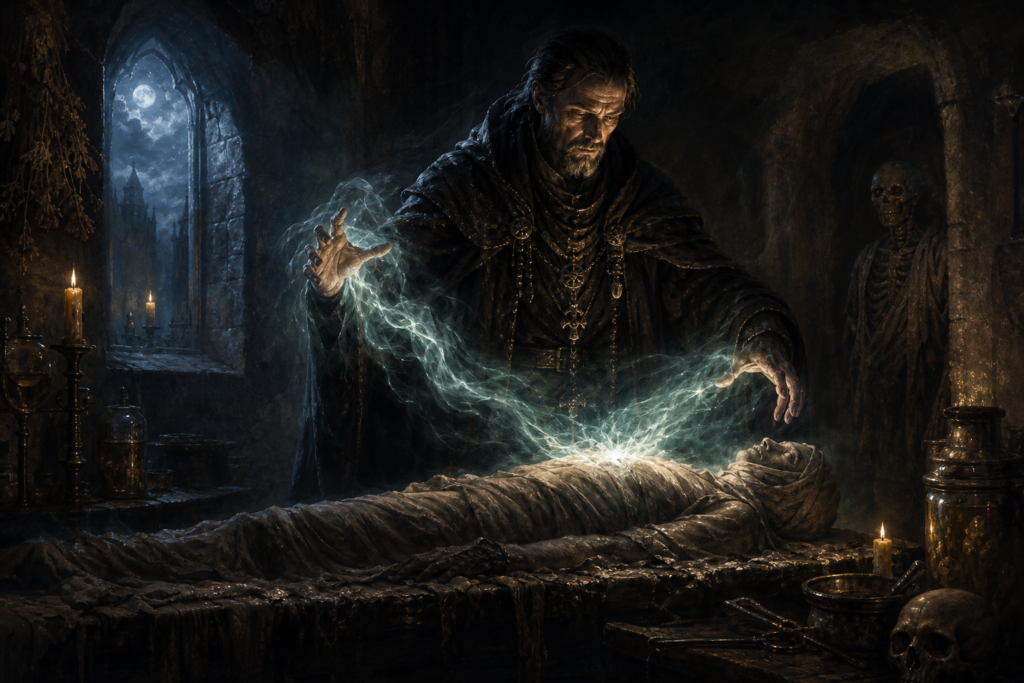
Necromantic effects often use a corpse as their focus, but the physical body and the person who once occupied it are not automatically the same game object.
A body may preserve wounds, appearance, identity and physical evidence while containing no active mind or soul. A spirit may possess memory without physical substance. An undead creature may be a new animating force, a distorted continuation of the deceased or something between those extremes.
- Preserving a corpse does not preserve or imprison its soul unless the spell says so.
- Animating remains does not automatically restore the deceased creature’s personality.
- Questioning a corpse does not necessarily call the complete departed soul.
- Destroying an undead creature does not automatically resurrect the original person.
- The exact spell and edition determine whether a corpse counts as an object, remains, a creature or a special target.
Edition Reference
Identify the active rules system before deciding which spells belong to Necromancy. The school’s boundaries change considerably between modern and legacy editions.
Life and Death
Current spell listings use Necromancy broadly for magic affecting death, vitality, corpses, spirits, undeath and return from death.
Examples include Animate Dead, Speak with Dead, Ray of Enfeeblement, Raise Dead and Resurrection.
Necrotic damage does not automatically make an effect Necromancy, and not every Necromancy spell deals necrotic damage. Damage type and magical school are separate classifications.
Death, Unlife and Life Force
Pathfinder 1e uses Necromancy for death effects, ability damage or drain, energy drain, fear, curses, disease, undead magic and other manipulation of life force.
Healing and resurrection are normally classified as Conjuration (Healing). Raise Dead and Resurrection therefore should not be described as Pathfinder Necromancy spells.
Descriptors such as death, evil, curse or fear add information to a spell, but they are not substitutes for its school.
Death, Unlife and Life Force
D&D 3.5e defines Necromancy as magic manipulating death, unlife and life force. Undead effects form a major part of the school.
As in Pathfinder 1e, ordinary cure, healing and resurrection spells generally belong to Conjuration (Healing). Legacy classifications must not be replaced with their 2024 equivalents.
Many hostile Necromancy effects allow spell resistance, but the individual spell remains the governing authority.
Rules Distinctions That Matter
Necromancy becomes confusing when evocative language replaces the actual target, duration and effect of a spell.
| Distinction | What it means | Do not assume |
|---|---|---|
| Corpse and creature | A dead body may be an object, remains or a specially defined spell target depending on the ruleset. | An effect that targets a creature can automatically target a corpse, or the reverse. |
| Corpse and person | A body may retain physical evidence and recognisable identity without containing the former creature’s active mind or soul. | Moving, preserving or animating the body restores the deceased person. |
| Spirit and soul | Fantasy rules use these words differently. A spell may produce an answering presence without summoning the complete departed soul. | Every voice from the dead possesses complete knowledge, freedom or truthfulness. |
| Creation and control | One effect may create an undead creature while another establishes or renews control. | Undead remain obedient forever merely because the caster originally created them. |
| Undead and identity | Some undead retain memory and personality; others are new supernatural creatures using dead matter. | All undead are either the original person or an entirely empty shell. |
| School and morality | A spell’s school describes its magical operation. Moral descriptors, setting law and the caster’s choices are separate questions. | Every Necromancy spell is evil, or that classification alone excuses its use. |
| Necromancy and necrotic damage | Necromancy is a school; necrotic is a damage type used in modern editions. | All Necromancy deals necrotic damage or all necrotic damage comes from Necromancy. |
| Instantaneous and ongoing | An instantaneous spell completes its magic at the moment of casting and may leave a lasting non-spell result. | Ordinary dispelling can always reverse an animation, death or resurrection after it has resolved. |
- Read the exact target and determine whether it includes a corpse, remains or an undead creature.
- Check whether the effect creates, summons, transforms, controls or communicates.
- Apply duration and concentration normally.
- Determine whether a departed soul must be free or willing.
- Do not add knowledge, memories or obedience the spell does not grant.
- Resolve resurrection limits from the exact spell and edition.
Morality, Consent and the Dead
Necromancy is not automatically wicked, but its subjects make ethical neutrality difficult. The school repeatedly asks who has authority over a body, a soul and a person’s remains.
Protective Necromancy
A practitioner may delay death, preserve evidence, prevent a corpse from rising, question the dead or drive a predatory spirit away from a tomb.
Protective use remains socially charged because it approaches the same boundary that forbidden practitioners violate.
Forbidden Necromancy
Forbidden practice treats persons as material: corpses become property, souls become fuel and grief becomes leverage.
Its horror lies not merely in killing but in continuing to use the victim after death.
Consent and Authority
Consent may be personal, familial, legal, religious or military. Those systems can conflict, and authorisation does not automatically make an act merciful or just.
The dead person’s stated wishes should matter whenever the setting permits those wishes to be known.
Necromancers in Play
A necromancer is defined by specialised knowledge, not a mandatory alignment, costume or army of servants.
Adventuring Role
Necromancers weaken durable enemies, exploit mortality, interrogate remains, identify unnatural death and counter undead threats.
Their most consequential spells often create information, obligations or moral pressure rather than direct damage.
Possible Vocations
- Plague scholar
- Battlefield physician
- Mortuary mage
- Ancestor speaker
- Tomb guardian
- Forensic investigator
- Criminal anatomist
- War-magician or corpse master
The Defining Question
The strongest necromancer concept is not defined merely by whether death magic is used.
What boundary is this practitioner willing to cross, and what do they believe death owes them?
Necromancy in the World
In a setting where Necromancy works reliably, decide how its existence affects burial, warfare, medicine, criminal investigation and inheritance.
Burial and Security
Who guards remains, and what prevents theft, animation or spiritual intrusion? Cremation, sealed tombs and protective rites may have practical as well as ceremonial purposes.
Battlefields
Who recovers and identifies the dead? A battlefield may remain dangerous because of unattended bodies, restless spirits or magic concentrated by mass death.
Murder Investigations
A corpse may become a witness, but not an infallible one. Investigators must know exactly what the dead can perceive, remember and report.
Inheritance and Resurrection
When does an heir inherit: at death, burial, legal declaration or confirmed departure of the soul? Return from death can complicate marriage, property and succession.
Medicine and Plague
When ordinary treatment fails, which necromantic methods are permitted? Desperation can blur the line between healing, preservation and forbidden experiment.
Law and Regulation
Decide whether Necromancy is prohibited, licensed, restricted to particular offices or judged by the specific act rather than the school itself.
Charnel Houses
Bones are stored, labelled, guarded, studied, stolen or sold.
Royal Tombs
Dead rulers may still affect evidence, legitimacy and succession.
Plague Houses
Desperate circumstances make dangerous methods easier to justify.
Execution Grounds
The treatment of the condemned after death reveals the values of the state.
Sealed Battlefields
The dead may linger because of unfinished duties, curses or concentrated violence.
Forbidden Colleges
Anatomy, preservation, spirit contact and resurrection become dangerous scholarship.
Representative Necromancy Resources
These pages illustrate distinct branches of the school without turning this reference into a duplicate spell or monster catalogue.
Historical and Occult Development
Historical necromancy was primarily associated with obtaining knowledge through the dead. The modern fantasy image of manufacturing obedient undead armies is a later fictional development.
Divination Through the Dead
The word derives from Greek roots relating to the dead and divination. Its older sense concerns consulting shades, spirits or the deceased for knowledge unavailable to the living.
Encyclopaedia Britannica: NecromancyOdysseus and Teiresias
In Book 11 of the Odyssey, Odysseus performs rites that allow shades of the dead to approach. His purpose is divinatory: he seeks knowledge from the dead seer Teiresias.
Theoi Classical Texts: Odyssey Book 11Burial and Social Order
Greek funerary practice emphasised proper preparation, mourning and burial. Literary stories repeatedly treat the denial of burial as an offence against dignity and the proper relationship between living and dead.
The Metropolitan Museum of Art: Death and BurialGhosts, Magic and Medicine
In ancient Mesopotamia, ritual, medicine and religion were not separated according to modern categories. Learned practitioners used prescribed rites and objects against ghosts, demons, curses and illness.
The Met: Mesopotamian MagicMythological Parallels
These traditions contain themes that modern fantasy associates with Necromancy, but none should be treated as an exact historical version of the game school.
The Unburied Shade
Elpenor’s shade asks Odysseus for burial so that he is not left forgotten and unresting. The episode connects funeral duty, memory and the consequences of neglected remains.
Orpheus and Eurydice
Orpheus descends into the realm of the dead and attempts to recover Eurydice. The story provides a model for return from death governed by strict supernatural conditions rather than simple restoration.
Egyptian Preservation
Ancient Egyptian funerary practice linked preservation, ritual objects and written spells with the deceased’s successful transition into the afterlife. Its purpose was continued existence, not the creation of mindless undead.
British Museum: Egyptian Death and AfterlifeRestless and Returning Dead
Many traditions tell of corpses or spirits returning because of violent death, broken oaths, improper burial, curses or unfinished obligations. These revenant patterns are distinct from a magician deliberately creating servants.
Further Viewing
Two useful perspectives retained from the former page: a general fantasy overview and a historical discussion of ancient Near Eastern ritual texts.

Rules Sources and Licensing
D&D 5.5e / 2024
Pathfinder First Edition
D&D 3.5e
Keep this reference growing
If this page helped with your reading or game, you can support its upkeep or explore the curated books.
Explore the Bookshop — epics, classics and stories behind imagined worlds.