
Peleus of Phthia — Father of Achilles and King of the Myrmidons
A king made by exile, purified by blood, bound to a sea-goddess, and trapped in the chain of events that will make his house immortal and doomed.

- Aliases: Peleus of Phthia; King of the Myrmidons; Husband of Thetis; Father of Achilles
- Gender: Male
- Race: Human
- Occupation: King, warrior, Argonaut, royal hunter, oath-bound noble
- Homeland: Aegina by birth; Phthia in Thessaly by kingship
- Base of Power: Phthia, Thessaly
- Dynasty: House of Aeacus
- Father: Aeacus, king of Aegina
- Brother: Telamon
- Wife: Thetis, Nereid of the sea
- Former Wife: Antigone, daughter of Eurytion
- Son: Achilles
- Allies: Thetis, Chiron, Telamon, the Myrmidons, selected Argonauts
- Enemies: Acastus, Astydamia, hostile Thessalian houses, rival claimants, oath-breakers
- Languages: Greek, court dialects of Aegina and Thessaly; may understand ritual sea-speech through Thetis
- Alignment: Lawful Neutral, with Lawful Good leanings in his noblest moments
- Suggested Role: Major NPC, royal patron, heroic king, quest-giver, judge of oath-breakers, husband of a dangerous sea-goddess
Peleus is one of the great hinge-figures of Greek heroic myth: a king whose life stands between the age of wandering heroes and the catastrophe of Troy. He is best known as the husband of Thetis and the father of Achilles, but that fame should not reduce him to a footnote. Before Achilles becomes the great doomed warrior of Troy, Peleus has already lived a life marked by exile, blood-guilt, purification, royal service, heroic fellowship, divine marriage, and hard-won kingship.
His story begins in violence. Peleus and his brother Telamon are driven from Aegina after the death of their half-brother Phocus. Peleus finds refuge in Phthia, where Eurytion purifies him, gives him land, and marries him to his daughter Antigone. Yet the pattern of his life repeats itself. During the Calydonian Boar Hunt, Peleus accidentally kills Eurytion, the very man who cleansed him. His life is not one clean heroic ascent, but a chain of honours and stains, each victory shadowed by a debt.
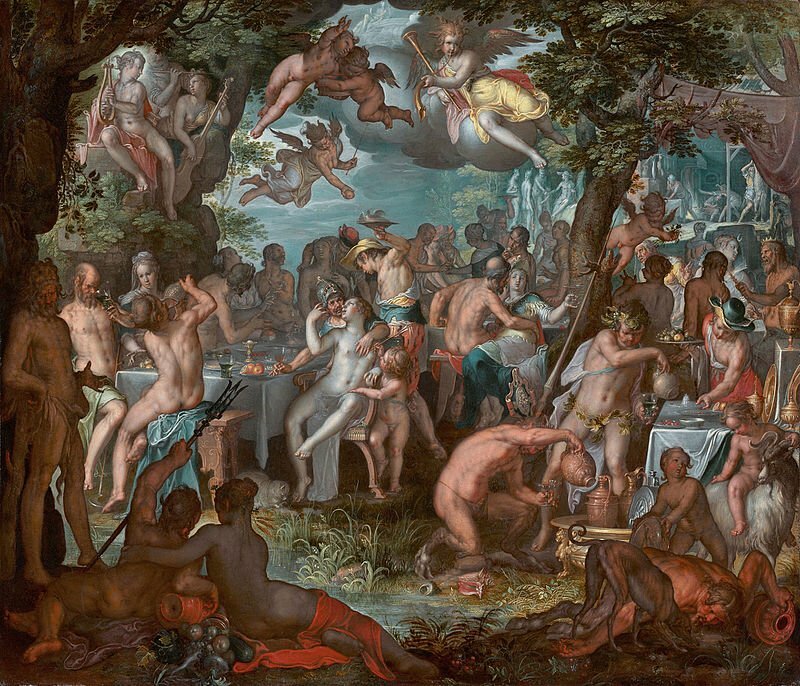
His marriage to Thetis raises his story from heroic misfortune into divine history. Thetis is not merely a beautiful sea-nymph. She is a Nereid whose child is prophesied to become greater than his father. Peleus wins her, but never truly domesticates her. Their marriage joins mortal kingship to the sea’s older, colder power. The wedding feast of Peleus and Thetis becomes one of myth’s great turning points, for the divine quarrel that begins there leads toward Paris, Helen, and the Trojan War.
This entry presents Peleus as a definitive heroic king in the full force of his mythic life: not aged, not diminished, not scaled downward. He is a mortal, but one whose household, marriage, and bloodline stand at the centre of divine politics.
Peleus is therefore not just a king and not merely Achilles’ father. He is the man whose marriage gives birth to the greatest warrior of Troy, whose past sins keep returning through ritual and accusation, and whose house becomes the fault line of an age.
Personality
Peleus is disciplined, proud, and slow to trust. He understands law because he has broken it. He understands purification because he has needed it. He understands kingship because he had to rebuild himself after disgrace.
He is not a cruel man by nature, but he belongs to an older heroic world where honour, oath, kinship, hospitality, accusation, and insult carry terrible consequences. He can be generous, protective, and just; he can also be savage when betrayed. A good campaign version should not flatten him into a kindly father or simple tragic noble. Peleus is a purified killer, a war-tested king, and a man who knows that mercy and vengeance can both be sacred.
He fears being swallowed by prophecy. The gods do not merely touch his life; they use his household as a hinge for events larger than any mortal king can control.
What Peleus Wants
Peleus wants his house to endure without being consumed by divine design.
That means securing Phthia, holding the loyalty of the Myrmidons, protecting his name from old accusations, keeping Thetis from slipping wholly back into the sea, and raising Achilles without surrendering him entirely to prophecy.
He may ask the party to recover a stolen sea-token, expose a false claimant, cleanse a renewed blood-guilt, defend Phthia from a rival house, escort a sacred guest to his wedding feast, or prevent a divine quarrel from spilling into mortal war.
What Peleus Fears
Peleus fears repetition.
His life is marked by recurring wounds: brotherly blood, accidental killing, exile, purification, betrayal, and divine interference. He fears that every cleansing is temporary. He fears that one mistake can reopen every old accusation. He fears that the gods do not forgive mortals, but merely postpone the price.
Most of all, he fears that Thetis’s prophecy is not a warning but a sentence.
Peleus in Play
Peleus works best when he creates pressure rather than simply providing information. He should bring old obligations into the present scene.
Use him as a royal patron whose request is morally complicated, a judge of warriors and oath-breakers, a source of divine-marriage relics, a link between mortal kingship and sea-divinity, or a heroic king whose authority is real but not unstained.
Peleus should enter scenes with authority already attached: guards fall silent, Myrmidon warriors lower their spears, sea-wind moves through closed halls, or a guest suddenly realises that this is the mortal man chosen to marry Thetis. His scenes should test honour, inheritance, accusation, and whether a mortal house can survive the attention of gods.
A strong Peleus scene should include at least one of these pressures:
- A choice between law and family.
- A blood-guilt that has returned through curse, dream, or witness.
- A demand from Thetis or another sea-power.
- A rival noble challenging Peleus’s right to rule.
- A wedding guest carrying a divine insult.
- A young warrior asking whether glory is worth the cost.
Do not use Peleus only as “Achilles’ father.” His value is that he shows the machinery behind heroic greatness: exile, purification, marriage alliance, divine interference, political rule, and inherited doom.
Peleus, King of Phthia D&D 5.5e / 2024
Peleus, King of Phthia, Pathfinder 1e
Peleus, King of Phthia D&D 5.5e / 2024
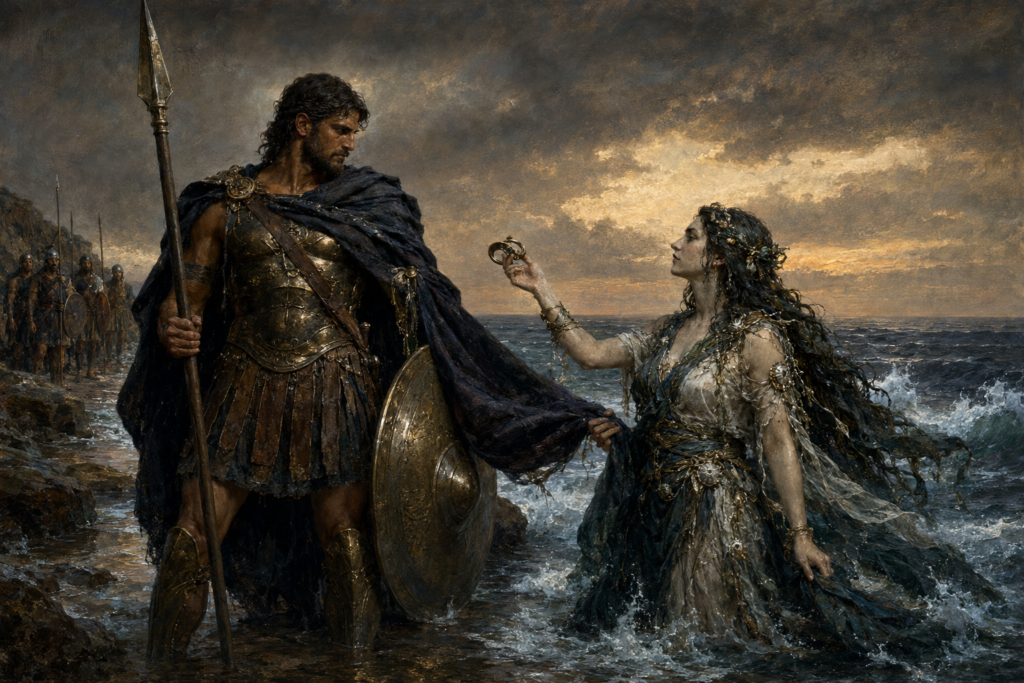
Medium Humanoid, Lawful Neutral
Armour Class 19 ancient bronze panoply and shield
Hit Points 178 (21d8 + 84)
Speed 30 ft.
Proficiency Bonus +4
Initiative +2
| STR | DEX | CON | INT | WIS | CHA |
|---|---|---|---|---|---|
| 21 (+5) | 14 (+2) | 18 (+4) | 14 (+2) | 17 (+3) | 18 (+4) |
Saving Throws Str +9, Con +8, Wis +7, Cha +8
Skills Athletics +9, History +6, Insight +7, Intimidation +8, Perception +7, Persuasion +8, Survival +7
Senses passive Perception 17
Languages Greek; one court, heroic, or sea-ritual language appropriate to the campaign
Challenge 12 (8,400 XP)
Traits
Heroic King. Peleus has advantage on saving throws against being frightened. Allied warriors within 30 feet of him who can see or hear him also have advantage on saving throws against being frightened while Peleus is conscious.
Purified Blood-Guilt. Peleus has advantage on saving throws against curses, possession, fear, and magical effects that exploit guilt, exile, dishonour, or accusation. If the effect is tied specifically to Phocus, Eurytion, Antigone, Thetis, Acastus, Astydamia, or Achilles, the DM may remove this advantage or turn the scene into a roleplaying test instead of a simple saving throw.
Old Hero’s Endurance. If Peleus fails a saving throw, he can choose to succeed instead. Once he uses this trait, he cannot use it again until he finishes a long rest.
Myrmidon Command. As a bonus action, Peleus commands one allied creature within 60 feet that can hear him. That creature may use its reaction to move up to half its speed without provoking opportunity attacks or make one weapon attack.
Sea-Bound Marriage. Peleus has resistance to cold damage and advantage on ability checks and saving throws made to survive storms, drowning, shipwreck, or hostile sea conditions. This protection does not mean the sea loves him; it means Thetis has not fully released her claim.
Actions
Multiattack. Peleus makes two Spear of Phthia attacks. He may replace one attack with Shield Bash.
Spear of Phthia. Melee or Ranged Weapon Attack: +9 to hit, reach 10 ft. or range 20/60 ft., one target. Hit: 13 (1d8 + 9) piercing damage, or 14 (1d10 + 9) piercing damage if used with two hands. If Peleus hits the same target twice in one turn with this spear, the target must succeed on a DC 17 Strength saving throw or be knocked prone.
Sword. Melee Weapon Attack: +9 to hit, reach 5 ft., one target. Hit: 12 (1d8 + 8) slashing damage.
Shield Bash. Melee Weapon Attack: +9 to hit, reach 5 ft., one target. Hit: 10 (1d6 + 7) bludgeoning damage, and the target must succeed on a DC 17 Strength saving throw or be pushed 10 feet.
Shield-Breaking Thrust. Peleus makes one Spear of Phthia attack. On a hit, the target takes normal damage and must succeed on a DC 17 Strength saving throw or suffer one of the following effects: drop a held shield, lose the benefit of half cover until the start of Peleus’s next turn, or be pushed 10 feet and knocked prone.
Voice of the Heroic Court. Peleus targets up to three creatures within 60 feet that can hear him. Each target must make a DC 16 Wisdom saving throw. On a failure, a creature is either frightened of Peleus until the end of its next turn or forced to stop and listen, losing its reaction until the end of its next turn. This is not mindless domination; it is the force of royal, heroic, and ancestral authority.
Bonus Actions
King’s Repositioning. Peleus moves up to 15 feet without provoking opportunity attacks, provided he ends this movement adjacent to an ally, doorway, throne, standard, altar, ship-rail, or other defensible position.
Reactions
Interpose Shield. When a creature Peleus can see hits him or an ally within 5 feet with an attack, Peleus adds +3 to the target’s AC against that attack, potentially causing it to miss.
Punish False Honour. When a creature within Peleus’s reach misses him with a melee attack after lying, betraying an oath, attacking under false pretences, or breaking guest-right during the same scene, Peleus may make one Spear of Phthia attack against it.
Equipment
Peleus carries ancient bronze panoply, a heavy shield, the Spear of Phthia, a royal sword, the cloak of Phthia, the signet of the Aeacid line, and a sea-worn token from Thetis.
Peleus, King of Phthia, Pathfinder 1e

CR 12
XP 19,200
Male human fighter 10/aristocrat 3
LN Medium humanoid
Init +2; Senses Perception +16
Defense
AC 25, touch 12, flat-footed 23 (+9 armour, +2 Dex, +4 shield)
hp 142 (13 HD; 10d10+3d8+65)
Fort +14, Ref +7, Will +10
Defensive Abilities bravery +3, heroic endurance, purified blood-guilt
Offense
Speed 30 ft.
Melee royal spear +21/+16/+11 (1d8+12/×3) or sword +20/+15/+10 (1d8+9/19–20)
Ranged royal spear +16 (1d8+8/×3)
Special Attacks weapon training, command of warriors, shield-breaking thrust
Statistics
Str 22, Dex 14, Con 20, Int 14, Wis 17, Cha 18
Base Atk +12; CMB +18; CMD 30
Feats Combat Expertise, Greater Weapon Focus (spear), Improved Bull Rush, Improved Initiative, Iron Will, Leadership, Power Attack, Shield Focus, Skill Focus (Diplomacy), Weapon Focus (spear), Weapon Specialization (spear)
Skills Diplomacy +21, Handle Animal +15, Intimidate +18, Knowledge (history) +13, Knowledge (nobility) +17, Perception +16, Ride +14, Sense Motive +18, Survival +15
Languages Greek; one additional court, heroic, or ritual language
SQ armour training 2, noble authority, purified exile, sea-bound marriage
Gear ancient bronze panoply, heavy shield, masterwork or magical spear, royal sword, cloak of Phthia, signet of the Aeacid line, sea-token of Thetis
Special Abilities
Command of Warriors (Ex). As a standard action, Peleus grants one ally within 60 feet who can hear him a +2 morale bonus on attack rolls, saving throws against fear, and combat manoeuvre checks for 1 round. If the ally is a Myrmidon, Thessalian warrior, sworn retainer, or member of his household, the bonus increases to +3.
Heroic Endurance (Ex). Once per day, when Peleus fails a saving throw, he may reroll the save and take the better result.
Purified Blood-Guilt (Su or Ex). Peleus gains a +4 bonus on saving throws against fear, curses, guilt-based enchantments, possession, and magical effects that exploit exile, accusation, or dishonour. Against effects tied directly to Phocus, Eurytion, Antigone, Acastus, Astydamia, Thetis, or Achilles, this bonus may be reduced or removed if the scene is built around unresolved blood-guilt.
Sea-Bound Marriage (Su). Peleus gains a +4 bonus on Swim checks, Survival checks at sea, and saving throws against drowning, storms, cold sea-water, and hostile sea-spirits. This ability marks Thetis’s lingering claim over him rather than simple divine favour.
Shield-Breaking Thrust (Ex). Once per round when Peleus hits with his spear, he may attempt a bull rush, disarm, or sunder combat manoeuvre as a free action without provoking an attack of opportunity.
Relics and Treasures
Sea-Token of Thetis
A shell, bronze pin, strip of sea-dark cloth, or salt-polished stone given by Thetis. Once per day, it may protect its bearer from drowning, calm hostile sea-water around them, or allow them to survive one scene of storm, shipwreck, or sea-spirit hostility.
This is not a casual magic item. It is a marital token. If stolen, traded, or used for selfish ends, it draws the attention of Thetis.
Spear of the Aeacid House
A long ash spear associated with Peleus and the Aeacid royal house. In lower-magic games, it is a masterwork or +1 spear. In high-mythic games, it may be a +2 spear that deals additional damage against oath-breakers, kin-slayers, and enemies who attack under false pretence.
Cloak of Phthia
A royal cloak clasped with bronze or silver. It grants advantage, or a +2 bonus in Pathfinder, on social checks involving Thessalian nobles, Myrmidon warriors, heroic cults, and courts that still respect the Aeacid name.
Wedding Bowl of Thetis
A dangerous relic from the wedding feast of Peleus and Thetis. It may reveal hidden divine quarrels, compel truth during formal feasts, or cause buried rivalries to surface. It should create story pressure rather than function as a simple treasure object.
Adventure Hooks
The Sea-Wife’s Summons
Thetis sends a tide-born messenger to Peleus’s hall, but the message is not tender. Something promised at their wedding has been broken, stolen, or misused. The party must enter a sea-cave shrine where Nereids, drowned sailors, and divine witnesses wait to decide whether mortal marriage can bind an immortal power.
The Spear Before Troy
A relic said to belong to the Aeacid house has surfaced in a private armoury. Three factions claim it: a Myrmidon warband, a Thessalian temple, and a prince who believes possession of the spear gives him command over Peleus’s line. Peleus asks the party to recover it before the wrong man learns how to wake it.
The Second Purification
A plague of blood-guilt spreads through Phthia. Men dream of Phocus, Eurytion, Antigone, and unnamed dead. Peleus believes the old rites that cleansed him are failing. The party must discover whether the cause is divine anger, forged evidence, a curse from Acastus’s line, or Peleus’s own refusal to confess the full truth.
Source and Literary Context
Peleus is a major figure in Greek heroic tradition: king of Phthia, husband of the sea-nymph Thetis, and father of Achilles. His story belongs to the generation before the Trojan War, among the heroes of exile, purification, hunting, divine marriage, and dangerous royal alliance. For a concise overview, see Encyclopaedia Britannica’s article on Peleus.
One of the most important episodes in Peleus’s myth is his marriage to Thetis. Thetis was desired by powerful gods, but prophecy warned that she would bear a son greater than his father. Her marriage to Peleus placed a mortal king at the centre of divine politics and led to the birth of Achilles. The wedding feast of Peleus and Thetis also becomes one of the great pre-Trojan turning points, because the quarrel begun there eventually leads toward the Judgement of Paris and the Trojan War.
Peleus’s earlier life is marked by blood-guilt and purification. After the death of Phocus, he is driven from Aegina and received in Phthia, where Eurytion purifies him and gives him his daughter Antigone in marriage. Peleus later accidentally kills Eurytion during the Calydonian Boar Hunt, repeating the pattern of blood, exile, and cleansing that defines much of his heroic life.
Keep this reference growing
If this page helped with your reading or game, you can support its upkeep or explore the curated books.
Explore the Bookshop — epics, classics and stories behind imagined worlds.