
Ascanius / Iulus — Son of Aeneas and Founder of Alba Longa
A survivor-prince of fallen Troy whose arrow can start a war, whose name can crown a dynasty, and whose bloodline carries the future of Rome.
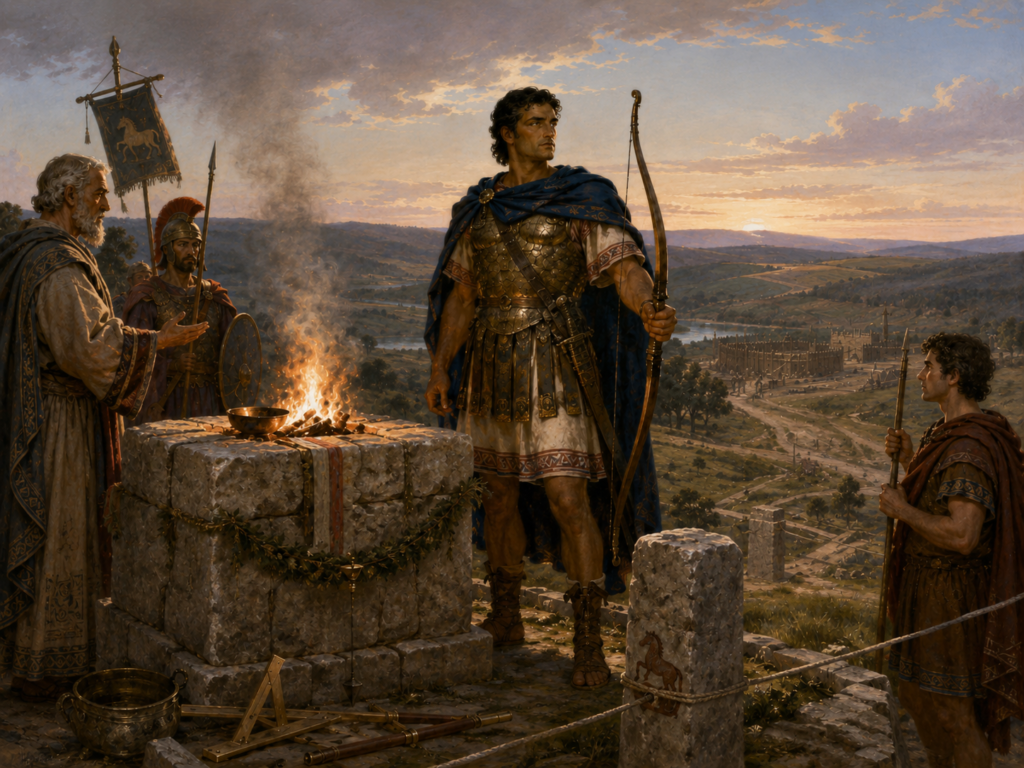
- Name: Ascanius
- Alternative Names: Iulus, Ilus
- Gender: Male
- Race: Human, Trojan royal bloodline
- Occupation: Trojan heir, exile-prince, founder-king, dynastic ancestor
- Homeland: Troy; later Latium
- Associated Cities: Lavinium, Alba Longa
- Lineage: Son of Aeneas; usually son of Creusa in the Virgilian tradition, though Livy preserves an alternate tradition in which his mother is Lavinia
- Divine Ancestry: Grandson of Anchises and Venus through Aeneas
- Affiliations: Trojan exiles, House of Aeneas, Lavinium, Alba Longa, later Julian dynastic tradition
- Enemies: Turnus’s faction, hostile Latian war leaders, rival claimants, enemies of the Trojan-Latin settlement
- Allies: Aeneas, the Trojan remnant, loyal household guards, Alban settlers, oath-bound retainers, later houses claiming descent from Iulus
- Alignment: Lawful Neutral
- Languages: Trojan Greek, Latin, dynastic oath-formulae, royal treaty language
- Role in Play: Founder-king, sacred claimant, ancestral witness, dynastic patron, relic-bound sovereign, disputed ancestor, or living prince during the Trojan-Latin wars
Overview
Ascanius is the surviving son of Aeneas and one of the great dynastic figures of Roman legendary history. He is not remembered as Troy’s greatest warrior. He matters because Troy’s continuity passes through him. He survives the burning city, inherits exile, becomes associated with Alba Longa, and carries the name later claimed by the Julian line.
He is also called Iulus, a name with immense political and sacred weight. Through Iulus, later dynasties can claim more than ancestry. They can claim continuity with Troy, descent from Aeneas, favour through Venus, and a place in the chain of history leading toward Rome.
Ascanius should not be treated as a low-level protected child unless the campaign is deliberately using his early exile period. The definitive Ascanius is the full founder-king: older, trained, politically dangerous, divinely shadowed, and capable of commanding men, founding cities, settling claims, and causing war by accident or design.
His power is not the power of Heracles, Achilles, or Diomedes. He is not a supreme battlefield champion. His power is legitimacy. When Ascanius acts, people do not ask only who was struck. They ask what treaty, bloodline, city, or future was touched.
Appearance
Ascanius appears as a noble Trojan prince hardened by exile and kingship. He wears royal clothing that remembers catastrophe: a finely bordered tunic, a short cloak fastened with a bronze pin, a signet of the Trojan remnant, and armour practical enough for campaign life but ceremonial enough to mark him as more than a wandering soldier.
As a young exile, he has the alertness of someone raised among burning walls and hurried departures. He watches adults closely before speaking. He knows fear, but he has been taught not to show it.
As founder of Alba Longa, he becomes more severe. His face carries the discipline of a ruler who has survived ruin and must now make settlement into law. He should look less like a decorative prince and more like a man who understands that founding a city is an act of oath, memory, boundary, and force.
Character
Ascanius is brave, proud, dutiful, and deeply conscious of inheritance. He has been told all his life that his survival matters. That gives him strength, but it also burdens him with expectation.
His flaw is dynastic certainty. Ascanius believes that the future entrusted to him must be protected, continued, and justified. This makes him capable of courage and sacrifice, but also of severity. If a rival threatens the Trojan-Latin settlement, challenges his legitimacy, or endangers the foundation of Alba Longa, Ascanius does not treat the matter as a private insult. He treats it as an attack on history.
His younger flaw is eagerness to prove himself. In the episode of Silvia’s stag, his hunting shot helps ignite war between Trojans and Latins. That moment should not be treated as a random accident. It reveals the central danger of Ascanius: even a youthful act can become public, symbolic, and catastrophic.
What He Wants
Ascanius wants continuity. He wants a home that cannot be burned, a line that cannot be erased, and a city that proves Troy did not end in ash.
As a younger prince, he wants to be worthy of Aeneas. He wants adults to stop treating him as a vessel of destiny and start recognising him as a ruler in formation.
As founder of Alba Longa, he wants walls, rites, heirs, tombs, laws, and oaths. He wants the wandering Trojan remnant to become a people again.
What He Fears
Ascanius fears being the weak link between Troy and the future. He fears that Creusa’s death, Aeneas’s exile, and the suffering of the Trojan remnant will be made meaningless by his failure.
He also fears replacement and dispute. The traditions around Creusa, Lavinia, Ascanius, Iulus, and later Alban succession make him especially useful in campaigns about legitimacy. Competing versions of his birth and inheritance should not be smoothed away too quickly. They are excellent sources of political and sacred pressure.
Ascanius in the Campaign World
In the 1454 CE campaign world, Ascanius is long dead in ordinary history, but not gone. Myths are real history. A founder’s name can still carry force through relics, bloodline claims, city rites, ancestral law, underworld testimony, dynastic tombs, and oath-bound houses.
He can appear as:
- a living prince during the Trojan exile or Latian war;
- the founder-king of Alba Longa;
- an ancestral shade summoned in a dynastic dispute;
- a witness to the truth or falsehood of a Julian or Alban bloodline;
- a relic-bound presence attached to his bow, signet, cloak-pin, or foundation token;
- a disputed patron claimed by rival noble houses;
- a sacred obstacle to anyone trying to falsify, sever, or corrupt the line of Aeneas.
If Ascanius appears as a shade, ancestral witness, or relic-bound sovereign, use the same core identity and authority, but adjust creature type, resistances, and encounter difficulty to match the supernatural form.
Running Ascanius by Power Level
Young Exile Ascanius: Use a lower-powered version around CR 4 if the scene is set during his youth, especially for the stag episode, escort scenes, hostage plots, or early Trojan exile material.
Founder-King Ascanius: Use the definitive CR 9 version below for Ascanius as Iulus, founder of Alba Longa, trained prince, sovereign claimant, and dynastic ancestor.
Ancestral or Relic-Bound Ascanius: Use CR 10–11 if he appears as a supernatural founder-shade, tomb guardian, oath-witness, or relic-bound sovereign with undead, divine, or lair-like traits.
Role at the Table
Ascanius is strongest in scenes about protection, provocation, inheritance, foundation, and irreversible consequence.
Use him when the party must decide whether to:
- defend a founder whose claim is politically dangerous;
- stop a small act from becoming a war;
- prove or disprove a bloodline claim;
- recover a relic tied to Alba Longa;
- decide whether destiny excuses violence;
- negotiate between rival heirs of the same sacred line;
- face a sovereign who may be right, dangerous, and uncompromising at the same time.
Ascanius should not feel like an ordinary archer with a famous name. He should feel like a ruler whose presence changes the legal, sacred, and military stakes of the scene.
Signature Scene: The Arrow Before the War
The best Ascanius scene begins before the arrow is loosed.
The party sees the stag first. It is not just game. It wears a collar, garland, ribbon, bell, painted antler-mark, or household token. It is tame, protected, and loved. Ascanius sees a hunting opportunity. His companions see a chance for the prince to prove himself. A hostile divine power, rival noble, or oath-breaking faction may be steering the moment.
Run the scene with clear pressure:
- Visible Warning: The stag bears signs of household protection.
- Emotional Pressure: Ascanius wants to prove his courage.
- Political Pressure: Trojan retainers do not want their prince publicly shamed.
- Hidden Pressure: A rival faction wants the shot fired.
- Divine Pressure: A hostile power wants bloodshed without appearing responsible.
- Immediate Trigger: The dogs are already running.
Success does not have to prevent all conflict. Stronger outcomes include saving the stag, exposing the manipulation, negotiating blood-price, stopping a retaliatory massacre, or preventing a border quarrel from becoming a full dynastic war.
Ascanius / Iulus, Founder of Alba Longa D&D 5.5e / 2024
Ascanius / Iulus, Founder of Alba Longa Pathfinder 1e
Ascanius / Iulus, Founder of Alba Longa D&D 5.5e / 2024
Medium Humanoid, Lawful Neutral
Armour Class: 18
Hit Points: 135
Speed: 30 ft.
Proficiency Bonus: +4
Initiative: +5
| STR | DEX | CON | INT | WIS | CHA |
|---|---|---|---|---|---|
| 14 (+2) | 20 (+5) | 16 (+3) | 15 (+2) | 16 (+3) | 20 (+5) |
Saving Throws: Dex +9, Wis +7, Cha +9
Skills: Animal Handling +7, History +6, Insight +7, Perception +7, Persuasion +9, Survival +7
Senses: Passive Perception 17
Languages: Trojan Greek, Latin, dynastic oath-formulae
Challenge: 9
XP: 5,000
Traits
Heir of Aeneas. Ascanius has Advantage on Charisma checks made to influence Trojans, Trojan-descended peoples, Alban claimants, Roman traditionalists, and those who recognise the sacred line of Aeneas.
Founder’s Authority. Allies of Ascanius within 30 feet have Advantage on saving throws against being Charmed or Frightened while they can see or hear him.
Bloodline of Venus. Ascanius has Advantage on saving throws against curses, possession, and effects that would magically compel him to betray his lineage, city, sworn household, or ancestral duty.
Royal Child of Ruin, Founder of a City. Ascanius cannot be surprised while conscious if he is within a settlement, camp, shrine, royal hall, battlefield standard, dynastic tomb, or foundation-site connected to his people.
Dynastic Consequence. If Ascanius is harmed, kidnapped, publicly humiliated, falsely accused, or stripped of a recognised relic, nearby factions react as though a sacred royal incident has occurred. This is not magical compulsion. It is the force of legitimacy, omen, law, and political reality.
Actions
Multiattack. Ascanius makes three attacks: either three with his royal hunting bow, or two with his Trojan short sword and one with his royal hunting bow.
Trojan Short Sword. Melee Weapon Attack: +9 to hit, reach 5 ft., one target. Hit: 10 piercing damage.
Royal Hunting Bow. Ranged Weapon Attack: +9 to hit, range 150/600 ft., one target. Hit: 12 piercing damage.
The Arrow That Starts a War. Recharge 5–6. Ascanius makes one Royal Hunting Bow attack against a creature, sacred animal, standard, treaty-marker, shrine object, gate, heraldic emblem, or politically protected target. On a hit, the attack deals 22 piercing damage. If the target has sacred, legal, household, or factional importance, one hostile or oath-bound faction that witnesses or learns of the shot must make a DC 17 Wisdom saving throw. On a failed save, the faction escalates immediately: drawing weapons, calling retainers, breaking negotiation, demanding blood-price, declaring vengeance, or invoking treaty law.
Command of the Alban Founder. Ascanius chooses up to three allies within 60 feet who can hear him. Each chosen ally may move up to half its speed without provoking Opportunity Attacks, make one weapon attack as a Reaction, or gain 10 temporary hit points.
Seal the Claim. Ascanius presents a signet, oath-token, foundation relic, or ancestral witness. One creature within 60 feet that can hear him must make a DC 17 Charisma saving throw. On a failed save, it cannot knowingly lie about lineage, inheritance, treaty, blood-price, oath-breaking, or rightful succession until the end of Ascanius’s next turn. This is not mind reading; it forces public truthfulness only on a narrow dynastic or legal matter.
Bonus Actions
Prince Among Exiles. Ascanius chooses one ally within 30 feet who can hear him. Until the start of Ascanius’s next turn, that ally gains a +2 bonus to AC and saving throws while defending Ascanius, a standard, a relic, a gate, a shrine, or a noncombatant.
Founder’s Mark. Ascanius marks one visible creature, object, gate, standard, tomb, battlefield position, or foundation-site within 60 feet. Until the end of his next turn, Ascanius and his allies have Advantage on attack rolls and ability checks made to defend, seize, protect, restore, or recover that marked target.
Reactions
Do Not Let the Heir Fall. When a creature Ascanius can see targets him with an attack while at least one ally is within 5 feet of him, Ascanius may impose Disadvantage on the attack. If the attack misses, one allied creature within 5 feet of Ascanius takes 10 damage as it physically intervenes.
The Line Does Not Break. When Ascanius fails a saving throw, he may add +4 to the result, potentially turning the failure into a success. He can use this reaction three times per day.
Legendary Actions
Ascanius can take 2 legendary actions, choosing from the options below. Only one legendary action can be used at a time, and only at the end of another creature’s turn. Ascanius regains spent legendary actions at the start of his turn.
Move. Ascanius moves up to half his speed without provoking Opportunity Attacks.
Command Retainer. One ally within 30 feet who can hear Ascanius makes one weapon attack or moves up to half its speed.
Founding Oath. One ally within 30 feet gains 10 temporary hit points, or one hostile creature within 30 feet has Disadvantage on the next attack roll it makes against Ascanius before the end of its next turn.
Equipment
Ascanius carries a royal hunting bow, Trojan short sword, bronze cuirass, small shield, signet of Iulus, cloak-pin of the Trojan remnant, foundation token of Alba Longa, hunting horn, treaty cords, and sealed ancestral correspondence.
Treasure
Ascanius should not be treated as ordinary loot. His treasure is symbolic, political, and dangerous.
- Signet of Iulus: Worth 1,500 gp as an object, but far more as proof of bloodline. It may open dynastic archives, tombs, or oath-halls tied to Alba Longa.
- Trojan Cloak-Pin: Worth 500 gp. Once per long rest, a creature openly wearing it gains Advantage on one Charisma check involving Trojan exiles, Alban descendants, Roman traditionalists, or houses claiming descent from Aeneas.
- Royal Hunting Bow of Ascanius: A +1 longbow. Before loosing an arrow, its wielder can sense whether a hunted creature is tame, sacred, under household protection, or politically dangerous to harm.
- Foundation Token of Alba Longa: No ordinary market value. It may open Alban tombs, sealed archives, oath-halls, foundation shrines, or ritual gates bound to the line of Iulus.
Ascanius / Iulus, Founder of Alba Longa Pathfinder 1e
CR 9
XP 6,400
Male human founder-king
LN Medium humanoid
Init +6; Senses Perception +16
Defence
AC 24, touch 16, flat-footed 18
hp 105
Fort +10, Ref +13, Will +11
Defensive Abilities founder’s authority, royal child of ruin
Immune mundane fear while within sight of his standard, relic, or oath-bound retainers
Offence
Speed 30 ft.
Melee +1 short sword +15/+10 (1d6+4/19–20)
Ranged royal hunting bow +18/+13 (1d8+6/x3)
Special Attacks arrow of consequence 1/day, command of the Alban founder 3/day, founder’s mark 3/day, seal the claim 1/day
Statistics
Str 14, Dex 22, Con 16, Int 15, Wis 16, Cha 20
Base Atk +9; CMB +11; CMD 27
Feats Deadly Aim, Leadership, Point-Blank Shot, Precise Shot, Rapid Shot, Skill Focus (Diplomacy), Weapon Focus (longbow)
Skills Diplomacy +20, Handle Animal +14, Knowledge (history) +14, Knowledge (nobility) +17, Perception +16, Ride +18, Sense Motive +16, Survival +15
Languages Trojan Greek, Latin, dynastic oath-formulae
Special Abilities
Heir of Aeneas. Ascanius gains a +4 sacred bonus on Diplomacy checks involving Trojans, Trojan-descended peoples, Alban claimants, Roman traditionalists, or those who honour the line of Aeneas.
Founder’s Authority. Allies within 30 feet of Ascanius gain a +2 morale bonus on saving throws against fear and charm effects while they can see or hear him.
Bloodline of Venus. Ascanius gains a +4 sacred bonus on saving throws against curses, possession, and magical effects that would compel him to betray his lineage, city, sworn household, or ancestral duty.
Royal Child of Ruin, Founder of a City. Ascanius is never flat-footed during the first round of combat while inside a settlement, camp, shrine, royal hall, battlefield standard-area, dynastic tomb, or foundation-site connected to his people.
Arrow of Consequence 1/day. Ascanius may make a single bow attack against a creature, sacred animal, treaty-marker, heraldic object, shrine item, gate, standard, or politically important target. On a hit, the attack deals normal damage plus 2d6 precision damage. If the target has sacred, legal, household, or factional importance, nearby hostile or oath-bound creatures must succeed at a DC 19 Will save or escalate the scene: drawing weapons, calling retainers, breaking negotiation, demanding blood-price, or declaring vengeance. This is a narrative-political effect, not charm or compulsion.
Command of the Alban Founder 3/day. As a standard action, Ascanius chooses up to three allies within 60 feet who can hear him. Each chosen ally may immediately move up to half its speed without provoking attacks of opportunity, make one weapon attack, or gain 2d8+5 temporary hit points.
Founder’s Mark 3/day. As a swift action, Ascanius marks one visible creature, object, gate, standard, tomb, battlefield position, or foundation-site within 60 feet. Until the start of his next turn, Ascanius and his allies gain a +2 morale bonus on attack rolls, saving throws, and skill checks made to defend, seize, protect, restore, or recover the marked target.
Seal the Claim 1/day. Ascanius presents a signet, oath-token, foundation relic, or ancestral witness. One creature within 60 feet must succeed at a DC 19 Will save or become unable to knowingly lie about lineage, inheritance, treaty, blood-price, oath-breaking, or rightful succession for 1 round. This effect does not reveal hidden thoughts or unrelated secrets.
Gear
+1 royal hunting bow, +1 short sword, bronze cuirass, small shield, signet of Iulus, cloak-pin of the Trojan remnant, foundation token of Alba Longa, hunting horn, treaty cords, and sealed ancestral correspondence.
Tactics
Ascanius fights as a founder-king, not as a berserker or demigod champion. He uses distance, command, legitimacy, terrain, and loyal retainers. He is brave enough to stand in danger, but too politically important to waste himself in reckless melee.
He should:
- open with Founder’s Mark if a gate, standard, relic, tomb, or royal person must be protected;
- use Command of the Alban Founder to reposition allies and control the field;
- attack with his bow from guarded ground;
- use Seal the Claim in public confrontations, succession disputes, and treaty scenes;
- reserve The Arrow That Starts a War for targets whose injury would change the scene politically;
- avoid pointless duels unless honour, foundation, or bloodline is at stake.
Killing Ascanius should never feel like defeating a simple CR 9 combatant. It should feel like damaging a sacred line, breaking a future city, or inviting dynastic catastrophe.
Using Ascanius as an Ally
As an ally, Ascanius is powerful but dangerous. He brings legitimacy, command, courage, and access to sacred or dynastic spaces. He also attracts assassins, rival claimants, divine hostility, and factions that want his name controlled.
He works well as:
- a founder-king the party must protect during the establishment of Alba Longa;
- a sovereign whose treaty must survive sabotage;
- a sacred ancestor summoned to judge a bloodline claim;
- a relic-bound patron who can open Alban tombs or expose forged descent;
- a ruler whose single command can decide whether exile becomes settlement or war.
Using Ascanius as an Antagonist
Ascanius should not be made villainous without a strong reason. His best antagonistic role is as a legitimate founder whose claim creates real harm for others.
He may oppose the party if they:
- defend a Latian household against Trojan expansion;
- challenge his right to found, inherit, or judge;
- expose a succession secret that threatens Alba Longa;
- prevent a prophecy he believes must be fulfilled;
- serve a rival claimant to the line of Aeneas;
- try to remove a relic he considers essential to the city’s survival.
Ascanius is most interesting when he is not simply wrong. He may be defending a real future, but the cost of that future may fall on people the party can see, speak to, and save.
Adventure Hooks
The Stag With the Garlanded Horns
A sacred household stag wanders near a hunting party led by Ascanius. The animal is tame, beloved, and protected by treaty, but the dogs are already running. A hostile divine power wants the shot fired. The party must stop the hunt, expose the manipulation, or control the aftermath before an insult becomes war.
The False Iulus
A noble house in 1454 CE claims descent from Iulus and produces a signet said to belong to Ascanius. Rival families demand judgement, priests refuse to bless the claimant, and an Alban tomb opens only to the true bloodline. The party must decide whether the claim is sacred truth, clever fraud, or a dangerous half-truth.
The Foundation That Refuses Its King
A ritual site connected to Alba Longa rejects the current claimant to Ascanius’s legacy. Stones crack, oath-fires gutter, and ancestral tablets bleed old names through their surfaces. Ascanius’s shade can be summoned, but he will not answer a weak question. The party must discover what has broken the succession: false descent, hidden murder, divine anger, or a rightful heir deliberately erased from history.
Source and Literary Context
Ascanius, also called Iulus, is a major figure in Trojan and Roman legendary tradition. He is best known as the son of Aeneas and as the traditional founder of Alba Longa, the ancestral city connected with the later Roman foundation story. In the usual Virgilian tradition, his mother is Creusa, Aeneas’s Trojan wife; Livy preserves an alternate tradition in which Ascanius is the son of Lavinia. For a concise overview, see Encyclopaedia Britannica’s article on Ascanius.
Ascanius’s dynastic importance comes from his other name, Iulus. Through that name, the Julian family claimed descent from him, making him not only a surviving Trojan prince but a symbolic ancestor of Roman power. The British Museum also summarises this tradition, noting his association with Alba Longa, the alternate parentage tradition, and the Julian family’s claimed descent through Iulus. See the British Museum’s entry for Ascanius.
One of Ascanius’s most important narrative moments occurs in Book 7 of Virgil’s Aeneid, when he wounds Silvia’s cherished stag and helps ignite war between Trojans and Latins. The Ashmolean Museum’s discussion of Claude Lorrain’s Ascanius Shooting the Stag of Sylvia identifies Ascanius as the son of Aeneas and explains that he unknowingly becomes the instrument of Allecto, whom Juno sends to provoke war. See the Ashmolean’s page on Ascanius shooting the stag of Sylvia.