
Detaching Ram: Hidden Naval Weapon for Merchant Ships and Raiders
Detaching Ram: Hidden Naval Weapon for Merchant Ships and Raiders
A removable ship ram that lets a vessel appear harmless until the moment it is ready to strike.
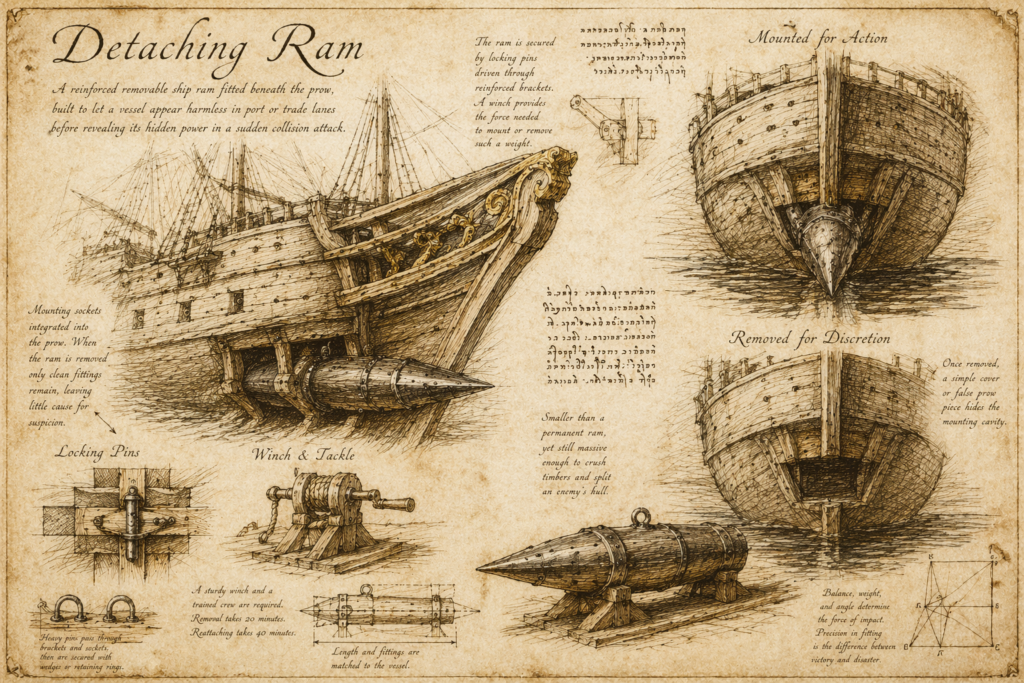
Alternative Names: Removable Ram, False-Merchant Ram, Concealed Prow Ram
The detaching ram is a removable naval ram favored by captains who prefer deception to open intimidation. Smaller than a permanent ram but still heavy enough to crush timbers and split hulls, it allows a ship to present the outward look of a harmless merchantman while retaining a hidden capacity for sudden violence.
It is especially valued by captains who trade in dangerous waters, raiders who disguise themselves as peaceful carriers, privateers who wish to conceal their strength until the last moment, and wary merchants who know that appearing vulnerable can sometimes be safer than looking prepared. The detaching ram turns a ship’s prow into a secret. It is not merely a weapon, but a lie built of timber, iron, and timing.
Overview
A detaching ram is a reduced version of a standard ship ram, designed to be mounted to the prow when needed and removed when discretion matters more than brute force. In battle it functions like a normal ram in almost every respect, though its smaller size means it inflicts slightly less damage on impact.
The value of the detaching ram lies in concealment. A vessel fitted with one can move through trade lanes, harbors, and uncertain political waters without openly declaring itself a warship. This makes it ideal for commerce in hostile seas, ambush tactics, covert patrols, piracy, anti-piracy operations, and any captain who survives by keeping strength hidden until the decisive instant.
Description
The detaching ram is built to fit securely onto a ship’s prow, usually by means of heavy brackets, reinforced locking pins, fitted sockets, and winched supports. Though smaller than a permanent ram, it remains monstrously heavy. It is not the sort of thing sailors lift by hand and slide casually into place. Even when designed for removal, it demands real machinery, practiced labor, and careful alignment.
When mounted, it projects from the prow as a blunt or tapered striking mass of reinforced timber, bronze, iron, or layered construction. Some are shaped to blend with the natural line of the hull, making them less obvious at a distance. Others are hidden under false fittings or decorative prow structures until stripped or revealed.
Removing a detaching ram takes 20 minutes. Reattaching it takes 40 minutes. Both tasks require a winch and a crew that knows what it is doing. A detaching ram is removable, but never convenient.
Why This Item Matters in the World
The detaching ram matters because it tells you something immediately about the ship and the captain who use it. This is not the choice of a proud admiral who wants to be seen. It is the choice of a cautious, cunning, or predatory commander who values surprise, plausible innocence, and controlled escalation.
That makes it excellent worldbuilding material. A merchant house operating in raider waters might quietly outfit its best ships with detachable rams while publicly claiming neutrality. A pirate captain may hide one beneath a harmless-looking prow to lure escorts into closing distance. A prince forbidden by treaty to arm merchant hulls may interpret the law very creatively. A patrol captain hunting smugglers might use one to keep targets from fleeing until the last possible moment.
In all these cases, the detaching ram is not simply a ship upgrade. It is a statement about secrecy, fear, and the politics of the sea.
Failure and Risk
The detaching ram trades raw striking power for flexibility and concealment. It hits less hard than a permanent ram, and it demands time and labor to manage. A captain who expects to mount or remove it in haste may find that weather, damage, panic, or exhausted crew turn a clever design into a dangerous delay.
It also creates legal and political risk. In some ports, merely carrying such a device may be seen as evidence of bad intent, smuggling, or covert piracy. A captain caught with a detaching ram in the hold may have trouble persuading customs officials that the ship is a peaceful trader. In wartime, possession of one may be treated as proof of hostile preparation.
Value in the World
A detaching ram is costly because it is more than reinforced metal. It requires careful fitting to a specific hull, secure mounting systems, shipwright labor, and enough strength to survive catastrophic impact without tearing loose too early. Yet it is still cheaper than the sort of heavy permanent naval fitting used by openly martial vessels, because it sacrifices some striking power in exchange for flexibility and concealment.
That makes it an attractive commission for wealthy merchants, privateers, corsairs, and discreet rulers who need a ship to look harmless without being helpless. At 3,000 gp, a detaching ram is still a serious investment, but one within reach of prosperous captains and organized patrons rather than only great navies and princes.
A badly made detaching ram is worse than useless. It can fail at the moment of collision, damage the mounting ship, or reveal hostile intent while offering no real striking advantage. For that reason, the best examples are usually commissioned through experienced shipwrights rather than bought as ordinary dockside goods.
Trade, Craft, and Common Variants
- Common Detaching Ram (3,000 gp): The standard working version, built for practical concealment and reliable mounting.
- Blended Prow Ram (3,500 gp): Shaped to follow the line of the hull more closely, making it less obvious at a glance. The extra cost reflects more careful shaping and finishing to integrate it with the vessel’s prow.
- Heavy-Fit Ram (3,500 gp): More robustly mounted and slightly bulkier, favored by captains who expect repeated action and care less about concealment. The higher cost reflects stronger fittings and more demanding shipwright work.
- False-Trim Variant (4,000 gp): Built with decorative or merchantlike prow fittings to help disguise the ram when installed. This version costs more because it combines naval hardware with convincing false exterior work.
- Custom Naval Commission (4,500 gp or more): Precisely fitted to a specific vessel, often with superior locking systems, better finish, and the patron’s insignia hidden within the hardware. This is the premium version, built to match a single hull and the captain’s exact requirements.
Using the Item in Your Game
The detaching ram is most useful when treated as part of maritime behavior rather than as a dry naval statistic. It changes how a ship is read by others. A vessel that appears unarmed may suddenly become far more dangerous once the ram is mounted or revealed. That makes it ideal for scenarios involving false flags, suspicious inspections, escort duty, ambushes, insurance fraud, covert war, or merchants who have learned to survive in cruel waters.
It also adds strong texture to ports and harbors. Shipwrights may whisper about who ordered one. Dockworkers may recognize the fittings even when officials do not. A customs officer may know exactly what the mounting scars on a prow mean. Players may come to understand that not every soft-looking vessel is truly defenseless.
Adventure and Worldbuilding Hooks
- A merchant vessel seized as a prize turns out to have a hidden detaching ram in its hold, suggesting the crew were not merchants at all.
- A shipwright who specializes in removable rams is found murdered before delivering a secret commission to a powerful patron.
- A customs inspector hires the party after discovering a pattern of “ordinary” grain ships carrying disguised prow fittings and reinforced winch mounts.
- A captain insists his vessel is peaceful, but the scars along the prow say a detaching ram has been fitted and removed many times before.
Detaching Ram 5.5e
Detaching Ram, Pathfinder
Detaching Ram
| Item Type | Cost | Weight | Install Time | Remove Time |
|---|---|---|---|---|
| Vehicle Upgrade | 3,000 gp | Vehicle-mounted | 40 minutes | 20 minutes |
Effect
When a ship equipped with a detaching ram makes a successful ram attack, it deals 1d3 bludgeoning damage per 10 feet of the attacking ship’s length instead of the 1d4 dealt by a standard ram.
Requirements
Mounting or removing a detaching ram requires a winch, suitable prow fittings, and a crew capable of handling heavy ship equipment. A vessel not designed or modified to accept one cannot simply strap it on without GM approval and shipyard work.
Designer’s Note
The 5.5e version keeps the original idea intact: a concealed naval weapon that sacrifices some striking power in exchange for flexibility, deception, and roleplaying value.
Detaching Ram
| Item | Price | Install Time | Remove Time | Damage |
|---|---|---|---|---|
| Detaching Ram | 3,000 gp | 40 minutes | 20 minutes | 1d3 per 10 ft. of ship length |
Effect
When a ship equipped with a detaching ram makes a successful ram attack, it deals 1d3 bludgeoning damage per 10 feet of the attacking ship’s length instead of the 1d4 dealt by a standard ram.
Pathfinder Notes
Though built for removal, a detaching ram is still massively heavy and requires a winch to detach or remount. It is best suited to ships whose captains value deception, covert readiness, and control over how martial their vessel appears in public.
Closing Note
The detaching ram is memorable because it makes a ship dangerous twice: once when it strikes, and once when no one realizes it can.
For broader background on historical naval rams and prow warfare, see Encyclopaedia Britannica’s overview of the naval ram.