
Drag Anchor — A Heavy Sea Brake for Ships
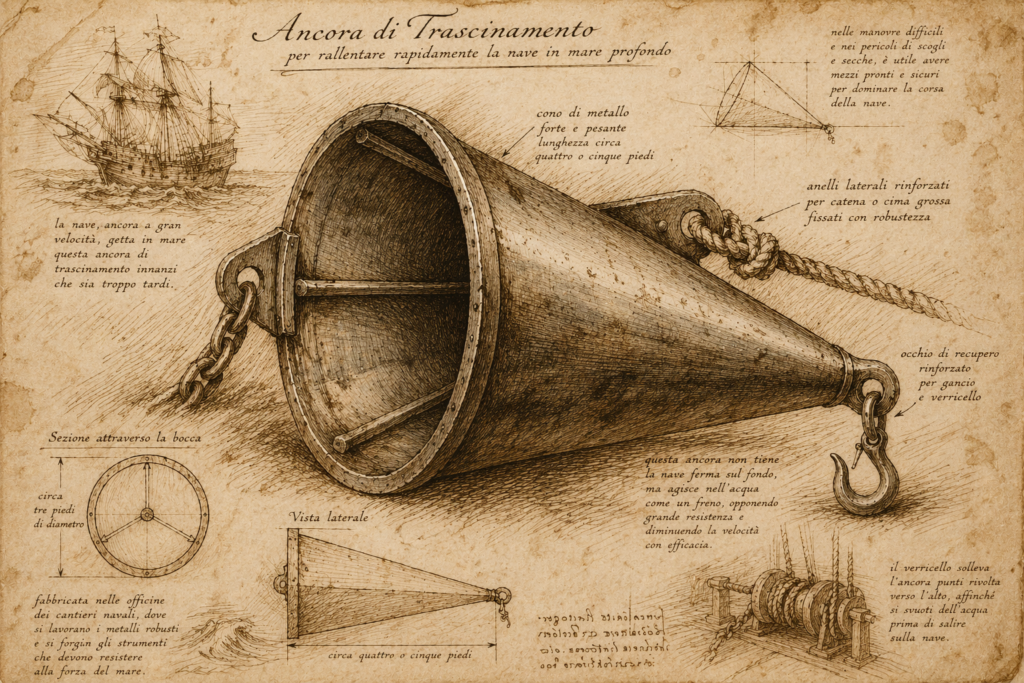
At a Glance
- Type
- Heavy conical sea brake deployed on a rope or chain
- Construction
- Large metal cone with side loops and a reinforced recovery eye
- Typical Size
- Four to five feet long, with a mouth about three feet wide
- Use
- Slowing an approaching or pursued ship in deep water
- Recovery
- Hooked at the pointed end and raised by windlass or capstan
- Hazards
- Snapped tackle, loose fittings, sudden braking and an uncontrolled swinging load
Beyond the breakwater, a carrack is running towards the harbour far too fast. The pilot shouts for the sails to be shortened, but the gust has already caught her broad canvas. On the afterdeck the crew heaves a heavy metal cone across the rail. The chain takes the strain, the hull shudders and sailors throw themselves flat as the ship begins to lose speed. If the fitting gives way now, the harbour wall lies directly ahead.
A drag anchor is a specialist’s emergency brake for a vessel in deep water. Unlike a ground anchor, which is expected to hold a ship when its flukes bite the sea floor, this fitting resists movement through the water itself. It may prevent an overshoot into a reef or pier, buy time in a dangerous approach, or shorten the distance a ship travels after the captain gives the order to stop. It will not hold a ship permanently against the tide.
Construction and Deployment
The specialised design is a thick metal cone, four or five feet long, with a wide open mouth. Two pivoting loops hold the main chain or rope, spreading the force across the broad rim. At the pointed end a second forged eye lets the recovery crew hook the cone and bring it from the sea tip-first, spilling its water rather than lifting a heavy submerged load onto the deck.
Setting the drag anchor. The captain first orders the crew to secure the ship’s speed and prepare the tackle. The line must be fastened to a reinforced point, not a lightly built railing. When the anchor is cast overboard it fills, resisting the ship’s advance. The line is paid out in a controlled fashion as the ship slows.
Recovering it. The crew cannot normally haul the device back by hand when the ship is still surging ahead. Once the vessel has slowed, sailors catch the pointed eye with a hook and use a capstan or windlass to lift the cone. Its wide end drains as it rises, reducing the weight of water held inside.
The wrong conditions. In shoal water the cone may catch on the bottom and damage itself or the ship. A slack line can foul the rudder, and a badly secured line can tear away its anchor point. In rough seas the suspended cone may swing dangerously when pulled aboard.
Workshops and cost. Large ports with smiths, riggers and heavy lifting equipment make these fittings. The precise cone is expensive and awkward to carry, and its crew must practise before an emergency. A merchant captain who has bought the device but neglected its tackle has purchased little security.
Storms, Chases and Harbour Law
Drag anchors are most valuable on large ships approaching dangerous harbours, reefs and crowded anchorages. A captain may cast one to avoid striking a quay or to slow an unexpected pursuit. A sea brake should never be mistaken for a guarantee against collision; turning room, wind and hull condition still matter.
The Broken Recovery Eye. A ship entering harbour has deployed its drag anchor successfully, but the recovery eye snaps as the crew lifts it from the waves. The massive cone now hangs beneath the ship’s stern, threatening the rudder. A rival merchant’s vessel is closing on the same narrow berth.
The Cone in the Deep. Fishermen recover an ancient drag anchor from the channel floor. Its metal is untouched by rust, and beneath the fastening eye is a royal crest erased from every surviving charter. That night the harbour chains rise by themselves whenever anyone tries to carry the object ashore.
Law and salvage. A drag anchor lost in a shipping channel may endanger later vessels. Harbour authorities can demand its removal, while a wreck hunter might claim it as salvage. The owner may be liable if an abandoned chain damages another ship.
Drag Anchor — Equipment Rules
Drag Anchor — D&D 2024
Conical sea brake (setting shipboard fitting). The device is a drag-producing cone, not a permanent seabed anchor or independent water vehicle.
| Price | 110 GP |
|---|---|
| Weight | 450 lb. |
| Crew | Three sailors at the release tackle |
| Deployment | One round when rigged; ten minutes to rig or recover |
| Stopping | Half the vessel’s current movement in the first round after release; fully stopped the following round in calm water if sails are reduced |
Deploy. Three available sailors take the Utilize action during the same round to release the rigged cone and tend its line. The ship’s controlled speed immediately drops to half its current movement, rounded down; if the sails are struck and the water is calm, it halts on the next round. In rough seas the crew leader must succeed on a DC 15 Strength (Athletics) check or the line runs uncontrolled and no braking benefit is gained that round. If a line is cut, the cone is lost and the vessel resumes normal momentum.
Use. A specialised ship must have a reinforced lifting point for the heavy cone. These are complete setting rules, not official 2024 stopping-time statistics.
Published framework: D&D 2024 Basic Rules — Vehicles.
Drag Anchor — D&D 2014
Special naval brake (custom equipment). Cost 110 gp; weight 450 lb.; three sailors required at the winch; a pre-rigged cone can be released within one round and takes ten minutes to recover and re-rig.
Braking. Three available sailors use their actions to release the cone and pay out its line. The vessel moves at most half its current movement during the first round after release, and, in calm water with its sails reduced, stops the following round. Under rough conditions the crew leader must succeed on a DC 15 Strength (Athletics) check; failure causes uncontrolled line payout without the speed reduction that round.
Recovery. After securing the ship, three sailors and a suitable winch lift the cone point-first in ten minutes, allowing trapped water to drain. A snapped chain, inadequate mounting or submerged obstruction can damage the ship, and the object or environmental rules apply. The price and weight come from a specialist design; the two-round braking procedure is a setting conversion, not a listed 2014 ship feature.
Official framework: Dungeon Master’s Guide (2014), Waterborne Vehicles.
Drag Anchor — Pathfinder 1e
Conical drag-anchor fitting (setting equipment). Cost 110 gp; Weight 450 lb.; Crew three sailors with a suitable release and recovery winch. The cone has no vehicle CMB, CMD, ramming damage or separate driving space.
Apply Brake. Three crew members must spend a standard action to release and tend a pre-rigged cone. For the next three rounds, the fitted vessel’s normal deceleration is doubled, provided it remains in sufficiently deep water and the lines stay intact. This effect changes only the slowing rate, not the vessel’s maximum speed, acceleration, base save, or weapon statistics. The pilot continues using the standard vehicle driving actions.
Risk and recovery. In waves or while under fire, the lead sailor must succeed on a DC 15 Profession (sailor) check for the release to work safely. Failure leaves the cone fouled and grants no increased deceleration until corrected. A worn or broken chain may destroy the fitting. A winch crew takes ten minutes to recover and reset the cone. These capacities and timings are setting values based on a third-party shipboard item, not an official Paizo upgrade.
Official framework: Pathfinder Ultimate Combat — Deceleration and Driving.
Drag Anchor — D&D 3.5e
Third-party supplemental ship accessory, Ultimate Equipment Guide II (Mongoose Publishing, 2005); Cost 110 gp; Weight 450 lb. The source describes a four- to five-foot metal cone with a mouth about three feet across, attached by pivoting loops to thick line or chain.
Stopping effect. Under the supplement, a ship fitted with and successfully deploying this anchor can come to a stop in half the regular time. That is this specific third-party equipment rule, not a universal benefit given to all sailing ships by the D&D 3.5e SRD.
Recovery. The cone has an eye at its pointed end, enabling the crew to hook and winch it tip-first out of the sea, draining the trapped water. Resolve dangerous operations using the rules for Profession (sailor), ropes, objects and appropriate Strength checks. The supplement gives no independent AC or HP for the cone.
Third-party source: Greg Lynch and J. C. Alvarez, Ultimate Equipment Guide II (Mongoose Publishing, 2005). Core reference: D&D 3.5e SRD — Wilderness and Sea Travel.
Related Gear and Attribution
A ship may recover its drag anchor using a Sturdy Winch or a heavy shipboard tackle. Compare the Sailing Ship, Warship and Sea Ram, or return to the Vehicles catalogue.
Original specialised device, 110 gp price, 450 lb. weight and stopping-time benefit: Greg Lynch and J. C. Alvarez, Ultimate Equipment Guide II (Mongoose Publishing, 2005). All other mechanical comparisons are identified in their respective panels, and the setting material and encounters are newly written.
Keep this reference growing
If this page helped with your reading or game, you can support its upkeep or explore the curated books.
Explore the Bookshop — epics, classics and stories behind imagined worlds.