
Spell, Rotting Curse of Urfestra, “Urfestra’s Black Rot”
Rotting Curse of Urfestra, “Urfestra’s Black Rot”
A forbidden touch that causes the body to die by the hour, flesh loosening, breath souring, and strength failing while the victim is still alive to feel it.

Overview
Rotting Curse of Urfestra is a vile wasting spell used by corrupt priests, plague cultists, grave-witches, and assassins who want death to arrive slowly. It is not a clean combat spell. It is a sentence delivered by touch.
Once the curse takes hold, time becomes the weapon. A victim may survive the first encounter, defeat the caster, and still be dying before sunset. The spell is at its best when it creates pursuit, desperate travel, temple bargaining, relic-hunting, confession, sacrifice, and hard choices.
In some courts and cults, Rotting Curse of Urfestra is known as “the hourly death”: a punishment reserved for oathbreakers, traitors, failed disciples, and enemies whose suffering must be witnessed.
Effect
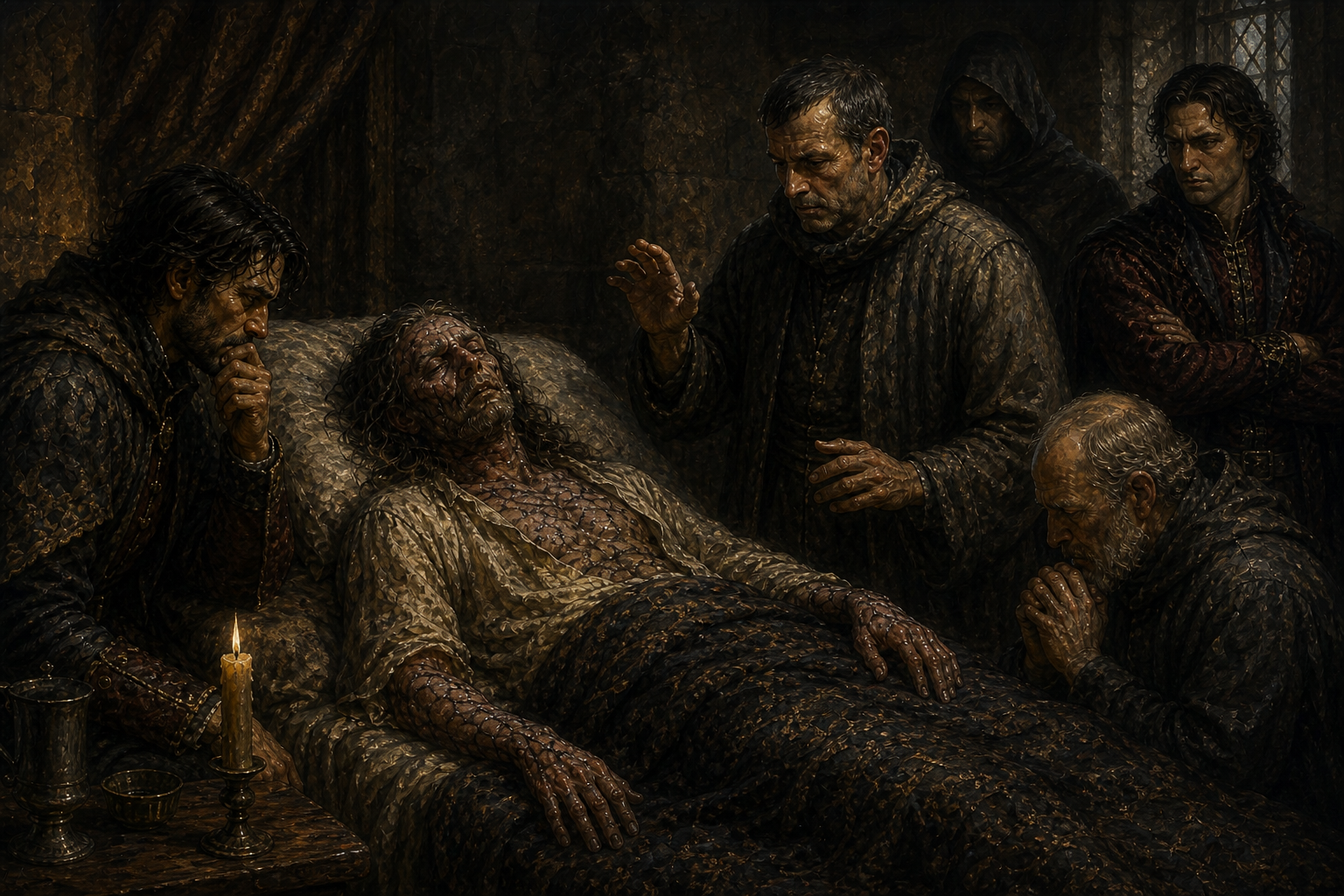
A living creature touched by the caster must resist a corrupt wasting curse. On a failure, the victim’s body begins to rot from within. The first signs are fever, sour breath, darkening veins, and pain deep in the joints. As the hours pass, weakness sets in, flesh bruises and softens, old wounds reopen, and the body begins to smell faintly of wet earth and carrion.
The caster also suffers for invoking the spell, paying a physical corruption cost as their own strength withers.
Edition Tabs
Rotting Curse of Urfestra 5.5e / 2024
Rotting Curse of Urfestra, Pathfinder 1e / 3.5e
Rotting Curse of Urfestra 3.5e
Rotting Curse of Urfestra 5.5e / 2024
Alternative Spell Name: Urfestra’s Black Rot
3rd-Level Necromancy Spell
Casting Time: 1 action
Range: Touch
Components: V, S
Duration: Until removed
Saving Throw: Constitution
Make a melee spell attack against one living creature (not undead or constructs). On a hit, the target must make a Constitution saving throw. On a failed save, the target takes 3d6 necrotic damage, and its hit point maximum is reduced by the same amount.
At the end of each hour, the target repeats the saving throw. On a failure, it takes 2d6 necrotic damage, and its hit point maximum is reduced by the same amount. If the target fails two or more of these hourly saving throws, it gains one level of exhaustion. This exhaustion can occur only once from this spell. On a success, the target suffers no effect that hour, but the curse does not end.
This curse ends only if removed by remove curse, greater restoration, wish, divine intervention, or similarly powerful magic.
If the target’s hit point maximum is reduced to 0, it dies.
Corrupt Cost: After casting the spell, the caster’s Strength score is reduced by 1d4 until the caster finishes a long rest. This reduction cannot be prevented or transferred.
Rotting Curse of Urfestra, Pathfinder 1e / 3.5e

Transmutation [Evil, Curse]
Level: Corrupt 3
Components: V, S, Corrupt
Casting Time: 1 standard action
Range: Touch
Target: One living creature touched
Duration: Instantaneous; see text
Saving Throw: Fortitude negates
Spell Resistance: Yes
The subject’s flesh and bones begin to rot. On a failed Fortitude save, the target takes 1d6 points of Constitution damage immediately, then takes 1d6 points of Constitution damage every hour until it dies or the curse is removed.
Rotting Curse of Urfestra can be removed by remove curse, wish, miracle, or comparable curse-breaking magic.
Corruption Cost: The caster takes 1d6 points of Strength damage.
Rotting Curse of Urfestra 3.5e

The subject’s flesh and bones begin to rot.
(Book of Vile Darkness, p. 102)
Originally posted on D&D tools
Transmutation [Evil]
Level: Corrupt 3
Components: V, S, Corrupt,
Casting Time: 1 action
Range: Touch
Target: Living creature touched
Duration: Instantaneous
Saving Throw: Fortitude negates
Spell Resistance: Yes
The subject takes 1d6 points of Constitution damage immediately, and a further 1d6 points of Constitution damage every hour until the subject dies or the curse is removed with a wish, miracle, or remove curse spell.
Corruption Cost: 1d6 points of Strength damage.
Why This Spell Is Dangerous in the World
Rotting Curse of Urfestra is feared because it does not need to win a battle. A handshake, a prison blessing, a touch in a crowd, or a hand laid on a sleeping victim may be enough. Once the rot begins, armour, guards, and locked doors matter less than distance from the nearest true cure.
The spell also exposes character. Who rides through the night with the cursed victim? Who refuses to touch them? Who bargains with a hag, saint, fiend, or enemy priest when ordinary healing fails? The curse turns a wound into a moral crisis.
Best Uses
Use Rotting Curse of Urfestra when the story needs pressure after the fight. It suits villains who want a victim dead slowly, publicly, or symbolically.
It also works as the engine of an adventure: the curse has landed, the cure exists, and the road to it is dangerous.
Tactics
A caster using Rotting Curse of Urfestra wants one successful touch and then distance. Disguise, invisibility, paralysis, grappling allies, crowded streets, narrow corridors, and hostage scenes all make the spell more dangerous.
In battle, the caster should use it as an opening strike or a parting curse. Once the spell lands, escape matters more than staying to fight.
DM Notes
This is severe magic for its level. Use it as forbidden villain magic, not routine enemy damage. The players should understand the stakes quickly: the victim is worsening by the hour, and ordinary healing is not enough.
For fair play, make the cure difficult but reachable. A village priest may recognise the curse but lack the power to remove it. A monastery may be one hard day away. A relic might suppress the hourly decay long enough to travel. A hag, saint, fiend, or enemy priest may know how to break it, but demand a price.
Good Combinations
- Disguise Self: Lets the caster reach the victim without appearing as a threat.
- Hold Person: Makes the touch far easier to deliver.
- Invisibility: Allows the caster to strike from a crowd or during confusion.
- Bestow Curse: Deepens the theme, but should be used carefully to avoid overwhelming the target.
- Misty Step / Dimension Door: Lets the caster land the curse and withdraw immediately before retaliation.
Adventure and Worldbuilding Hooks
The Hourly Death: A noble survives an assassination attempt, but his body begins to rot before the whole court. The gates are sealed, the killer is trapped inside, and every hour the dying man’s heirs grow less patient.
The Saint’s Delay: A shrine relic can halt the curse for one night, but not remove it. Two victims arrive before dawn, and the relic can preserve only one until help comes.
The Weak-Handed Priest: A plague-priest suspected of using the curse is visibly wasting away himself. His enemies call it proof of guilt. His followers call it proof that he carries the suffering of others.
Historical Context
Rotting Curse of Urfestra reflects a long-standing belief that disease arose from corruption and decay. In pre-modern medicine, illness was often attributed to foul air rising from rotting organic matter—carcasses, stagnant water, refuse, and unburied dead. This “bad air” was thought to carry sickness into the body, especially in places where decay was visible or smelled. Such ideas made physical rot itself a sign of danger, not just a symptom. For context on this belief, see Encyclopaedia Britannica’s overview of miasmatism.