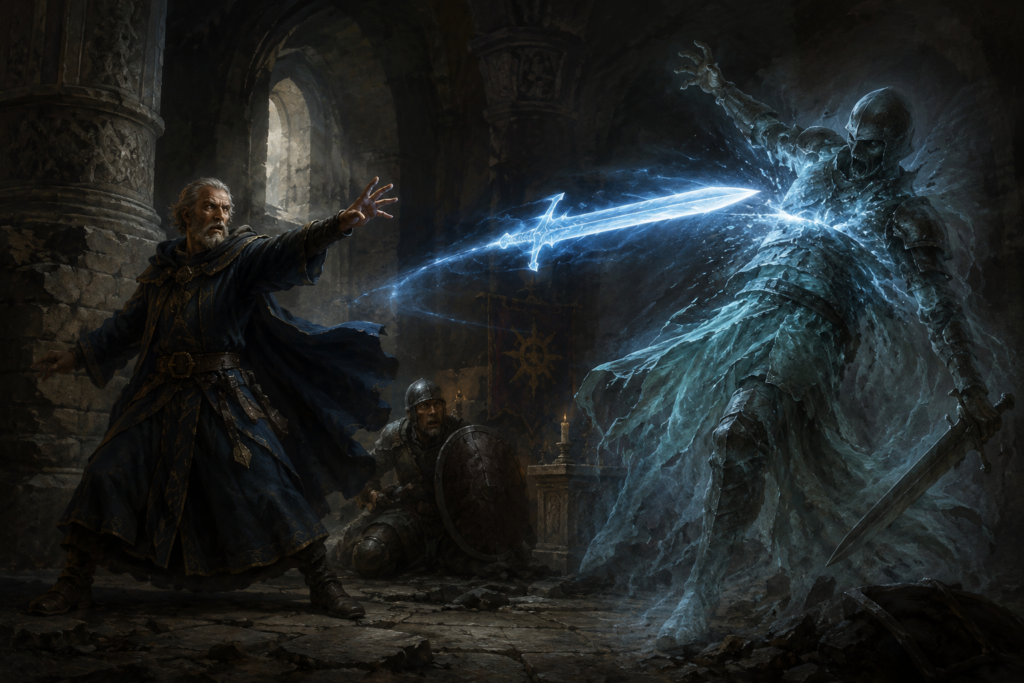
Mage’s Sword, “Thanatos Scythe” — Force Blade Spell
A blade of pure force appears in the air, cutting where the caster’s will has already condemned.

Mage’s Sword creates a hovering weapon of force that fights at the caster’s command. It is not a summoned creature, an animated weapon, or an invisible servant with a blade. It is a shaped plane of magical force: weightless, untouchable by normal weapons, and able to cut creatures that ordinary steel cannot reach.
The spell’s strength is sustained pressure. It lets a high-level caster keep damaging a dangerous enemy while using later turns for movement, defence, counterspells, or other battlefield control. Its best targets are foes who rely on distance, flight, incorporeality, ethereal movement, or the assumption that mundane weapons cannot touch them.
Effect
You bring into being a shimmering weapon-shaped plane of force. The weapon appears within range and attacks a creature you can see, beginning when you cast the spell.
The force weapon attacks once on each of your turns. It always strikes from your direction. It does not flank, does not grant flanking, does not occupy space, does not block movement, does not carry objects, and does not make opportunity attacks.
If the weapon leaves the spell’s range, passes out of your sight, or is not being directed, it returns to hover near you.
As a force effect, Mage’s Sword can strike incorporeal and ethereal creatures.
Mage’s Sword, 5.5e / 2024
Mage’s Sword, Pathfinder 1e / 3.5e
Mage’s Sword 3.0e
Mage’s Sword, 5.5e / 2024
7th-Level Evocation
Casting Time: 1 Action
Range: 60 feet
Components: V, S, M; a miniature platinum sword with a grip and pommel of copper and zinc, worth at least 250 gp
Duration: Concentration, up to 1 minute
Available To: Wizard
Alternative Spell Name: Thanatos Scythe
You create a sword-shaped plane of shimmering force in a space you can see within range. When the sword appears, make a melee spell attack against one creature within 5 feet of it. On a hit, the target takes 22 (5d8) Force damage.
Until the spell ends, you can use a Bonus Action on each of your later turns to move the sword up to 30 feet to a space you can see within range and repeat the attack against one creature within 5 feet of it.
The sword can strike incorporeal creatures and creatures you can see on the Ethereal Plane.
The sword is a magical force effect, not a creature or object. It cannot be attacked, grappled, disarmed, shoved, restrained, used as cover, used to flank, or used to make opportunity attacks.
If the sword is ever beyond the spell’s range, outside your line of sight, or not directed by you, it returns to hover within 5 feet of you. It makes no attack again until you direct it.
At Higher Levels. When you cast this spell using an 8th-level or 9th-level spell slot, the damage increases by 1d8 for each slot level above 7th.
Mage’s Sword, Pathfinder 1e / 3.5e
Evocation [Force]
Level: Sorcerer/Wizard 7
Components: V, S, F
Casting Time: 1 standard action
Range: Close; 25 ft. + 5 ft./2 levels
Effect: One sword
Duration: 1 round/level; D
Saving Throw: None
Spell Resistance: Yes
Focus: A miniature platinum sword with a grip and pommel of copper and zinc, worth 250 gp
This spell brings into being a shimmering, swordlike plane of force.
The sword strikes at any opponent within range, as you desire, beginning in the round you cast the spell. The sword attacks its designated target once each round on your turn. Its attack bonus equals your caster level + your Intelligence modifier or Charisma modifier, as appropriate, with an additional +3 enhancement bonus.
The sword deals 4d6+3 force damage, threatens a critical hit on 19–20, and has a ×2 critical multiplier. As a force effect, it can strike ethereal and incorporeal creatures.
The sword always strikes from your direction. It does not gain a flanking bonus and does not help another combatant gain one. If the sword moves beyond the spell’s range from you, goes out of your sight, or is not being directed, it returns to hover near you.
Each round after the first, you may use a standard action to switch the sword to a new target. If you do not, the sword continues to attack the previous target.
The sword cannot be harmed by physical attacks, but dispel magic, disintegrate, a sphere of annihilation, or a rod of cancellation can affect it. The sword has AC 13.
If an attacked creature has Spell Resistance, check its resistance the first time the sword strikes that creature. If the resistance succeeds, the spell is dispelled. If it fails, the sword affects that creature normally for the spell’s duration.
Mage’s Sword 3.0e

This spell brings into being a shimmering, swordlike plane of force.
This material is Open Game Content, and is licensed for public use under the terms of the Open Game License v1.0a.
Evocation [Force]
Level Sorcerer/Wizard 7
Components V, S, F
Casting Time 1 standard action
Range Close (25 ft. + 5 ft./2 levels)
Effect One sword
Duration 1 round/level (D)
Saving Throw None
Spell Resistance Yes
The sword strikes at any opponent within its range, as you desire, starting in the round that you cast the spell. The sword attacks its designated target once each round on your turn. Its attack bonus is equal to your caster level + your Intelligence bonus or your Charisma bonus (for wizards or sorcerers, respectively) with an additional +3 enhancement bonus. As a force effect, it can strike ethereal and incorporeal creatures. It deals 4d6+3 points of force damage, with a threat range of 19-20 and a critical multiplier of x2.
The sword always strikes from your direction. It does not get a bonus for flanking or help a combatant get one. If the sword goes beyond the spell range from you, if it goes out of your sight, or if you are not directing it, the sword returns to you and hovers.
Each round after the first, you can use a standard action to switch the sword to a new target. If you do not, the sword continues to attack the previous round’s target.
The sword cannot be attacked or harmed by physical attacks, but dispel magic, disintegrate, a sphere of annihilation, or a rod of cancellation affects it. The sword’s AC is 13 (10, +0 size bonus for Medium object, +3 deflection bonus).
If an attacked creature has Spell Resistance, the resistance is checked the first time Mage’s sword strikes it. If the sword is successfully resisted, the spell is dispelled. If not, the sword has its normal full effect on that creature for the duration of the spell.
Focus A miniature platinum sword with a grip and pommel of copper and zinc. It costs 250 gp to construct.
Why This Spell Is Dangerous in the World
Mage’s Sword is dangerous because it separates violence from the body. The caster does not need to stand beside the victim, swing a weapon, expose an arm, or risk a counterstroke. The blade hangs in the air and continues its work while the caster thinks, watches, and chooses.
Against guards, soldiers, and duelists, the spell is frightening because there is no solid weapon to parry. Shields meet empty light. Spears pass through it. Arrows do nothing. Even disciplined warriors can be forced to defend against an attacker that cannot be disarmed.
Against supernatural foes, the spell is worse. Ghosts, shades, ethereal spies, and incorporeal assassins often rely on being unreachable. Mage’s Sword punishes that confidence.
Best Uses
Use Mage’s Sword when the caster needs continuing damage without standing in melee. It is especially strong against incorporeal enemies, flying spellcasters, enemy commanders, monsters with dangerous reach, and foes who expect mundane weapons to fail.
It is also useful when the caster wants to split pressure. The sword can harry one enemy while the caster uses other spells to lock down the battlefield, protect allies, counter enemy magic, or withdraw from danger.
Tactics
The spell should usually be aimed at a high-value target. Enemy spellcasters, flying threats, ghosts, assassins, wounded champions, and protected commanders are all better targets than ordinary infantry.
The caster should protect line of sight. Corners, fog, magical darkness, invisibility, and forced movement can all reduce the spell’s value. The sword is relentless, but it is not independent.
A caster using the Thanatos Scythe version can lean into execution imagery: the crescent blade hovering behind a doomed target, the caster raising one hand like a judge, the force-edge falling again and again while allies hold the victim in place.
DM Notes
Mage’s Sword should not become a free extra fighter. It does not flank, hold ground, block corridors, carry objects, threaten opportunity attacks, or act on its own initiative. It is a directed magical attack, not a summoned warrior.
Unlike lower-level force-weapon spells, Mage’s Sword is a high-level killing spell: it has better target access, stronger damage, and a more explicit role against incorporeal or ethereal enemies, but it still depends on concentration, sight, and the caster’s action economy.
For the 5.5e / 2024 version, Concentration is the main balance control. The spell is powerful when it lasts, but a caster who is struck, blinded, forced behind cover, or made to lose line of sight can lose much of its value.
For the Pathfinder 1e / 3.5e version, the important limits are action economy, line of sight, range, and Spell Resistance. The sword’s damage is steady rather than explosive, so its threat comes from persistence and target access rather than a single overwhelming strike.
Good Combinations
- Hold Monster: Keeps a dangerous target in place while the sword continues attacking.
- Wall of Force: Lets the caster divide the battlefield while the sword pressures a creature on the accessible side.
- True Seeing: Helps the caster keep valid sight of targets that rely on invisibility, illusion, or ethereal tricks.
- Fly: Allows the caster to maintain range and sight while avoiding melee retaliation.
- Counterspell or Dispel Magic: Stops enemy escape, concealment, or defensive magic before it breaks the spell’s pressure.
Spellcasting Culture and Worldbuilding Hooks
Battle-mages treat Mage’s Sword as a spell of disciplined killing. It is not a duelist’s flourish. It is the art of placing a blade where no hand can reach.
Underworld cults, death-priests, and Hellenic necromancers may teach the spell as Thanatos Scythe, presenting the force blade as the clean edge of appointed death. In that tradition, the spell is not described as rage or murder, but as inevitability: the named target has already been chosen, and the scythe merely completes the sentence.
Royal courts fear the spell because it bypasses many ordinary assumptions of protection. A bodyguard can step between a killer and a ruler; it is harder to step between a ruler and a blade of force that appears in the air.
Adventure and Worldbuilding Hooks
The Sword That Waits: A dead archmage’s sanctum still contains a hovering force blade that returns to life whenever a forbidden door is opened.
The Death-Warrant Scythe: A Hellenic death-cult marks condemned traitors with black wax seals. When the seal breaks, a Thanatos Scythe appears and begins its work.
The Wound Without a Weapon: A prince is found dying behind locked doors, cut by a blade no guard saw and no armour could turn. The court searches for an assassin, but the real clue is the faint trace of force magic left in the room.
Source and Literary Context
Mage’s Sword is adapted from the Open Game Content version of the spell in the 3.5 System Reference Document, where it appears as a 7th-level evocation that forms a swordlike plane of force. For the original SRD spell text, see d20 SRD: Mage’s Sword.
The spell’s image belongs to the older literary tradition of supernatural weapons: blades that carry authority beyond ordinary steel, strike enemies that cannot be reached by mundane force, or embody the will of a ruler, god, hero, or magician. Famous examples include enchanted swords in heroic and Arthurian tradition, where the weapon is often more than equipment: it is a sign of power, judgement, legitimacy, or fate.
The alternate name Thanatos Scythe gives the spell a darker, underworld-facing identity. Thanatos is the Greek personification of death, the son of Nyx and brother of Hypnos. Classical sources usually associate him with the allotted end of life rather than battlefield slaughter; Theoi notes his connection with non-violent death, while Britannica describes him as carrying mortals away when their fated time has expired. For reference, see Theoi: Thanatos and Encyclopaedia Britannica: Thanatos.
The scythe image is therefore a later visual adaptation for this campaign version of the spell, not a claim that Thanatos was originally a scythe-bearing reaper. Used carefully, the name works because the spell behaves less like a duelist’s weapon and more like an appointed magical sentence: a force-blade sent to find a chosen victim.
Buy me a coffee