
Sigmund Völsungsson — Norse Hero, Bearer of Gram, Father of Sigurd
Sigmund Völsungsson — Norse Hero, Bearer of Gram, Father of Sigurd
The doomed Völsung hero whose sword was given by Odin, broken by Odin, and left as destiny for Sigurd.
- Full Name: Sigmund Völsungsson
- Common Name: Sigmund
- Other Forms: Sigemund, Sigmundr
- Gender: Male
- Race: Human, Völsung bloodline
- People / House: House of Völsung
- Tradition: Norse and Germanic heroic legend
- Religion: Asgardian Pantheon; especially Odin as giver, tester, and breaker of his fate
- Occupation: Völsung prince, exile, avenger, later king, war-leader, mythic ancestor
- Homeland: The hall and lands of the Völsungs
- Base of Operations: Völsung halls, forest refuges during exile, later his royal court
- Languages: Northern heroic speech; court and war-tongues appropriate to neighbouring kingdoms
- Alignment: Lawful Neutral, strained by ruthless blood-feud and divine doom
- Affiliations: House of Völsung; Odin’s chosen bloodline; the inheritance of Gram
- Allies: Signy, Sinfjötli, Hjördis, loyal Völsung retainers
- Enemies: Siggeir, rival kings, oath-breakers, betrayers of guest-law and kinship
- Significant Relatives: Völsung, Signy, Sinfjötli, Helgi, Hjördis, Sigurd
- Signature Item: Gram, the divine sword drawn from Barnstokkr and later broken
- Suggested Role: Major named NPC, tragic king, doomed ally, ancestral patron, fate-marked war-leader
Sigmund is the great tragic hinge of the Völsung line. He is not merely the father of Sigurd and not merely the man who once bore Gram. He is the hero in whom Odin’s favour, family vengeance, royal inheritance, and doom first become inseparable.
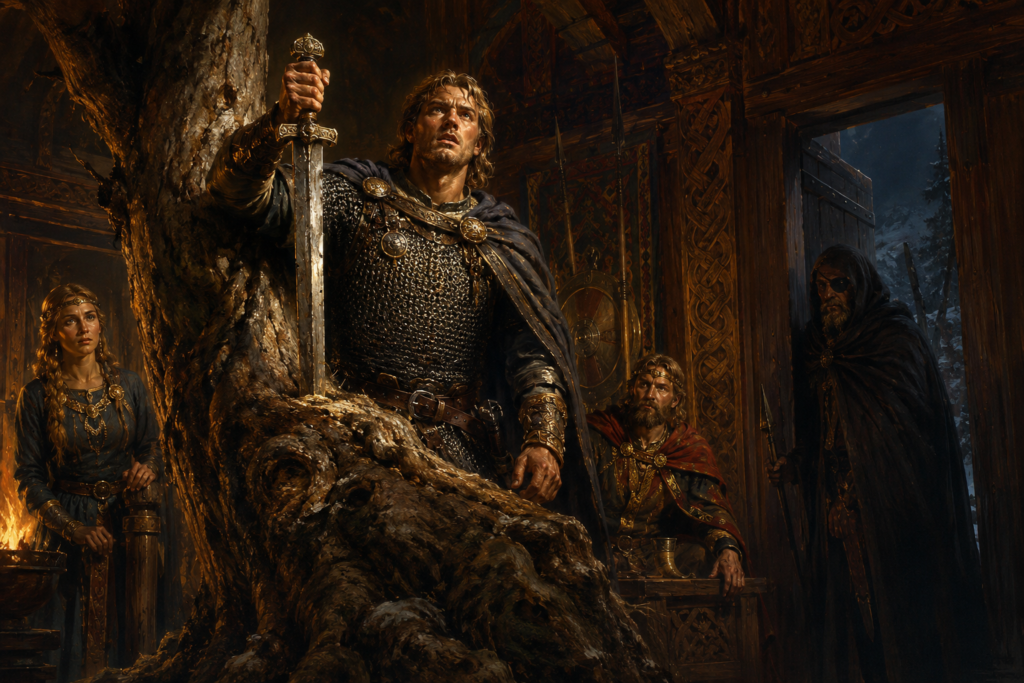
His story begins in splendour and betrayal. At the wedding feast of Signy and King Siggeir, a one-eyed stranger drives a sword into the great tree Barnstokkr. Only he can draw it out. The gift marks him as chosen, but it also makes him dangerous. Siggeir’s envy and treachery help bring ruin upon the Völsungs, leaving Sigmund to survive as exile, avenger, and eventual king.
In play, Sigmund should feel like a man forged by survival rather than a simple heroic champion. He is brave, commanding, and capable of deep loyalty, but he has lived too long inside blood-debt to be gentle. He believes kinship must be answered, oaths must be paid, and treachery must be remembered until it is burned out.
His greatness is real. So is the damage it causes.
Sigmund Is Not Sigurd
Sigmund should not be written or run as a lesser copy of Sigurd.
Sigurd is the dragon-slayer, the inheritor, the young hero whose life turns toward Fafnir, Brynhild, treasure, betrayal, and fatal glory. He is the ruined ancestor who prepares that inheritance before Sigurd can ever claim it. His story is older, harder, and more rooted in kinship, exile, oath, vengeance, and the terrible cost of divine selection.
Where Sigurd’s legend often feels like the heroic blaze of youth, Sigmund’s feels like iron surviving the fire. His importance is not that he does everything his son later does. His importance is that he leaves behind the bloodline, the broken sword, and the unfinished doom.
Appearance
Sigmund is a hard, broad-shouldered northern king, scarred by forest life and war. In youth he has the force of a chosen prince; in exile he becomes leaner, quieter, and more dangerous; in age he carries the austere dignity of a ruler who knows the gods do not give gifts freely.
He wears mail, heavy cloak, oath-rings, and war-gear rather than soft court finery. His hands are scarred. His gaze is steady. Even seated in a hall, he looks prepared for ambush.
Gram should never appear like an ornamental fantasy weapon. It should look ancient, severe, and god-touched: a sword too clean in a bloody world, magnificent without decoration, more terrible because it does not need to announce itself.
Character
Sigmund’s defining virtue is endurance.
His defining flaw is that he confuses endurance with rightness.
He can suffer, wait, hide, and strike. He can command warriors because he has known hunger, concealment, grief, and humiliation. He respects courage, silence under pain, loyalty to kin, and oaths kept when keeping them costs something.
He does not trust easy mercy. He has seen hospitality turn into murder and marriage become a trap. When blood is owed, he does not ask whether revenge will heal the wound. He asks whether the dead have been answered.
What Sigmund Wants
Sigmund wants the Völsung line to survive dishonour, treachery, and erasure.
That desire changes shape across his life:
- As a prince, he wants to prove worthy of Odin’s sword.
- As a fugitive, he wants the murdered Völsungs avenged.
- As a war-leader, he wants Siggeir destroyed.
- As a king, he wants his house restored.
- As a dying father, he wants the broken sword and the unborn heir protected.
He does not seek peace for its own sake. Peace without justice feels like surrender.
What Sigmund Fears
Sigmund does not fear death. He fears surviving for nothing.
He fears being the last living branch of a cut-down house. He fears that Odin’s gift was never a blessing, but a summons. He fears that the Völsungs are not loved by the god who marks them, only sharpened.
His deepest fear is that his whole life may be preparation for a destiny that belongs to someone else.
Role in the Campaign
The Chosen Prince
Sigmund draws the sword from the tree when every other warrior fails. The party may witness the moment and immediately understand that the feast has changed. A divine gift has entered the hall, and every ambitious man in the room has seen it.
The Hidden Avenger
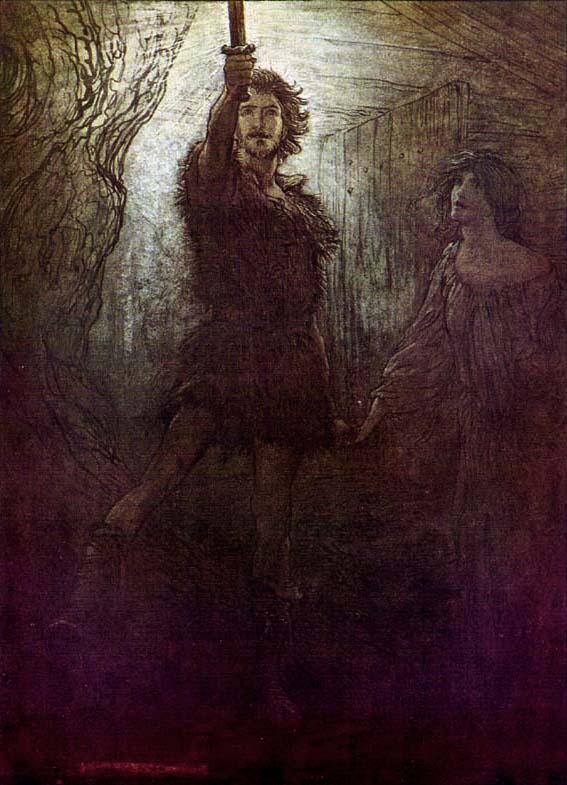
After the fall of his house, he survives in the forest. He is not waiting to be rescued. He is waiting until vengeance becomes possible. Helping him means entering a feud where justice is real, but mercy may be treated as weakness.
The Hard King
Sigmund rules after suffering, and suffering has made him dangerous. His hall offers honour, wealth, and protection, but every oath there matters. He may reward the party richly, but he will not forgive betrayal, cowardice, or clever neutrality when kin-blood is at stake.
The Dying Ancestor
Sigmund’s final battle is not about victory. It is about inheritance. When Odin breaks Gram, Sigmund’s story begins to pass into Sigurd’s. The party may be charged with protecting Hjördis, carrying the broken sword, or ensuring the unborn child survives long enough to receive his father’s fate.
Sigmund in the World
Sigmund’s name carries the force of a warning.
Warriors invoke him when speaking of chosen swords, murdered kin, vengeance after exile, and kings who survive the ruin of their houses. His story is not used to teach comfort. It teaches that divine favour may be indistinguishable from divine use.
Among northern courts, Sigmund is admired, feared, and argued over. To praise him is to praise courage, endurance, and blood-loyalty. To study him too closely is to notice that every gift he receives becomes a wound for someone else.
Bards do not sing of Sigmund because he is safe. They sing of him because his life explains why greatness is dangerous.
Edition Tabs
Sigmund Völsungsson D&D 5.5e / 2024
Sigmund Völsungsson Pathfinder 1e
Sigmund Völsungsson D&D 5.5e / 2024
Medium Humanoid, Lawful Neutral
Armor Class 19; mail, shield, heroic battlecraft
Initiative +6
Hit Points 202; 27d8 + 81
Speed 30 ft.
Proficiency Bonus +5
Saving Throws Str +11, Dex +7, Con +8, Wis +8, Cha +8
Skills Athletics +11, Insight +8, Intimidation +8, Perception +8, Persuasion +8, Survival +8
Senses passive Perception 18
Languages Northern heroic speech, courtly and battlefield tongues appropriate to neighbouring realms
Challenge 15; 13,000 XP
| STR | DEX | CON | INT | WIS | CHA |
|---|---|---|---|---|---|
| 23 (+6) | 15 (+2) | 17 (+3) | 14 (+2) | 16 (+3) | 17 (+3) |
Traits
Völsung Endurance. Once per long rest, when Sigmund is reduced to 0 hit points but not killed outright, he drops to 1 hit point instead.
Oath-Hardened. Sigmund has advantage on saving throws against being frightened or magically compelled to abandon sworn kin, a blood-debt, or an oath-bound ally.
Blood-Feud Focus. As a bonus action, Sigmund marks one creature he can see that has betrayed an oath, harmed his kin, injured an ally, or attacked him. For 1 minute, Sigmund deals an extra 1d8 damage to that creature once per turn and has advantage on Wisdom checks made to track or read it.
Bearer of Gram. While Gram is whole and in Sigmund’s possession, his weapon attacks are magical. Gram functions as a +3 greatsword. The version below assumes Sigmund wields it in two hands.
Actions
Multiattack. Sigmund makes three attacks with Gram.
Gram. Melee Weapon Attack: +14 to hit, reach 5 ft., one target. Hit: 16 (2d6 + 9) slashing damage plus 7 (2d6) force damage. Against a creature marked by Blood-Feud Focus, Sigmund deals an extra 4 (1d8) damage once per turn.
Spear. Melee or Ranged Weapon Attack: +11 to hit, reach 5 ft. or range 20/60 ft., one target. Hit: 10 (1d8 + 6) piercing damage, or 11 (1d10 + 6) piercing damage if wielded in two hands.
Shield Bash. Melee Weapon Attack: +11 to hit, reach 5 ft., one target. Hit: 9 (2d4 + 6) bludgeoning damage. If the target is Large or smaller, it must succeed on a DC 19 Strength saving throw or be knocked prone.
King’s Command. Sigmund chooses up to three allied creatures within 60 feet who can hear him. Each chosen ally may use its reaction to move up to half its speed without provoking opportunity attacks or make one weapon attack.
Vengeance Stroke. Sigmund makes one attack with Gram against a creature marked by Blood-Feud Focus. On a hit, the attack deals an extra 17 (5d6) slashing damage. If the target has betrayed an oath, murdered kin, or broken guest-law, it must succeed on a DC 17 Wisdom saving throw or be frightened of Sigmund until the end of his next turn. Recharge 5–6.
Bonus Actions
Mark the Betrayer. Sigmund uses Blood-Feud Focus.
War-Leader’s Advance. Sigmund moves up to 15 feet toward a hostile creature he can see. This movement does not provoke opportunity attacks from the target of his Blood-Feud Focus.
Reactions
Parry. Sigmund adds 4 to his AC against one melee attack that would hit him. He must see the attacker and be wielding a melee weapon.
Break the Line. When a creature within 5 feet misses Sigmund with a melee attack, Sigmund makes one Gram attack against that creature.
Legendary Actions
Sigmund can take 3 legendary actions, choosing from the options below.
Move. Sigmund moves up to half his speed without provoking opportunity attacks.
Strike. Sigmund makes one Gram attack.
Command Ally. One allied creature within 60 feet who can hear Sigmund moves up to half its speed or makes one weapon attack.
Old Grief Made Steel. Sigmund targets one creature marked by Blood-Feud Focus. Until the start of Sigmund’s next turn, that creature cannot benefit from being hidden from Sigmund unless it has total cover.
Fate Scene: Odin Breaks the Sword
This is not a normal combat feature. Use it only when Sigmund’s destined death is part of the campaign.
In the Völsung tradition, Odin first gives the sword through the one-eyed stranger at Barnstokkr, then later intervenes in battle and breaks Sigmund’s sword. Sigmund dies soon after, and the broken sword eventually becomes Sigurd’s inheritance.
At the table, this should be a major story event, not a way to weaken Sigmund randomly. Once Gram is broken, Sigmund loses Bearer of Gram and cannot use Völsung Endurance in that scene. The broken sword remains sacred and can later be reforged for Sigurd.
Sigmund Völsungsson Pathfinder 1e
Male human fighter 11 / barbarian 3 / noble scion 2
LN Medium humanoid
Init +6; Senses Perception +17
Defense
AC 29, touch 14, flat-footed 27; +10 armor, +3 shield, +2 Dex, +3 deflection, +1 natural
hp 211; 16 HD
Fort +16, Ref +9, Will +11
Defensive Abilities bravery +3, improved uncanny dodge, indomitable bloodline 1/day; DR 2/— while raging
Offense
Speed 30 ft.
Melee Gram +29/+24/+19/+14 (2d6+18/17–20 plus 2d6 force)
Melee Alternative spear +26/+21/+16/+11 (1d8+11/x3)
Special Attacks blood-feud challenge, rage 15 rounds/day, weapon training
Statistics
Str 23, Dex 14, Con 18, Int 14, Wis 16, Cha 17
Base Atk +16; CMB +22; CMD 37
Feats Cleave, Combat Reflexes, Critical Focus, Dazzling Display, Furious Focus, Great Cleave, Improved Critical, Improved Initiative, Intimidating Prowess, Iron Will, Leadership, Power Attack, Toughness, Weapon Focus, Weapon Specialization
Skills Diplomacy +18, Intimidate +25, Knowledge nobility +16, Perception +17, Ride +15, Sense Motive +17, Survival +17
Languages Northern heroic speech; courtly and battlefield tongues appropriate to neighbouring realms
SQ armor training, kingly bearing, oath-bound reputation
Gear Gram, heavy mail, heavy shield, cloak of resistance +3, ring of protection +3, oath-rings, royal torc, war gear
Special Abilities
Gram. Gram is a +3 keen greatsword. In Sigmund’s hands, it deals an additional 2d6 force damage against creatures bound to divine fate, oath-breaking enemies, and foes marked by blood-feud challenge.
Blood-Feud Challenge. Three times per day as a swift action, Sigmund may challenge one visible enemy that has harmed him, his kin, his allies, or his honour. Against that enemy, he gains a +3 morale bonus on attack rolls, damage rolls, Sense Motive checks, Survival checks to track, and Will saves against fear or compulsion effects created by that foe. This lasts for 1 minute or until the foe is defeated.
Indomitable Bloodline. Once per day, when Sigmund would be reduced below 0 hit points, he instead remains at 1 hit point. This does not function during the fate scene in which Odin breaks Gram.
Kingly Bearing. Allied warriors within 30 feet gain a +2 morale bonus on saving throws against fear while Sigmund is conscious and fighting.
Oath-Bound Reputation. Sigmund gains a +4 circumstance bonus on Diplomacy and Intimidate checks when dealing with warriors, kings, exiles, oath-bound companies, and those who know the Völsung name.
Destined Breaking of Gram. In Sigmund’s final fate-scene, Gram may be broken by divine intervention. This should not be used as an ordinary disarm or sundering effect. The broken fragments remain sacred and can later be reforged.
Equipment and Treasure
Sigmund’s possessions should feel inherited, political, and dangerous. They are not random loot.
Gram, Whole or Broken. The defining treasure of Sigmund’s story. If whole, it is a major legendary weapon. If broken, its fragments are more valuable as destiny than as metal.
Völsung Oath-Rings. Heavy rings of gold or silver used to seal alliances, blood-debts, and war-vows. A single ring may be worth 500–1,500 gp, but returning one to the correct heir may be worth more than selling it.
King’s Torc. A royal marker of Völsung authority. Worth around 2,500 gp as treasure, but politically dangerous in the wrong hands.
Wolf-Hide Cloak. A grim heirloom from exile. It may be mundane, or in a mythic campaign it may grant advantage or a small bonus on Survival checks in winter forests and wild country.
War Hoard. Sigmund’s hall may contain 10,000–16,000 gp in mixed wealth: arm rings, amber, silver, sword fittings, mail, horses, captured banners, oath-gifts, and royal feast vessels.
GM Boundaries
Sigmund’s source tradition includes dark material: massacre, revenge killing, incestuous lineage, coercive family duty, and the use of children as instruments of vengeance. Those elements are part of the tragedy of the Völsung cycle, but they do not need to be staged directly at the table.
For most campaigns, the strongest approach is to keep the darkest material in background lore, bardic warning, inherited shame, or the private knowledge of Sigmund and Signy. The players can feel the moral weight of the story without being forced into scenes that derail the campaign or make the table uncomfortable.
Use Sigmund’s darker inheritance to create consequence, not shock. The useful play material is not the transgression itself, but what it leaves behind: a damaged bloodline, a revenge that costs too much, a house that survives by becoming frightening, and a hero who cannot tell whether he has preserved his family or cursed it further.
Adventure Hooks
The Sword in the Tree
A one-eyed stranger drives a sword into the living tree at the centre of a royal hall. No warrior can draw it until Sigmund steps forward. The party must decide whether to protect the chosen man, calm the jealous kings, or investigate why the god has marked this feast.
The Last Völsung in the Wood
Sigmund survives the destruction of his house and hides in the forest under a false name. His enemies believe the Völsung line is finished. Sigmund asks for aid, but his plan is not escape. It is revenge.
The Broken Blade Must Travel
After Sigmund’s final battle, Hjördis must be escorted through hostile lands with the fragments of Gram. Rival kings, oath-breakers, spies, and supernatural watchers all know the unborn child matters.
Using Sigmund at the Table
Sigmund works best when he creates pressure, not when he simply hands out quests.
His requests should be honourable but costly. His enemies should be treacherous enough that the party understands his rage, but his revenge should still trouble them. He should never become a bland “good king” figure. He is a man shaped by divine favour, massacre, exile, and family obligation.
Strong Sigmund scenes include:
- a feast where the sword in the tree changes the future of every guest;
- a forest refuge where survival has become a sacred discipline;
- a private oath before a revenge killing;
- a battlefield where Odin’s favour turns cold;
- a deathbed charge to protect Hjördis, Sigurd, and the broken sword.
Source and Literary Context
Sigmund is a major hero of the Völsung cycle, especially the Völsunga Saga. He is the son of Völsung, brother of Signy, father of Sinfjötli and Sigurd, and the first great bearer of the sword later associated with Sigurd. In the saga, a mysterious one-eyed figure places the sword in Barnstokkr, and Sigmund alone draws it out. Later, Odin intervenes in battle and Sigmund’s sword is broken, allowing the inheritance of Gram to pass toward Sigurd. For a public-domain English version, see William Morris and Eiríkr Magnússon’s translation, The Story of the Volsungs.
Sigmund also belongs to the wider Germanic heroic tradition. A related form of the name, Sigemund, appears in Beowulf, where he is remembered as a dragon-slaying hero in the older heroic memory of the Germanic peoples. For a public-domain English translation of Beowulf, including the Sigemund passage, see Project Gutenberg’s edition of Beowulf.
For campaign use, Sigmund is strongest when treated as the tragic ancestor of the Sigurd story rather than as Sigurd’s duplicate. His legend is about the sword before it is reforged, the bloodline before it reaches its most famous hero, and the cost of being chosen before anyone knows what the choice truly means.
Keep this reference growing
If this page helped with your reading or game, you can support its upkeep or explore the curated books.
Explore the Bookshop — epics, classics and stories behind imagined worlds.