
Clay Pitcher — Common Adventuring Gear and Household Vessel
Clay Pitcher — Common Adventuring Gear and Household Vessel
A Clay Pitcher is a simple fired earthenware vessel with a handle and pouring lip, used to carry, pour, and serve small amounts of water, ale, wine, milk, oil, or wash water.
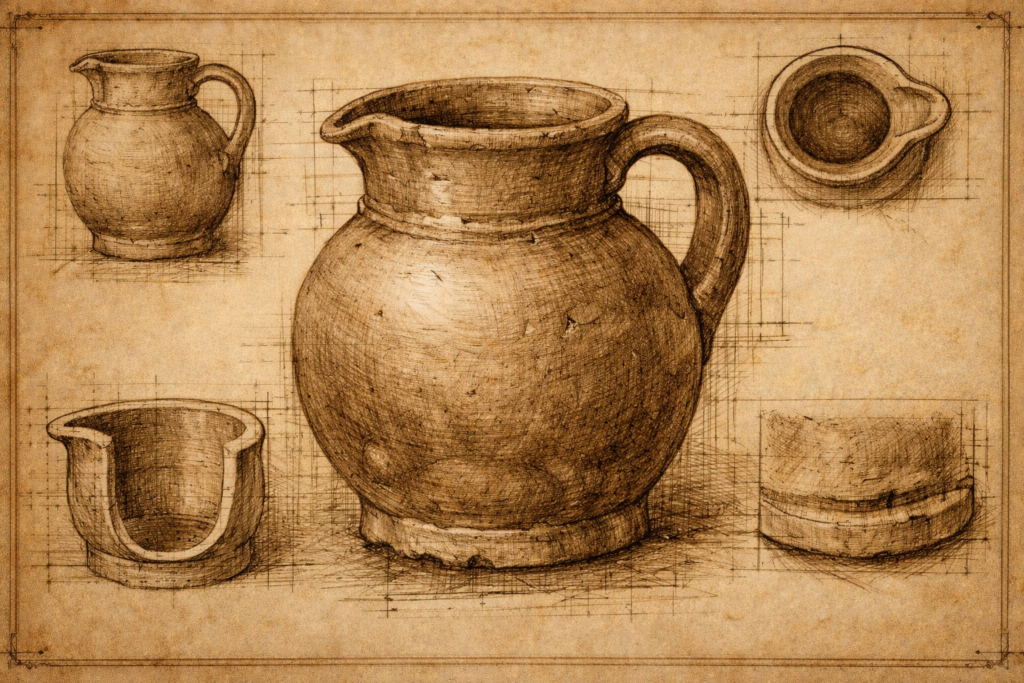
A Clay Pitcher is one of the simplest household vessels in common use: a handled clay container with an open top and a shaped lip for pouring. It holds enough liquid for a table, a work crew, a sickroom, a ritual washing, or a short journey from well to hearth.
Unlike a sealed jug, a clay pitcher is made for immediate use. It is meant to be filled, carried, poured, and set down again. It belongs in kitchens, taverns, guesthouses, workshops, shrines, stables, sickrooms, camps, and market stalls.
A clay pitcher is cheap, breakable, and easily overlooked, but it is part of the working life of almost every settled place. Adventurers may use it for water, ale, wine, milk, oil, dye, sand, small offerings, or anything else that can be carried carefully and poured out again.
Description
They are usually made from fired earthenware, with a rounded body, an open neck, a single handle, and a pouring groove or lip. Most are plain, though better examples may be glazed, painted, stamped with a potter’s mark, or darkened from long use near a hearth.
Its greatest weakness is obvious: it breaks. Dropped onto stone, struck in a fight, or packed carelessly in a saddlebag, a clay pitcher is likely to crack or shatter. That fragility is also part of its usefulness. A pitcher can be broken deliberately to scatter liquid, create noise, expose hidden contents, mark a threshold, or leave a trail of shards.
Why the Item Matters
A clay pitcher is not heroic gear, but it makes places feel lived in. It gives a table something to serve from, a healer something to wash with, a servant something to carry, and a tavern something to break when a brawl begins.
In play, a clay pitcher is a practical prop. It can hold clean water in a sickroom, sour wine in a poor inn, lamp oil in a cellar, watered ale in a guardhouse, dye in a workshop, or consecrated water beside a local shrine. It is small enough to be ordinary and useful enough to appear almost anywhere.
Failure, Risk, and Limitations
A clay pitcher is not a secure container. It has no stopper, does not travel well when full, and is poorly suited to carrying liquid over long distances. For that, a skin, flask, bottle, or sealed jug is usually better.
It is also fragile. A clay pitcher may crack if dropped, crushed, frozen while full, packed badly, or struck by a weapon. If used as an improvised thrown object, it should normally shatter on impact.
Value in the World
Clay pitchers are common goods made by village potters, town kilns, monastery workshops, and urban ceramic sellers. They are bought by households, inns, brewers, dairies, apothecaries, temples, market cooks, and anyone who needs a cheap vessel for pouring liquid.
A fine pitcher may be decorated, but the ordinary clay pitcher is a working object. Its value lies not in beauty but in the simple fact that every kitchen, stable, hall, and washroom needs something to pour from.
Trade, Craft, and Common Variants
- Rough Clay Pitcher, 1 cp: A crude local vessel, unevenly fired and likely to chip. Suitable for water, ale, or wash use, but not a reliable travelling container.
- Plain Clay Pitcher, 2 cp: The standard adventuring and household version. It holds 1/2 gallon, weighs about 1/2 lb. empty, and weighs about 5 lb. when filled with water, wine, or ale.
- Glazed Clay Pitcher, 5 cp: A better household pitcher with a smoother inner surface, easier to clean and less likely to sour milk, wine, or ale.
- Painted or Stamped Clay Pitcher, 1 sp: A decorated vessel bearing a potter’s mark, household sign, tavern emblem, or simple regional pattern.
- Large Table Pitcher, 5 cp: A broader serving vessel for inns, feasts, and work crews. It holds about 1 gallon when full but is awkward to carry far.
Using a Clay Pitcher in Your Game
Use a clay pitcher when a scene needs something ordinary and physical. It can sit on a tavern table, beside a sickbed, near a shrine basin, in a dairy, outside a stable, or on the floor of a prison cell.
It can also become useful in small ways. A character might pour water across a dusty floor to reveal tracks, carry oil to spread before a fire, use the pitcher as a distraction, hide a key beneath it, listen at a wall through its mouth, or smash it to create noise during an escape.
Clay Pitcher 5.5e / 2024
Clay Pitcher, Pathfinder
Clay Pitcher
Adventuring Gear
Cost: 2 cp
Weight: 1/2 lb. empty; about 5 lb. filled with water, ale, or wine
Capacity: 1/2 gallon
This basic clay pitcher has a handle and an open top with a shaped lip for pouring. It can hold up to 1/2 gallon of liquid.
A clay pitcher is fragile. If dropped onto a hard surface, struck, or used as an improvised thrown object, it usually breaks unless the DM decides otherwise. A broken pitcher may leave sharp ceramic shards and spill whatever it contained.
Clay Pitcher
Source: Core Rulebook
Price: 2 cp
Weight: 5 lb. when filled with water, wine, or ale
Empty Weight: about 1/2 lb.
Capacity: 1/2 gallon
Category: Adventuring Gear
This basic clay pitcher has a handle and an open top with a groove for easy pouring. It holds 1/2 gallon of liquid. The listed weight is for a pitcher filled with water, wine, or ale; empty, it weighs about 1/2 pound.
Adventure and Worldbuilding Hooks
- The Pitcher at the Door: A clay pitcher of water is left outside a locked room every morning, but today the pitcher is full of wine, blood, saltwater, or ash.
- The Potter’s Mark: A broken pitcher found near a crime scene bears the stamp of a kiln that supposedly closed years ago.
- The Sickroom Vessel: A healer’s pitcher keeps refilling with cold water from no visible source. The household calls it a blessing, but something beneath the floor is answering every prayer.
- The Tavern Shard: A brawl begins with a smashed pitcher, and one of the shards reveals a hidden scrap of parchment baked inside the clay.
For historical examples of medieval earthenware vessels, see The Metropolitan Museum of Art’s European glazed earthenware pitcher, 1400–1600 and The Metropolitan Museum of Art’s British partially glazed earthenware jug, late 1400s or early 1500s.