
Arborea – Plane of Passionate Freedom
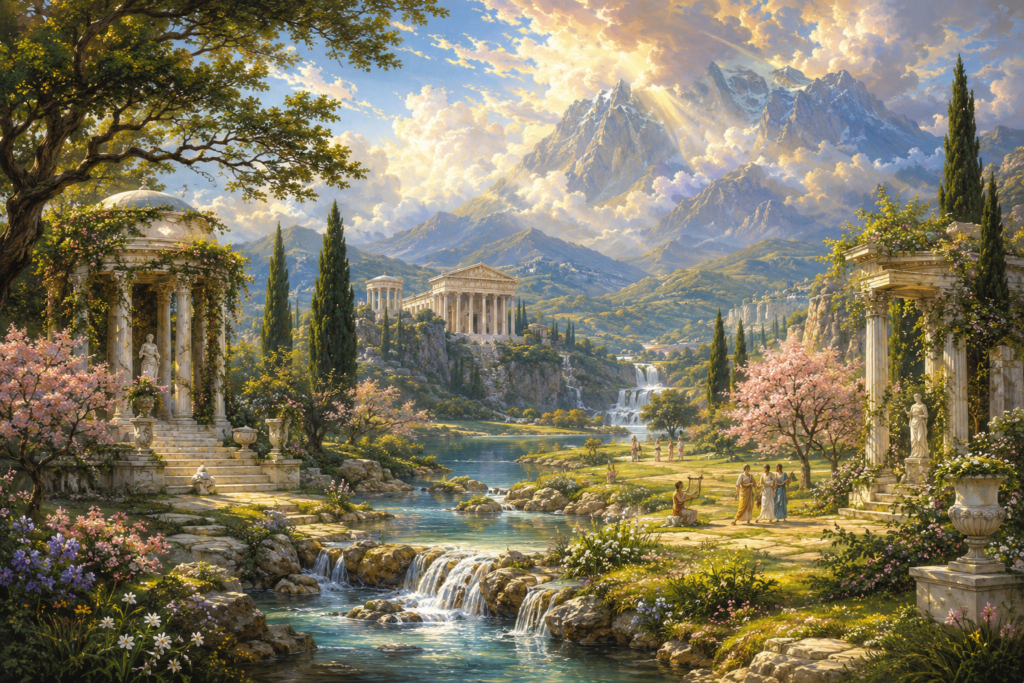
Arborea is the Upper Plane where freedom, emotion, beauty, memory and artistic creation possess the power to reshape the world.
Plane Profile
- Plane Type
- Outer Plane
- Cosmic Region
- Upper Outer Planes
- Moral Gravity
- Chaotic Good
- Common Names
- Arborea, the Passionate Heaven
- Layers
- The Olympian Glades, Ossa and Pelion
- Extent
- Infinite and immeasurable
- Gravity
- Normal across most inhabited regions
- Time
- Normally passes at the same rate as the Material Plane
- Planar Nature
- Divinely morphic and emotionally responsive
- Primary Expression
- Freedom through emotion, art, hospitality, love, grief, celebration, memory and heroic choice
- Major Divine Realms
- Mount Olympus, Mount Zaphon, Aegae, the Elder Waters, Yam’s Waters, Hawaiki, Pelion’s surviving Elder Courts and Hyperion’s elder estates
- Primary Inhabitants
- Petitioners, celestials, nymphs, dryads, satyrs, centaurs, sea peoples, sacred animals, heroes and Titan-age communities
Overview
Arborea is the plane of passionate freedom.
Its forests rise higher than mortal towers. Its mountains carry divine halls above the storms. Its seas answer songs sung on distant shores. Vineyards preserve memories within their fruit, flowers open when beloved names are spoken and valleys change colour as their people celebrate or mourn.
Everything in Arborea feels intensely alive.
Joy becomes festival. Grief becomes rain. Love becomes shelter. Anger becomes thunder. Inspiration shines as visible light. Memory takes root in orchards, statues and songs. Courage opens passages through mountains, while shame, jealousy and possessiveness may close them again.
The plane welcomes powerful emotion, but passion gains worth through what it creates, protects and allows others to become.
A ruler may command respect, but title alone cannot compel loyalty. A host may protect a guest, but cannot turn hospitality into captivity. Lovers may promise devotion, but neither may claim ownership of the other. A poet may rebuke a god when the poem carries truth. A hero may reject a divine command and remain honourable.
Arborea is beautiful, generous and dangerous. Its greatest perils are celebration without rest, love turned possessive, grief preserved as a weapon, anger emptied of mercy, memory rewritten for power and beauty treated as something to own.
The Nature of Arborea
Arborea stands philosophically between the Beastlands and Ysgard within the Upper Outer Planes.
The Beastlands expresses freedom through instinct, wilderness, migration and animal life. Ysgard expresses it through courage, struggle, contest and heroic defiance. Arborea expresses freedom through feeling, relationship, art, celebration, remembrance and the power to become someone new.
Its chaos is living choice. Communities form around friendships, sacred duties, artistic movements, shared grief and common causes. People remain because they choose to remain. Settlements divide when their purposes diverge, reunite when old injuries are answered and transform themselves without waiting for distant permission.
Its goodness is active. Arborea resists slavery, magical domination, humiliation, historical erasure and pleasure founded upon another person’s suffering. It honours hospitality, generosity and protection while demanding that those virtues remain freely given.
Anger, rivalry, sorrow, desire, pride and longing all have a place here. The plane judges them by what follows.
Planar Laws
Emotion Shapes the World
Strong and honestly recognised emotions alter local weather, colour, vegetation, music and terrain.
A reconciliation may cause a dead orchard to flower. Suppressed grief may gather as a storm that cannot break. A community preparing for rebellion may hear drums beneath the earth.
False displays produce weaker and shorter-lived effects. Arborea answers most strongly when emotion is genuine and carries consequences.
Hospitality Carries Power
A host who welcomes a willing guest gains supernatural standing to protect that guest from violence, intrusion and betrayal.
Guest-right weakens when a host conceals a dangerous condition, demands obedience as payment or prevents the guest from departing.
Art Reveals Truth
Songs, plays, sculptures, dances and stories may expose realities concealed by ordinary speech.
A performance might reveal the emotional cost of an ancient victory, give form to communal grief or allow witnesses to experience an event through another person’s eyes.
Promises Bind; People Remain Free
Freely sworn oaths possess real force in Arborea. Friendship, marriage, service, kinship and loyalty can create profound obligations.
Those bonds preserve the will and personhood of everyone involved. An oath extracted through fear carries little authority.
Grief Must Be Allowed to Move
Arborea protects mourning and allows sorrow to be expressed openly. Grief becomes dangerous when deliberately trapped, exploited or denied.
Celebration Requires Willing Participants
Feasts, dances, athletic games, dramas and ecstatic rites are common. Participation remains a choice.
A revel that prevents its guests from resting or departing ceases to embody Arborean celebration.
Beauty Creates Responsibility
Beauty can heal, inspire and reveal possibility. It can also provoke vanity, obsession and possessiveness.
Those who protect beautiful places while allowing them to remain alive and changing earn Arborea’s favour.
Memory Cannot Be Owned
Memories may be shared, performed, preserved or entrusted to another person. They retain the personhood, history and responsibilities of those who lived them.
Pelion reacts strongly to historical erasure. False monuments crack. Suppressed witnesses return through song, theatre and inherited memory.
Game Mechanics
Arborea uses three native rules presentations. The cosmology remains the same in every tab while terminology and mechanical expression follow the selected edition.
Arborea — 5.5e
General Planar Traits
- Gravity: Normal across most inhabited regions.
- Time: Normal.
- Extent: Infinite.
- Morphic Nature: Divinely morphic and emotionally responsive.
- Rest: Normal unless a regional or divine effect states otherwise.
- Food and Water: Abundant throughout inhabited regions.
- Local Sovereignty: Divine realms may impose additional regional effects, but no single deity’s rules automatically apply to Arborea as a whole.
Arborean Resonance
Once per Long Rest, the GM may award Heroic Inspiration to a creature that willingly accepts meaningful danger, loss or hardship in order to:
- protect another person’s freedom;
- preserve a living place or work of genuine beauty;
- keep a freely sworn promise;
- offer hospitality despite personal risk;
- speak a difficult truth before someone able to punish it; or
- restore a stolen name or suppressed memory.
The choice must carry a real consequence. Repeating a safe gesture merely to gain Heroic Inspiration does not awaken Arborean Resonance.
Freedom of the Self
A creature has Advantage on a saving throw against a magical effect that would:
- permanently enslave it;
- erase or replace its identity;
- compel marriage, affection or intimate devotion; or
- prevent it from leaving a feast, performance or place after it has clearly chosen to depart.
This trait does not grant general Advantage against the Charmed condition.
Guest-Right
When a creature accepts a sincere invitation into a household, sanctuary, ship or recognised camp, host and guest become bound by guest-right until the guest willingly leaves or either party openly breaks the terms of hospitality.
- The host has Advantage on Wisdom checks made to recognise threats against the guest.
- The guest has Advantage on saving throws against being Frightened while defending the host, household or fellow guests.
- Neither party can gain Heroic Inspiration from betraying the other.
Living Performance
A creature proficient with a musical instrument, Performance or an appropriate Artisan’s Tool may spend 10 minutes creating or performing before willing listeners.
At the end of the performance, the creature makes a DC 15 Charisma (Performance) check or an appropriate ability check using the relevant tool proficiency.
On a success, choose one willing listener. That creature gains Advantage on its next saving throw against the Charmed or Frightened condition before its next Long Rest.
Emotional Weather
- Concealed Anger: thunder gathers, granting Advantage on Wisdom (Insight) checks made to recognise hostility.
- Communal Grief: warm rain falls, granting Advantage on Wisdom (Medicine) checks made to stabilise a dying creature.
- Reconciliation: flowers open and vegetation parts, removing nonmagical Difficult Terrain within the affected area.
- Denial: roads, currents or paths repeat, imposing Disadvantage on Wisdom (Survival) checks until the concealed truth is acknowledged.
Echoes of the Titan Age
A creature that spends 10 minutes examining a Pelion monument, memory-fruit, ancient performance, surviving Elder Court, or Titan-age observatory may make a DC 15 Intelligence (History) or Intelligence (Religion) check.
On a success, the creature learns one truthful emotional or historical impression connected to the site and gains Advantage on its next ability check made to investigate the same event, person or community.
Regional Divine Effects
Mount Olympus, Mount Zaphon, Aegae, the Elder Waters, Yam’s Waters, Hawaiki, the surviving Elder Courts and Hyperion’s Pelion estates may each create additional local effects appropriate to the power or community governing that region.
Arborea — Pathfinder First Edition
General Planar Traits
- Gravity: Normal.
- Time: Normal.
- Size: Infinite.
- Morphic Trait: Divinely morphic.
- Alignment Traits: Mildly chaos-aligned and mildly good-aligned.
- Magic Trait: Normal magic across Arborea as a whole. Individual divine realms may possess local altered magic traits.
Alignment Influence
A lawful creature takes a –2 penalty on Charisma-based checks while within Arborea because it is opposed to the plane’s mildly chaos-aligned trait.
An evil creature takes a –2 penalty on Charisma-based checks because it is opposed to Arborea’s mildly good-aligned trait.
A creature that is both lawful and evil takes both penalties, for a total –4 penalty on Charisma-based checks.
Freedom of the Self
A creature affected by a charm or compulsion receives one immediate additional saving throw if the effect orders it to:
- accept permanent slavery;
- surrender or erase its identity;
- accept forced affection, marriage or intimate devotion; or
- remain in a place or celebration after clearly choosing to depart.
This additional saving throw gains a +2 morale bonus. Success ends the charm or compulsion for that creature. A creature receives only one additional saving throw against each separate effect through this planar trait.
Guest-Right
A creature that formally accepts sincere hospitality gains a +2 morale bonus on saving throws against fear while defending its host, household or fellow guests.
The host gains a +2 circumstance bonus on Sense Motive checks made to recognise threats or treachery directed against the guest.
Living Performance
A creature may spend 10 minutes performing before willing listeners and attempt a DC 20 Perform check.
On a success, one willing listener gains a +2 morale bonus on its next saving throw against a charm or fear effect made within 24 hours.
Emotional Weather
- Concealed Anger: +2 circumstance bonus on Sense Motive checks made to detect hostility.
- Communal Grief: Heal checks made to stabilise dying creatures gain a +2 circumstance bonus.
- Reconciliation: natural vegetation parts, removing nonmagical difficult terrain in the affected local area.
- Denial: Survival checks made to navigate the affected region take a –4 penalty until the concealed truth is acknowledged.
Echoes of the Titan Age
A creature that studies a Pelion monument, archive, performance, memory-fruit, Elder Court or Titan-age observatory for 10 minutes may attempt a DC 20 Knowledge (history) or Knowledge (religion) check.
On a success, the creature receives one truthful historical or emotional impression and gains a +2 insight bonus on the next check made to investigate the same event, person or community within 24 hours.
Arborea — D&D 3.5e
General Planar Traits
- Gravity: Normal.
- Time: Normal.
- Size: Infinite.
- Morphic Trait: Divinely morphic.
- Alignment Traits: Mildly chaos-aligned and mildly good-aligned.
- Magic Trait: Normal Magic.
Alignment Influence
Lawful creatures take a –2 circumstance penalty on Charisma-based checks while within Arborea.
Evil creatures take a –2 circumstance penalty on Charisma-based checks while within Arborea.
A lawful evil creature therefore takes a total –4 circumstance penalty on Charisma-based checks.
Freedom of the Self
A creature affected by a charm or compulsion receives one immediate additional saving throw if ordered to:
- accept permanent slavery;
- surrender or erase its identity;
- accept forced affection, marriage or intimate devotion; or
- remain in a place or celebration after clearly choosing to depart.
The additional saving throw receives no automatic modifier. Success ends the charm or compulsion for that creature.
Guest-Right
A creature that formally accepts sincere hospitality gains a +2 morale bonus on saving throws against fear while defending its host, household or fellow guests.
The host gains a +2 circumstance bonus on Sense Motive checks made to recognise threats or treachery directed against the guest.
Living Performance
A creature may spend 10 minutes performing before willing listeners and attempt a DC 20 Perform check.
On a success, one willing listener gains a +2 morale bonus on its next saving throw against a charm or fear effect made within 24 hours.
Emotional Weather
- Concealed Anger: +2 circumstance bonus on Sense Motive checks made to detect hostility.
- Communal Grief: Heal checks made to stabilise dying creatures gain a +2 circumstance bonus.
- Reconciliation: natural vegetation parts, removing nonmagical difficult terrain.
- Denial: Survival checks made to navigate the affected region take a –4 penalty until the concealed truth is acknowledged.
Echoes of the Titan Age
A creature that studies a Pelion monument, archive, performance, memory-fruit, Elder Court or Titan-age observatory for 10 minutes may attempt a DC 20 Knowledge (history) or Knowledge (religion) check.
On a success, the creature receives one truthful historical or emotional impression and gains a +2 insight bonus on the next check made to investigate the same event, person or community within 24 hours.
The Three Layers of Arborea
Arborea consists of three immeasurable layers joined through divine gates, sacred rivers, living currents, emotional storms, ancient performances and acts of mythic significance.
The Olympian Glades
Living passion, chosen community, artistic achievement, divine splendour and independent sovereign divine courts, including Mount Olympus and Mount Zaphon.
Ossa
Movement, transformation, voyage, separation, ancestral return and living seas divided among divine realms, elder waters and independent communities.
Pelion
The surviving inheritance of the Titan Age, where Elder Courts, great elder presences, scattered communities, sacred memory and unfinished history remain active.
The Olympian Glades embody Arborea’s most socially active present. Ossa embodies movement, memory, ancestral voyaging and the living sea. Pelion preserves the Titan-age civilisation that survived outside the prisons created after the Titanomachy.
The deeper Tartarean regions of Carceri hold those elder powers condemned after refusing the Olympian succession. Not every Elder Titan shared that fate.
The Olympian Glades
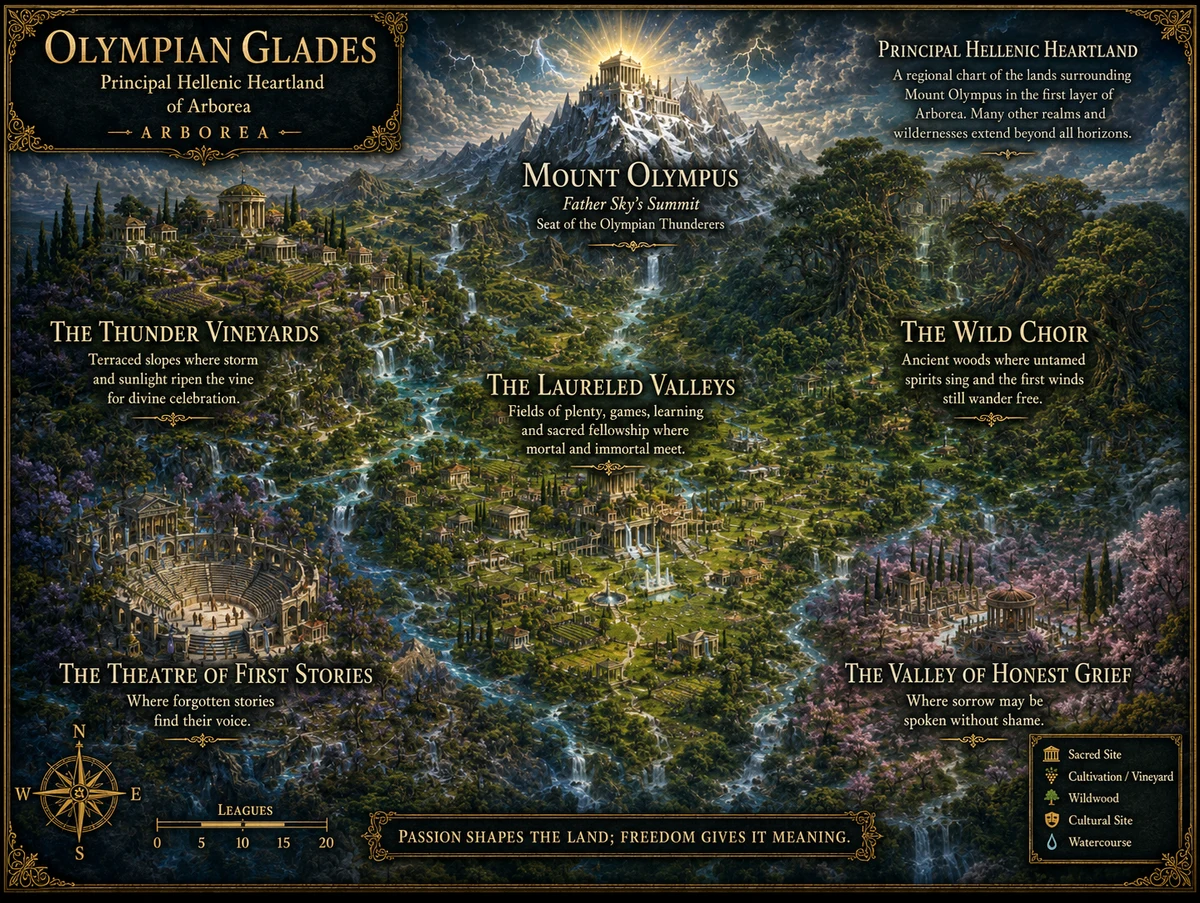
Arborea’s first layer is a vast realm of immense forests, flowering valleys, sacred rivers, storm-crowned mountains, orchards, vineyards, open-air theatres and divine estates.
It is the most heavily inhabited and socially active of Arborea’s layers, with communities formed around freely chosen bonds, shared traditions, artistic movements and sacred duties.
Gods receive petitioners upon mountain summits and within divine halls. Poets challenge rulers in public theatres. Athletes compete for honour. Travelling celebrations cross entire valleys carrying music, drama, debate and feasting between settlements.
Principal Regions
- Mount Olympus: divine summit and political heart of the Hellenic Olympian order.
- Mount Zaphon: independent storm-mountain court of Baal-Hadad and a major gathering place for Ugaritic, Canaanite and Phoenician divine diplomacy.
- The Laureled Valleys: olive groves, vineyards, gymnasia, feasting grounds and artistic or athletic contests.
- The Wild Choir: an immense living forest where birds, rivers, leaves, nymphs and musicians form one evolving song.
- The Thunder Vineyards: storm-fed vineyards whose wines preserve emotions present during harvest.
- The Theatre of First Stories: a sacred amphitheatre where performances reveal forgotten witnesses.
- The Valley of Honest Grief: a green valley of warm rain where the living and dead may mourn without judgement or forced consolation.
Mount Olympus
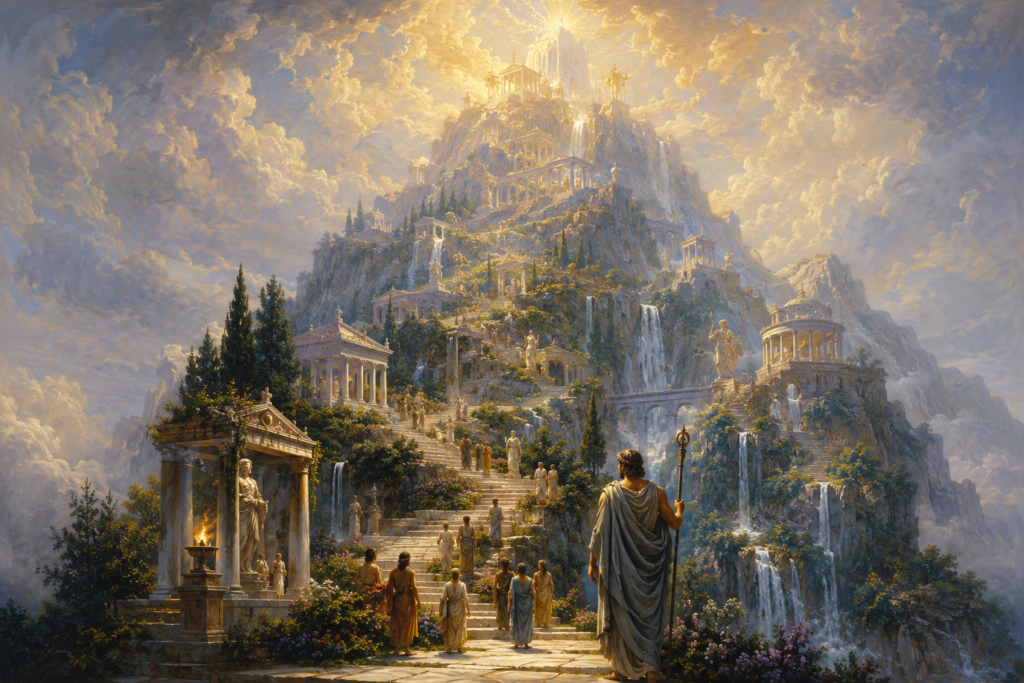
Mount Olympus rises above the Olympian Glades as the divine summit and gathering place of the Hellenic gods.
The earthly mountain in Greece is a Material Plane anchor. Sacred paths, divine invitation and exceptional mythic deeds may lead from that mountain to the planar summit, but an ordinary ascent remains within the mortal world.
Zeus, Hera and Athena are among the powers most strongly associated with the divine summit.
The wider Olympian order maintains halls, gardens, workshops, shrines, embassies and visiting places according to divine office, kinship and recognised realm.
Themis holds an honoured judicial and advisory seat at Olympus, but her principal surviving Elder Court remains in Pelion.
Mount Olympus is the political heart of the Olympian order. It is not the capital of Arborea as a whole.
Mount Zaphon
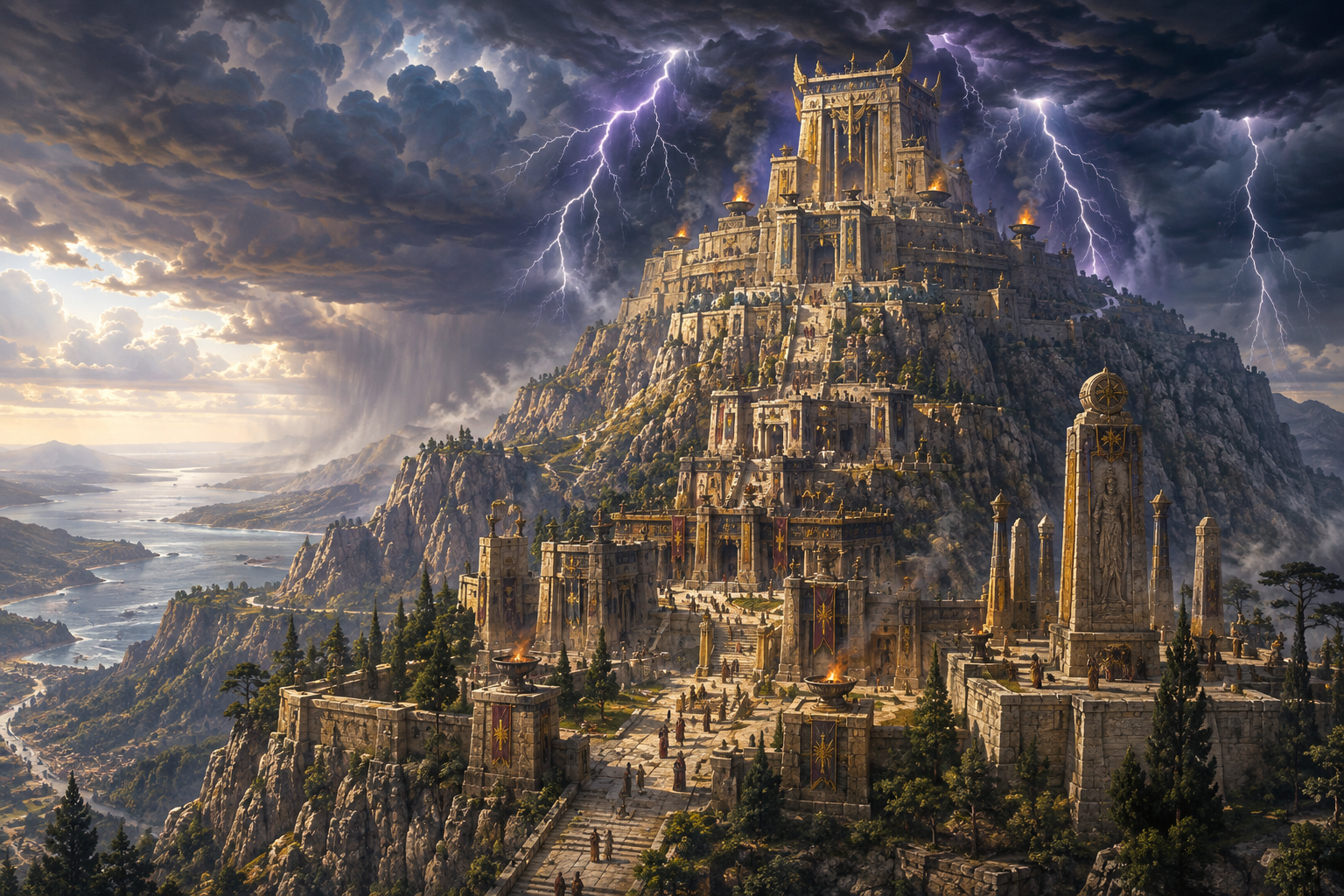
Mount Zaphon is an independent storm-crowned divine realm of the first layer and the Arborean seat of Baal-Hadad.
Its summit rises through thunderheads, cedar-scented rain, brilliant lightning and divine architecture rooted in the monumental sacred traditions of the ancient Levant.
The main sanctuary stands at the mountain’s crown while monumental courts, stairways, terraces, halls and processional approaches descend along the upper slopes.
Zaphon does not belong to Zeus and is not an Olympian province. Baal-Hadad is recognised as a separate storm sovereign whose authority arises from his own tradition, worship, victories, treaties and court.
The mountain serves as a major gathering, embassy and treaty centre for Ugaritic, Canaanite and Phoenician divine powers, but it is not the universal residence of every deity associated with those traditions.
El’s ancient dwelling is distinct. Yam maintains his own power in Ossa. Mot’s principal realm lies beyond Arborea.
Formal messages between Zaphon and Olympus are carried by recognised divine envoys. Among the swiftest are lesser Anemoi, sentient wind spirits able to cross the skies of the Olympian Glades with extraordinary speed.
The arrival of such an envoy is often accompanied by a change in the weather: thunderheads gathering above Zaphon, a sudden wind over Olympus or clouds opening along the herald’s path. These signs announce the messenger’s approach; the storm itself is not the message.
The Laureled Valleys
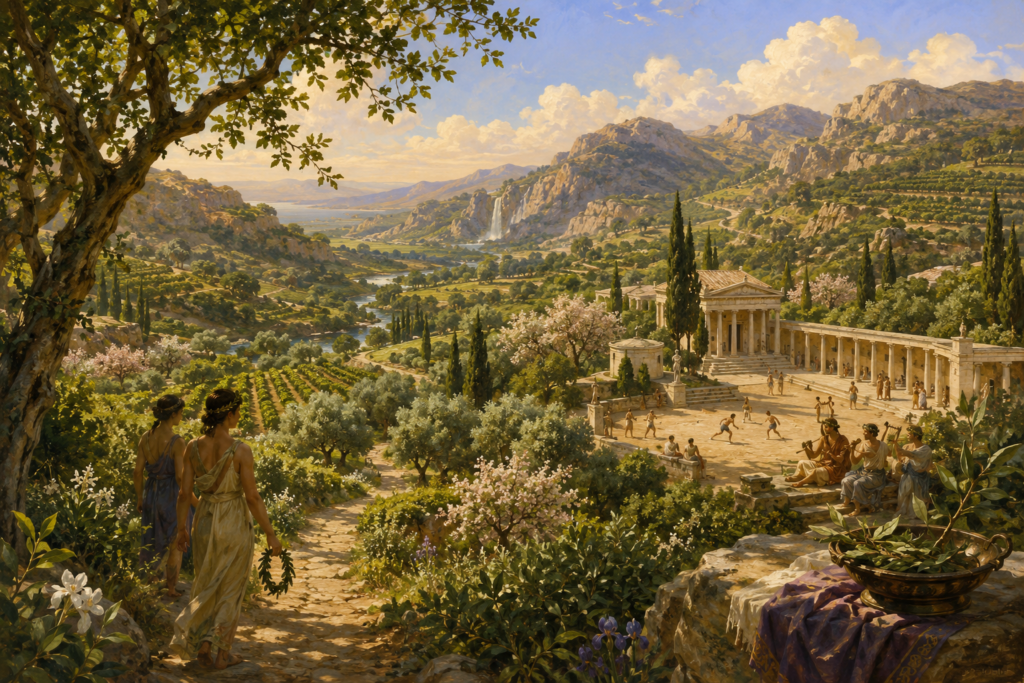
Vineyards, olive groves, orchards, gymnasia and public feasting grounds fill these broad valleys.
Competitions include racing, wrestling, poetry, music, debate, sculpture, dance and acts of hospitality. Victory brings honour, but victors are expected to enrich the community rather than merely humiliate the defeated.
Rival settlements sometimes allow artistic or athletic competition to harden into inherited hatred. The landscape magnifies the feud until someone finds the courage to break it.
The Wild Choir
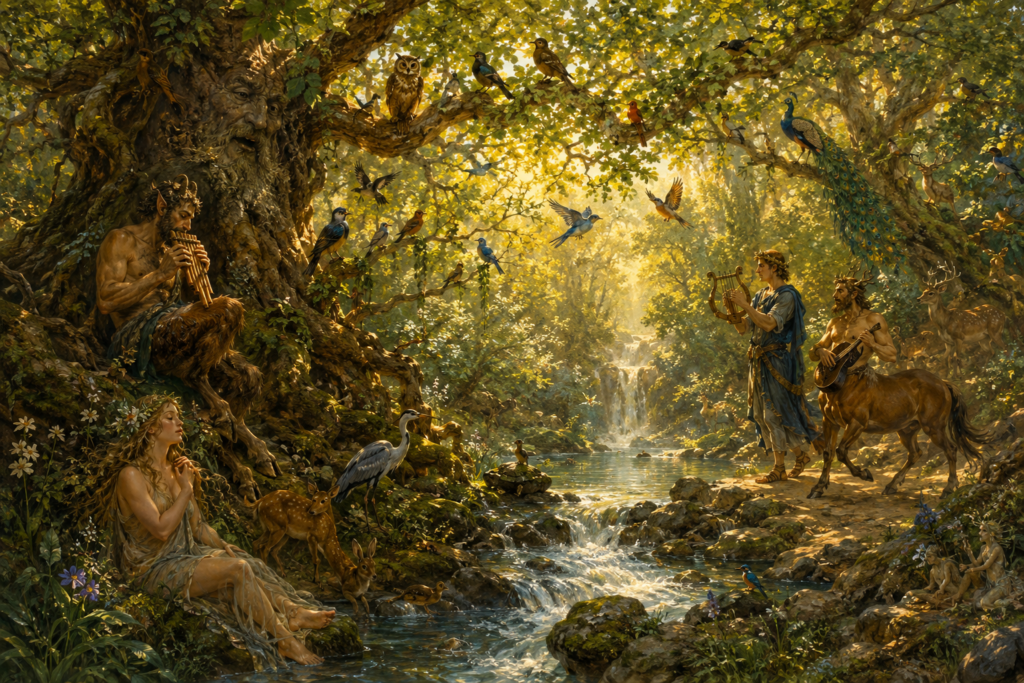
Every living thing in this enormous forest contributes to its music. Birdsong forms melody. Rivers provide rhythm. Leaves answer spoken verse.
Dryads, nymphs, satyrs, centaurs and travelling musicians tend its harmonies and search for songs that have never before been heard.
A missing voice may reveal disease, captivity, desecration or an old wrong concealed beneath the roots.
The Thunder Vineyards
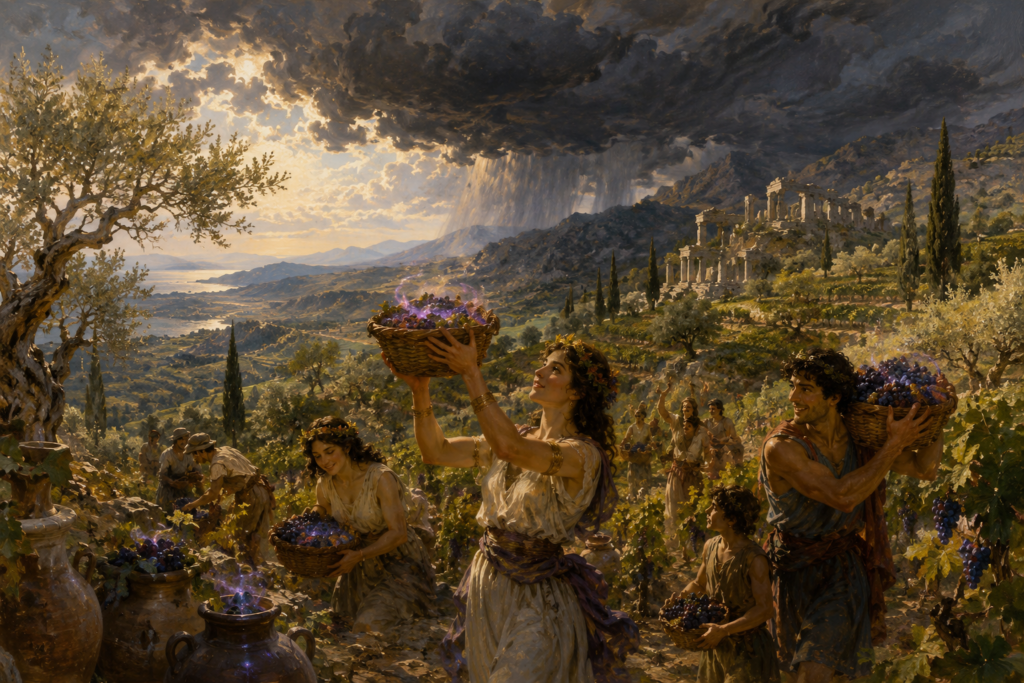
These vineyards spread across mountain slopes watered by warm rain and frequent storms.
Their terraces, groves, wine caves, theatres and open-air feasting grounds form one of the principal Arborean estates of Dionysus, god of wine, vegetation, theatre, revelry, wildness and sacred madness.
Dionysus moves freely through the vineyards rather than ruling from a single permanent palace.
His travelling retinue may include maenads, satyrs, Seilenoi, nymphs, centaurs, musicians, actors, vintners and sacred beasts.
Silenus frequently appears as old tutor, counsellor, storyteller and drunken prophet, while the Muses attend significant performances.
Each vintage preserves an emotion present during its harvest. One wine may restore the courage of a fallen defender. Another may carry the longing of people divided by war.
A revel that compels participation, prevents rest or refuses to let its guests depart violates Arborea’s law of freely chosen celebration.
The Theatre of First Stories
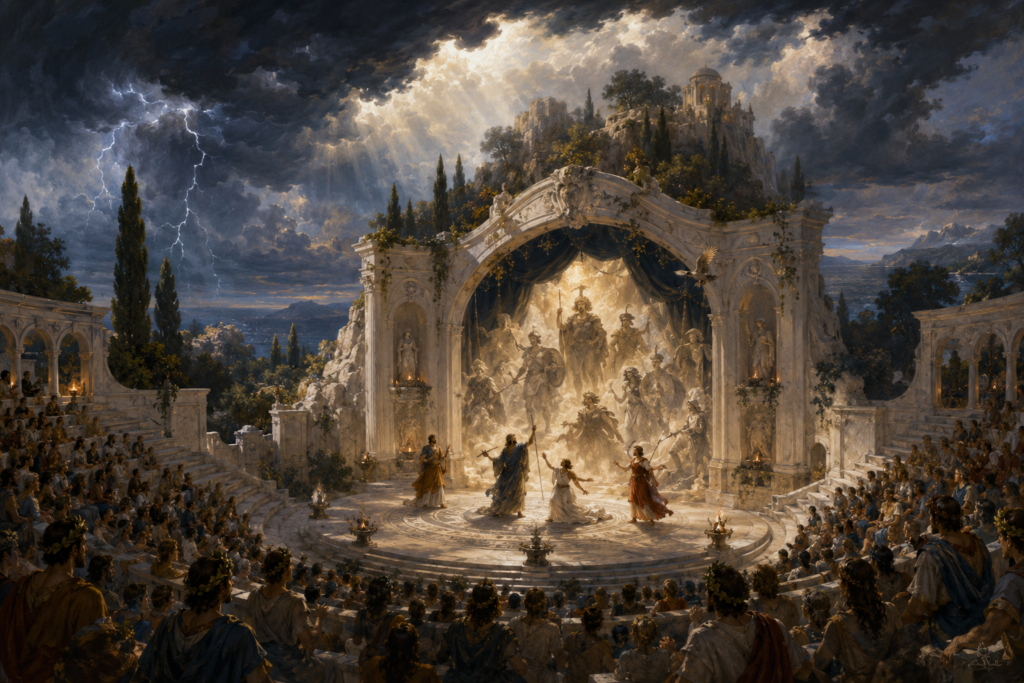
A vast amphitheatre stands within a natural bowl of white stone.
Performances here can transform how an event is understood, though they cannot change what physically occurred. A celebrated hero may be made to confront the cost of victory. A forgotten witness may finally be heard. A hated enemy may be revealed as something more complicated than the story preserved by the victors.
Several unfinished plays continue to influence mortal dreams.
The Valley of Honest Grief
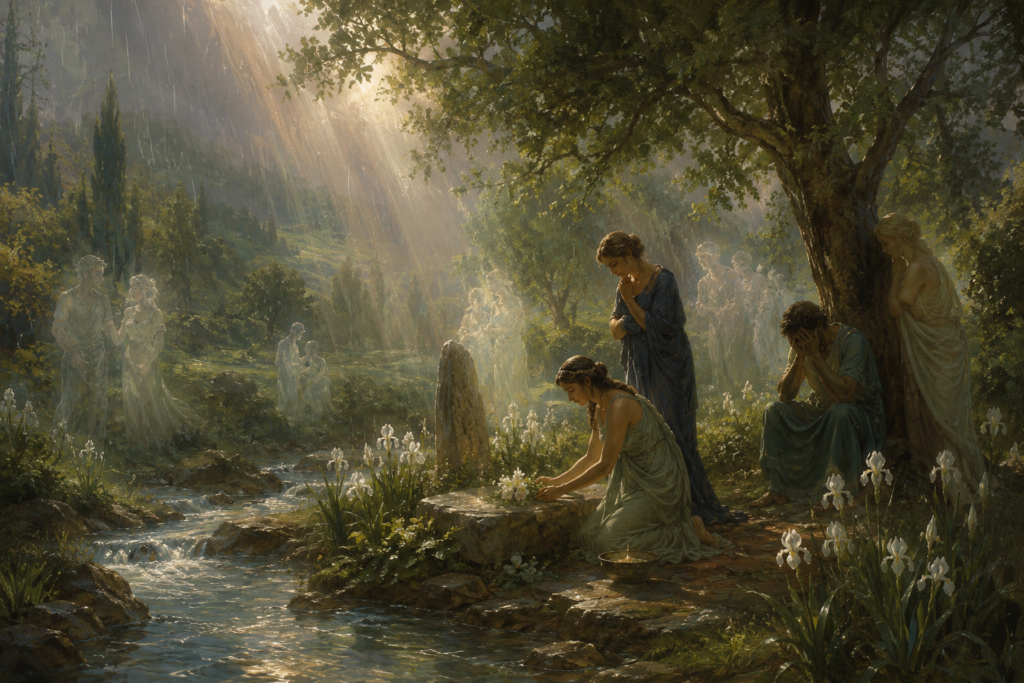
Warm rain falls across this green valley, nourishing white flowers, dark-leaved trees and clear streams that carry sorrow gently through the Olympian Glades.
The living and the dead come here to mourn. Arborean petitioners remember their mortal lives, companions who passed into other divine realms, families divided by death and losses that followed them beyond the grave.
Living visitors may meet the dead who dwell in Arborea, provided those petitioners freely choose the meeting.
Ossa – The Living and Remembering Sea
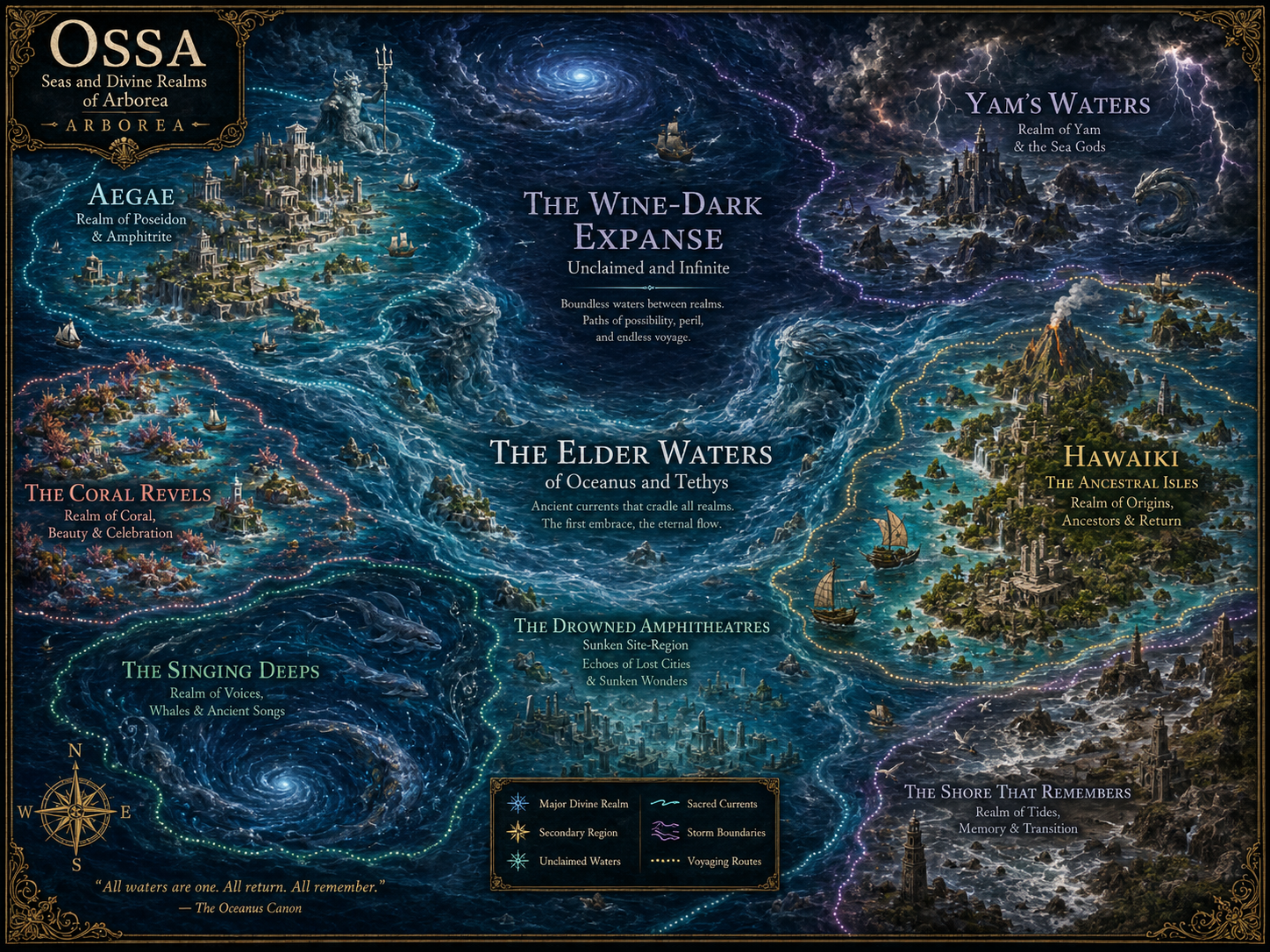
Ossa is Arborea’s sea layer: an infinite world of living oceans, migrating islands, submarine kingdoms, ancestral currents, coral settlements, storm paths, sea caves, impossible horizons and shores that remember every departure.
Distance is emotional as well as geographical. A traveller who has abandoned an unresolved promise may sail for months toward a shore visible every evening. A voyager returning with honest purpose may cross a thousand leagues before sunrise.
No single god or pantheon owns Ossa.
Plural Sovereignty
Ossa is divided among recognised divine realms, ancestral routes, elder waters, free communities and unclaimed seas.
Poseidon is the strongest Olympian authority in the layer, but his sovereignty does not automatically extend to the Elder Waters, Yam’s domain, Hawaiki or independent sea peoples.
Major Waters and Regions
- Aegae: the principal Arborean sea court of Poseidon and Amphitrite.
- The Elder Waters: ancient currents, rivers and primal waters associated with Oceanus and Tethys.
- Yam’s Waters: an independent Ugaritic/Canaanite sea-domain and ancient rival of Baal-Hadad.
- Hawaiki – The Ancestral Isles: a shifting ancestral archipelago grounded especially in Māori traditions of origin, voyage and return.
- The Wine-Dark Expanse: the vast unclaimed ocean connecting the major powers and regions of Ossa.
- The Coral Revels: free marine settlements, markets, festivals and reef-grown meeting places.
- The Singing Deeps: deep ocean territories shaped by whale-song, nereid choirs and ancient currents.
- The Drowned Amphitheatres: a scattered site-region of submerged stages and lost cities.
- The Shore That Remembers: a long coast where the sea returns traces of departure, promises and people who never came home.
Aegae – Court of Poseidon and Amphitrite
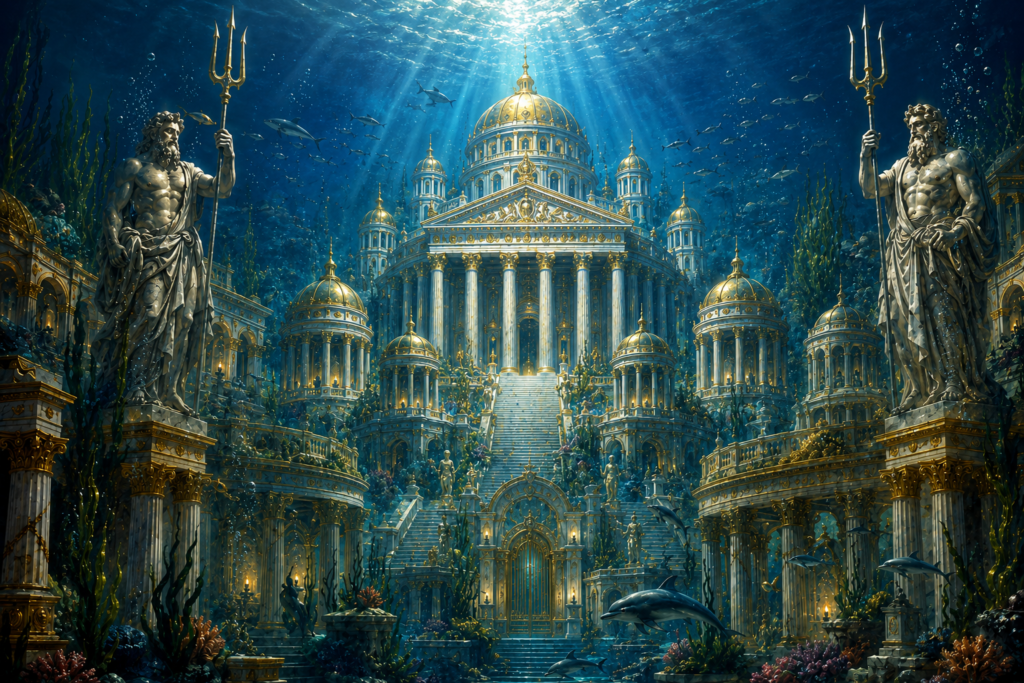
Poseidon and Amphitrite maintain one of Ossa’s greatest divine sea courts.
Aegae moves between storm-crowned islands, immense submarine halls and palaces raised from the waves.
The realm serves as the principal Arborean Hellenic sea court, concerned with seas, storms, earthquakes, horses, voyages and coastal communities.
Poseidon also maintains an Olympian presence and a powerful connection to the Elemental Plane of Water. Aegae is therefore a principal divine seat rather than his only residence.
Beyond waters that recognise Aegae’s protection, its authority depends upon treaty, kinship, oath, hospitality and recognition.
The Elder Waters – Oceanus and Tethys
Some currents are older than the Olympian settlement of the sea.
Oceanus and Tethys maintain the Elder Waters: immense currents, rivers, springs, estuaries and sea-roads whose names predate Poseidon’s rule.
The Elder Waters are not a neatly enclosed kingdom. They flow through and between other regions, following older cosmological relationships than modern divine borders.
River gods, Oceanids, nereids and ancient aquatic communities preserve relationships with the elder pair.
Poseidon and the Elder Waters recognise one another through ancient rights, kinship and negotiated boundaries rather than simple ruler-and-subject hierarchy.
Yam’s Waters
Yam claims a powerful sea-domain within Ossa associated with untamed waters, divine challenge and the ancient rivalry between Sea and Storm.
His realm is independent of Aegae and independent of Mount Zaphon. The mythic conflict between Yam and Baal-Hadad therefore crosses Arborea’s layers: sea against storm mountain, oceanic claim against rain-bearing kingship.
Yam’s presence does not render every violent sea his property. Independent storms, sea peoples, ancestral currents and elder waters retain their own identities.
Hawaiki – The Ancestral Isles
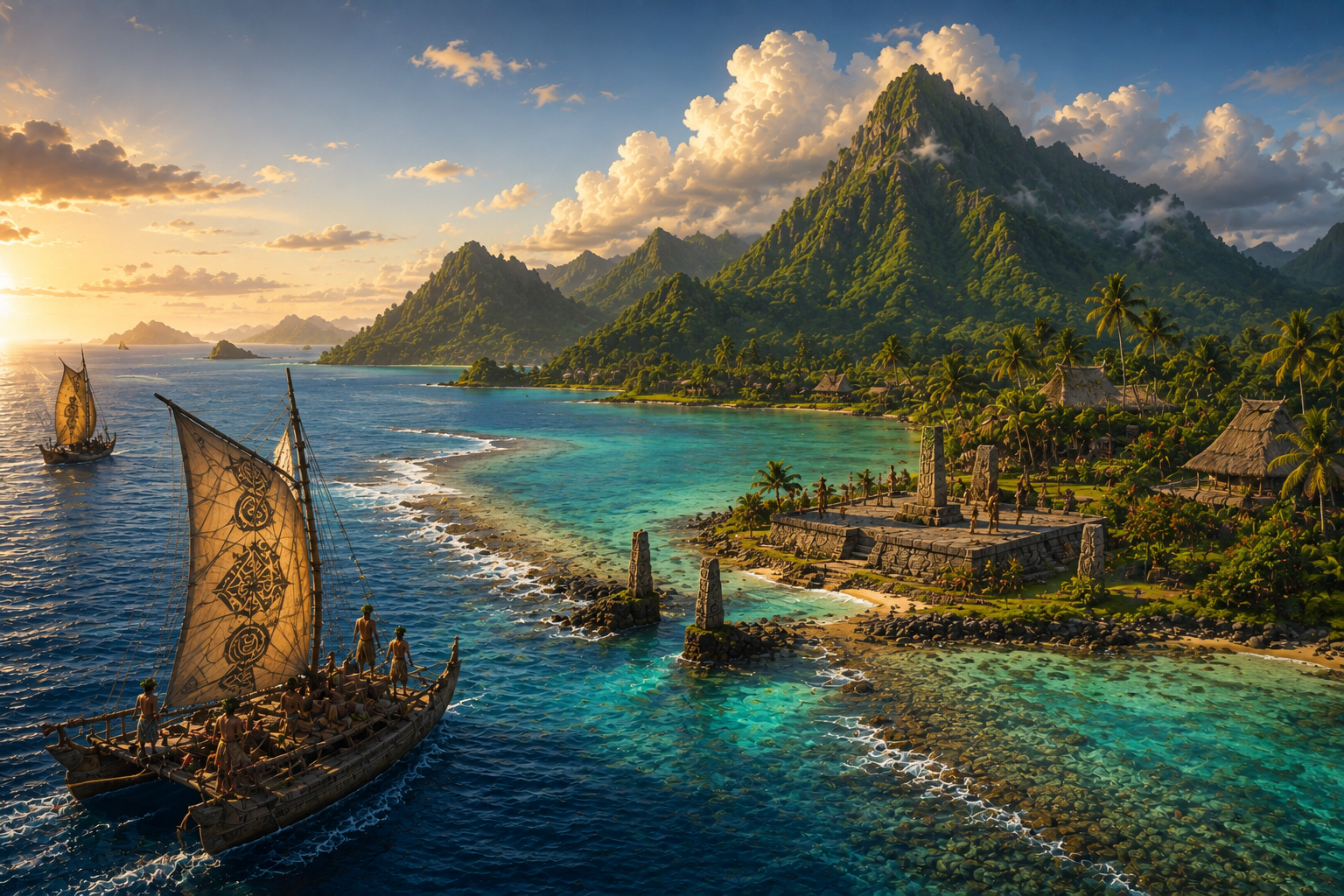
Hawaiki is the ancestral archipelago of Ossa: living islands of origin and return, departure beaches, sacred houses, forested ridges, luminous reefs and remembered sea-roads. Here, genealogy can guide a voyage as surely as stars or currents.
For Players
- Follow an ancestral route: recover a lost way between Hawaiki and a mortal shore.
- Seek an ancestor: find someone whose memory, name or promise still shapes the living world.
- Return something sacred: a relic, body, name or stolen inheritance may belong on a particular island.
- Voyage rather than teleport: some routes open only through the right vessel, lineage, story or act of remembrance.
For the Game Master
- The route remembers. A current can recognise a voyager, reject an impostor or carry someone toward an unresolved ancestral obligation.
- Islands need not stay still. Hawaiki is infinite; an island may be reached by relationship and story rather than fixed distance.
- Arrival should mean something. Reaching Hawaiki works best as the result of a voyage, invitation, divine sign or recovered genealogy—not an ordinary planar shortcut.
- Ossa is larger than Hawaiki. The ancestral isles do not rule the whole living sea, and other divine realms and independent peoples remain beyond them.
Gods and Hawaiki
The Polynesian divine traditions are deeply connected to these ancestral islands, but not every deity lives here permanently. Māui and Hina remain tied to ancestral routes while retaining their own stories and residences. Pele may voyage to Hawaiki, but her principal elemental residence remains on the Elemental Plane of Fire.
Keep the traditions distinct. Hawaiki is grounded especially in Māori traditions of ancestral homeland, origin and return. Related ancestral-homeland traditions occur across Polynesia, but Māori, Hawaiian, Tahitian, Samoan, Tongan and other traditions remain their own traditions rather than one interchangeable mythology.
The Wine-Dark Expanse
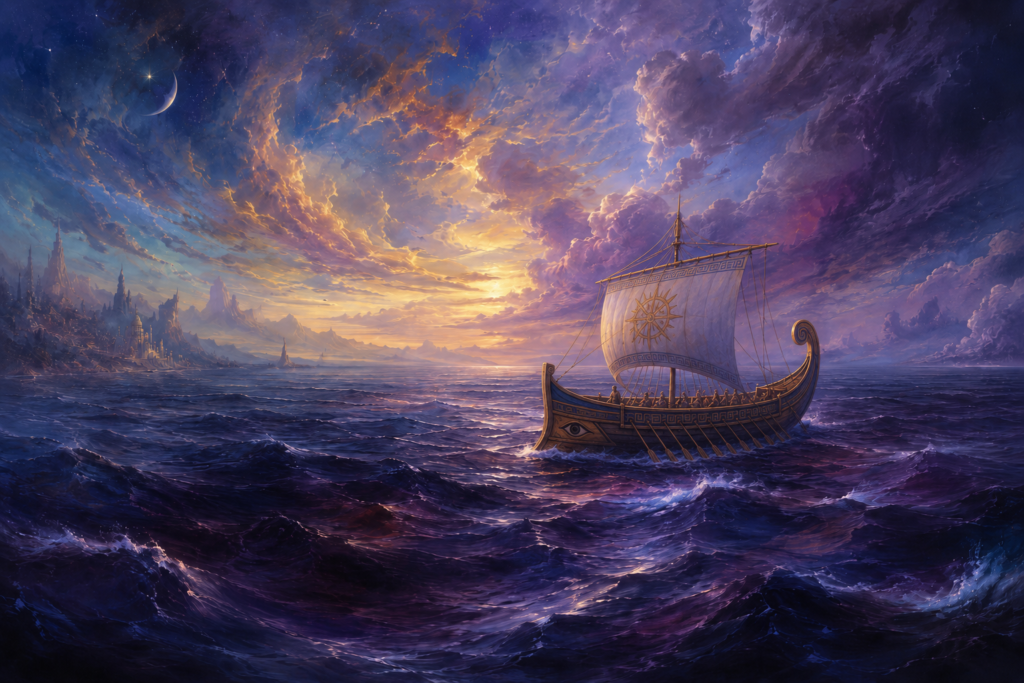
The Wine-Dark Expanse forms much of Ossa’s unclaimed connective ocean.
The horizon may appear close enough to touch yet remain days away. Stars can rise beneath the water, remembered coastlines appear at dusk and currents turn towards places a voyager most fears or desires to revisit.
Captains who navigate only by distance often become lost. Those who understand why they are travelling fare better.
The Isles of Sudden Weather
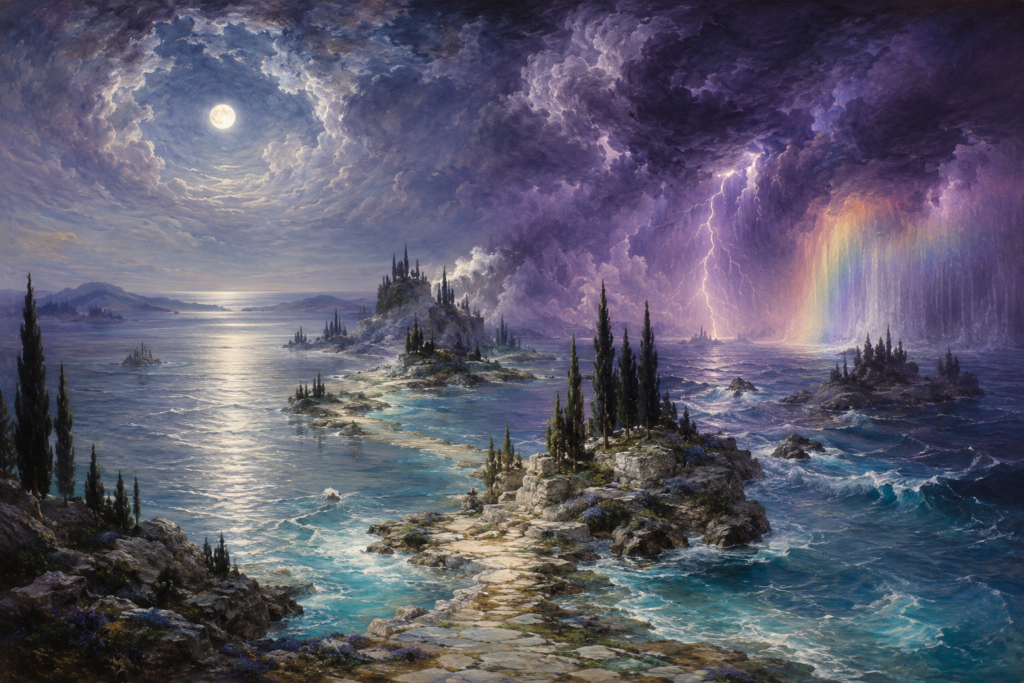
These islands move through Ossa without fixed celestial coordinates.
One may wake beneath a cloudless dawn and pass into a thunderstorm by midday because an old argument has resumed in a village several valleys inland.
Some islands follow particular ships. Others return only when estranged families or rival rulers become willing to speak again.
The Coral Revels
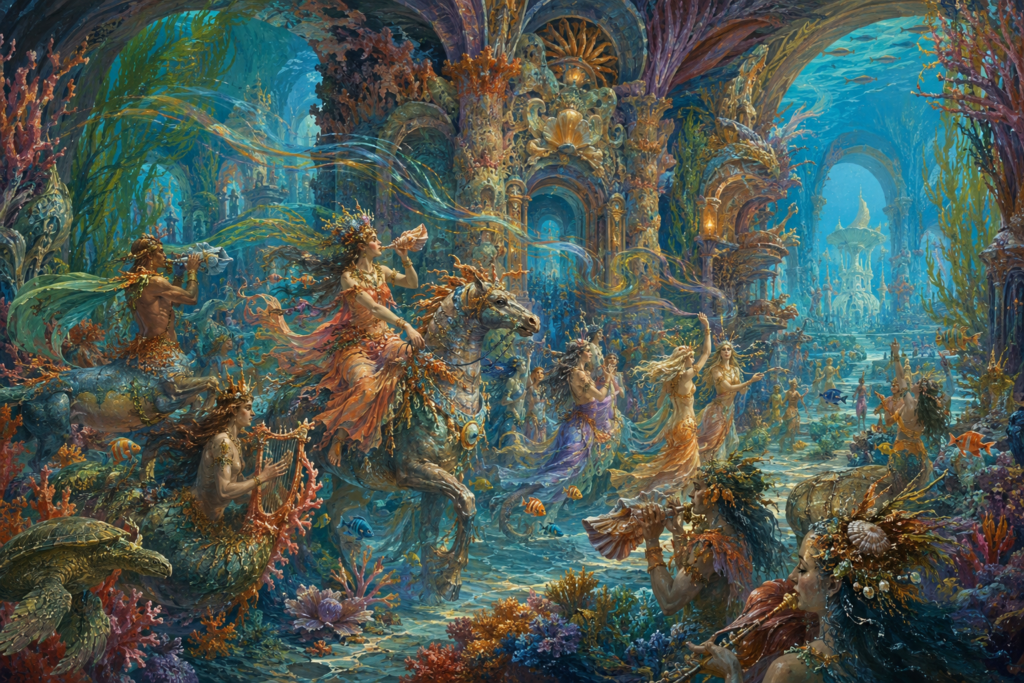
Living reefs grow into halls, markets, gardens and festival terraces inhabited by nereids, aquatic petitioners, visiting mariners and independent sea communities.
The Revels recognise no permanent emperor. Assemblies form when migration routes, reefs, storms or common dangers require shared action, then dissolve when their work is complete.
The Singing Deeps
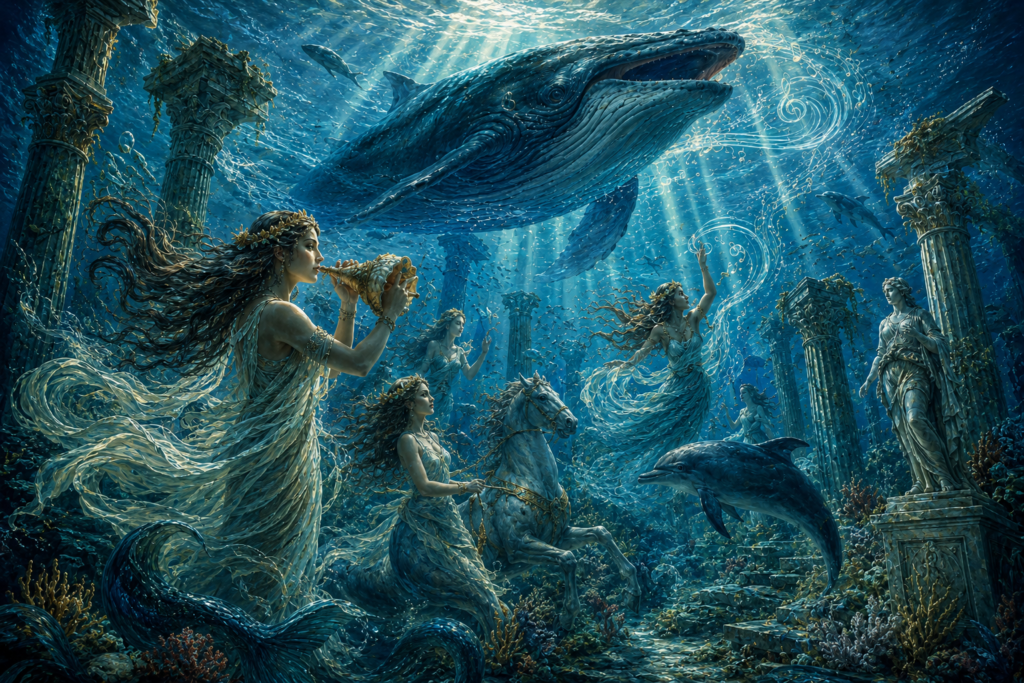
The deepest inhabited waters carry songs over impossible distances.
Deep singer whales, nereid choirs and living currents preserve news, genealogies, warnings and memories within layered music.
A sailor who learns the right refrain can sometimes send a message farther than any ordinary vessel could travel.
The Drowned Amphitheatres
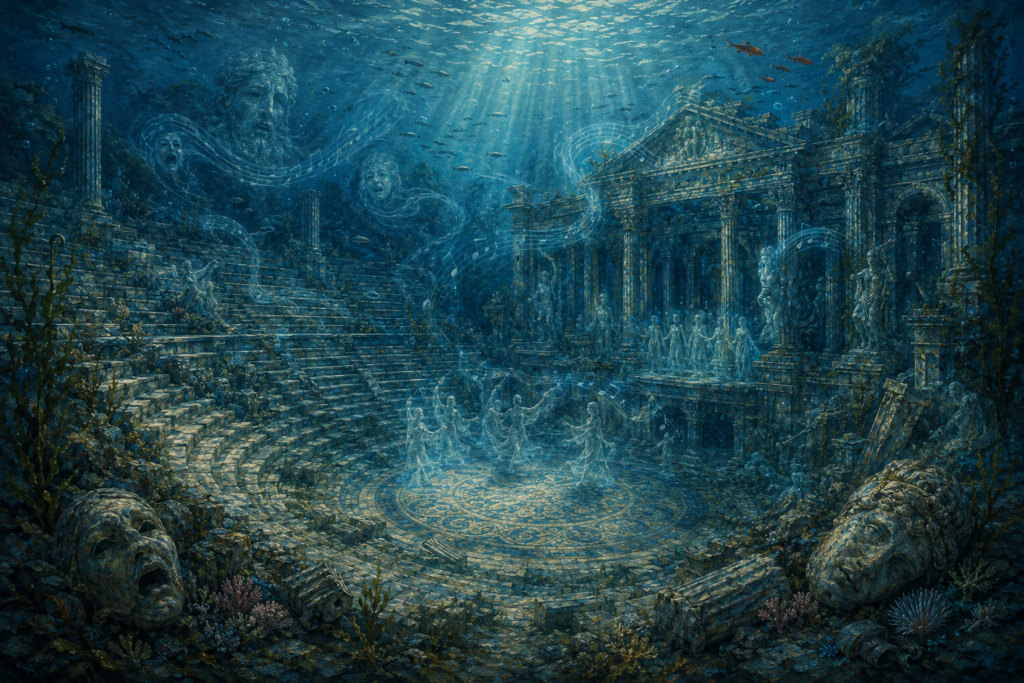
Stone theatres lie beneath clear water throughout a scattered site-region rather than a unified political state.
Plays performed here tell of lost ships, difficult homecomings, divine storms and communities erased from ordinary maps.
An audience may breathe the water for as long as the performance remains truthful. A deliberately falsified ending causes the protection to fail.
The Shore That Remembers
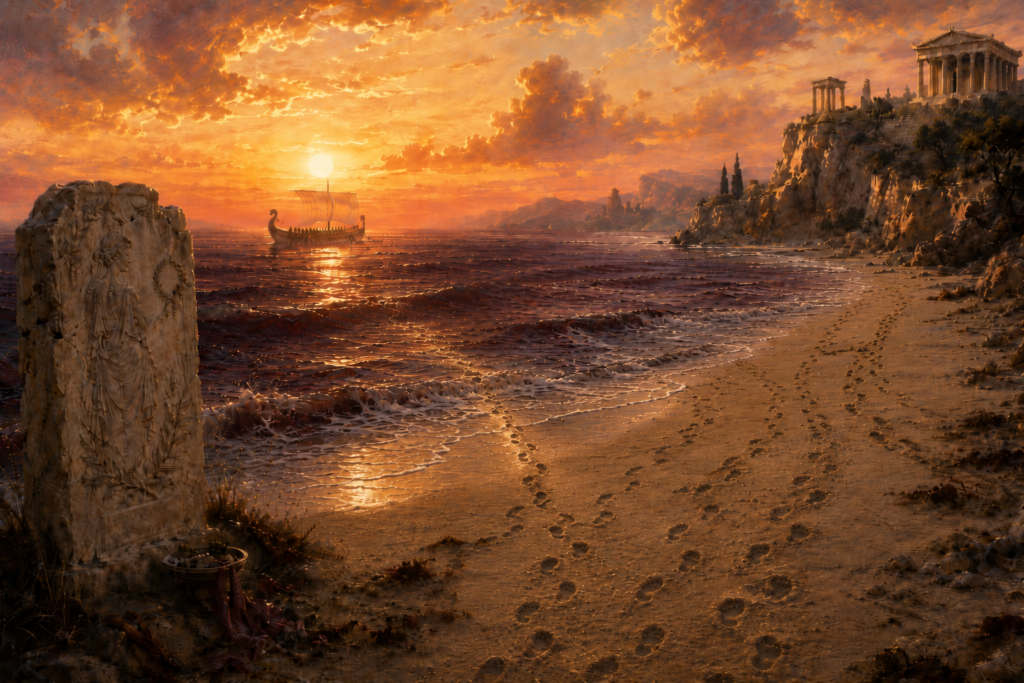
Along this long and shifting coast, waves return objects associated with departure: a broken oar, a child’s shell, a wedding ribbon, a captain’s cup or a stone carried from a distant home.
The shore does not promise that the absent person is alive or dead. It remembers that someone left and that someone else still waits.
Pelion – The Surviving Titan Age
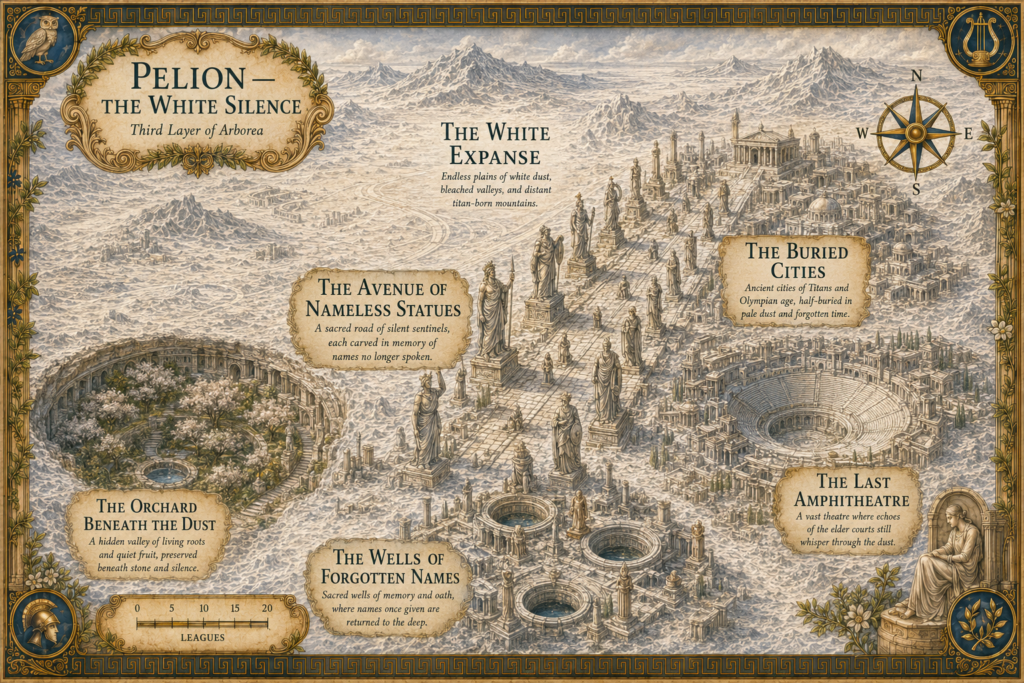
Pelion is a realm of immense pale landscapes, half-buried cities, monumental roads, old orchards, hidden estates, broken courts and memories too persistent to disappear merely because a dynasty fell.
Some cities were destroyed during the Titanomachy. Others were abandoned when their rulers were killed, exiled or imprisoned.
Still others survived, changed government and continued for ages beneath the care of elder gods, heirs, petitioners, councils and retainers.
Pelion holds the elder civilisation that continued outside the prisons of Carceri and Tartarus.
The layer is quiet because its spaces are immense and its population scattered. Life gathers around surviving estates, hidden cities, sacred groves, sealed valleys, observatories and ancient workshops.
Elder households maintain gardens beneath the dust. Petitioners preserve ancient crafts. Dactyls work in sealed forges. Meliai guard sacred groves. Primordial cyclopes repair structures whose first purposes belong to the age before Olympian rule.
Pelion expresses freedom through remembrance: the freedom of people, gods and communities to survive the fall of an old order without surrendering every part of their identity.
The Principal Surviving Elder Courts and Hyperion
Five Elder Titans maintain principal surviving courts in Pelion: Mnemosyne, Phoebe, Rhea, Theia and Themis .
Their courts are separate houses rather than a restored Titan government. Their relationships with Olympus range through kinship, loyalty, treaty, guarded neutrality, reconciliation, rivalry and unresolved grievance.
Hyperion also survives as one of Pelion’s great Elder presences. He does not join the hostile Titans in the final Titanomachy: when Zeus establishes the new divine settlement, Hyperion accepts the succession rather than fighting it.
He therefore remains within Pelion among Titan-age estates, sanctuaries, observatories and ancient divine courts, neither reduced to an Olympian courtier nor condemned with the elder powers who refuse the new order.
| Elder Power | Present Placement | Relationship to Arborea |
|---|---|---|
| Mnemosyne | Pelion | Surviving Elder Court; memory, inheritance and preserved history. |
| Phoebe | Pelion | Surviving Elder Court and ancient divine household. |
| Rhea | Pelion | Surviving Elder Court with deep kinship ties to the Olympian generation. |
| Theia | Pelion | Surviving Elder Court within the continuing Titan-age civilisation. |
| Themis | Pelion | Principal Elder Court in Pelion; honoured judicial and advisory seat also maintained at Mount Olympus. |
| Hyperion | Pelion | Great Elder presence; accepts the Olympian settlement and remains among Pelion’s Titan-age estates, sanctuaries, observatories and ancient divine courts. |
| Oceanus | Ossa | Elder authority within the Elder Waters. |
| Tethys | Ossa | Elder authority within the Elder Waters. |
| Cronus | Carceri / Tartarus | Condemned after opposing the Olympian succession; not resident in Pelion. |
| Coeus | Carceri / Tartarus | Condemned; not part of Pelion’s surviving Elder Courts. |
| Crius | Carceri / Tartarus | Condemned; not resident in Arborea. |
| Iapetus | Carceri / Tartarus | Condemned; not resident in Arborea. |
Principal Regions
- The White Expanse: open country between surviving elder estates, abandoned monuments and half-buried cities.
- The Buried Cities: former centres of Titan civilisation, some inhabited and others sealed since the Titanomachy.
- The Avenue of Nameless Statues: a ceremonial road whose erased figures preserve rulers, allies and witnesses removed from official history.
- The Last Amphitheatre: a monumental theatre containing an unfinished account of the war between Titans and Olympians.
- The Orchard Beneath the Dust: a hidden valley whose fruit preserves memories from the Titan Age.
- The Wells of Forgotten Names: sacred wells holding names deliberately erased from mortal and divine remembrance.
The White Expanse
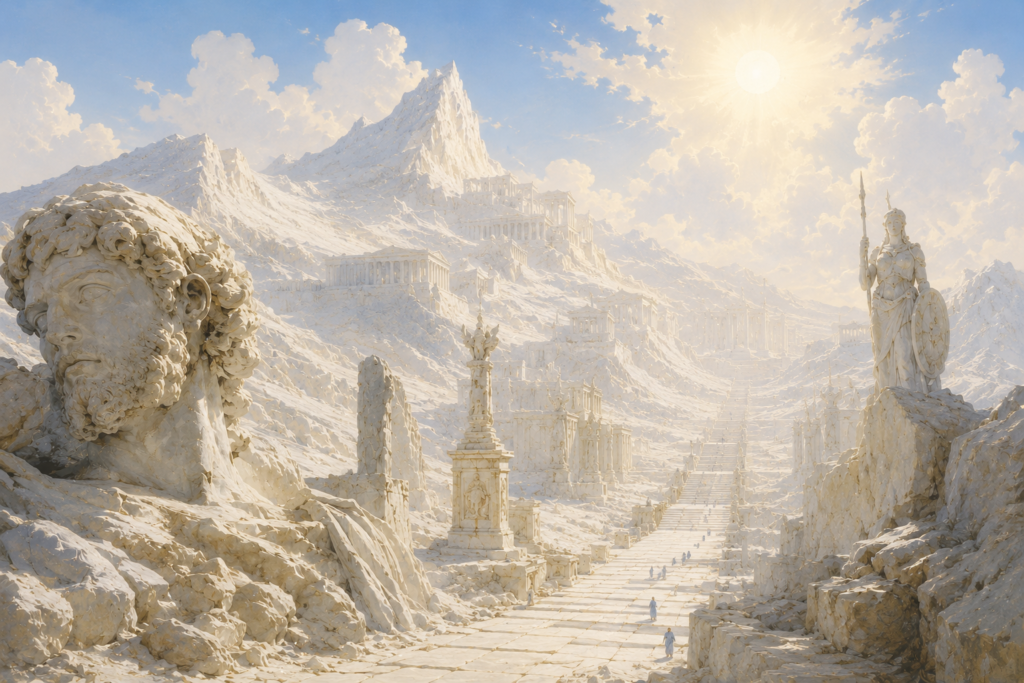
Pale dunes and plains extend beneath a brilliant sky. White mountains rise in the distance, their slopes cut by monumental stairs, roads and terraces built for divine rulers and their households.
Sound travels immense distances and sometimes arrives years after it was made.
At the brightest hour of the day, buried roads and structures become visible beneath the dust.
The Buried Cities
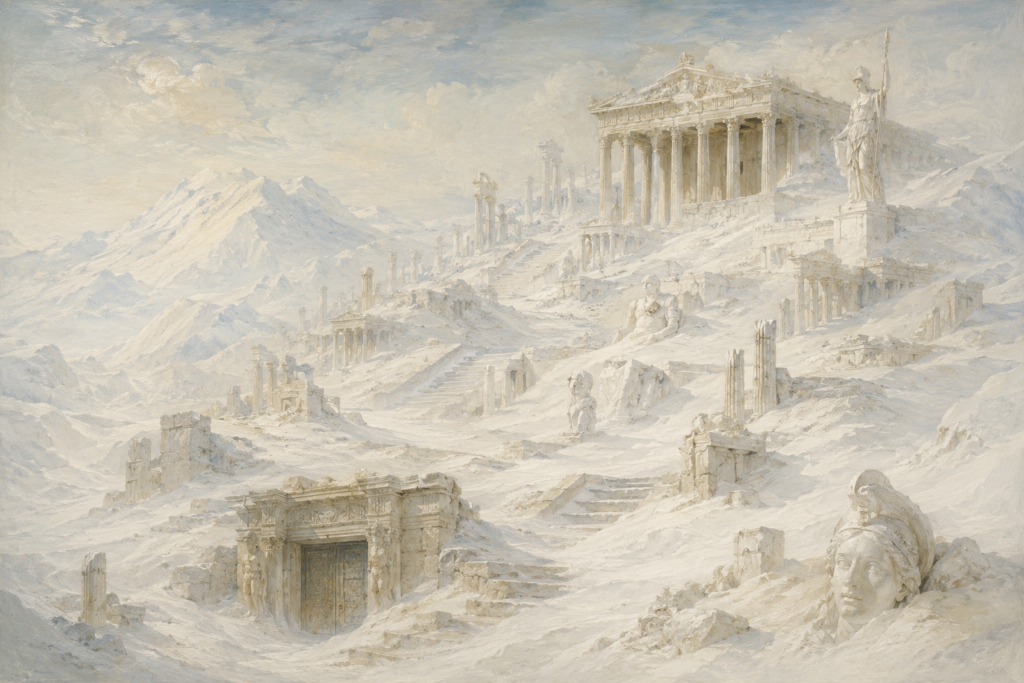
Whole cities lie beneath Pelion.
Some were destroyed during the Titanomachy. Others were abandoned when their divine rulers were cast into Tartarean exile.
Several remain inhabited beneath protective domes, sealed valleys or layers of white dust that open to recognised descendants, petitioners and sworn guests.
Each city retains its own people, heirs, custodians and claims.
The Avenue of Nameless Statues
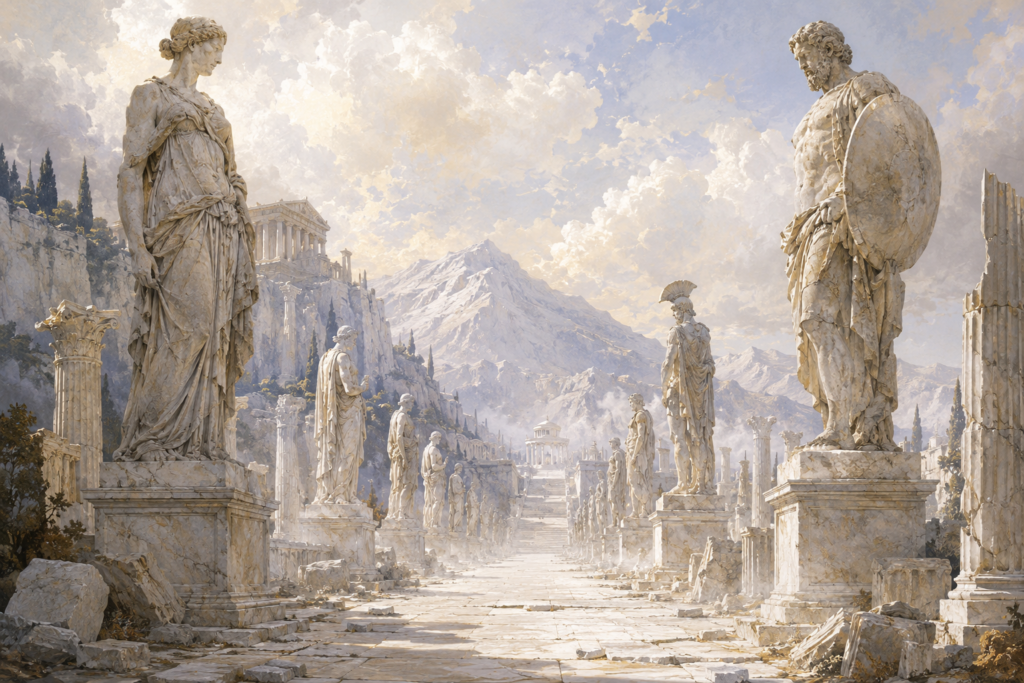
Colossal statues line a ceremonial avenue leading toward one of Pelion’s oldest courts.
Their faces remain intact, but many names and inscriptions were removed after the Olympian victory.
Some represented condemned rulers. Others depicted neutral Titans, elder allies, servants, negotiators or witnesses whose existence complicated the victorious account of the war.
Restoring a false name causes the statue to turn away. Restoring a true name allows it to speak once.
The Last Amphitheatre
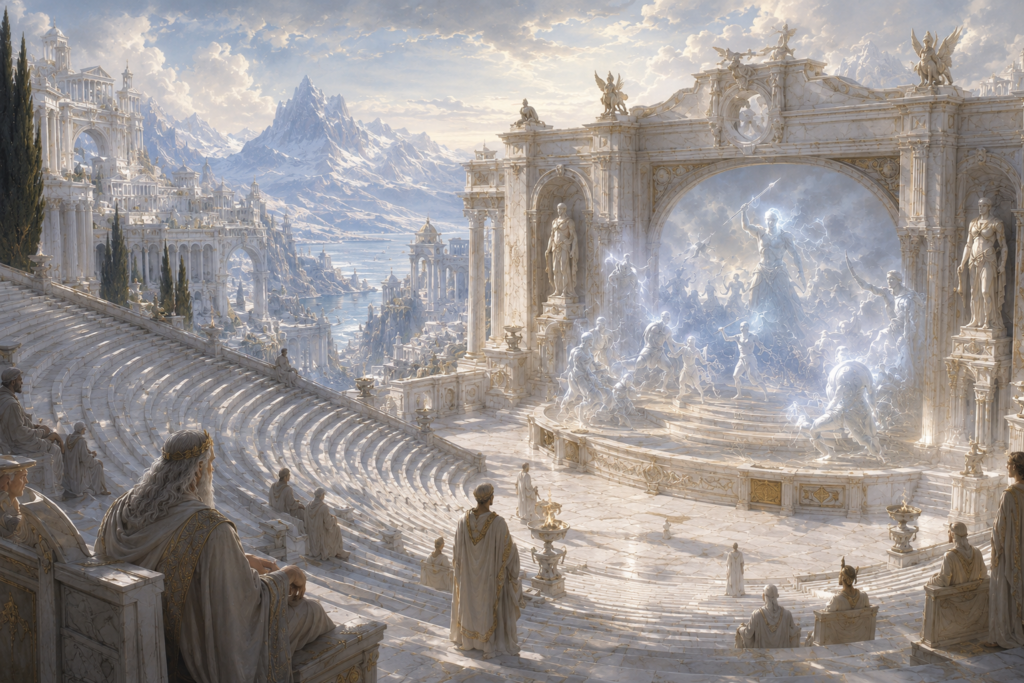
An immense stage waits at the centre of a partially inhabited city.
The final act of its civilisation’s greatest epic was never performed.
The surviving play recounts the Titanomachy from several perspectives: Olympian liberation, Titan betrayal, civil war, divine succession and the collapse of an entire cosmic order.
Spirits, scholars, gods and elder retainers disagree over whether completing the final act will reconcile Pelion with Olympus, expose a false history, vindicate a forgotten neutral party, free a condemned power or renew the ancient war.
The Orchard Beneath the Dust
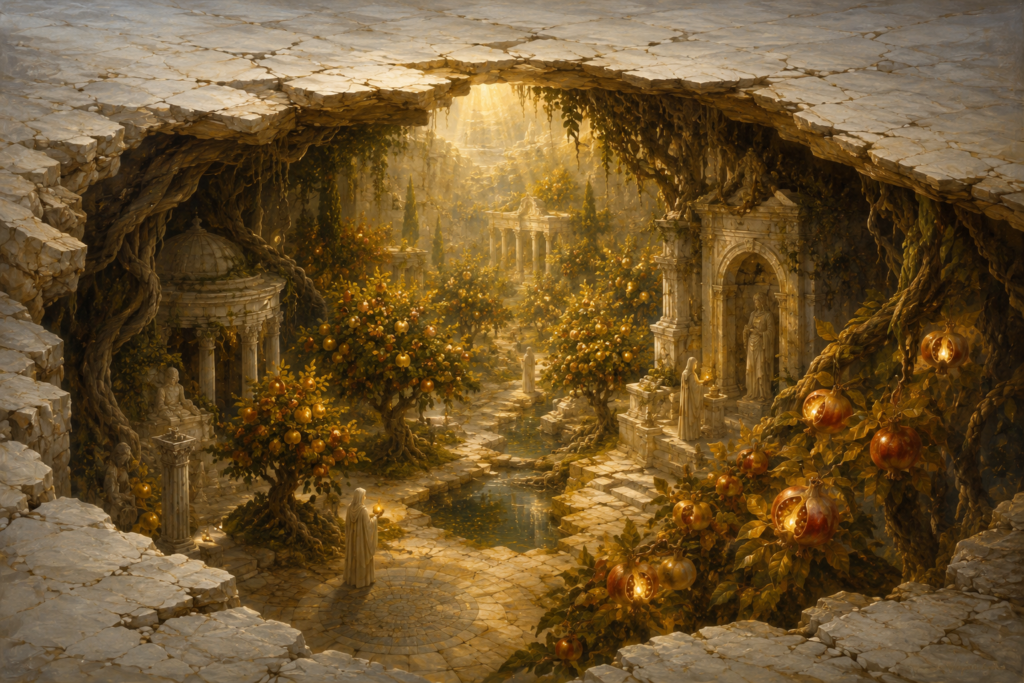
A living orchard survives within a sealed underground valley.
Its fruit contains memories belonging to Titans, servants, petitioners and mortal witnesses from the elder age.
Eating the fruit grants the memory and its accompanying responsibility to the person who receives it.
The Wells of Forgotten Names
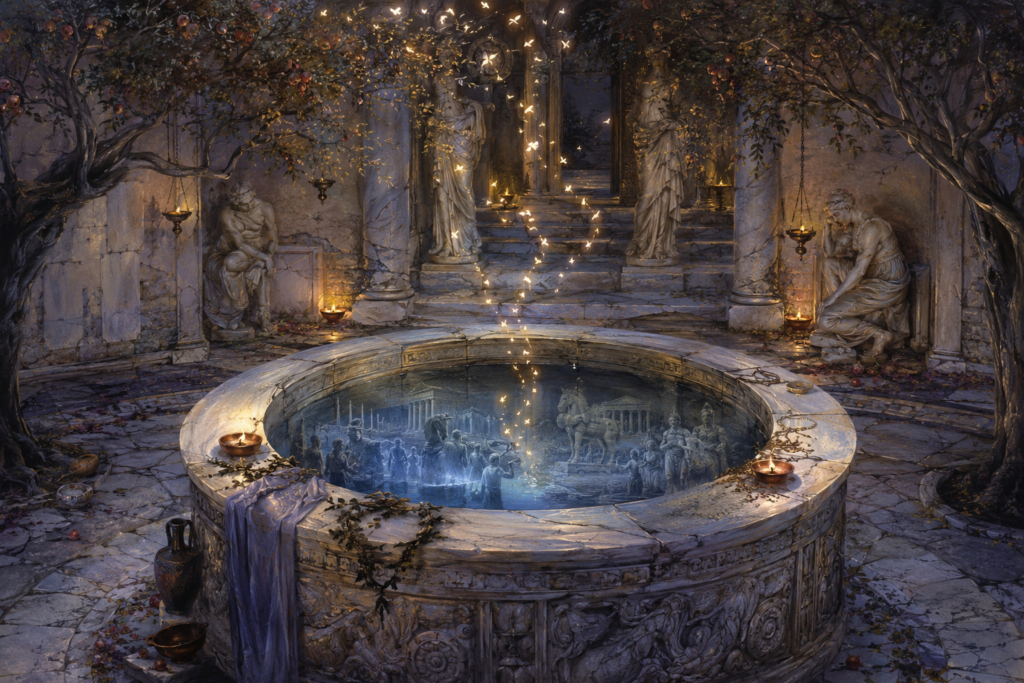
Deep stone wells contain names erased from mortal and divine remembrance.
Some names belong to defeated Titans. Others belong to servants, cities, children, witnesses and peacemakers omitted because their existence disturbed a simpler account of victory.
A name restored to the world may awaken loyalties, debts, inheritance claims, divine obligations and enemies that have waited since the Titan Age.
Divine Powers and Sovereign Realms
Arborea contains multiple divine civilisations. Sharing a plane does not merge their pantheons, erase their distinct traditions or place them beneath a single ruler.
The Olympian Order – Mount Olympus
The Hellenic Pantheon maintains its principal Arborean political centre at Mount Olympus.
Olympian authority is immense within its recognised realms, but it does not make Zeus monarch of every power living in Arborea.
The Storm Court – Mount Zaphon
Baal-Hadad maintains his independent storm throne upon Mount Zaphon.
The mountain serves as a major Arborean gathering place for Ugaritic, Canaanite and Phoenician divine diplomacy without becoming the residence of every god from those traditions.
Aegae – The Olympian Sea Court
Poseidon and Amphitrite maintain a great sea court within Ossa.
Poseidon is the strongest Olympian authority in the layer, not ruler of the whole layer.
The Elder Waters
Oceanus and Tethys retain elder rights over primordial currents, rivers and ancient waters that precede the Olympian sea order.
Yam’s Waters
Yam possesses an independent Ugaritic sea-domain whose rivalry with Baal-Hadad carries the ancient contest between Sea and Storm across Arborea’s layers.
Hawaiki – The Ancestral Isles
Ancestral islands and sacred routes associated especially with Māori Hawaiki and related Polynesian traditions form an independent region of origin, voyage and return.
Hawaiki is not subordinate to Aegae or Yam.
The Surviving Elder Houses
Mnemosyne, Phoebe, Rhea, Theia and Themis maintain principal surviving Elder Courts within Pelion.
Hyperion also remains one of Pelion’s great Elder presences after accepting the Olympian settlement rather than fighting Zeus in the final Titanomachy.
These surviving powers preserve Titan-age civilisation without forming a restored government under Cronus.
Powers Beyond Arborea
Divine family does not require common residence.
Cronus, Coeus, Crius and Iapetus remain associated with Tartarean confinement in Carceri.
Mot’s principal realm lies in Abaddon.
Other gods may maintain elemental, chthonic, Material or foreign-planar seats while retaining kinship and political relationships with Arborean courts.
Cross-Pantheon Diplomacy and Conflict
Arborea’s freedom allows divine cultures to neighbour one another without forcing them into a single celestial empire.
Its politics depend on guest-right, ancient treaty, kinship, recognised sovereignty and the willingness of communities to accept authority.
Olympus and Zaphon
Zeus and Baal-Hadad are separate storm sovereigns. Similar divine portfolios do not make them aliases.
Their courts negotiate the passage of storms, divine envoys, ritual access, mortal cultic correspondences and guest-right between their territories. Formal correspondence may be carried by lesser Anemoi and other recognised heralds.
Zaphon and Yam
The ancient rivalry of Baal-Hadad and Yam crosses the boundary between the Olympian Glades and Ossa.
Storms rising from Yam’s waters may test Zaphon’s boundaries, while rain and thunder descending from the mountain can become visible demonstrations of divine power without themselves functioning as sentient messengers.
Olympus and Pelion
The Titanomachy ended one political order but did not destroy every Titan, city or household.
Olympus and Pelion remain connected by marriages, descent, old obligations, inherited property, divine offices and conflicting memories of the war.
Themis is one of the most important bridges between the two ages: sovereign in her surviving Pelion court while retaining recognised judicial standing at Olympus.
Hyperion represents a different form of continuity. Although involved in the earlier overthrow of Uranus, he does not fight the Olympians in the final Titanomachy. When Zeus establishes the new divine settlement, Hyperion accepts it and remains an Elder presence within Pelion.
His survival demonstrates that the settlement following the Titanomachy is not a simple division between Olympian victors and universally imprisoned Titans. Individual choices during the succession determine the fate of individual elder powers.
Aegae and the Elder Waters
Poseidon is the dominant Olympian sea authority, while Oceanus and Tethys retain elder precedence and rights over waters whose identities predate Olympian rule.
Their arrangements are therefore expressed more often as kinship, treaty and recognised spheres than as ruler and subject.
Aegae, Yam and Hawaiki
Neither Aegae nor Yam automatically possesses Hawaiki’s ancestral routes.
Hawaiki’s authority concerns recognised islands, genealogical passage, sacred departure and return rather than domination of all surrounding ocean.
A foreign divine court that attempts to close, tax or appropriate one of those ancestral routes may discover that the route itself disappears from its charts and opens elsewhere for those who retain the right to follow it.
Independent Communities
Many Arborean communities belong to no divine court.
A nereid settlement, theatre company, vineyard, satyr village, centaur school, petitioner household or Titan-age city may accept a god as patron without surrendering its own laws and internal standing.
Divine power matters enormously. Consent still matters.
Inhabitants
Petitioners
The dead who reach Arborea remain people.
They form households, artistic companies, athletic societies, orchards, theatres, travelling communities, sea-going settlements and elder households.
Some retain clear memories of mortal life. Others remember through skills, relationships, emotions, songs or recurring dreams.
Nymphs, Dryads and Water Spirits
Nymphs embody living places and the relationships that sustain them.
Dryads are associated with trees and groves, naiads with freshwater and nereids with seas and oceanic places.
The Meliai are ash-tree nymphs with ancient ties to the transition between the Titan and Olympian ages.
Satyrs and Centaurs
Satyrs and centaurs inhabit the Olympian Glades in independent communities.
Satyrs serve as musicians, vintners, herders, scouts, hosts, provocateurs and guardians of ecstatic traditions.
Centaurs maintain families, herds, sacred grounds, athletic societies, schools and travelling settlements.
Sea Peoples
Nereids, ichthyocentaurs, hippocampi and other aquatic peoples inhabit Ossa.
Their settlements may be mobile, submerged, amphibious or grown from living reef.
Migration rights, ancestral routes, songs, storms, currents and responsibility for the health of the sea often matter more than fixed borders.
Wind Heralds and Celestial Spirits
Lesser Anemoi are among Arborea’s swiftest recognised wind-heralds. Divine courts may entrust them with formal messages, warnings, invitations and treaty documents when speed, neutral passage and an identifiable sentient courier are required.
Other chaotic-good celestial beings serve as guardians, messengers, healers, artists, defenders and witnesses.
Celestial service preserves individual judgement. A celestial may challenge a divine command that violates hospitality, personhood or meaningful freedom.
Sacred Animals
Arborea supports extraordinary horses, lions, deer, boars, birds, marine creatures and other animals associated with divine households, local traditions or living regions.
Celestial pegasi are especially associated with high valleys, divine roads and heroic travel.
Primordial Cyclopes and Titan-Age Peoples
Primordial cyclopes, Dactyls, Meliai, elder craftsmen, heralds, retainers and Titan-age petitioners persist in Pelion.
They are not automatically servants of imprisoned Titans.
Many communities survived the Titanomachy by changing allegiance, negotiating new terms, withdrawing into remote estates, accepting the new divine settlement or simply continuing to maintain the places for which they were responsible.
Heroes and Visitors
Mortal heroes, artists, athletes, sailors, historians, mourners, rebels and guests travel through Arborea.
The site’s Hellenic heroes and notable figures provide further examples of legendary mortals and individuals whose stories may intersect with Olympus, Pelion and the wider Hellenic divine world.
Legendary status does not make every Hellenic, Canaanite or Polynesian culture hero a permanent resident of the plane.
Law, Personhood and Consequences
Arborea recognises personhood through mind, will, relationship, responsibility and established standing rather than creature type, age or divine allegiance.
Petitioners, nymphs, satyrs, centaurs, sea peoples, celestials, Titan retainers and other thinking inhabitants may possess homes, inherit obligations, give testimony, demand restitution and receive the protection of their communities.
Guest-Right
A formal welcome places both host and guest under obligation.
The host must provide protection, sustenance and a clear opportunity to depart.
The guest must respect the household, refrain from treachery and declare any known danger brought to the host’s door.
Oaths and Agreements
Freely sworn oaths carry great weight.
Witnesses, sacred places and the emotional truth of the promise matter more than elaborate written forms.
Coercion, deception and concealed conditions weaken an oath and may render it powerless.
Memory, Names and Testimony
Stealing memories, erasing names, falsifying monuments and silencing witnesses are serious wrongs.
A person who restores a lost memory becomes its witness rather than its owner.
Serious Wrongs
The gravest offences include enslavement, magical domination, treacherous murder, imprisonment under the guise of hospitality, destruction of a spirit’s bonded place, theft of names or memories and deliberate suppression of testimony.
Judgement and Restitution
Some divine realms maintain formal courts, but many Arborean communities rely upon assemblies, respected witnesses, elders, poets, champions and public testimony.
Common consequences include restitution, return of stolen works or memories, restoration of damaged land, public acknowledgement, service freely accepted by the injured party and exile where trust cannot be restored.
Punishment without repair carries little honour.
Duels and Contests
A duel or contest is lawful only when all participants understand and accept its terms.
Intimidation, enchantment, concealed rules or inability to withdraw invalidates the contest.
Killing
Killing in defence of another person may be praised. Killing for humiliation, vengeance or pleasure remains subject to judgement.
Travel
Reaching Arborea
Stable or temporary entrances may appear within:
- sacred groves and ancient orchards;
- old theatres where a forgotten work is performed correctly;
- mountain sanctuaries touched by divine storms;
- islands reached during supernatural weather;
- festivals founded upon genuine hospitality;
- places of communal mourning;
- sites where captives have just won meaningful freedom;
- works of art completed through shared sacrifice;
- monuments where a deliberately erased name has been restored;
- Titan-age sanctuaries reopened by recognised heirs or retainers;
- ancestral voyaging routes followed under the correct stars, obligations and inherited knowledge; and
- storm mountains where divine weather briefly overlaps the mortal and planar worlds.
Moving Between Layers
The three layers are joined through divine gates, sacred rivers, living ocean currents, storms that cross from mountain to sea, performances that recreate forgotten voyages and ancient arches uncovered beneath Pelion’s dust.
Rivers and springs may connect Pelion to Ossa. Divine processions, old treaties and restored names can open passages between Pelion and the Olympian Glades.
Zaphon’s storms may descend into Yam’s waters. An ancestral current from Hawaiki may carry a voyager to a mortal shoreline without crossing the intervening sea in any ordinary sense.
Leaving Arborea
Recognised gates, divine passages and planar magic allow travellers to depart.
Some visitors remain because Arborea offers belonging, inspiration or emotional fulfilment they have never found elsewhere. The freedom to depart gives the choice to remain its meaning.
Arborea and the Mortal World in 1454
Arborea has no single mortal gateway. Its major cultural interfaces express different relationships between the Material Plane and divine geography.
Mount Olympus and the Hellenic World
The mortal Mount Olympus remains Arborea’s strongest Hellenic terrestrial correspondence.
In 1454 the physical mountain stands within the changing political world of the eastern Mediterranean, but its supernatural antiquity has not disappeared.
Ancient paths, caves, springs, groves, surviving local traditions and exceptional acts can still intersect with the planar summit.
An ordinary climber remains on Earth. A recognised sacred path, divine invitation or mythic deed may reach farther.
Jebel al-Aqra and Mount Zaphon
The terrestrial correspondence of Mount Zaphon is the great storm mountain traditionally identified with Jebel al-Aqra near the ancient coast of Ugarit.
By 1454 the Bronze Age city of Ugarit has been ruined for millennia.
Arborea does not preserve a living 1454 Ugaritic kingdom on Earth. Instead, the Material interface survives through the mountain itself, ancient cultic memory, buried places, coastal storms and supernatural routes older than the states surrounding them.
Hawaiki and the Pacific
Hawaiki possesses no single geographical portal equivalent to Mount Olympus or Zaphon.
Its Material connections appear through sacred voyaging, ancestral and genealogical memory, waka traditions, departure and return shores, star paths and seas understood through inherited knowledge.
By 1454 Polynesian communities in Aotearoa have been established for generations.
Their relationship with ancestral homelands therefore belongs to the living contemporary world of the campaign, not to a vanished prehistory awaiting European discovery.
Other Arborean Manifestations
Beyond these principal interfaces, Arborea’s influence may appear wherever:
- a ruler is publicly challenged through art;
- a captive people wins meaningful freedom;
- strangers receive protection without hidden obligation;
- a community allows grief to be spoken openly;
- rivals choose creation over inherited hatred;
- a festival restores its participants rather than consuming them;
- a promise is kept despite the absence of force or reward;
- a suppressed witness is finally heard;
- a monument’s false history is corrected; or
- an old community survives the fall of its rulers while preserving its identity.
Artists, lovers, mourners, athletes, rebels, hosts, historians, sailors and travellers may encounter Arborea’s influence without ever learning the plane’s name.
Adventure Hooks
The Feast Without Dawn
A celebrated festival has continued for thirty years. Every guest appears happy, but anyone who tries to leave forgets why departure mattered.
The Silent Voice
Part of the Wild Choir has fallen silent. The missing voice belongs to a dryad whose tree was secretly moved into a divine garden.
The Treaty of Two Storms
A formal Anemoi envoy carrying a sealed treaty between Olympus and Zaphon has disappeared. Both courts deny recalling it, while its abandoned message-tube has appeared in a neutral valley.
The Sea Beneath Zaphon
Yam’s waters rise through a passage that should have been sealed by ancient treaty.
The Route That Refuses a King
A divine court announces that an ancestral passage into Hawaiki now belongs to its navy. The route vanishes immediately.
The Returning Island
An island rises in Ossa whenever two estranged rulers consider reconciliation. Someone is killing their messengers to keep it beneath the sea.
The Wrong Ending
A newly recovered fragment gives the Last Amphitheatre’s account of the Titanomachy a peaceful conclusion.
The Stolen Vintage
Wine containing the courage of an ancient rebellion has been stolen from the Thunder Vineyards.
The Observer’s Record
A sealed observatory associated with Hyperion opens for the first time since the divine succession. Its celestial records appear to prove that one celebrated account of the Titanomachy is incomplete.
The Unopened Court
A buried city sends formal invitations to Olympus, Zaphon, Ossa and the mortal world.
The Memory Claimed by Three Gods
A fruit from the Orchard Beneath the Dust contains proof of an ancient promise claimed by rival divine powers.
The Elder Current
Aegae closes a dangerous current to protect mortal sailors. Oceanus insists that the current predates Poseidon’s court and cannot be closed without wider consent.
Historic and Mythic Context
Hellenic Foundations
Ancient Greek traditions preserve distinct divine homes, sacred mountains, blessed destinations, cosmic waters, islands, underworld regions and generations of gods rather than one unified historical plane identical to SpiralWorlds Arborea.
Hesiod’s Theogony provides one of the most influential surviving accounts of divine generations and succession from Uranus to Cronus and from Cronus to Zeus.
SpiralWorlds develops that succession into the political and historical distinction between the present Olympian order and the surviving civilisation of Pelion.
The Hellenic Pantheon preserves primordial gods, Elder Titans, Olympians and chthonic powers as distinct divine categories whose individual histories determine present residence, alliance, imprisonment and activity.
Those individual histories matter. Hyperion stands with Cronus and several Titan brothers during the overthrow of Uranus, but that earlier act does not determine his later fate.
In current SpiralWorlds canon, Hyperion does not fight the Olympians in the final Titanomachy. He accepts Zeus’s new divine settlement and therefore survives as one of Pelion’s great Elder presences rather than being condemned with the hostile Titan powers.
Homeric traditions of Olympus as a divine gathering place support the planar Mount Olympus.
The Odyssey contributes to Ossa’s themes of voyage, uncertain islands, changing identity, separation and difficult return.
Ugaritic, Canaanite and Phoenician Foundations
Texts recovered from ancient Ugarit preserve a divine world in which El, Athirat, Baal, Anat, Astarte, Yam, Mot and many other powers possess distinct roles and relationships.
Baal is strongly associated with Mount Zaphon, identified with Jebel al-Aqra, and his struggle with Yam provides one of the great surviving divine contests between storm and sea.
El’s dwelling is distinct from Baal’s Zaphon, which is why Mount Zaphon is not treated here as the universal residence of every Canaanite deity.
SpiralWorlds therefore places Baal-Hadad’s Zaphon within the Olympian Glades, Yam’s principal sea power within Ossa and Mot beyond Arborea in Abaddon.
This preserves a neighbouring Canaanite/Ugaritic/Phoenician divine civilisation without folding it into Olympus or relocating the entire Mesopotamian pantheon merely because Hadad/Baal crosses cultural traditions.
Hawaiki and Polynesian Traditions
In Māori tradition, Hawaiki is of profound ancestral significance: a homeland of origin, a place associated with gods and great ancestral figures and a realm linked with departure and return.
Names and concepts related to ancestral homelands occur across Polynesia, but their meanings are not identical in every culture.
SpiralWorlds therefore uses Hawaiki as the principal name of this Ossa region while allowing its infinite islands and routes to preserve distinct related traditions rather than treating Polynesian societies as one interchangeable mythology.
The Polynesian Pantheon is correspondingly treated as a broad site category rather than proof that every listed god shares one permanent residence.
Māui, Hina and Pele illustrate why shared tradition does not require shared residence. Different gods and culture heroes retain their own histories, offices and principal seats while remaining connected through ancestry, voyage, story and ritual.
Arborea within SpiralWorlds
The three layers perform distinct cosmological roles.
The Beastlands expresses freedom through instinct and living wilderness.
Ysgard expresses freedom through heroic struggle and defiance.
Arborea centres freely chosen bonds, emotional truth, artistic creation, hospitality, sacred memory, meaningful voyage and the right of independent communities to remain themselves even while living beside gods.
Historical and mythic sources provide the foundations. This entry remains the authoritative description of Arborea within the SpiralWorlds campaign.
Video Lore
Guide to Arborea – Legacy RPG Cosmology
A substantial treatment of Arborea’s older RPG interpretation, including Olympus, Ossa and Pelion.
It also contains realms and setting material that are not SpiralWorlds canon, so it should be used as comparative legacy context rather than authority over this page.
Ugarit: City of Baal
Historical and archaeological background for Ugarit and the world in which the Baal traditions were preserved.
This complements the Mount Zaphon material without treating modern reconstruction as campaign canon.
Sources and Further Reading
Hellenic Sources
- Hesiod, Theogony.
- Hesiod, Works and Days.
- Homer, Iliad.
- Homer, Odyssey.
- The Homeric Hymns.
- Apollonius of Rhodes, Argonautica.
- Pindar, Olympian Odes.
Ugaritic / Canaanite Context
- The Metropolitan Museum of Art, The Gods and Goddesses of Canaan.
Hawaiki and Polynesian Context
- Te Ara – The Encyclopedia of New Zealand, Hawaiki.
- UNESCO World Heritage Centre, Taputapuātea.
- Scientific Reports, archaeological research concerning early Polynesian settlement and landscape change in Aotearoa.
SpiralWorlds
- Hellenic Pantheon
- Hyperion
- Mnemosyne
- Theia
- Polynesian Pantheon
- Hadad / Baal-Hadad
- Anemoi
- Carceri – The Tarterian Depths
- Abaddon
Game-System References
- Pathfinder First Edition: Planar Traits.
- D&D 3.5e: Planes and Planar Traits.
- System Reference Document 5.2.1.
This work includes material from the System Reference Document 5.2.1 (“SRD 5.2.1”) by Wizards of the Coast LLC, available at https://www.dndbeyond.com/srd. The SRD 5.2.1 is licensed under the Creative Commons Attribution 4.0 International License, available at https://creativecommons.org/licenses/by/4.0/legalcode.
Keep this reference growing
If this page helped with your reading or game, you can support its upkeep or explore the curated books.
Explore the Bookshop — epics, classics and stories behind imagined worlds.