
Eon XLIII — The Iron Ascendancies, Empires, Republics and the Laws of Conquest
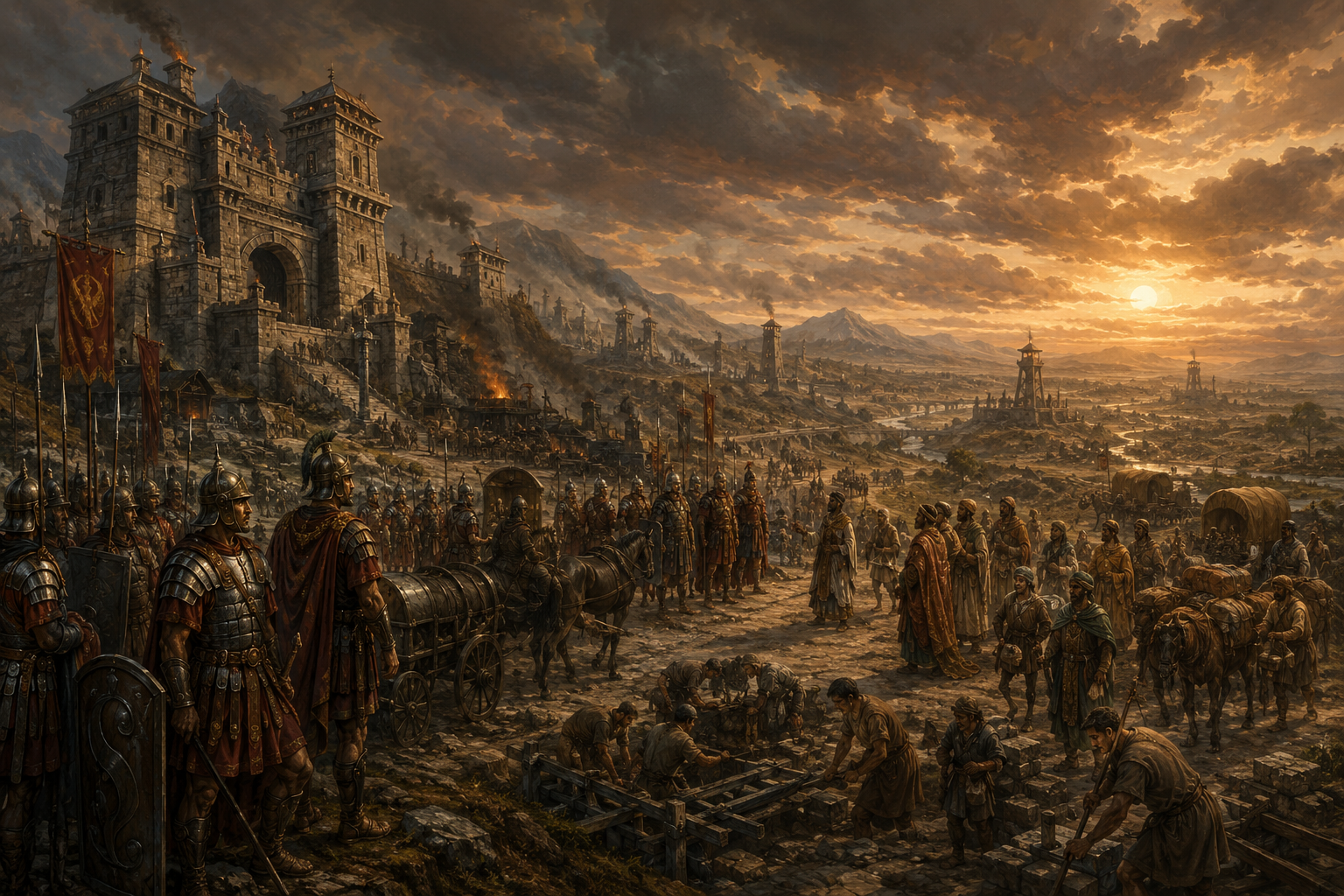
The Iron Ascendancies begin when survivors rebuild beyond the burned palaces of the Bronze Age—and end when vast states discover that roads, law, iron and disciplined armies cannot make dominion permanent.
Time Frame: c. 1200 BCE–300 CE
Common Name: The Iron Age and Classical Antiquity, depending upon the region
Theme: Ironworking, cavalry, coinage, written law, citizenship, philosophy and imperial administration allow states to command wider territories, while every expanding power creates frontiers, subject peoples and rivals determined not to be ruled.
The Iron Ascendancies continue directly from The Rise of Kingdoms. The palace world of the eastern Mediterranean has broken. Hattusha and Ugarit have fallen, Mycenaean administration has disappeared, and Kemet has survived only by surrendering much of its former reach. Yet the collapse does not empty the world. Farmers remain on the land. Smiths preserve difficult skills. Sailors redirect old routes. Refugees establish new settlements. Former mercenaries become rulers, pirates, guards or founders.
The first centuries of the age are therefore not a simple “dark age.” They are centuries of regional recovery, migration and political invention. Some societies lose writing or palace government while retaining agriculture, seafaring, oral law and craft. Others, untouched by the eastern Mediterranean collapse, continue along entirely different paths. Zhou rulers establish a new political order in China. Kush regains independence south of Kemet. Olmec and Chavín centres grow in the Americas. Lapita voyagers continue across the Pacific. Australian peoples maintain inherited law and sacred custodianship without adopting kingdoms, iron or urban states.
Iron does not spread at one speed or produce one result. In some regions it remains rare and prestigious for centuries. In others it becomes a practical material for tools, weapons and agricultural clearing. Bronze does not vanish. It remains essential for armour, vessels, sculpture, ritual objects, coinage and specialised craft. A society with iron weapons may lack coinage, writing or cavalry. A society without iron may possess sophisticated astronomy, agriculture, navigation, law or monumental architecture.
The defining change is political scale. Assyrian kings turn deportation, provincial government and siege warfare into instruments of empire. Persian rulers govern through satrapies, roads and negotiated local authority. Greek cities create republics, oligarchies, tyrannies and leagues. Carthage turns maritime trade into territorial power. Mauryan rulers govern much of South Asia. Qin and Han administrators standardise law, measure and record across immense populations. Rome expands from one city into a republic and then an imperial monarchy. None follows exactly the same path.
This is also the age in which states classify people more aggressively. Citizen and subject, free and enslaved, resident and foreigner, tributary and exempt community, lawful person and declared monster all become political categories. An archive can protect a treaty or preserve a claim. It can also reduce a village to taxable households, register captives as property or redefine an older people as trespassers upon its own land.
Nonhuman peoples face the same pressure without sharing one response. Some dwarven holds profit from iron and build regulated mining kingdoms. Others seal their gates rather than arm human empires. Some elven courts enter diplomacy with mortal states, while forest and island communities reject fixed borders. Gnome enclaves may serve as surveyors or healers under treaty, and halfling river leagues may remain independent by controlling food, ferries or marsh routes. Orc, goblin and kobold peoples develop regional states, confederacies and fortified settlements of their own.
Mixed settlements remain specific arrangements rather than the ordinary condition of the world. A Persian port may recognise a dwarven trade house because one royal charter protects it. A Celtic sanctuary may shelter humans and elves under the same sacred law. A Roman frontier town may contain a recognised nonhuman quarter while denying equal status to similar people beyond the walls. Coexistence depends upon named custom, treaty and power.
The Iron Ascendancies are therefore not the inevitable triumph of civilisation over wilderness. They are the age in which states learn to name, measure and command the world—and in doing so create the borderlands, rebellions, hidden sovereignties and unresolved legal claims that remain active .
The World at the Beginning
- The Late Bronze Age collapse has destroyed or weakened many eastern Mediterranean palace states.
- Mycenaean palaces have fallen, but Greek-speaking communities, cults, farms and seafaring traditions survive.
- The Hittite Empire has fractured into Neo-Hittite and other Anatolian successor states.
- Phoenician cities inherit important maritime routes from the older Canaanite and palace worlds.
- Kemet survives the collapse but loses much of its authority in the Levant and Nubia.
- Kushite communities regain political independence in Upper Nubia.
- Assyria and Babylonia endure as reduced but literate kingdoms capable of rebuilding.
- The Shang realm remains powerful in northern China but will soon be overthrown by Zhou rulers.
- Iron objects exist in several regions but remain uneven in availability, quality and social importance.
- Bronze remains essential and does not disappear when ironworking spreads.
- Olmec centres continue developing in Mesoamerica, while Andean communities create new ceremonial and exchange networks.
- Lapita voyagers continue settling islands across Remote Oceania.
- Australian societies maintain sophisticated land, water, kinship, fire and sacred law without adopting state institutions.
- The Hellenic gods already possess their divine realms; mortal political change does not create them.
- The Tuatha Dé Danann remain active within Irish sídhe courts after losing primary surface sovereignty.
- Dwarven realms remain divided by the legacy of giant enslavement, liberation and collaboration.
- Serpentfolk, elder cults and surviving prehuman archives exploit the destruction of Bronze Age institutions.
The age begins amid fragmentation. It ends with Rome, Han China, Kush, Parthia, the Kushan world, Teotihuacan and other great powers maintaining political systems that would have appeared impossibly large to most Bronze Age kings.
The Iron Ascendancies Timeline
c. 1200–1100 BCE — The World after the Palace Fires
Across the eastern Mediterranean, palace archives close, burn or cease to be maintained. Royal workshops disperse. Some specialised crafts decline where courts can no longer support them. Long-distance trade contracts, but local exchange continues.
Former palace soldiers, sailors, captives and labourers move through regions whose old authorities can no longer control them. Some become raiders or mercenaries. Others establish villages, join surviving cities or carry military and craft knowledge into new communities.
The collapse does not erase entire peoples. “Sea Peoples,” refugees, former palace subjects and raiding coalitions overlap, but are not one race, nation or supernatural army.
Ruined capitals become dangerous because their guardians, temple wards and royal oaths remain active after the institutions responsible for maintaining them have vanished.
c. 1200–1000 BCE — Phoenician Cities Take to the Sea
Tyre, Sidon, Byblos and other Phoenician cities preserve and expand maritime traditions inherited from the Levantine Bronze Age.
Ships carry timber, metal, textiles, glass, purple dye, carved ivory and luxury goods through the Mediterranean. Trading stations and colonies grow where local agreements, harbours and merchant families make settlement possible.
No single Phoenician empire controls every city. Tyre, Sidon and their rivals possess separate rulers, gods, laws and commercial interests.
Binding campaign ruling: Phoenician navigators maintain treaties with sea spirits, island powers and some Deep One communities. These agreements differ by port and do not make Phoenician sailors servants of one hidden oceanic power.
c. 1150–900 BCE — Ironworking Becomes a Regional Advantage
Knowledge of smelting and forging iron spreads unevenly through Anatolia, the Levant, Mesopotamia, Europe, Africa and parts of Asia.
Early iron is not automatically superior to good bronze. Its importance lies in access to ores, the development of suitable furnaces and the ability to organise skilled labour.
Iron tools allow some communities to clear woodland, cultivate heavier soils and equip larger numbers of soldiers. In other regions, environmental conditions, trade traditions or social choices make bronze, stone, wood, bone and shell more useful.
Dwarven ironworking predates widespread human iron industries, but dwarves neither invent every mortal tradition nor possess one universal secret. Human, dwarven and other smithing traditions develop through independent discovery, exchange, captivity and adaptation.
c. 1100–800 BCE — Neo-Hittite and Aramaean Successor States
In Anatolia and northern Syria, successor kingdoms emerge from the remains of Hittite provincial rule and local traditions.
Neo-Hittite, Luwian, Aramaean, Hurrian and other communities maintain fortified cities, royal inscriptions and regional cults. Some inherit Hittite titles or art without claiming to restore the old empire.
These states mediate trade and warfare between Assyria, Anatolia, the Levant and the Mediterranean.
Imperial succession does not transfer every divine treaty. A new king may occupy an old capital while lacking recognition from the mountain god, dragon, giant house or subterranean people bound to the previous dynasty.
1046 BCE — Zhou Overthrows Shang
Zhou forces defeat the last Shang king and establish a new ruling house in northern China.
The Zhou explain legitimate rule through the Mandate of Heaven: a dynasty governs while it maintains moral and ritual order, but may lose authority through tyranny, failure and cosmic disorder.
Shang royal ancestors remain genuine powers after the dynasty falls. They do not cease to exist merely because Zhou ritual places them within a defeated lineage.
Binding campaign ruling: the Mandate is real but not mechanically automatic. Drought, defeat or rebellion may indicate lost legitimacy, but rulers and rivals can misinterpret signs, falsify records or claim heavenly approval before the divine judgement is clear.
c. 1050–800 BCE — The Greek Post-Palatial World
Mycenaean palace administration disappears, and the use of Linear B ends. Population declines in some regions while other communities endure or grow.
Local chiefs, households, sanctuaries and warrior groups replace palace bureaucracies. Oral poetry preserves memories of heroic houses, Troy and divine intervention while changing names, sequences and political meanings.
Iron becomes more common, but bronze remains important. Pottery, burial and settlement patterns change region by region.
The gods do not withdraw from Greece. Their cults become more local and less dependent upon palace institutions, while heroic dead gain stronger authority at tombs, ruined citadels and ancestral territories.
c. 1000–750 BCE — Kush Regains Sovereignty
As Egyptian control in Nubia weakens, Kushite centres near Napata and older sacred landscapes regain political independence.
Local rulers command cattle, gold, river trade and desert routes while maintaining relationships with Egyptian temples and gods on Kushite terms.
Kushite kings preserve some Pharaonic forms without becoming merely Egyptian rulers in the south.
Binding campaign ruling: the royal dead of Kerma and later Napata recognise continuity in Kushite sovereignty. Egyptian occupation does not cancel their claims to land, tombs or divine office.
c. 1000–500 BCE — Lapita Voyaging and the Western Pacific
Lapita-descended communities establish and maintain settlements through Melanesia and western Polynesia.
Navigation depends upon stars, waves, winds, birds, cloud forms, inherited route knowledge and relationships among island communities.
Political authority remains local. No oceanic empire commands every route, and new islands require new agreements with land, reef, ancestors and existing peoples.
The Polynesian gods and ancestral powers are not created by migration, but their mortal titles and island relationships develop as communities settle new lands.
911–745 BCE — Assyria Returns
Assyrian rulers rebuild military power from the northern Mesopotamian heartland.
Campaigns secure tribute, trade routes and buffer territories. Royal annals present victories as restoration of the order demanded by Ashur.
Armies combine infantry, cavalry, chariots, engineers and siege specialists. Conquered rulers may remain in place while paying tribute and providing troops.
Assyrian state power grows through repeated administrative choices rather than one sudden transformation into empire.
c. 900–600 BCE — Urartu and the Highland Kingdoms
Urartu becomes a powerful kingdom around Lake Van and the Armenian highlands.
Its rulers build fortresses, canals, temples and storage systems while competing with Assyria and neighbouring peoples.
Mountain geography limits direct control. Local communities, sacred peaks, giant remnants and mining peoples retain their own authority beyond royal strongholds.
Some Urartian fortresses occupy older giant and dwarven works. Reuse does not prove that either people willingly transferred ownership.
c. 900–400 BCE — La Venta and the Later Olmec World
La Venta becomes an important ceremonial and political centre after the decline of San Lorenzo.
Monumental sculpture, trade, water management and sacred rulership continue across the Gulf Coast and influence neighbouring regions.
Olmec communities are not one unchanging empire. Centres rise and decline while local peoples adapt symbols of jaguar, maize, rain, serpent and ancestral power.
Binding campaign ruling: rulers depicted with supernatural features are humans engaged in ritual transformation, divine descent or spirit alliance. They are not automatically members of one hidden nonhuman race.
c. 1200–300 BCE — Chavín and the Andean Sacred Network
Building upon traditions established before this age, Chavín de Huántar becomes a major ceremonial centre connecting highland, coastal and forest communities.
Pilgrimage, exchange, art and ritual authority spread through networks rather than one conquering state. Chavín influence is strongest at different times in different regions and begins to fragment long before every local tradition abandons its imagery.
Priests and local rulers use sound, darkness, water channels, carved stone and controlled movement through temple interiors to shape sacred experience.
Binding campaign ruling: Chavín transformation imagery records genuine contact with feline, serpent, bird and underworld powers, but individual initiates do not all undergo literal bodily transformation. The oldest obligations attached to Chavín de Huántar predate this eon and remain enforceable after the wider sacred network disperses.
c. 850–450 BCE — Hallstatt Elites and the Central European Iron World
Across central Europe, ranked communities control iron, salt, farming land and long-distance exchange.
Fortified hill settlements, rich burials, wagons and imported Mediterranean goods display the authority of warrior and trading elites.
No single Celtic kingdom controls the Hallstatt world. Language, material culture and elite customs overlap without creating one nation.
Elven and human communities interact differently by region. Some forest courts trade amber, horses or healing knowledge. Others treat settlement expansion and iron clearing as invasion.
c. 800–600 BCE — The Greek Poleis and New Colonies
Greek communities form increasingly distinct poleis: citizen bodies tied to cities, farmland, sanctuaries and law.
Monarchies, aristocracies, oligarchies and tyrannies compete. Colonists establish settlements around the Mediterranean and Black Sea, often through negotiation, violence or both.
The Greek alphabet develops from Phoenician models and supports public inscriptions, trade, poetry and law.
Zeus, Athena, Apollo, Artemis, Hera, Poseidon and other gods receive increasingly formal civic cults.
Civic patronage strengthens mortal routes to divine powers but does not make a god the property of one city. A deity may support a polis in one dispute and oppose its rulers in another.
c. 800–500 BCE — Etruscan Cities Rise
Etruscan-speaking cities flourish in central Italy through agriculture, mining, metalwork, trade and control of inland and maritime routes.
They form leagues and shared religious institutions without becoming one permanent centralised state.
Etruscan divination, funerary art and city planning influence neighbouring Italic peoples, including early Rome.
Binding campaign ruling: Etruscan haruspices interpret genuine divine signs. Accuracy depends upon training, ritual context and the honesty of those presenting the omen.
c. 814 BCE — Carthage Is Founded
Phoenician settlers establish Carthage on the North African coast, traditionally under the exiled royal woman remembered as Elissa or Dido.
The city grows through harbour access, agriculture, merchant networks and relationships with neighbouring African peoples.
Carthage remains culturally connected to Tyre without becoming a permanent colony governed from the eastern Mediterranean.
Binding campaign ruling: Dido is a historical and supernatural founder whose later association with Trojan heroes compresses separate generations. Her boundary bargain remains embedded in Carthaginian land law and can still judge rulers who seize protected ground by deception.
c. 900 BCE–200 CE — Nok Communities, Terracotta and Iron
Across parts of present-day central Nigeria, communities associated with the Nok tradition farm, work iron and create distinctive terracotta sculpture.
The chronology remains debated. The binding campaign chronology places established Nok ironworking by approximately 900 BCE, while the surviving terracotta sequence becomes archaeologically clearer from about 500 BCE onward.
Settlement, language and technology vary across the region. Nok is not one centralised empire and does not represent every West African people living within the same broad centuries.
Terracotta heads and figures preserve status, ritual, ancestry and transformation without functioning as simple portraits in every case.
Binding campaign ruling: some Nok figures house ancestral presence during ceremonies. Removing one without the community’s rites can sever protection from the settlement while leaving the spirit attached to the stolen object.
776 BCE — The Games at Olympia Enter Recorded Tradition
The traditional chronology of the Olympic Games begins.
Athletes, aristocrats, envoys, merchants and pilgrims gather under sacred truce. Victory grants prestige to competitors, families and cities.
The games honour Zeus but do not end political rivalry. Sacred truce protects recognised travellers for the festival without creating permanent peace.
c. 753 BCE — Rome’s Founding Tradition
Later Roman tradition places the founding of Rome under Romulus in 753 BCE.
The historical city grows from several communities around the hills and river crossings of the lower Tiber.
Romulus, Remus, the she-wolf, divine ancestry and the killing at the boundary preserve supernatural and political truths without providing a simple civic record.
Binding campaign ruling: Rome’s boundary rites possess lasting magical force. The first murder committed over the wall creates a precedent: Roman expansion is protected when conducted under recognised law, but unlawful violation of sacred limits generates curses the state repeatedly attempts to redirect onto enemies.
c. 747–656 BCE — Kushite Pharaohs Rule Kemet
Kushite rulers expand north and establish the Twenty-Fifth Dynasty of Kemet.
Piye, Shabaka, Taharqa and their successors restore temples, sponsor building and present themselves as defenders of Ma’at.
Kushite kings rule through both Egyptian and Nubian traditions. Their authority is neither foreign imitation nor simple conquest.
The Pharaonic gods recognise lawful offerings and royal duty, but individual temples and divine powers do not agree automatically on every succession.
745–612 BCE — The Neo-Assyrian Imperial Machine
Tiglath-pileser III and later rulers transform Assyria into a more directly governed territorial empire.
Provinces, governors, roads, garrisons, taxation and organised deportation weaken local resistance and redistribute labour and skill.
Siege warfare becomes systematic. Engineers bridge rivers, undermine walls and build ramps. Royal art presents conquest as irresistible and rebellion as chaos.
Assyrian terror is state policy, not an inherited moral quality of every Assyrian. Farmers, merchants, deported communities, soldiers, officials and kings possess unequal power and responsibility.
The god Ashur legitimises Assyrian kingship but does not personally approve every atrocity claimed in his name. Other Mesopotamian gods protect their cities, temples and worshippers within and beyond imperial rule.
671 BCE — Assyria Invades Kemet
Esarhaddon’s forces enter Egypt and temporarily capture Memphis.
Assyrian armies, Kushite rulers, Delta dynasts and local temples contest authority. No single conquest permanently settles the region.
Taharqa withdraws south but continues resistance. Assyrian control depends upon local rulers and repeated military intervention.
Binding campaign ruling: no conqueror acquires automatic control over the Duat, divine tomb law or the royal dead of Kemet. Mortal occupation and supernatural sovereignty remain separate questions.
626–539 BCE — The Neo-Babylonian Kingdom
Nabopolassar establishes a new Babylonian dynasty as Assyrian power collapses.
Nebuchadnezzar II strengthens Babylon, campaigns in the Levant and sponsors monumental building.
Babylonian temples, scribes and scholars preserve Mesopotamian astronomical, legal and ritual traditions.
Marduksupports Babylon’s restored cult but does not grant its kings universal ownership of every land formerly held by Assyria.
612 BCE — Nineveh Falls
A coalition led by Babylonian and Median forces captures Nineveh.
Royal palaces are destroyed, monuments defaced and archives scattered. Assyrian political power survives briefly elsewhere before the empire’s final defeat.
The destruction releases bound guardians, royal dead and oath spirits from buildings whose ritual maintenance ends abruptly.
Binding campaign ruling: some tablets from Ashurbanipal’s library are removed before the fall. A portion enters hidden serpentfolk and underworld collections rather than later human archives.
c. 600–400 BCE — Sages, Philosophers and Lawgivers
Across several regions, teachers and reformers question inherited authority and organise ethical, political and metaphysical traditions.
Confucius teaches ritual, moral cultivation and ordered relationships. Daoist traditions emphasise harmony, restraint and the limits of imposed order. South Asian teachers develop Buddhist, Jain, Brahmanic and other paths. Greek thinkers investigate nature, law, politics and knowledge.
These movements do not arise as one worldwide school and do not replace older gods, ancestors or rites.
Binding campaign ruling: disciplined philosophy can have supernatural force. A school that maintains coherent practice across generations may create stable protection against possession, deception or divine coercion without becoming a priesthood.
c. 600–300 BCE — The Mahajanapadas and the Rise of Magadha
Kingdoms and republics compete across northern South Asia.
Urban centres, coinage, trade, armies and new religious communities grow. Magadha gains strength through fertile land, river access, elephants, fortified capitals and political consolidation.
Republican clans and oligarchic assemblies remain significant alongside monarchies.
Binding campaign ruling: ascetics, philosophers and ritual specialists may reject royal authority without becoming socially powerless. Their vows can create recognised sanctuary and obligations even kings hesitate to violate.
550–530 BCE — Cyrus Creates the Persian Empire
Cyrus II defeats Median, Lydian and Babylonian rulers and establishes the Achaemenid Empire.
He presents conquest as restoration of lawful order and commonly governs through existing elites, temples and local customs.
This policy is practical imperial rule rather than modern equality. Communities remain subject to taxation, military obligation and royal supremacy.
Binding campaign ruling: Cyrus’s reputation for lawful kingship gives his proclamations unusual authority over oaths and captive restoration. It does not make every later document attributed to him genuine.
522–486 BCE — Darius Organises Imperial Rule
Darius I secures the throne, suppresses revolts and divides the empire into satrapies.
Royal roads, messengers, taxation, coinage and multilingual inscriptions connect diverse lands without making them culturally uniform.
Satraps possess great authority but remain accountable to the king and subject to inspection.
Binding campaign ruling: a royal road is protected by law, garrison and divine oath only where those institutions can act. Beyond maintained stations, older local sovereignty remains capable of refusing imperial passage.
c. 509 BCE — The Roman Republic
Roman tradition places the expulsion of the final king and the establishment of the Republic near the end of the sixth century BCE.
Magistrates, Senate, assemblies, priesthoods and aristocratic competition divide authority without creating political equality.
Conflict between patricians and plebeians produces offices, laws and protections through repeated struggle.
The Roman pantheon binds civic ritual to office, boundary, household and military duty.
499–449 BCE — The Persian Wars
Revolt among Ionian Greek cities leads to wider conflict between the Achaemenid Empire and Greek coalitions.
Marathon, Thermopylae, Salamis and Plataea become defining events in later Greek memory.
The wars are not a simple struggle between freedom and slavery. Greek cities include democracies, oligarchies and tyrannies; many Greeks fight for Persia, and the Persian Empire governs many peoples through negotiated local systems.
Athena, Poseidon, Zeus and other powers influence omens, weather, morale and sacred obligations without removing mortal responsibility.
c. 500–300 BCE — The La Tène World and Celtic Expansion
La Tène art, warrior culture and exchange networks spread across much of central and western Europe.
Celtic-speaking peoples migrate, raid, settle and establish new political communities in Italy, the Balkans and Anatolia.
They do not form one Celtic empire. Kings, aristocracies, assemblies, priestly specialists and local customs vary sharply.
The Celtic gods receive different names and cult forms among related peoples. The Tuatha Dé Danann remain the divine houses of Irish tradition rather than rulers of every Celtic community.
431–404 BCE — The Peloponnesian War
Athens and Sparta lead rival alliances through decades of war.
Plague, civil conflict, siege, naval warfare and shifting diplomacy damage cities throughout the Greek world.
Democracy, oligarchy and imperial tribute become weapons within the conflict rather than neutral constitutional forms.
The plague is a historical disease intensified by crowding and war. Cults of Apollo, Asclepius and local healing powers can mitigate individual outbreaks but cannot erase the political causes that spread them.
359–336 BCE — Philip II Remakes Macedon
Philip II reforms the Macedonian army, strengthens royal finances and expands influence across Greece.
The Macedonian phalanx works with cavalry, skirmishers, engineers and diplomacy rather than functioning as one invincible formation.
After Chaeronea, Philip leads a league of Greek states while preparing war against Persia.
His assassination leaves a powerful but politically dangerous inheritance to Alexander.
334–323 BCE — Alexander Breaks the Old Boundaries
Alexander III invades the Persian Empire, defeats its armies and takes Egypt, Mesopotamia, Iran and territories reaching into Central and South Asia.
He founds or refounds cities, adopts elements of Persian court practice and incorporates local soldiers and elites.
Claims of divine descent and heroic ancestry strengthen his authority but increase tension among Macedonian companions and subject peoples.
Binding campaign ruling: Alexander is an exceptional mortal ruler with genuine divine ancestry claims, not a god whose every decision is sacred. Oracles recognise unusual destiny without granting unlimited moral authority.
His death at Babylon leaves no stable succession and transforms conquest into wars among his generals.
323–281 BCE — The Wars of the Successors
Alexander’s generals divide and repeatedly contest the empire.
Ptolemaic Kemet, the Seleucid realm, Macedon and smaller Hellenistic kingdoms emerge from decades of war.
Greek and Macedonian settlers establish cities and military communities amid older populations and institutions.
Binding campaign ruling: syncretism does not prove that similar gods are one being. A Greek ruler may identify Zeus with a local high god for political purposes while both divine powers retain separate wills, histories and realms.
c. 322–185 BCE — The Mauryan Empire
Chandragupta Maurya establishes a powerful empire centred upon Magadha after the retreat of Macedonian authority from the northwest.
Administration, taxation, roads, fortified cities, spies, officials and armies support imperial rule across much of South Asia.
Regional authority remains uneven. Forest peoples, frontier communities, republics and southern polities do not all experience Mauryan power in the same manner.
The Arthashastra tradition preserves genuine statecraft but does not describe every Mauryan policy or prove that one minister secretly controls the empire.
c. 261 BCE — Ashoka and the Kalinga War
Ashoka’s conquest of Kalinga causes immense death, displacement and suffering.
He later promotes dhamma through inscriptions, officials, patronage and moral instruction.
His reforms do not dissolve the army, taxation or imperial hierarchy. Moral kingship remains an attempt to restrain power from within power.
Binding campaign ruling: Ashoka’s edicts possess no enchantment forcing obedience. Their supernatural strength arises when rulers, officials and communities publicly accept obligations recorded before divine and ancestral witnesses.
264–146 BCE — Rome and Carthage Fight for the Western Mediterranean
The Punic Wars transform Rome and destroy Carthaginian supremacy.
Naval construction, citizen levies, allied obligations, mercenary armies and long-distance logistics determine the conflicts.
Hannibal crosses the Alps and defeats Roman armies but cannot force Rome’s political system to surrender.
Rome eventually carries war into North Africa. Carthage is destroyed in 146 BCE.
Carthage’s fall does not erase Phoenician people, language, gods or maritime traditions. Refugees, subject cities and hidden temples preserve claims Rome cannot fully extinguish.
c. 250 BCE–224 CE — Parthia and the Iranian Frontier
Arsacid rulers establish Parthian power across Iran and Mesopotamia.
Mounted archers, armoured cavalry, regional nobles and control of trade routes support a decentralised imperial system.
Parthia competes with Seleucid, Roman, Central Asian and local powers while preserving Iranian, Mesopotamian and Hellenistic traditions.
Parthian noble houses retain recognised ancestral and local divine authority. A king who commands the empire cannot simply abolish every house cult without risking supernatural as well as political revolt.
221–206 BCE — Qin Unifies China
Qin defeats the remaining Warring States and establishes a centralised empire.
Weights, measures, writing forms, roads and administrative divisions are standardised. Weapons are collected, fortifications altered and populations relocated.
Harsh labour demands and Legalist government create order at immense human cost.
The First Emperor’s tomb gathers craftsmen, soldiers, officials, animals and supernatural protections into a funerary state.
Binding campaign ruling: the terracotta army is not an ordinary construct legion ready to march. Most figures are ritual bodies and spiritual offices. Specific command pits can animate if the imperial tomb’s boundaries are violated under the conditions recorded by its builders.
206 BCE–220 CE — The Han Imperial Order
The Han dynasty restores central rule after Qin collapse while retaining many Qin administrative foundations.
Imperial government depends upon commanderies, kingdoms, taxation, law, armies, roads, canals, archives and an expanding educated bureaucracy.
Confucian learning gains official importance without eliminating Legalist practice, local cults, ancestor rites or competing philosophies.
Western and Eastern Han periods are separated by Wang Mang’s short-lived Xin dynasty and civil war.
Binding campaign ruling: imperial documents can carry spiritual authority when issued through recognised office and ritual. Forging the seal may imitate bureaucratic force but also attracts the attention of ancestral and celestial auditors.
c. 200 BCE–200 CE — Xiongnu, Saka and the Steppe Powers
Pastoral confederacies dominate routes and grasslands across Central and Inner Asia.
The Xiongnu build a powerful political order capable of war, diplomacy, tribute and marriage agreements with Han China.
Saka, Scythian, Sarmatian and other peoples move across regions from the Black Sea to Central Asia and South Asia.
These societies are not shapeless hordes. They possess rulers, assemblies, clan law, ritual specialists, herding economies, craft and long-distance diplomacy.
Mounted peoples do not automatically belong to one orc, human or nonhuman ancestry. Human and nonhuman pastoral communities may share tactics or territory while retaining separate histories.
c. 200 BCE–200 CE — Roads of Silk, Horse and Glass
Trade networks connect Han China, Central Asia, India, Iran, the Mediterranean, Arabia and East Africa.
Silk, horses, spices, glass, metal, gems, textiles, medicines and religious ideas move through many intermediaries.
There is no single “Silk Road.” Routes change with war, season, taxation and political protection.
Merchants depend upon translators, caravan leaders, hostages, temples, wells and local agreements as much as imperial roads.
146 BCE — Rome Destroys Carthage and Corinth
Roman victories in the same year demonstrate the Republic’s dominance in both western and eastern Mediterranean affairs.
Carthage is destroyed after the Third Punic War. Corinth is sacked following conflict with the Achaean League.
Art, captives, wealth and sacred objects flow into Italy.
Binding campaign ruling: removing a cult statue does not automatically transfer the god. Some Roman evocatio rites successfully invite divine powers to accept new worship; others capture only an image, guardian spirit or dangerous absence.
c. 133–31 BCE — The Roman Republic Breaks under Expansion
Conquest enriches elites, expands slavery and increases competition for military command.
Land conflict, reform attempts, allied demands, slave wars and civil wars destabilise republican government.
Marius, Sulla, Pompey, Caesar, Antony, Octavian and other leaders use armies whose loyalty increasingly attaches to commanders as well as the state.
The Republic’s institutions continue operating while being repeatedly overridden, weaponised or emptied of meaning.
73–71 BCE — The Revolt of Spartacus
Gladiators and enslaved people escape and build a large rebel force in Italy.
The revolt defeats several Roman armies before being crushed by Crassus.
Participants include people of different origins and motives. Some seek escape, some plunder, some revenge and some a route home.
No divine judgement makes enslavement lawful merely because Roman law recognises it. Gods, spirits and nonhuman powers judge bondage according to their own covenants, which may conflict directly with state ownership.
44 BCE — Caesar Is Assassinated
Julius Caesar’s accumulation of offices and honours leads senators to kill him in the name of restoring the Republic.
The assassination does not restore stable government. It begins another sequence of civil wars.
Caesar’s posthumous deification creates political and supernatural consequences. Public cult, ancestral honour and genuine divine transformation are not always identical.
Binding campaign ruling: Caesar becomes a powerful imperial dead and receives divine recognition, but does not enter the Roman pantheon with authority equal to Jupiter, Mars or the older gods.
31–27 BCE — Augustus Establishes Imperial Rule
Octavian defeats Antony and Cleopatra at Actium and becomes the dominant ruler of the Roman world.
He presents restored order through republican titles while holding military, political and religious power sufficient to found an imperial monarchy.
Provincial administration, taxation, army settlement and civic patronage stabilise the state after civil war.
The Augustan settlement is a lawful political construction, not the spontaneous return of a lost golden age. Its peace depends upon victory, surveillance, patronage and the exclusion of rival claims.
c. 500 BCE–300 CE — Monte Albán and the Early Maya Polities
Monte Albán develops into a major Zapotec centre above the Valley of Oaxaca.
Monuments, writing, calendrical records and military imagery support expanding political authority.
Across the Maya region, growing communities develop dynastic rulership, writing, monumental architecture, trade and complex calendrical traditions.
There is no single Maya empire. Cities and royal houses maintain independent alliances, wars and divine relationships even when they share language families, scripts and ceremonial forms.
c. 100 BCE–300 CE — Teotihuacan Becomes a Great City
Settlements in the Basin of Mexico consolidate into Teotihuacan, which grows rapidly during the first centuries CE into a vast urban and ceremonial centre.
Planned avenues, monumental pyramids, apartment compounds, craft production and long-distance exchange support a diverse population.
Its political structure remains uncertain. Authority may be shared among elite houses, priesthoods or corporate groups rather than concentrated in one publicly represented king.
Binding campaign ruling: the city’s great avenue aligns civic, celestial and underworld geography. It is not a portal by itself, but coordinated rites can open controlled passages beneath specific temple complexes.
c. 100 BCE–300 CE — Hopewell Networks Flourish
Communities across eastern North America build earthworks and participate in far-reaching ceremonial and exchange networks.
Copper, mica, shell, stone and crafted objects move across great distances through relationships among many communities rather than through one imperial market.
Hopewell interaction is not one empire, ethnicity or permanently governed capital. Ceremonial centres host gatherings whose participants retain distinct languages, settlements and political identities.
The networks continue beyond the close of this eon into the following centuries.
Binding campaign ruling: some geometric earthworks regulate relationships with stars, ancestors and spirit routes. Their authority depends upon continued custodianship rather than ownership by a distant ruler.
c. 300 BCE–300 CE — Paracas, Nazca and the Beginnings of Moche
After Chavín influence fragments, regional Andean traditions develop along the coast and highlands.
Late Paracas communities maintain extraordinary textile and funerary traditions. Nazca societies emerge around the final century BCE and develop ceremonial centres and vast ground markings. Moche polities begin forming in northern coastal valleys during the first and second centuries CE.
Irrigation, craft, warfare and ritual authority develop differently in each region; these societies are not successive names for one Andean kingdom.
Binding campaign ruling: the Nazca lines are not one universal landing field or spell diagram. Different figures mark pilgrimage, water, celestial and territorial obligations maintained by separate custodial communities.
c. 300 BCE–300 CE — Meroë, Garamantes and African Regional Powers
Kushite royal activity increasingly centres upon Meroë, which commands river, savannah and desert connections.
Queens and queen mothers can exercise major political authority. Meroitic writing, iron production, temples and distinctive royal traditions develop without abandoning older Kushite identity.
The Garamantes build oasis settlements and irrigation systems in the Sahara, linking Mediterranean and sub-Saharan exchange.
Elsewhere, farming, pastoral, forest and river societies continue independent development without becoming extensions of Kemet, Kush or Carthage.
c. 100–300 CE — Aksum Rises beside the Red Sea
Aksum emerges by the first century CE as a major highland and Red Sea power through agriculture, ivory, gold, livestock and maritime exchange.
Its rulers use monumental inscriptions and, by the third century CE, issue coinage that communicates authority across trading networks.
Aksumite power grows alongside Kush, Arabian kingdoms, Roman Kemet and Indian Ocean commerce rather than emerging in isolation.
Imported scripts, titles and gods enter Aksum through negotiation with local royal ancestors and land powers. Foreign recognition strengthens kingship but cannot create it.
c. 4th Century BCE–300 CE — Yayoi Communities and the Japanese Archipelago
Wet-rice agriculture, bronze and iron technologies spread through parts of the Japanese archipelago during the Yayoi period.
The transition begins at different times in different regions. Migration, exchange and conflict connect newcomers with Jōmon-descended communities, while many northern and island societies follow separate histories.
By the third century CE, Chinese records describe the polity of Yamatai and the ruler Himiko.
Binding campaign ruling: Himiko is a mortal queen and powerful ritual mediator. Her authority depends upon alliances among communities and recognised relationships with kami, ancestors and diviners rather than personal ownership of the islands.
c. 200 BCE–300 CE — Southeast Asian Maritime and River States
Dong Son, Sa Huynh and other regional cultures develop bronze, iron, seafaring and exchange traditions.
Trade brings Indian, Central Asian, Chinese and Mediterranean goods through local intermediaries.
Early states emerge around river deltas, ports and agricultural centres without representing one wave of external civilisation replacing local peoples.
Imported gods, scripts and royal titles require local recognition. A foreign rite cannot simply overwrite the river, ancestor and land powers already governing a place.
c. 50–250 CE — The Kushan Ascendancy
Kushan rulers establish an empire across parts of Central Asia, Afghanistan, Pakistan and northern India.
Trade, urban life, coinage and artistic exchange flourish. Greek, Iranian, Indian and Central Asian languages and divine images appear within Kushan political culture.
Kanishka becomes an important royal patron of Buddhism. His exact accession remains disputed; the binding campaign chronology places his principal reign provisionally at approximately 127–150 CE without treating that date as archaeologically certain.
Binding campaign ruling: Kushan coins depicting several divine traditions are acts of imperial recognition, not proof that every god shown accepts one unified pantheon.
108 BCE Onward — Han Commanderies and Korean Polities
Han forces defeat Gojoseon and establish commanderies in parts of the Korean peninsula and neighbouring regions.
Direct control remains uneven. Local polities, fortified communities and emerging kingdoms continue beyond the commanderies.
Trade, warfare and migration carry iron, writing, ritual objects and political models without turning the peninsula into a simple extension of Han China.
Local ancestors and land powers do not recognise a foreign commandery merely because an imperial map includes their territory.
9 CE — The Teutoburg Forest Defeat
Germanic forces led by Arminius destroy three Roman legions in the Teutoburg Forest.
The defeat limits Roman expansion east of the Rhine and exposes the danger of relying upon local allies whose political interests differ from imperial assumptions.
Binding campaign ruling: the forest itself does not fight as one conscious being. Local sacred groves, ancestral powers and hidden elven territories aid resistance separately, sometimes without recognising Arminius as their ruler.
79 CE — Vesuvius Buries Pompeii and Herculaneum
The eruption of Vesuvius destroys towns around the Bay of Naples.
Ash preserves buildings, objects and bodies while killing inhabitants unable to escape.
The disaster is interpreted through omen, divine anger and natural philosophy.
Binding campaign ruling: the eruption is a natural volcanic catastrophe with supernatural consequences. It is not caused by one god’s simple punishment, although neglected underworld and mountain rites worsen the release of bound spirits after the deaths.
c. 2nd Century BCE–105 CE — Paper Develops in Han China
Forms of paper exist before Cai Lun and are used alongside bamboo, wood and silk.
In 105 CE, Cai Lun’s traditional court presentation becomes associated with improved materials, methods and official support rather than the first invention of paper.
Cheaper and more flexible writing surfaces gradually expand administrative, scholarly, ritual and private record-keeping, but paper does not immediately replace older materials.
Paper carries no inherent magical superiority. Its historical power lies in multiplying permits, maps, charms, orders and archives more quickly and cheaply than many earlier media.
117 CE — Rome Reaches Its Greatest Territorial Extent
Under Trajan, Roman rule reaches its widest formal extent.
Legions, roads, fleets, client rulers, provincial governors and urban elites maintain imperial authority.
The frontier remains a zone of trade, migration, diplomacy and violence rather than one fixed wall dividing civilisation from wilderness.
The Roman gods, local cults, imported deities and mystery traditions coexist throughout the empire. Roman names may identify Hellenic powers under distinct civic forms, while Janus, Vesta and other Roman gods possess their own authority.
c. 100–250 CE — High Empire, Local Gods and Hidden Sovereignties
Rome, Han China, Kush, Parthia, the Kushan Empire and Teotihuacan maintain large political systems at the same time.
Long-distance trade and diplomacy connect distant courts, but most people remain governed by local households, villages, cities, temples and customary law.
Imperial cults do not erase local divinities. They add another layer of obligation and another source of conflict.
Serpentfolk, Fey courts, ancestral kingdoms, giant remnants and underworld powers learn to work through permits, governors, merchants and provincial rivalries rather than confronting empires only through open war.
184 CE — The Yellow Turban Rebellion
A religious and social movement leads a major uprising against the Eastern Han.
Economic distress, land concentration, disease, local corruption and weakened central authority contribute to rebellion.
The state suppresses the uprising but becomes increasingly dependent upon regional military leaders.
Healing rites and prophetic signs used by the rebels possess genuine power, but supernatural truth does not guarantee that every military leader, local cell or political claim remains just.
220 CE — The Han Dynasty Ends
The last Han emperor abdicates after decades of warlord power and court collapse.
Wei, Shu and Wu compete during the Three Kingdoms period.
Han institutions, titles and records survive within successor states rather than disappearing.
Later heroic tradition magnifies generals, strategists and rulers whose historical actions were already extraordinary.
224 CE — The Sasanian Dynasty Replaces Parthia
Ardashir I defeats the final Arsacid king and establishes Sasanian rule in Iran.
The new dynasty claims stronger central kingship and revives older Iranian imperial forms.
Regional nobles, cities and temples remain important, preventing complete centralisation.
Dynastic replacement changes royal ritual but does not extinguish Parthian ancestral contracts. Several remain enforceable against Sasanian officials who occupy the lands attached to them.
235–284 CE — The Roman Third-Century Crisis
Rapid imperial succession, civil war, invasion, plague, inflation and provincial breakaway states strain Roman rule.
Military emperors rise and fall through army support. The Gallic Empire and Palmyrene Empire temporarily govern large territories outside central control.
Trade and local government continue despite political instability, but frontier and urban populations bear the cost.
Binding campaign ruling: imperial cult cannot stabilise a throne when office, army and divine recognition disagree. Some emperors receive worship without gaining secure posthumous power; others become dangerous unquiet dead after official condemnation.
260 CE — A Roman Emperor Is Captured
The Sasanian king Shapur I captures the Roman emperor Valerian after the Battle of Edessa.
The event shatters the assumption that Roman emperors cannot be taken alive by foreign enemies.
Accounts of Valerian’s later fate become instruments of propaganda.
Binding campaign ruling: the capture breaks several imperial protective rites dependent upon the emperor remaining within Roman command. Provincial cults must decide whether office, person or Senate carries the interrupted sacred obligations.
270–275 CE — Aurelian Reunites the Roman Empire
Aurelian defeats Palmyrene and Gallic breakaway powers and restores central imperial control.
Rome receives new defensive walls, acknowledging that the imperial capital itself is vulnerable.
Solar imperial cult gains prominence as a possible unifying institution.
Binding campaign ruling: Sol Invictus is a recognised solar power and imperial title, but cannot absorb every sun god, local solar spirit or divine flame into one obedient being.
284–300 CE — Diocletian Hardens Imperial Government
Diocletian establishes new administrative divisions, tax systems and shared imperial rule.
The Tetrarchy attempts to solve succession and frontier pressure by distributing authority among several emperors.
Imperial ceremony becomes more distant and formal. Subjects encounter the state through officials, assessments, military demands and legal status.
The reforms stabilise parts of the Roman world while increasing administrative weight.
The age closes as the great iron states begin to transform into the sacred, fortified and ideologically harder orders of The Wars of Dominion.
The Imperial and Republican World
Mesopotamia, Iran and Anatolia
Assyria, Babylonia, Media, Persia, the Hellenistic kingdoms, Parthia and the Sasanians repeatedly reorganise the same broad regions without creating one uninterrupted imperial tradition.
Old cities, gods and scribal cultures survive changes of dynasty. A conqueror may control taxation and garrisons while depending upon local temples, canals, merchants and landholders.
Anatolia remains divided among coastal cities, highland peoples, Hellenistic kingdoms, Galatian communities, Roman provinces and older sacred territories.
Kemet, Kush and Northeast Africa
Kushite rulers govern Kemet during the Twenty-Fifth Dynasty before withdrawing south under Assyrian pressure.
Later Kemet passes through Saite, Persian, Macedonian, Ptolemaic and Roman rule.
Kush continues independently at Napata and Meroë. Egyptian influence remains important, but Kushite language, kingship, burial and divine law follow their own development.
The Mediterranean
Phoenician cities, Carthage, Greek poleis, Etruscan cities, Macedonian kingdoms and Rome compete through colonies, leagues, trade, warfare and diplomacy.
The Mediterranean is not one cultural world even when imperial power connects its ports. Local law, language and religion remain decisive.
Europe beyond the Mediterranean
Hallstatt and La Tène societies, Iberian communities, Dacians, Thracians, Germanic peoples, Sarmatians and many other groups follow separate histories.
Some build towns, royal centres or confederacies. Others remain dispersed among villages, seasonal assemblies and warrior households.
Roman descriptions of “barbarians” are political categories rather than neutral measures of social complexity or personhood.
South Asia
Mahajanapadas, republics, Magadhan dynasties, Maurya, regional kingdoms, Indo-Greek rulers, Satavahanas, Kushans and southern Tamil polities create overlapping political worlds.
Religious traditions, trade and languages cross borders without producing one unified culture.
Southern India and Sri Lanka follow their own royal, maritime and sacred histories rather than developing only in response to northern empires.
China, Korea and Japan
Zhou rule fragments into rival states before Qin unification and Han consolidation.
Korean polities develop amid trade, migration and conflict with Chinese states, steppe peoples and local powers.
Yayoi communities spread agriculture and metallurgy unevenly through Japan while Jōmon-descended traditions remain influential.
Central Asia and the Steppe
Scythian, Saka, Sarmatian, Xiongnu, Yuezhi and other peoples control routes, pastures and military networks across enormous distances.
Confederacies can be politically sophisticated without permanent cities or central archives.
Settled empires alternately fight, hire, marry, trade with and pay tribute to steppe rulers.
Southeast Asia
Dong Son and Sa Huynh traditions, river settlements and maritime communities connect inland agriculture with long-distance trade.
External goods and ideas are adapted to local political and sacred systems rather than copied unchanged.
Africa beyond Kemet and Kush
Nok communities, Garamantian oasis settlements, early Aksumite centres and many pastoral, farming, forest and river societies develop independently.
Ironworking appears through different regional histories. It does not spread from one universal African source or produce identical kingdoms.
The Americas
Olmec centres decline and transform while Zapotec Monte Albán, Teotihuacan, Maya communities, Hopewell networks, Chavín, Paracas, Nazca and early Moche traditions develop.
These societies possess distinct chronologies. Monumental building, writing, urbanism and state power do not appear everywhere at once.
Australia and Oceania
Australian peoples maintain complex sacred, ecological and territorial law without adopting iron empires.
Oceanic communities continue long-distance navigation, settlement and exchange through independent island societies.
Peoples beyond One Imperial Model
Dwarves — Iron, Oath and the Deep Kingdoms
Dwarven societies possess no single homeland or universal monarchy.
Some holds control iron, salt, silver or specialised furnaces and become wealthy through trade with human states. Others restrict exports to prevent surface rulers from equipping armies against dwarven interests.
Former giant slave settlements remain divided. One kingdom may free any enslaved person reaching its gate, while another protects only recognised dwarves and exploits foreign captives.
Imperial roads sometimes intersect ancient deep roads. Surface charters do not automatically grant rights below ground.
Elves — Courts against the Measured World
Elven communities respond differently to expanding states.
Some coastal and woodland courts negotiate with Greek, Celtic, Persian, Indian or East Asian rulers. Others reject written borders because rivers, forests and spirit territories change through season and covenant.
Long-lived rulers create succession problems different from mortal monarchies. A single elven king may outlive several human dynasties and still be bound by a treaty those dynasties no longer remember.
Gnomes — Surveyors, Healers and Captive Specialists
Gnome enclaves may possess exceptional knowledge of measurement, medicine, alchemy, clocks, seals or portal geometry.
Empires invite, license, bribe or abduct their specialists. A gnome working for a court does not make the entire enclave an imperial subject.
Some communities linked to the Fey World maintain sophisticated crossing law while using simple local tools and farming methods.
Halflings — Food, Ferries and Local Independence
Halfling communities often organise through households, villages, river leagues and market networks.
Control of grain storage, gardens, ferries and marsh routes can make them indispensable to larger states.
Some secure exemptions through treaty. Others become tenants, tributaries, smugglers, rebels or slaves.
Orcs, Goblins and Kobolds
Orc, goblin and kobold peoples follow distinct regional histories.
Some establish hill forts, mining states, pastoral confederacies, forest towns or mercenary communities. Others remain small and politically divided.
Human and elven states may call their lands monster territory to avoid recognising treaties or surrender.
Technological level varies by community. No ancestry possesses one universal stage of development.
Giants
Open giant dominion declines in many regions, but mountain, island and high-plateau kingdoms survive.
Some retain enslaved dwarven and mortal populations. Others enter treaty, abandon older systems or divide into rival houses.
Imperial conquest of a valley does not necessarily defeat the giant sovereign of the peaks above it.
Serpentfolk and Elder Courts
Serpentfolk use expanding archives, roads and royal bloodlines as tools.
Some serve courts as physicians, astrologers, librarians or diplomats. Others infiltrate mystery cults or seek objects recovered from Bronze Age ruins.
They retain advanced knowledge without one unified empire or common political purpose.
Mixed Settlements
Mixed settlements require a specific cause: a chartered port, mine, sanctuary, refugee quarter, military colony, royal marriage, trade station or supernatural crossing.
Law must establish who may own land, bear arms, marry, inherit, testify, receive burial, hold office and claim sanctuary.
An imperial grant may protect one community while leaving related people outside its terms vulnerable to enslavement or expulsion.
Gods, Cults and Imperial Power
The gods do not originate during the Iron Ascendancies, and mortal worship does not create the planes.
States build larger cult institutions, standardise festivals, move sacred objects and present divine favour as proof of political legitimacy. These actions strengthen particular mortal relationships with the gods without giving rulers ownership of divine power.
Mesopotamia and Iran
The Mesopotamian pantheon survives every imperial transition.
- Ashur becomes inseparable from Assyrian royal ideology without replacing every local god.
- Marduk’s cult rises again under Neo-Babylonian rule.
- Ishtar retains authority over war, desire and sovereignty across changing states.
- Nabu protects writing and scribal order.
- Enki remains a power of wisdom, water and cunning solution.
- Enlil retains older authority even when political supremacy shifts away from his cities.
Iranian rulers recognise Ahura Mazda and other divine powers through royal and regional traditions. Persian kingship does not make every subject worship one god or follow one rite.
Lamassu, guardian spirits and other beings represented in the Near East Bestiary may protect a city, temple, dynasty or ancient covenant. Capturing the monument does not necessarily command the being or inherit the agreement.
Kemet and Kush
The Pharaonic pantheon remains active under Kushite, Saite, Persian, Macedonian and Roman rule.
- Horus remains bound to living kingship.
- Osiris governs lawful death and restoration.
- Isis expands far beyond Kemet through sailors, merchants and imperial cult networks.
- Anubis guards tomb and embalming law despite foreign occupation.
- Set remains a dangerous power of desert, storm, violence and royal defence.
- Amun’s relationship with Kushite and Egyptian kings creates genuine shared cult without erasing regional difference.
Sphinxes and other recognised tomb guardians may serve a dynasty, a god, a necropolis or their own ancient law. Foreign conquest does not automatically transfer their allegiance to the new ruler.
The Hellenic Gods
The Hellenic pantheon becomes central to polis identity, colonisation, war and philosophy.
- Zeus protects oaths, hospitality and kingship but does not endorse every ruler.
- Athena protects cities, craft and disciplined strategy.
- Poseidon governs sea routes, earthquakes, horses and coastal power.
- Apollo governs prophecy, healing, plague and dangerous clarity.
- Artemis protects wilderness, animals and territories resisting civic enclosure.
- Ares embodies violence states attempt to direct.
- Aphrodite influences desire, marriage, alliance and political ruin.
- Eris thrives wherever civic rivalry turns into destructive faction.
- Themis preserves divine order beyond the interests of any one city.
Gigantes, local guardian beings and other older territorial powers survive beneath later civic claims. A foundation myth naming them as defeated does not prove that every treaty, grave or boundary has ceased to bind.
Olympus remains within Arborea. Mortal temples and festivals strengthen routes to it; they do not create the plane.
The Roman Gods
The Roman pantheon binds divine observance to household, office, army and state.
Jupiter, Juno, Mars, Minerva, Venus, Diana, Mercury and other Roman forms are recognised relationships with major Hellenic powers under Roman titles and duties.
Janus, Vesta, Terminus, Quirinus and other distinct Roman gods govern thresholds, hearth, boundary and civic identity.
Foreign gods enter Rome through migration, conquest, trade and formal invitation. Acceptance by the state does not make a god harmless or politically obedient.
The Celtic Gods
The Celtic pantheon includes divine powers known through local names, rivers, tribes, crafts, sovereignty and war.
Lugh, the Dagda, Brigid, the Morrígan, Nuada, Goibhniu and the Tuatha Dé Danann retain their Irish courts and histories.
Continental Celtic communities honour related and distinct gods. Similar titles do not make every local power one deity.
Roman identification of Celtic gods with Roman names can create diplomatic cults, but may also conceal the local god’s true obligations.
The Northern Gods
The Asgardian gods are already ancient powers, but the mortal cult forms later recognised as Odin, Thor, Tyr, Freyja and related traditions become clearer across northern warrior, farming and seafaring societies.
This does not mean all northern peoples worship one identical pantheon or that every older god disappears.
South and East Asian Divine Traditions
Vedic, Brahmanic, Buddhist, Jain, local, ancestral and nature traditions coexist and compete throughout South Asia.
In China, Tian, imperial ancestors, local gods and philosophical traditions shape political legitimacy. Qin and Han rulers do not monopolise every spirit or ancestor within the empire.
The Chinese, Japanese and Indian pantheons provide the wider divine context for these powers while preserving their distinct traditions rather than reducing them to one court.
African, Mesoamerican and Oceanic Powers
The African gods remain regionally diverse. Kushite, Nok, Garamantian and other peoples possess distinct ancestors, land powers and divine relationships.
The African Bestiary preserves supernatural beings from many separate cultures and regions; their presence does not imply a single continental pantheon or shared political order.
The Mesoamerican gods develop mortal cults through Olmec, Zapotec, Maya and Teotihuacan traditions without appearing everywhere in one unchanged form.
The Polynesian pantheon travels through genealogy, navigation and island settlement while forming new local covenants.
Law, Citizenship, War and Labour
Citizens and Subjects
Many states distinguish citizens from resident foreigners, allies, tributaries, slaves and conquered peoples.
Citizenship can protect property, marriage, trial and political participation while imposing taxation and military service.
Empires often preserve local law until it conflicts with royal taxation, military security or claims of sovereignty.
Written Law and Custom
Public inscriptions, decrees, edicts, contracts and court records allow law to outlive rulers.
Writing does not eliminate oral custom. Many communities recognise witnessed speech, sacred oath and ancestral precedent as equally binding.
A copied law may survive after the office capable of interpreting it has vanished.
Republics and Assemblies
Republic does not mean democracy or equality.
Roman, Greek, South Asian, Celtic and other assemblies distribute authority among citizens, nobles, clans, magistrates or warriors in different ways.
Women, slaves, foreigners, nonhumans and poorer residents may remain excluded even where kingship is rejected.
Imperial Provinces and Tribute
Empires govern through direct provinces, client rulers, allied cities, tribute arrangements, military colonies and negotiated exemptions.
The strongest states do not administer every village in the same manner.
Tax records can preserve rights or become tools for confiscation, deportation and forced labour.
Slavery
Slavery expands through warfare, piracy, debt, birth, punishment, sale and kidnapping.
Enslaved people work in households, farms, mines, workshops, armies, ships, administration and entertainment.
Manumission may grant freedom without equal citizenship or protection.
States often deny personhood to hostile nonhumans in order to enslave them outside ordinary law. Other realms may recognise those captives as persons and treat their seizure as kidnapping or war.
Infantry, Cavalry and Elephants
Iron allows some states to equip larger forces, but training, logistics and organisation remain decisive.
Greek hoplites, Macedonian phalangites, Roman legionaries, Persian infantry, steppe horse archers, Indian elephant corps and many other systems depend upon specific social and environmental conditions.
No formation is universally superior in every terrain.
Siege and Fortification
Assyrian and Hellenistic engineers develop powerful siege methods. Roman and Chinese states build roads, walls, forts and supply systems on enormous scales.
Fortifications remain vulnerable to famine, betrayal, disease, mining, artillery and supernatural attack.
A captured wall does not automatically settle the legal ownership of the land behind it.
Treaties with Nonhuman Powers
Imperial treaties with dwarven holds, elven courts, giant rulers, dragons, Fey communities and spirit nations must define boundaries, captives, trade, military passage and succession.
A treaty made with one king may not bind an immortal power who never recognised that king’s authority.
Magic in the Iron Ascendancies
Imperial Magic
Large states gather diviners, astrologers, physicians, engineers, curse-breakers, dream readers and ritual specialists.
Centralisation improves coordination while creating dependence upon courts and archives vulnerable to corruption or destruction.
Coin, Seal and Official Authority
Coins carry the images and claims of rulers, cities and gods.
A coin can serve as recognised payment, political message and minor ritual object without enchanting everyone who uses it.
Royal and civic seals possess stronger legal force. Forgery can create temporary authority while attracting official, ancestral or divine retaliation.
Roads and Measured Space
Surveying, milestones, cadastral records and standard measures make territory easier to govern.
Measurement does not erase sacred geography. A straight imperial boundary may cross seasonal land, spirit territory, underground holdings or a river covenant that recognises no fixed line.
Philosophical and Monastic Discipline
Some schools develop practices capable of resisting fear, illusion, possession or divine compulsion.
Such discipline requires teaching, repetition and community. It is not a universal anti-magic power available to anyone who quotes a maxim.
Imperial Tombs
Rulers create tombs containing guardians, servants, weapons, records and models of the realm.
Funerary states may continue enforcing hierarchy after death.
A tomb guard may distinguish lawful descendant, office-holder, foreign envoy, robber and enslaved builder according to rules no living person fully understands.
Mystery Cults and Hidden Associations
Urban and imperial worlds allow cults, philosophical associations, merchant fraternities and secret societies to spread across borders.
Some preserve legitimate rites for displaced peoples. Others serve demons, serpentfolk, underworld powers or political conspiracies.
Secrecy alone does not prove evil, and public recognition does not prove safety.
Imperial Syncretism
Rulers and priests identify foreign gods with familiar powers to make administration and worship easier.
These identifications can create genuine shared cults, negotiated titles or dangerous misunderstandings.
No mortal decree can force two unwilling gods to become one being.
What Changed During the Iron Ascendancies
- The Late Bronze Age collapse gives way to regional recovery and new political forms.
- Ironworking spreads unevenly without immediately replacing bronze.
- Phoenician cities expand Mediterranean trade and settlement.
- Zhou rulers establish the Mandate of Heaven.
- Kush regains sovereignty and later rules Kemet.
- Assyria builds a territorial empire through provinces, deportation and siege warfare.
- Neo-Babylonian rulers restore Babylonian power.
- The Achaemenid Empire governs diverse peoples through satrapies, roads and negotiated local authority.
- Greek poleis develop distinct systems of citizenship, oligarchy, tyranny and democracy.
- Etruscan cities shape central Italian politics and religion.
- Rome moves from monarchy to republic and then imperial rule.
- Hallstatt and La Tène societies reshape central and western Europe.
- Celtic-speaking peoples expand into Italy, the Balkans and Anatolia.
- Nok communities develop ironworking and terracotta traditions.
- Olmec centres transform while Zapotec, Maya and Teotihuacan traditions grow.
- Chavín connects Andean sacred and exchange networks.
- South Asian kingdoms, republics and philosophical traditions multiply.
- The Mauryan Empire reaches across much of South Asia.
- Ashoka attempts to restrain imperial violence through public moral rule.
- Qin unifies China through harsh centralisation and standardisation.
- Han government creates one of the age’s most durable bureaucratic empires.
- Xiongnu and other steppe confederacies become major diplomatic and military powers.
- Parthia and later Sasanian Persia challenge western and Central Asian rivals.
- The Kushan Empire links Central and South Asian trade and religious worlds.
- Carthage rises and is destroyed by Rome.
- Rome’s Republic collapses under the pressures of conquest, slavery and civil war.
- Augustus creates a durable imperial settlement.
- Meroë, the Garamantes and early Aksumite power reshape African exchange.
- Yayoi agriculture and metallurgy spread unevenly through Japan.
- Southeast Asian maritime and river states enter wider exchange networks.
- Paper becomes an increasingly important administrative medium.
- Imperial cult, local gods, mystery traditions and philosophy compete within vast states.
- Citizenship, taxation, enslavement and declared monstrosity become stronger tools of classification.
- The Roman and Han imperial systems enter major crisis before 300 CE.
What Survives from the Iron Ascendancies
- Assyrian reliefs and tablets preserving imperial claims and condemned rebellions;
- deportation records identifying communities whose descendants never returned;
- Babylonian astronomical tablets and temple contracts;
- Persian royal roads whose legal protections survive in fragments;
- satrapal archives containing disputed grants to mortal and nonhuman communities;
- Kushite pyramids, royal graves and sovereignty claims;
- Nok terracotta figures still carrying ancestral presence;
- Greek civic laws whose citizen categories exclude later inhabitants;
- oracles whose answers were recorded but never fulfilled;
- Hellenic sanctuaries built over older monster, giant or Fey territories;
- Etruscan ritual books preserved by Roman priestly houses;
- Celtic sacred objects removed during Roman conquest;
- dwarven iron treaties granting access to mines now considered exhausted;
- elven forest boundaries crossed by later imperial roads;
- the unresolved sacred protection of Rome’s first walls;
- Carthaginian temple treasures hidden before the city’s destruction;
- Hannibalic military routes remembered by mountain spirits;
- the decrees and divine witnesses of Achaemenid kings;
- Alexander’s city charters and unfulfilled divine claims;
- Hellenistic cult identifications that joined gods who later separated;
- Ashokan edicts whose accepted obligations remain binding;
- Mauryan spy archives copied by later serpentfolk cells;
- Qin command pits capable of animating funerary guardians;
- Han seals whose offices no longer exist;
- Xiongnu marriage and tribute agreements disputed by successor peoples;
- Kushan coins recognised by several divine cults;
- Teotihuacan underways aligned with celestial and underworld routes;
- Hopewell earthworks protecting gathering places and spirit roads;
- Yayoi ritual bronzes whose owners vanished from written memory;
- Roman citizenship grants affecting descendants never entered in later rolls;
- slave sale tablets naming people whose freedom was unlawfully ignored;
- imperial tombs whose guardians still obey obsolete legal categories;
- mystery cults surviving through merchant and military networks;
- Palmyrene, Gallic and other breakaway imperial claims;
- the unquiet dead of condemned emperors and erased dynasties.
Campaign Legacies
The Satrapy That Never Surrendered
A Persian archive proves that one mountain province was granted permanent autonomy in exchange for guarding a sealed giant road. The current kingdom taxes the region but has never performed the required royal oath.
The Last Carthaginian Treasury
A submerged chamber contains sacred objects removed before Carthage fell. Recovering them could restore a Phoenician cult, awaken its sea guardians or prove that a Roman temple’s most famous relic was stolen.
The Ashokan Obligation
An edict accepted by an ancient city requires rulers to provide sanctuary to healers and envoys. A modern prince wants the stone destroyed before refugees use it to challenge his authority.
The Terracotta Command Pit
Excavation opens a sealed Qin chamber. Its figures recognise the bearer of an imperial seal as commander, but the seal’s office was abolished before the tomb closed.
The Elven Road Case
A Roman road cuts through an elven seasonal territory under a treaty permitting passage only while the empire maintains three vanished shrines. The road has remained in use for centuries without lawful renewal.
The Assyrian Deportation Roll
A tablet records the forced relocation of a nonhuman community and identifies the land promised for its return. Their descendants arrive to find a great city built upon it.
The Unfinished Oracle
An oracle given before the Persian Wars predicts a victory that never occurred. The final line has recently appeared on the stone, naming a ruler alive in 1454 CE.
The Meroitic Queen’s Treaty
A royal tomb contains an agreement between a Kushite queen and a desert spirit confederacy. Modern caravan routes violate the water rights established by the pact.
The Imperial Dead
Several deified Roman rulers begin issuing contradictory commands through provincial shrines. One is a genuine imperial spirit, one is a possessing outsider and one is the memory of office itself seeking a body.
The City beneath the Avenue
A Teotihuacan passage opens beneath a later settlement. The route leads not to treasure but to a civic underworld where the city’s ancient offices continue selecting living representatives.
Historic and Mythic Context
The Iron Ascendancies combine established history, archaeology and living myth within one campaign chronology.
The historical framework is global and uneven. The eastern Mediterranean moves from Bronze Age collapse through Assyrian, Babylonian, Persian, Greek, Hellenistic and Roman powers. China passes from Zhou through Warring States, Qin and Han. South Asia develops kingdoms, republics, Mauryan rule and Kushan exchange. Kush, Nok, Meroë, the Garamantes and early Aksumite power follow distinct African histories. Olmec, Chavín, Zapotec, Maya, Teotihuacan, Hopewell and other American traditions develop without dependence upon Old World states. Australian and Oceanic peoples continue separate political, technological and sacred paths.
Dates remain approximate where evidence is disputed. The traditional foundation of Rome is not treated as a literal civic record. Nok chronology, the beginning of the Yayoi transition, Kanishka’s reign, Hopewell boundaries, Teotihuacan government, the transition from Paracas to Nazca and the beginnings of Moche all remain open to archaeological revision. The 105 CE association of Cai Lun with paper marks court recognition and refinement rather than its first invention.
Mythic beings are real within the campaign, but later poetry, royal propaganda and religious identification can compress, reinterpret or misname them. A god’s worship may spread without creating the god. Similar divine titles may reflect alliance, shared office, political syncretism or mistaken identification.
Historical states remain responsible for their institutions. Divine favour, prophecy and supernatural ancestry do not excuse enslavement, massacre, deportation or unlawful conquest.
Monsters are not assumed to lack personhood. Some are predators or hostile supernatural powers. Others are peoples, cursed persons, territorial sovereigns or enemies labelled monstrous so that states can deny treaty, surrender and land rights. Recognition depends upon conduct, language, custom and authority rather than appearance alone.
The Iron Ascendancies do not describe one universal progression from bronze to iron, tribe to kingdom or kingdom to empire. Each people follows regional paths shaped by environment, resources, history, magic and political choice.
By 300 CE, the great systems of iron have not vanished. They have become too large, sacred and administratively demanding to remain unchanged. Their transformations open The Wars of Dominion.
Continue the Timeline
Timeline
Selected Historical and Archaeological References
- The Metropolitan Museum of Art — Heilbrunn Timeline of Art History
- The Metropolitan Museum of Art — Assyria to Iberia: Art and Culture in the Iron Age
- British Museum — Introducing the Assyrians
- The Metropolitan Museum of Art — The Achaemenid Persian Empire
- The Metropolitan Museum of Art — The Parthian Empire
- The Metropolitan Museum of Art — The Sasanian Empire
- The Metropolitan Museum of Art — Ancient Greece, 1000 BCE–1 CE
- The Metropolitan Museum of Art — The Roman Empire
- The Metropolitan Museum of Art — Eastern Mediterranean and Syria, 1000 BCE–1 CE
- The Metropolitan Museum of Art — South Asia, 1000 BCE–1 CE
- The Metropolitan Museum of Art — South Asia, 1–500 CE
- The Metropolitan Museum of Art — The Kushan Empire
- The Metropolitan Museum of Art — Han Dynasty
- Smithsonian National Museum of Asian Art — Timeline of Chinese History, Art and Culture
- The Metropolitan Museum of Art — Japan, 1000 BCE–1 CE
- The Metropolitan Museum of Art — Sudan, 1000 BCE–1 CE
- UNESCO World Heritage Centre — Archaeological Sites of the Island of Meroe
- UNESCO World Heritage Centre — Aksum
- The Metropolitan Museum of Art — Nok Terracottas
- The Metropolitan Museum of Art — The Age of Iron in West Africa
- The Metropolitan Museum of Art — Olmec Art
- UNESCO World Heritage Centre — Chavín Archaeological Site
- UNESCO World Heritage Centre — Pre-Hispanic City of Teotihuacan
- U.S. National Park Service — Hopewell Culture
- The Metropolitan Museum of Art — Central and Southern Andes, 1000 BCE–1 CE
- The Metropolitan Museum of Art — Central and Southern Andes, 1–500 CE
- Smithsonian Institution — Lapita and Western Pacific Settlement
Keep this reference growing
If this page helped with your reading or game, you can support its upkeep or explore the curated books.
Explore the Bookshop — epics, classics and stories behind imagined worlds.