
Skill Forgery
Forgery (Intelligence)
Turn ink into power, crafting false decrees, stolen identities, and dangerous lies that can topple kingdoms without drawing a blade.
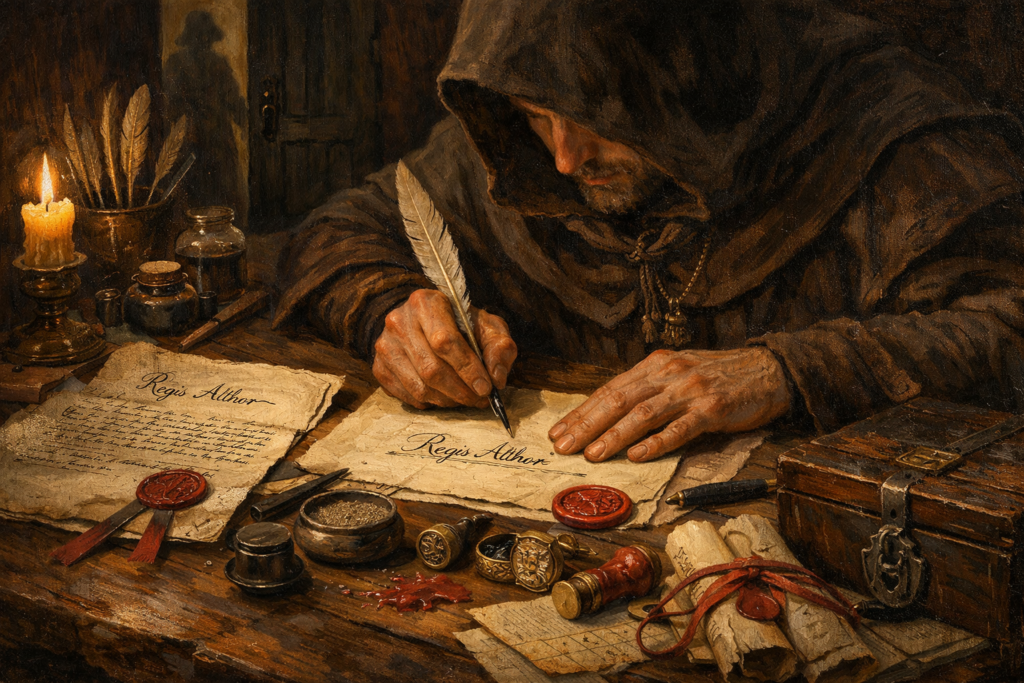
Forgery is the skill of creating false written proof that others will trust, whether in the form of letters, decrees, contracts, ledgers, warrants, seals, or signatures. In play, it turns patience, observation, and a steady hand into a powerful weapon of deception, allowing a character to fabricate authority, conceal the truth, manipulate institutions, and place convincing lies directly into the hands of enemies, officials, merchants, or courts.
Forgery 5.5e 2424
Forgery 3.5
Skill Forgery
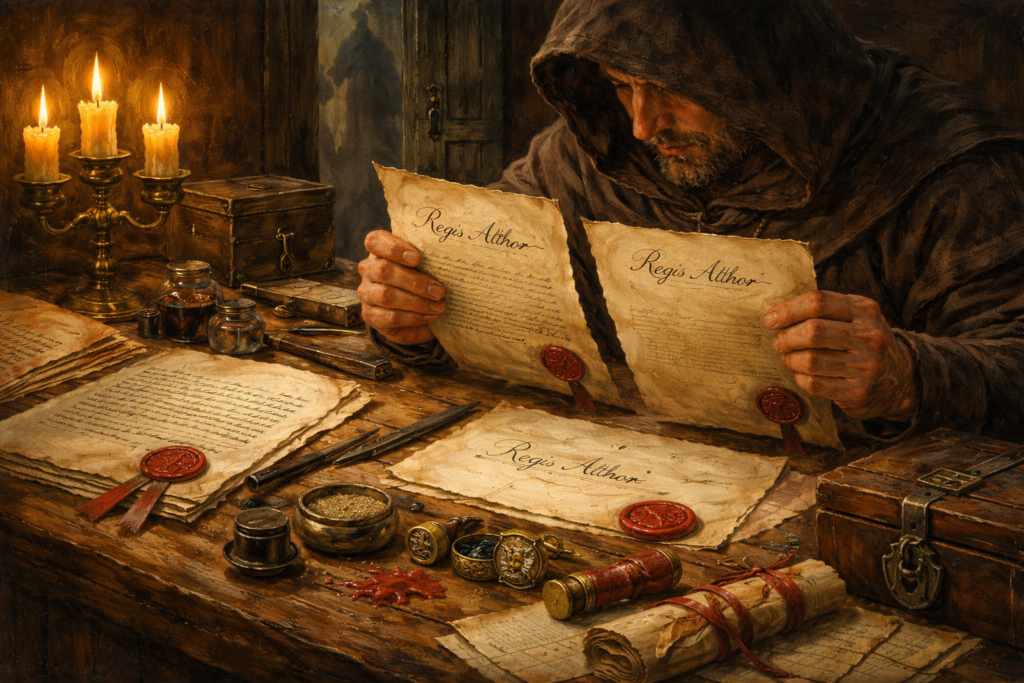
Turn ink into power, crafting false decrees, stolen identities, and dangerous lies that can topple kingdoms without drawing a blade.
Forgery is the art of creating false written proof that others will trust, whether in the form of letters, warrants, contracts, ledgers, seals, travel papers, decrees, or signatures. In play, it transforms patience, precision, and observation into a subtle weapon, allowing a character to fabricate authority, conceal the truth, manipulate institutions, and place convincing lies into the hands of guards, magistrates, merchants, nobles, and spies.
In D&D 2024 / 5.5e, Forgery is best treated as the use of a Forgery Kit rather than as a standalone skill. The 2024 rules present the Forgery Kit as a tool typically used with Dexterity, with published examples including mimicking short handwriting samples at DC 15 and duplicating a wax seal at DC 20. The same rules also note that proficiency with the relevant tool adds your Proficiency Bonus, and that relevant overlapping proficiency can justify Advantage when appropriate.
Forgery Kit (Dexterity)
A Forgery Kit allows you to imitate handwriting, duplicate seals, alter records, and produce false documents convincing enough to survive ordinary scrutiny.
A Forgery check is usually a Dexterity check made using the Forgery Kit. If you are proficient with the kit, add your Proficiency Bonus to the roll. If you also have proficiency in a relevant skill that directly supports the attempt, such as Deception, Investigation, or History, the DM may grant Advantage on the check. This follows the 2024 rules’ general approach to tools and overlapping proficiencies.
What Forgery Covers
Forgery can be used to create or alter almost any written proof that carries weight in the world. Common examples include:
- false letters of passage
- forged warrants, writs, and decrees
- counterfeit guild records
- altered ledgers and accounts
- false noble correspondence
- duplicated seals and signet impressions
- planted written evidence
- fabricated church, temple, or court documents
- disguised ownership papers
- copied signatures and endorsements
Forgery is especially powerful in campaigns involving intrigue, politics, espionage, crime, smuggling, infiltration, or institutional corruption.
Common Uses of Forgery
Mimic Handwriting
You imitate a known hand closely enough to pass casual inspection.
Typical DC: 15 for a short note, endorsement, or signature copied from a good sample. This matches the published 2024 example for mimicking ten or fewer words of someone else’s handwriting.
Duplicate a Seal
You reproduce a wax seal, official mark, or stamp of authority.
Typical DC: 20. This matches the published 2024 example for duplicating a wax seal.
Create False Papers
You produce a complete false document, such as travel papers, tax records, military orders, a contract, or a license.
Suggested DCs:
- 10 for a crude or hurried fake
- 15 for a convincing common document
- 20 for an official or high-status record
- 25 for a document meant to survive expert scrutiny
Alter a Genuine Record
You modify an existing document without making the changes obvious.
Suggested DCs:
- 15 for a small change
- 20 for a careful revision
- 25 or higher for high-security or heavily examined records
Manufacture Institutional Authority
You create the appearance of legal, military, religious, or civic approval where none exists.
This use often relies as much on wording, format, and expectation as on handwriting alone. A believable forgery should look correct not only in script, but in structure, tone, titles, seals, and procedure.
Time Required
A simple forged note, signature, or pass usually takes about 1 minute to prepare.
A more elaborate forgery, such as a contract, warrant, or page of official records, may take 10 minutes, 1 hour, or longer, depending on complexity, materials, and the level of scrutiny expected.
Detecting a Forgery
A forged document is usually tested only when someone has reason to read it carefully.
When a creature inspects a forged document, the DM can call for an Intelligence (Investigation) check opposed by the result of the original Forgery Kit check. Particularly suspicious, experienced, or well-informed readers may have Advantage, while hurried readers or those unfamiliar with the form may struggle to detect the falsehood.
A reader may be more likely to question a document if it:
- contradicts known facts
- violates custom or procedure
- demands sacrifice, obedience, or payment
- bears the name or seal of someone they know well
- arrives under suspicious circumstances
Circumstances That Affect Forgery
A forgery becomes easier or harder depending on context.
Favorable circumstances for the forger:
- access to an authentic sample
- routine or formulaic document types
- familiar official phrases or repeated formats
- good materials and time to work
- a reader who only glances at the document
Favorable circumstances for the examiner:
- close familiarity with the handwriting
- strong knowledge of the office, institution, or seal
- awareness of current procedure
- reason to be suspicious
- direct comparison with a genuine original
Example Rulings
Here are a few practical ways a DM might use Forgery in play:
Forge a guard pass:
A rogue creates papers allowing entry through a city gate. A basic local pass might require a DC 15 Forgery Kit check.
Alter a prisoner transfer order:
A party changes the destination and signatures on an existing writ. This may require DC 20 if the correction must survive close inspection.
Fake noble correspondence:
A court infiltrator writes a letter meant to look like it came from a rival house. If the target knows the noble’s style well, the examiner might gain Advantage on the detection check.
Duplicate a temple seal:
A spy reproduces a ritual or treasury seal to move restricted goods. This is a classic DC 20 use.
Relevant Skill Pairings
Forgery often overlaps naturally with other proficiencies:
- Deception for persuasive false content
- History for correct titles, eras, and institutional language
- Investigation for studying genuine samples and spotting inconsistencies
- Calligrapher’s Supplies where presentation and elegant script matter
- Disguise Kit when false papers support a false identity
If a second proficiency strongly supports the work, the DM may grant Advantage, consistent with 2024 tool guidance.
Restrictions
To create a convincing forgery, you must normally:
- be able to read and write the language involved
- have suitable materials such as paper, parchment, ink, wax, or seal tools
- know enough about the institution, writer, or document type to imitate it believably
A forged document in an unknown language, or in the style of an institution you do not understand, should usually be harder to produce.
Forgery in the Story
Forgery shines in adventures built on hidden doors rather than broken ones. It rewards planning, patience, and the ability to understand how power is recorded on paper. A forged blade kills one victim. A forged warrant may ruin a house, open a fortress, redirect an army, or erase a crime before it is even discovered.
Used well, Forgery is not merely trickery. It is the craft of weaponised legitimacy.
Quick 5.5e Rules Summary
Forgery Kit (Dexterity). Use a Forgery Kit to imitate handwriting, duplicate seals, alter written records, and create false documents. Make a Dexterity check using the kit. Add your Proficiency Bonus if you are proficient. The 2024 rules give examples of DC 15 to mimic a short sample of handwriting and DC 20 to duplicate a wax seal. A creature examining the forgery will often make an Intelligence (Investigation) check against your result. Relevant overlapping proficiency can justify Advantage.
Forgery
This material is Open Game Content, and is licensed for public use under the terms of the Open Game License v1.0a.
Check
Forgery requires writing materials appropriate to the document being forged, enough light or sufficient visual acuity to see the details of what you’re writing, wax for seals (if appropriate), and some time. To forge a document on which the handwriting is not specific to a person (military orders, a government decree, a business ledger, or the like), you need only to have seen a similar document before, and you gain a +8 bonus on your check. To forge a signature, you need an autograph of that person to copy, and you gain a +4 bonus on the check. To forge a longer document written in the hand of some particular person, a large sample of that person’s handwriting is needed.
The check is made secretly, so that you’re not sure how good your forgery is. As with Disguise, you don’t even need to make a check until someone examines the work. Your Forgery check is opposed by the check of the person who examines the document to check its authenticity. The examiner gains modifiers on his or her check if any of the conditions on the table below exist.
| Condition | Reader’s Forgery Check Modifier |
| Type of document unknown to reader | -2 |
| Type of document somewhat known to reader | +0 |
| Type of document well known to reader | +2 |
| Handwriting not known to reader | -2 |
| Handwriting somewhat known to reader | +0 |
| Handwriting intimately known to reader | +2 |
| Reader only casually reviews the document | -2 |
A document that contradicts procedure, orders, or previous knowledge, or one that requires sacrifice on the part of the person checking the document can increase that character’s suspicion (and thus create favorable circumstances for the checker’s opposing Forgery check).
Action
Forging a very short and simple document takes about 1 minute. A longer or more complex document takes 1d4 minutes per page.
Try Again
Usually, no. A retry is never possible after a particular reader detects a particular forgery. But the document created by the forger might still fool someone else. The result of a check for a particular document must be used for every instance of a different reader examining the document. No reader can attempt to detect a particular forgery more than once; if that one opposed check goes in favor of the forger, then the reader can’t try using his own skill again, even if he’s suspicious about the document.
Special
If you have the Deceitful feat, you get a +2 bonus on Forgery checks.
Restriction
Forgery is language-dependent; thus, to forge documents and detect forgeries, you must be able to read and write the language in question. A barbarian can’t learn the Forgery skill unless he has learned to read and write.
Keep this reference growing
If this page helped with your reading or game, you can support its upkeep or explore the curated books.
Explore the Bookshop — epics, classics and stories behind imagined worlds.