
Trading Post Settlement Quality: Pathfinder Settlement Trait Guide
Trading Post Settlement Quality: Pathfinder Settlement Trait Guide
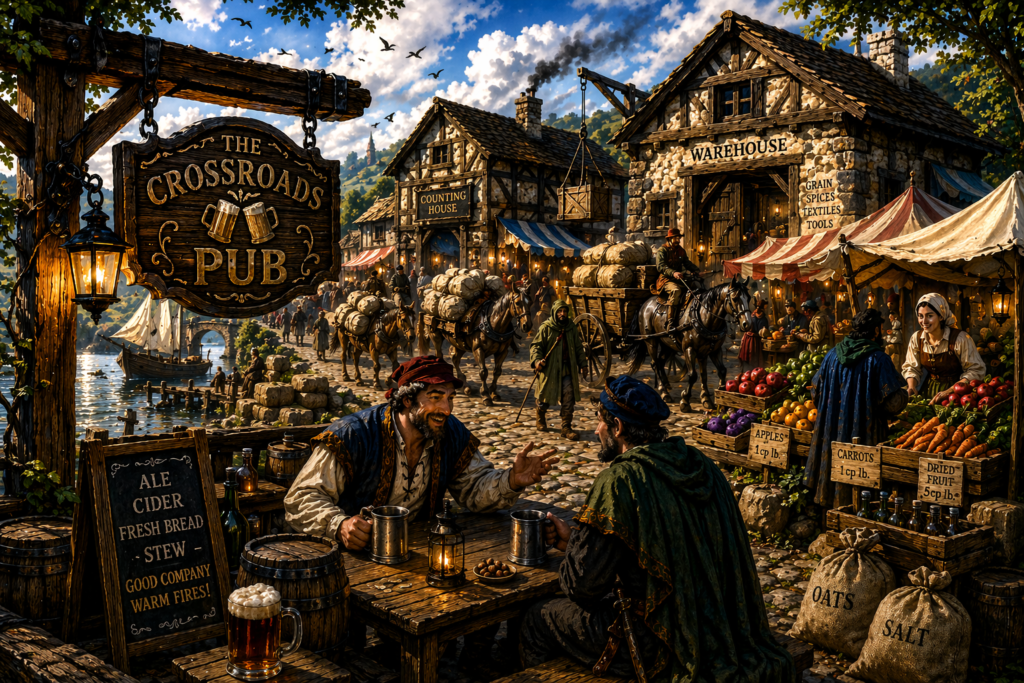
Trading Post is a Pathfinder settlement quality for communities built around commerce, caravan traffic, storage, and exchange. Learn how it shapes local life and doubles the settlement’s Purchase Limit.
A settlement built on commerce, traffic, and the steady movement of goods
Trading Post is a settlement quality for a community that exists chiefly as a center of trade. Merchants, caravan masters, drovers, factors, and buyers gather here to buy, sell, warehouse, and transport goods from the surrounding region and beyond. Market squares, storehouses, stockyards, and counting houses define much of the settlement’s character, and daily life turns on the steady flow of cargo, coin, and opportunity.
Modifier: Double the settlement’s Purchase Limit.
A Trading Post is more than a place where goods change hands. It is a settlement whose reason for existing is exchange. Caravans stop here to unload wares, merchants negotiate contracts, teamsters rest their animals, drovers bring livestock to market, and local producers bring in wool, grain, timber, ore, hides, fish, or worked goods to be sold onward. In play, a settlement with the Trading Post quality feels active, practical, and outward-facing.
This quality suggests a community shaped by movement rather than permanence. Visitors are common. Warehouses matter. Roads, river landings, market yards, scales, counting rooms, and secure storage all become part of the settlement’s identity. Even a small community can feel larger than it is when so many goods pass through it.
From a rules perspective, Trading Post improves access to purchasable goods by doubling the settlement’s Purchase Limit. That single modifier can matter a great deal in a campaign, especially for characters seeking equipment, mounts, trade goods, tools, supplies, and other items that might otherwise be difficult to obtain in a modest settlement. A Trading Post does not necessarily make a place wealthy, refined, or safe, but it does make it better connected to supply.
A settlement with the Trading Post quality should feel different from an ordinary village or town. Streets near the market may be crowded with wagons, pack animals, laborers, toll collectors, scribes, and guards. Inns may be full even when local homes are not. Prices on common goods may be stable because supply is reliable, while rarer items may depend on season, weather, caravan success, or recent disruptions on the road.
This quality works especially well for frontier crossroads, river ports, desert caravan stops, border towns, mountain pass settlements, and communities that stand between major regions. A Trading Post can also create immediate adventure material. Bandits may target caravans. Guilds may compete for influence. Warehouses may hide contraband. Merchants may need escorts, drovers may seek help recovering stolen stock, and shortages may spark tension between locals and visiting buyers.
For worldbuilding, Trading Post tells you what the settlement values. Space is given over to yards, barns, market sheds, scales, pens, and storage rather than ornament or ceremony. Local authority may care strongly about tolls, contracts, weights, measures, and public order. The settlement may be cosmopolitan by local standards, but not necessarily grand. It is built to handle goods, not to impress strangers.
The strength of Trading Post as a settlement quality is that it is simple, believable, and useful in play. It immediately tells the Game Master how the settlement functions and gives players a concrete benefit when they visit. It also helps distinguish one settlement from another without requiring major changes to the settlement’s wider identity. A community with Trading Post feels busy, transactional, and tied to the movement of the wider world.
See also Archives of Nethys for Pathfinder reference material and Pathfinder settlement rules for broader settlement mechanics.
Section 15: Copyright Notice — Cityscapes: New Settlement Options for the Pathfinder RPG
Cityscapes: New Settlement Options for the Pathfinder RPG © 2012 Otherverse Games. Author: Chris A. Field.
Keep this reference growing
If this page helped with your reading or game, you can support its upkeep or explore the curated books.
Explore the Bookshop — epics, classics and stories behind imagined worlds.