
Yggdrasill — The World Tree and Transitive Plane
Yggdrasill — often modernised as Yggdrasil — is the living World Ash through which worlds touch: an immeasurable transitive reality of branches, trunk, roots, wells, scars, sacred roads and remembered obligations. Its crown reaches towards divine and fey worlds, its trunk forms the great interchange of mortal and hidden roads, and its roots descend towards fate, ancient wisdom, giants, cold primordial waters and the dead.
A traveller does not cross Yggdrasill merely by finding the road. A traveller survives being recognised by the Tree.
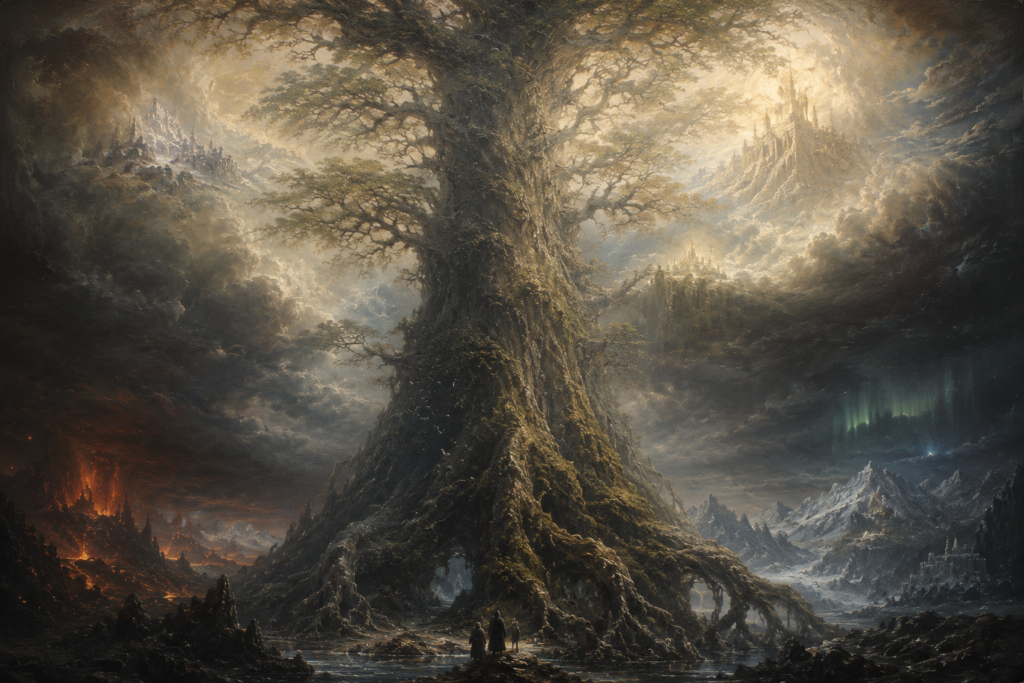
The Living Road Between Worlds
Yggdrasill is not a forest, continent or divine estate. It is a complete transitive reality whose living body establishes physical and mythic contact between otherwise separate planes.
The World Tree is best understood from its crown downward. Its branches are high roads of storm, light, divine approach and fey correspondence. Its trunk is the great interchange through which mortal roads, hidden hollows and lateral passages meet. Its roots descend towards judgement, ancient wisdom, giant territories, cold primordial waters and the dead.
The Tree does not replace the Astral Plane, the Ethereal Plane, Bifröst or conventional portals. Each form of passage obeys a different principle. Yggdrasill is living correspondence: branch recognising branch, root answering root, sap carrying memory and wounds becoming roads between otherwise separate realities.
Yggdrasill is not inside Ysgard. Asgard and Ysgard are among the destinations it reaches, but they do not contain the Tree. The same principle applies to Midgard, Alfheim, Muspellheim, Niflheim and the remaining northern mythic worlds.
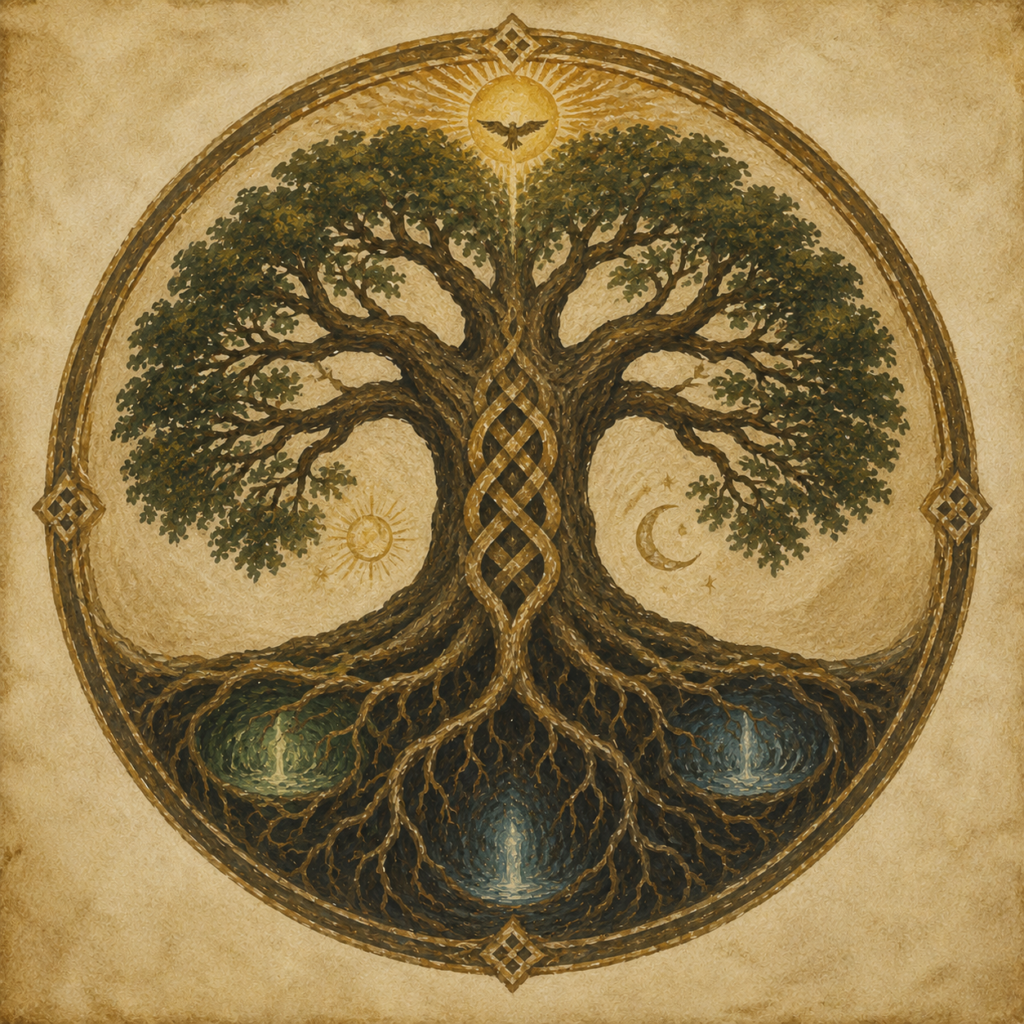
The World Ash
The emblem represents crown, trunk, roots and deep waters as one living pattern. It is a symbol of connection and cosmic order rather than a literal geographical map.
Cosmological Role
Yggdrasill links realities through organic correspondence rather than conventional distance. Its roads are alive. Some are ancient and dependable; others open only during a storm, death, oath, sacrifice, bloodline, season, prophecy or moment of genuine need.
The High Roads
High branches lead towards divine, fey and elemental correspondences. Their dangers are exposure, storm, judgement and being seen.
The Great Interchange
The trunk joins major routes, provides the strongest mortal crossings and contains hollows, camps, shrines and lateral roads.
The Deep Roads
The roots lead towards fate, ancient wisdom, giant territories, cold underworld waters and death.
The powers gathered within the Asgardian Pantheon use Yggdrasill but do not own it. Divine courts defend their own approaches and send messengers along recognised roads, yet no northern god possesses universal sovereignty over the Tree.
The lower Tree is under continual attack from Níðhöggr. He gnaws the root reaching towards Niflheim, creating Root-Wounds through which cold, death, venom and underworld pressure can penetrate Yggdrasill.
Cosmic History — The World Tree in the Master Chronology
Yggdrasill belongs to the ordered cosmos rather than to the first instant of creation. Its history follows the SpiralWorlds Timeline.
Cosmic Relationship Predates the World-Tree Roads
The Astral Plane establishes relationship across separation before Yggdrasill assumes its later role as a living cosmic road-system.
The Multiverse Is Wounded
The Elder Wars damage boundaries, routes and planar coherence. Some later World-Tree wounds inherit or exploit these ancient weaknesses.
The Present World-Tree Network Becomes Stable
During the Great Repair, Cosmic Leylines, anchors, junctions and seals bind the damaged multiverse into a survivable structure.
Yggdrasill’s present dependable role as an interplanar living axis becomes part of that repaired order.
The Northern Divine Houses Establish Courts
The Æsir, Vanir and related powers establish courts within planes older than themselves and begin using the already established World-Tree roads.
The Great Road Becomes Fragmented Mortal Memory
Sacred trees, burial routes, wells, judgement places and irminsuls preserve fragments of the greater cosmic truth.
The Tree — Branches, Trunk and Roots
Yggdrasill is best understood from crown to depth: branches first, then trunk, then roots. Each part has its own roads, dangers and destinations.
The Branches — The High Roads
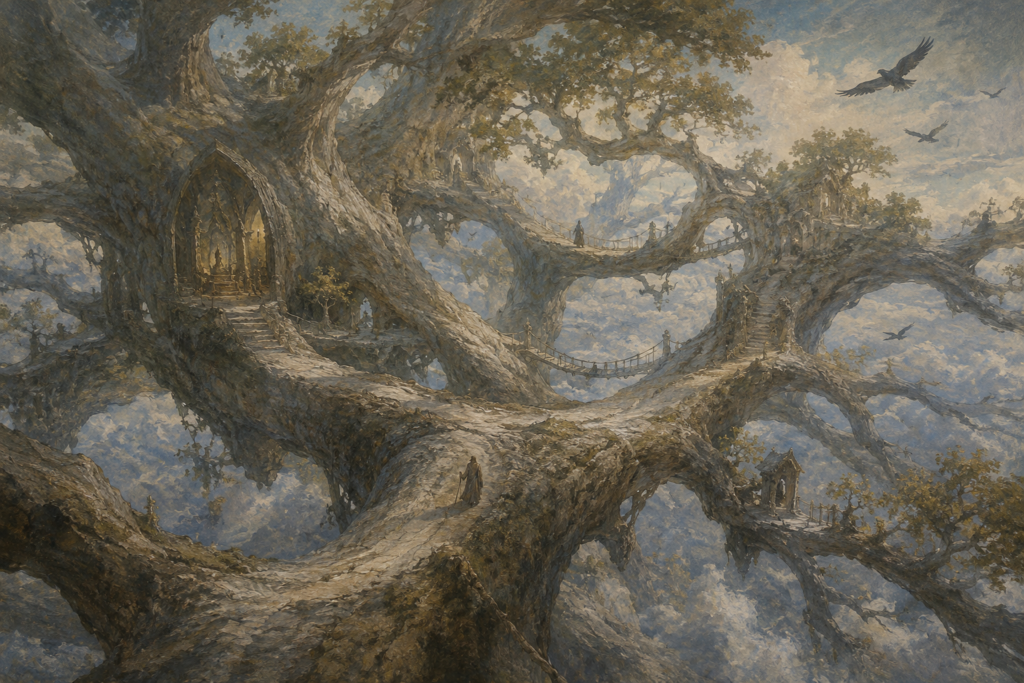
The branches spread outward through storm, cloud, leaf, light and impossible distance. Some support woods, shrines, camps and marching companies. Others narrow into paths before disappearing into weather, radiance or another plane.
Branchward travel is associated with ascent, visibility and approach. The higher travellers climb, the more difficult it becomes to remain unnoticed by the powers whose worlds they approach.
Where the Branches Lead
Asgard
The most famous upper roads rise towards Asgard within Ysgard. They become increasingly ordered, watched and difficult to approach without invitation, safe-conduct or recognised purpose.
Some high roads eventually intersect the sphere watched by Heimdall and the Bifröst-facing approaches.
Vanaheim
Fertile green branches lead towards Vanaheim and the territories of the Vanir within Ysgard.
These roads favour reciprocity, hospitality, gift-exchange, fertility, seasonal law and recognised peace.
Alfheim
Branches of strange light, flowering bark and unseasonal leaves can open into Alfheim and the wider Fey World.
Beauty, memory, invitation and fey law become increasingly important as the crossing deepens.
Muspellheim
Muspellheim is usually reached not by a healthy green branch, but by burned limbs, ember-roads and fire-scarred crossings opening towards the Plane of Fire.
Such passages bear the pressure of primordial flame and the influence of Surtr.
The Trunk — The Great Middle Road
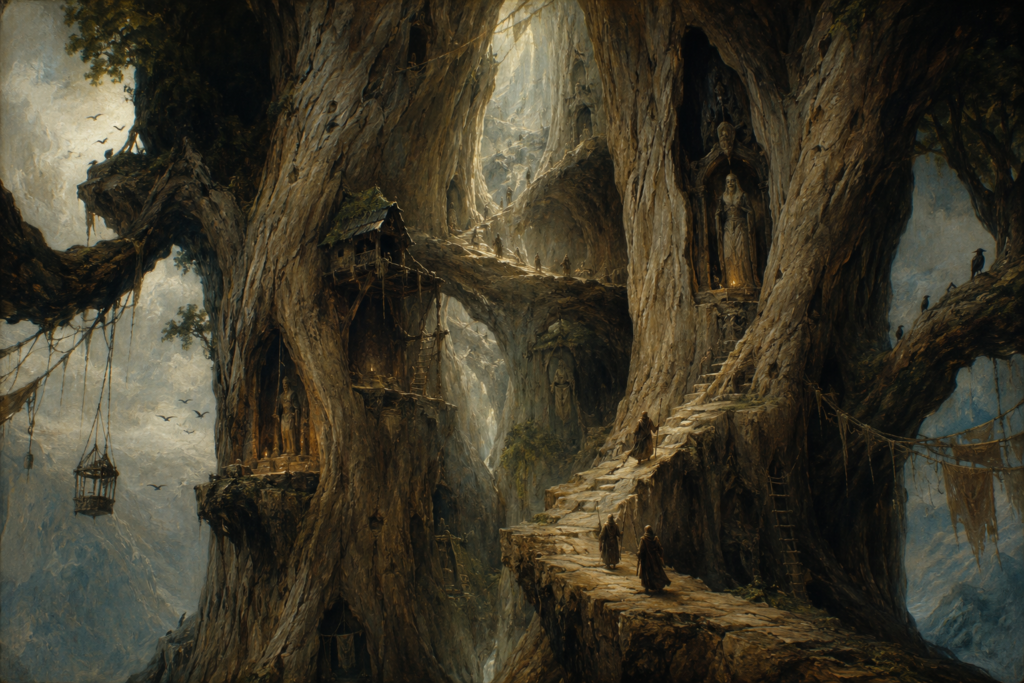
The trunk is Yggdrasill’s great middle road. Its bark forms cliffs, shelves, folds, caverns, stairs, natural bridges and inhabited hollows. Some cavities are large enough to contain shrines, markets, camps and entire travelling companies.
This is where most mortal travellers first learn how the Tree works. The trunk permits extended travel, negotiation, pursuit, shelter and route-finding without immediately committing travellers to one destination.
Where the Trunk Leads
Midgard
The strongest Material Plane correspondences emerge from trunk and lower bark through sacred trees, wells, burial mounds, judgement places, gallows trees and irminsuls.
These passages lead to Midgard, the mortal world, and are the World-Tree roads most likely to be encountered on Earth.
Svartalfaheim
Deep hollows, stone-filled cracks, forge-roads and passages descending within the trunk can turn towards Svartalfaheim and deeper regions of the Fey World / Otherworld.
These roads concern craft, ownership, bargain, secrecy and things made beneath the sight of the sky.
Branch and Root Junctions
The trunk is where travellers most often change direction: leaving a Midgard road for Asgard, moving from a divine passage towards Jotunheim or descending towards the underworld.
Several destinations can therefore be signposted from one hollow without those destinations being physically adjacent.
Unstable Correspondences
Old cuts, lightning scars, burned bark and forced gates can create temporary trunk passages to otherwise distant planes.
These are less dependable than established World-Tree roads and can disappear or change destination.
The Roots — The Deep Roads
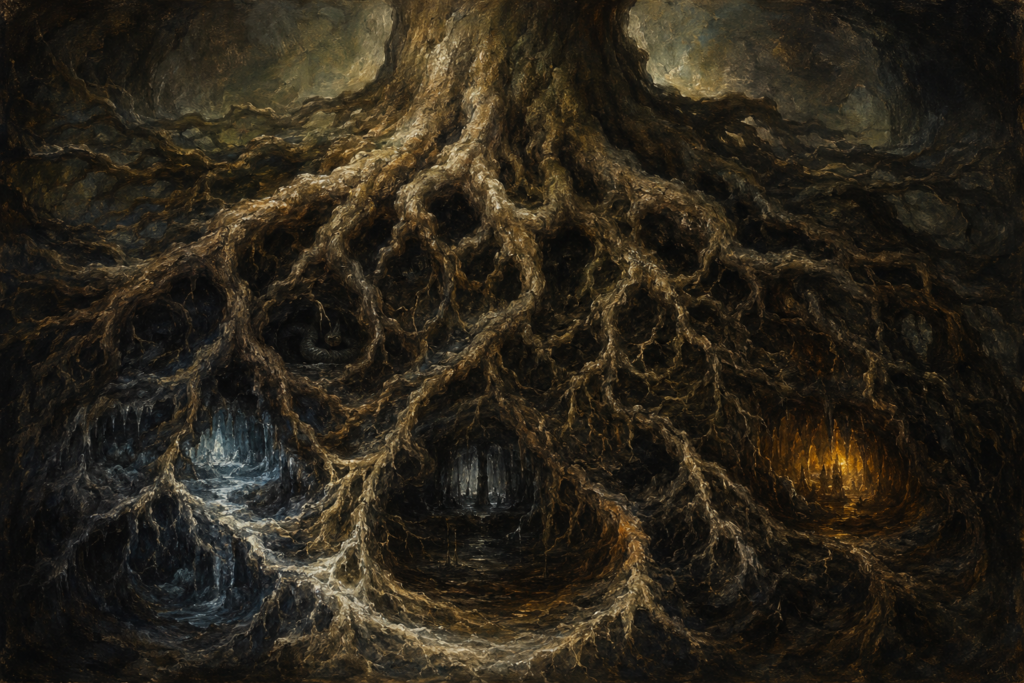
The roots are the oldest and most severe roads accessible through Yggdrasill. They descend through living wood into old water, stone, burial, memory, giant territory and death.
The deepest mythic structure is organised around three great root correspondences. Each is associated with one of the great wells and with a different region of the wider cosmos.
The Three Great Roots and Where They Lead
Asgard → Urðarbrunnr
One great root reaches towards the divine sphere of Asgard and the judgement-place associated with Urðarbrunnr, the Well of Urðr.
The Norns tend Yggdrasill here. This root concerns fate, judgement, oath, sequence and consequence.
This explains why Asgard can be approached both from high branch-roads and through the sacred root-junction of Urðarbrunnr. Yggdrasill is relational rather than Cartesian.
Jotunheim → Mímisbrunnr
A second great root reaches towards Jotunheim and the ancient wisdom associated with Mímisbrunnr, Mímir’s Well.
Mímir is bound to this root-complex, and Odin paid with an eye for the wisdom associated with the well.
These roads carry giant claims, ancient memory, knowledge and things older than later divine kingdoms.
Niflheim → Hvergelmir
The third great root reaches towards Niflheim, a northern death-region within Abaddon, the Gray Waste, and towards Hvergelmir, the Roaring Kettle.
This is the root gnawed by Níðhöggr. Its wounds are therefore the principal hostile breaches between Yggdrasill and the northern underworld.
Deeper deathward roads can continue towards the realm of Hel, Niflhel-associated regions and corpse-shores where Níðhöggr’s influence is greatest.
Yggdrasill and the Roads of the Nine Realms
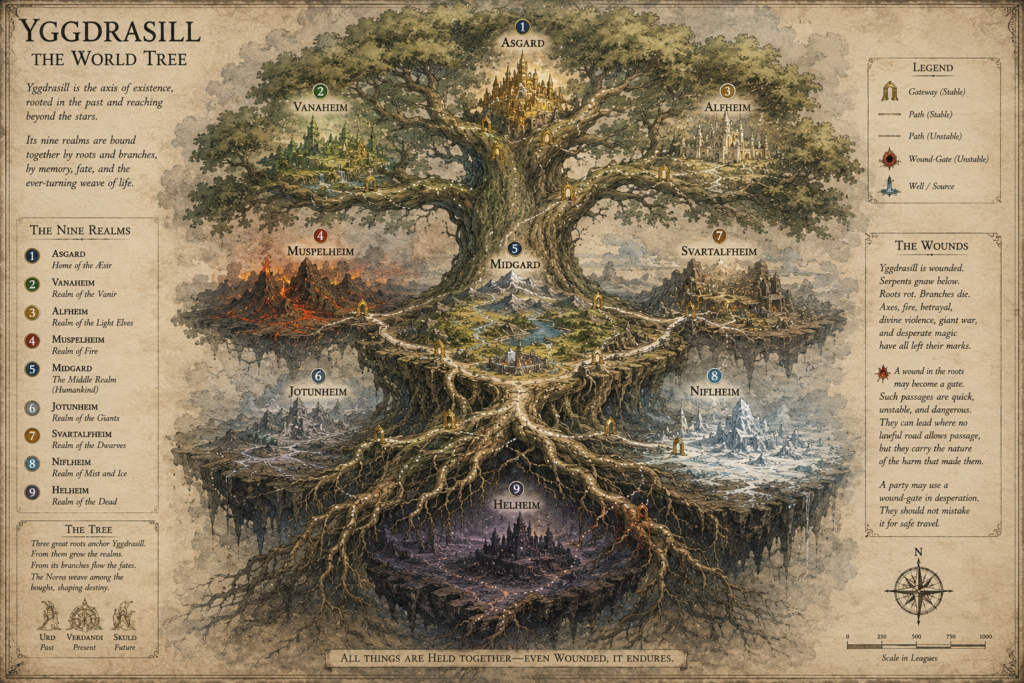
- Branches: roads towards Asgard, Vanaheim and Alfheim; burned branch-roads can reach Muspellheim.
- Trunk: the great interchange, with the strongest mortal roads to Midgard and hollow routes towards Svartalfaheim.
- Roots: three great correspondences: Asgard / Urðarbrunnr, Jotunheim / Mímisbrunnr, and Niflheim / Hvergelmir.
- Deep deathward roads: from the Niflheim-facing root towards Helheim, Niflhel-associated regions and the corpse-shores.
Níðhöggr Beneath the Niflheim-Facing Root
The defining hostile force of Yggdrasill’s lower structure is Níðhöggr, the Corpse-Dragon and Root-Gnawer. He lies beneath the great root reaching towards Niflheim, where Hvergelmir roars in the dark.
Níðhöggr does not merely inhabit the roots. His gnawing is one of their defining conditions. Living wood sweats black sap where his pressure rises. Roots split around old murders and broken oaths. Corpse-cold water gathers beneath healthy bark. Serpents find passages where no serpent should fit. The dead begin to hear roads beneath graves.
His influence is encountered long before his body is seen. An expedition can revolve entirely around the consequences of his bite without confronting Níðhöggr directly.
The Root-Wounds — Roads into Niflheim
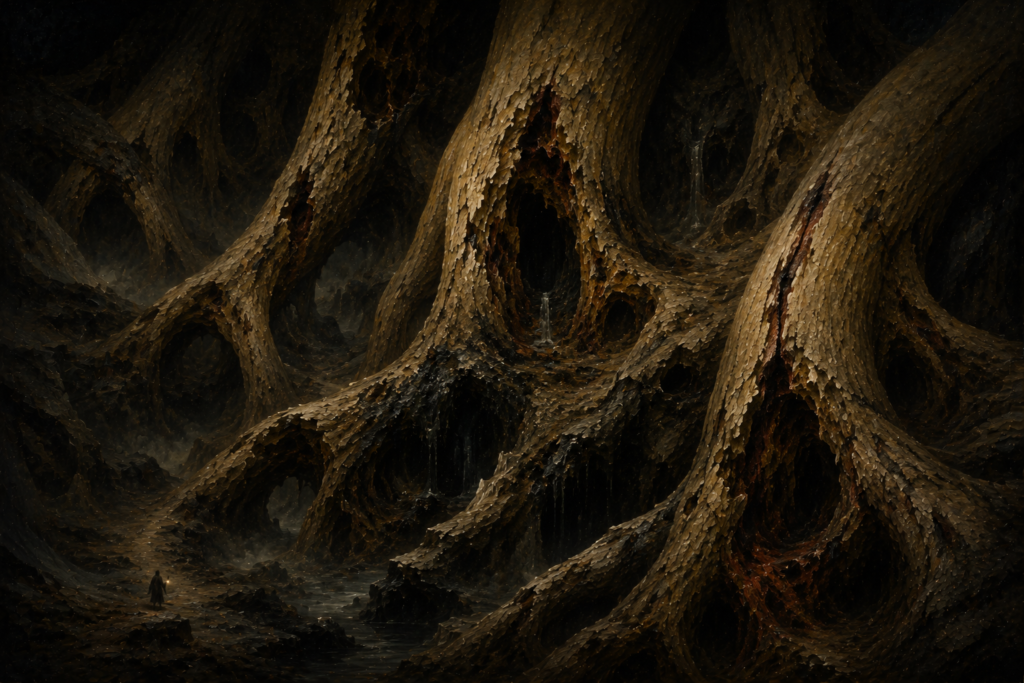
Yggdrasill can be injured by axes, fire, poison, divine war, giant violence, broken oaths and forced planar crossings. None defines the lower roots as completely as the endless gnawing of Níðhöggr.
His bite creates the archetypal Root-Wound: a place where living wood becomes black, corpse-cold and structurally thin. The wound increasingly corresponds with Niflheim and therefore with the wider Abaddon / Gray Waste death structure.
Shallow Root-Wound
Black sap, dead leaves, cold bark, carrion insects, restless corpses and dreams of gnawing beneath the floor.
Open Niflheim Wound
Frost forms upon living wood. Mist flows uphill. Corpse-water gathers in hollows. Physical passage into Niflheim becomes possible.
Hvergelmir Correspondence
Freezing primordial waters, serpents and the roar of Hvergelmir penetrate the root. Níðhöggr’s presence is now close.
Deep Corpse-Wound
The road reaches beyond ordinary Niflheim towards corpse-shores, Náströnd or deeper Niflhel-associated regions dominated by venom, dishonoured dead and Níðhöggr’s hunger.
Lesser World-Trees and Irminsuls
Sacred ash trees, ancient oaks, burial trees, World-Tree reflections and irminsuls can echo Yggdrasill on the Material Plane and other worlds. They are not Yggdrasill itself.
A lesser tree may anchor one branch-road, trunk-road or root correspondence. It can therefore serve as a mortal doorway into the greater system without reproducing the whole World Tree.
Six Laws of Yggdrasill
01 — The Tree Is Alive
Yggdrasill reacts to harm, healing, reverence, trespass and sacrilege.
02 — Direction Has Meaning
Branchward, trunkward, rootward, deathward and wellward describe mythic relationship as well as movement.
03 — Oaths Have Weight
Safe-conduct, treaties, promises and sworn messages become part of the road.
04 — Kinship Is Remembered
Descent, adoption, inheritance, feud, curse and sworn kinship can alter which roads recognise a traveller.
05 — Harm Creates Correspondence
A wound can begin touching another wounded place. Níðhöggr’s Root-Wounds are the most terrible example.
06 — Maps Record Tendencies
A chart records known relationships and routes. It does not freeze Yggdrasill into static geography.
Traveller’s Route Correspondence
The illustrated chart gives the traditional visual relationship of the Nine Realms. This table records where the roads lead within the wider SpiralWorlds cosmology.
| Realm | Canonical Placement | Part of Yggdrasill | Typical Road |
|---|---|---|---|
| Asgard | Ysgard | Branches and Root of Fate | High divine roads; Urðarbrunnr junction |
| Vanaheim | Ysgard | Branches | Green treaty-roads and fertile boughs |
| Alfheim | Fey World | Branches | Luminous leaf-roads and flowering boughs |
| Muspellheim | Plane of Fire | Burned Branches / Wounds | Ember-roads and fire-scarred crossings |
| Midgard | Material Plane | Trunk | Sacred trees, wells, burial mounds and irminsuls |
| Jotunheim | Ysgard | Root of Wisdom | Mímisbrunnr-facing giant roads |
| Svartalfaheim | Fey World / Deep Otherworld | Trunk / Hollows | Forge-roads, stone cracks and deep hollows |
| Niflheim | Abaddon / Gray Waste | Root of Death and Cold | Níðhöggr’s Root-Wounds and Hvergelmir-facing roads |
| Helheim | Abaddon / Gray Waste, through Niflheim | Deep Roots | Lawful death-roads descending beyond Niflheim |
Travel, Arrival and Planar Magic
Yggdrasill may be entered through sacred trees, old wells, storm-struck woods, burial mounds, gallows hills, divine roads, giant borders, deep tunnels and willing lesser World-Trees.
Seen and Exposed
The travellers have entered a high road of divine, fey or elemental approach.
Admitted to the Road-System
The party can navigate, bargain and choose among routes, but has not yet gained admission to a destination.
Debt, Wisdom or Death
The journey concerns ancient claims, fate, giants, burial, the underworld or something gnawing below.
Five Steps for a World-Tree Journey
- Name the destination.
- Choose branch, trunk, root, well or wound.
- Establish standing.
- Resolve the road itself.
- Give arrival a consequence.
Travel Magic
Teleport, Plane Shift, Gate, Forbiddance, Word of Recall, Scrying and Analyze Portal continue to use their ordinary edition rules.
Yggdrasill does not impose an arbitrary additional casting check. The distinction is between reaching a place and possessing the route knowledge, standing or permission needed to continue.
Inhabitants, Travellers and Sacred Authorities
Route-Users
Níðhöggr — The Root-Gnawer
Níðhöggr is not a routine inhabitant. He is the defining hostile pressure of the Niflheim-facing root, and his Root-Wounds transform cosmic mythology into playable planar danger.
Standing and Trespass
Grave Offences
- Cutting living bark without right
- Burning healthy wood
- Poisoning sap or well-water
- Widening a Root-Wound
- Breaking a sworn route-oath
- Murdering a protected messenger
- Using the Tree as an invasion road
Dangers of the World Tree
Divine Exposure
High branches reveal travellers to powers guarding their worlds.
False Junctions
A trunk road may have shifted since a traveller’s map was made.
Níðhöggr’s Root-Wounds
Black sap and corpse-cold mist signal a route opening towards Niflheim.
Root-Rot
Corruption gathers where lower roots have been gnawed or poisoned.
Well-Truth
True knowledge may impose consequences the questioner cannot avoid.
Falling Between Worlds
A fall can cross a living planar boundary rather than simply losing altitude.
Game Statistics
Route Checks, Sap-Marks, Root-Wounds and well effects are SpiralWorlds planar mechanics.
Yggdrasill — D&D 5.5e / 2024
Planar Nature
- Type: Transitive Plane / Cosmic Axis.
- Gravity: Normal on stable living surfaces; locally directional elsewhere.
- Time: Normally Material Plane rate.
- Space: Immeasurable and relational.
- Alignment: No universal alignment modifier.
- Morphic Nature: The Tree alters its own roads.
Route Checks
- DC 13: known trunk road or native guide.
- DC 15: difficult branch, root or guarded crossing.
- DC 18: wound-road, hostile approach or underworld route.
- DC 22: major Root-Wound or Níðhöggr-tainted passage.
Níðhöggr-Tainted Root-Wound
A creature entering an open Niflheim-facing Root-Wound for the first time after a Long Rest makes a DC 16 Constitution or Wisdom saving throw.
On failure, choose one: one level of Exhaustion, Frightened until the end of the next Short Rest, or a truthful but disturbing root-dream.
Sap-Mark
A creature seriously harming Yggdrasill can become marked by the Tree. The mark is normally removed through restitution; Remove Curse or Atonement can remove appropriate supernatural manifestations.
Yggdrasill — Pathfinder 1e
Planar Traits
- Type: Transitive Plane / Cosmic Axis.
- Gravity: Normal on stable surfaces; locally directional elsewhere.
- Time: Normal.
- Morphic: Sentient and alterable.
- Alignment: None inherent.
- Magic: No universal enhanced or impeded trait.
Route Checks
- DC 15: known road.
- DC 20: difficult branch, root or hollow.
- DC 25: hostile or wounded road.
- DC 30: major Níðhöggr-tainted Root-Wound.
Root-Wound
Entering an open Niflheim-facing wound requires a DC 18 Fortitude or Will save. Failure causes fatigue, 1 point of Wisdom damage or a prophetic root-dream.
Yggdrasill — D&D 3.5e
Planar Traits
- Type: Transitive Plane / Cosmic Axis.
- Gravity: Normal locally; directional in exposed regions.
- Time: Normal.
- Size: Immeasurable.
- Morphic: Sentient and alterable.
- Alignment: None inherent.
Route Checks
- DC 15: established road.
- DC 20: difficult branch or root.
- DC 25: wounded or hostile route.
- DC 30: great Root-Wound.
Níðhöggr-Tainted Root-Wound
A creature entering an open Niflheim-facing wound makes a DC 18 Fortitude or Will save. Failure causes fatigue, 1 point of Wisdom damage or a prophetic root-dream.
Running Yggdrasill at the Table
Use the Whole Tree
- Branches for divine and fey approach.
- Trunk for exploration, junctions and mortal travel.
- Roots for fate, giants, wisdom, burial and death.
- Root-Wounds for Níðhöggr and Niflheim adventures.
Avoid
- Treating the Tree as one ordinary forest.
- Treating all nine realms as one plane.
- Making every road equally accessible.
- Using Níðhöggr as a routine encounter.
- Ignoring where a branch, trunk-road or root actually leads.
Yggdrasill in 1454
In 1454 CE, Yggdrasill remains real even where mortal scholars lack a complete planar vocabulary for it. Knowledge survives through northern tradition, skaldic memory, magical correspondence, learned natural philosophy, family lore and sacred-tree custodians.
A learned traveller may carry a Nine Realms chart like the one shown above. Such a chart communicates the direction and character of World-Tree roads, not literal terrestrial mileage.
Níðhöggr’s influence can reach Earth through damaged lesser trees and Root-Wounds. A black-sapped ash, corpse-cold well, burial mound filled with serpents or root penetrating a murderer’s hall may indicate a distant Niflheim wound has found a mortal correspondence.
Adventure Hooks
The Branch That Burns
A once-green Vanaheim road is turning to ember and opening towards Muspellheim.
The Lost Midgard Road
A trunk crossing no longer reaches Earth. It opens into a hidden Otherworld hollow instead.
The Black Root
A healthy ash begins bleeding black sap. Beneath it lies a new passage into Niflheim.
The False Chart
A famous Nine Realms chart is accurate, but one of the living roads it records has been moved.
Mímir’s Road
A lost giant road to Mímisbrunnr reopens after centuries and several powers claim ownership.
The Corpse-Wound
A Root-Wound has deepened past ordinary Niflheim towards the corpse-shores associated with Níðhöggr.
Rewards, Tokens and Consequences
Possible Rewards
- A branch-token recognised on one future ascent.
- A trunk-map revealing one hidden junction.
- A root-token allowing one lawful descent.
- A bark-chart accurate for one season.
- A repaired Niflheim Root-Wound.
- A draught of true well-water carrying one omen.
Possible Consequences
- A divine branch-road now recognises the party.
- A trunk junction refuses them.
- A root remembers blood spilled upon it.
- A Norn has spoken one character’s name.
- Níðhöggr has learned an oath or crime belonging to the party.
Historical and Mythic Context
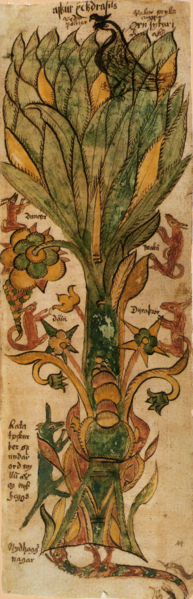
Yggdrasill is the great world ash of Norse mythological tradition, preserved particularly through the Poetic Edda and Snorri Sturluson’s Prose Edda.
The tradition associates the Tree with gods, worlds, the Norns, great wells, animals living upon it and the continuing threat of gnawing and decay.
Níðhöggr is central to the lower-root imagery. SpiralWorlds develops his gnawing into the playable concept of Root-Wounds opening towards Niflheim.
The Nine Realms
The illustrated Nine Realms chart is treated as a traditional traveller’s representation: high roads above, Midgard and the great interchange centrally, and the deepest underworld correspondences below.
SpiralWorlds distinguishes this route-position from literal planar placement. Yggdrasill allows separate planes to be represented meaningfully upon one Tree without collapsing them into one physical universe.
Further Viewing — Yggdrasill in Norse Mythology
A supplementary modern overview of Yggdrasill’s mythological associations. The SpiralWorlds planar structure above remains the campaign authority.
Quick Reference
- Yggdrasill is a living Transitive Plane and cosmic axis.
- Read the Tree from top to bottom: Branches → Trunk → Roots.
- Branches: Asgard, Vanaheim, Alfheim; burned roads towards Muspellheim.
- Trunk: Midgard, Svartalfaheim and the great route junctions.
- Root of Fate: Asgard and Urðarbrunnr.
- Root of Wisdom: Jotunheim and Mímisbrunnr.
- Root of Death and Cold: Niflheim and Hvergelmir.
- Deep deathward roads: Helheim, Niflhel-associated regions and corpse-shores.
- Níðhöggr gnaws the Niflheim-facing root.
- Níðhöggr’s bite creates Root-Wounds.
- Niflheim is part of Abaddon / the Gray Waste.
- The Nine Realms chart is a traveller’s route-map, not literal interplanar mileage.
- No god possesses universal sovereignty over Yggdrasill.