
 Buy me a coffee
Ancient Italy Timeline: From the Iron Age to Augustus
This ancient Italy timeline begins in a land that was never one people, one kingdom, or one story. It follows the peninsula from the age of heroes, sacred founders, and old cults to the rise of Rome, the fall of the Republic, and the rule of Augustus. Italy was a land of hill tribes and river settlements, fortified towns and sacred groves, bronze-rich cities, wandering heroes, prophetic rulers, and gods who still took part in mortal affairs. Before Rome mastered the peninsula, Italy already bore the weight of ancient bloodlines, old cults, divine claims, and remembered deeds. Rome did not rise in an empty land. It rose in a country already burdened with powers older than itself.
What follows in this ancient Italy timeline is a single history of the peninsula in which heroic events, divine interventions, sacred foundations, and political change all belong to the same real past. Read as a whole, this ancient Italy timeline shows how myth, kingship, war, and empire shaped the land.
Ancient Italy Timeline
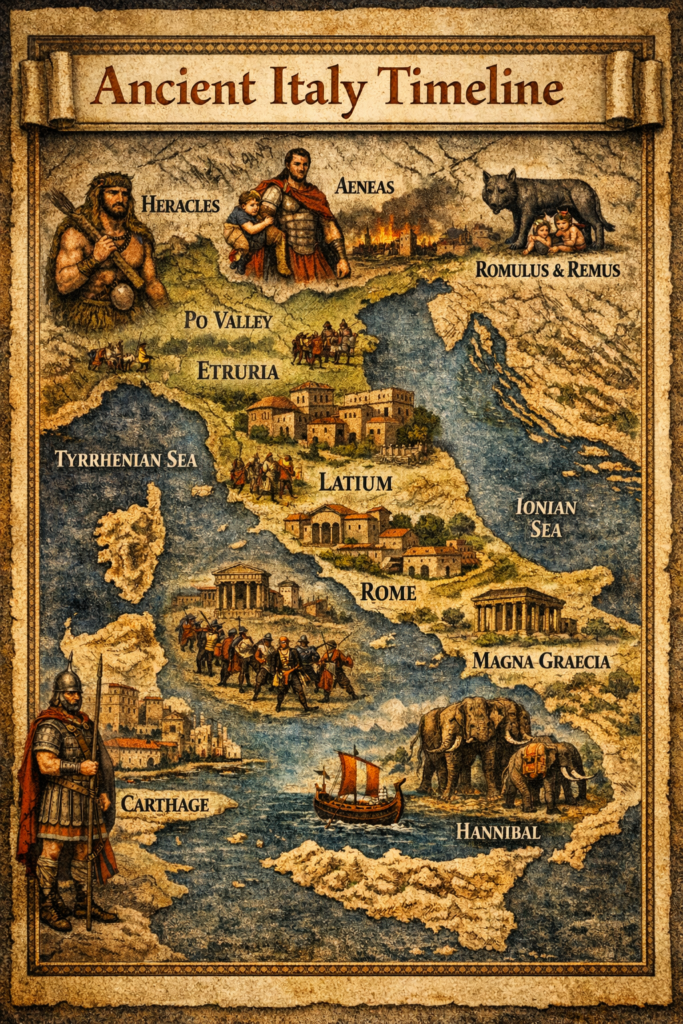
Heroic Age – Italy stands within the wider age of heroes, monsters, divine visitations, cursed houses, sacred kings, and wandering champions. Many of its oldest places are already marked by shrines, tombs, taboos, and the lingering works of greater powers.
Age of Heracles in Italy – Heracles passes through parts of Italy during his western labors. He destroys monstrous threats, leaves shrines and cults behind him, and becomes one of the earliest heroic presences fixed in the land’s remembered past.
After the Fall of Troy – Exiles, war-bands, and broken houses scatter across the sea. Among them is Aeneas, survivor of Troy, whose coming alters the future of Latium.
Age of Aeneas in Latium – Aeneas comes to Italy, fights for his place in the land, and founds the line from which Roman kings and founders will descend. Through him, the fate of Troy is carried west and rooted in Italian soil.
Age of Alba Longa – The kings of Alba Longa rule in the generations between Aeneas and the founding of Rome. Their line preserves the Trojan inheritance and binds heroic antiquity to the later destiny of Latium.
c. 900–700 BCE – Early Iron Age communities flourish across much of Italy. In central Italy, the Villanovan culture spreads through Etruria and neighboring lands, forming the earliest recognizable phase of what later becomes Etruscan civilization.
8th century BCE – Etruscan civilization emerges as one of the foremost powers of Italy. Its cities grow wealthy through trade, metalwork, religion, and aristocratic rule, and Etruscan influence extends far beyond Etruria itself.
753 BCE – Romulus and Remus, born of royal and divine blood, are exposed in infancy and preserved by fate. Reared to manhood, they return to claim their inheritance and found a new power in Latium.
753 BCE – Rome is founded by Romulus. In the struggle over rule and sacred boundary, Remus is slain. From its first day, Rome is marked by kingship, blood, omen, and the deadly sanctity of the city’s limits.
753–509 BCE – Age of the Roman kings. Rome is ruled by a succession of monarchs who shape its walls, rites, assemblies, and sacred order, turning a small Latin foundation into a rising city of consequence.
Reign of Numa Pompilius – Numa orders the sacred life of Rome, establishes rites, priesthoods, and observances, and gives the growing city a pattern of law rooted not only in rule, but in right relation with the gods.
616–579 BCE – Reign of Lucius Tarquinius Priscus. Rome grows in strength and splendor, and major public works become associated with the ambition of the kings.
534–509 BCE – Reign of Lucius Tarquinius Superbus, the last king of Rome. His rule hardens into tyranny, and the fall of the monarchy approaches.
509 BCE – The Roman kings are driven out, and the Republic is established. Rome no longer obeys a king, but it remains a city of omens, vows, sacred offices, and divine scrutiny.
5th century BCE – Rome strengthens its hold over Latium while contending with neighboring Italic peoples and rival communities across central Italy. It is an age of hard survival, local wars, oath-bound politics, and fierce struggle among the peoples of the peninsula.
Early Republican Age – Great deeds and harsh examples define Rome’s character. Defenders hold bridges against impossible odds, families sacrifice blood for public order, and the city’s moral memory grows beside its political power.
c. 400 BCE – Celtic peoples are established in northern Italy, especially in the Po Valley, adding a new and formidable strength to the balance of the peninsula.
390 BCE – The Battle of the Allia brings one of the great disasters of Roman history. The Gauls break Roman resistance and sack Rome, exposing the city to fire, humiliation, and near ruin.
390 BCE – During the Gallic crisis, the sacred geese of the Capitoline give warning and help save the citadel from surprise. The city endures through vigilance, divine favor, and the refusal to perish.
343–290 BCE – Rome fights the Samnite Wars, a long and brutal struggle that helps decide mastery of central and southern Italy. These wars show that Rome is no longer merely defending itself. It is becoming the power that will bend the peninsula to its will.
298 BCE – Battle of Camerinum during the Third Samnite War. Rome faces a widening resistance as multiple peoples and powers gather against its advance.
295 BCE – Battle of Sentinum. Rome defeats a coalition of Samnites, Gauls, Etruscans, and Umbrians in one of the decisive battles for control of Italy.
4th–3rd centuries BCE – Even as Roman power spreads, Italy remains crowded with older gods, local cults, mountain sanctuaries, spring shrines, sacred groves, tomb traditions, and fiercely guarded regional identities. Conquest does not erase the old powers of the land.
264–241 BCE – First Punic War. Rome and Carthage fight for mastery of the western Mediterranean. Rome emerges victorious and begins the transformation from Italian hegemon to imperial power.
241 BCE – End of the First Punic War. Rome secures Sicily and soon also Sardinia and Corsica, extending its rule beyond mainland Italy.
218–201 BCE – Second Punic War. Hannibal crosses the Alps and descends into Italy, bringing one of the greatest invasions the peninsula has ever endured.
218 BCE – Hannibal’s Alpine crossing enters history as one of the great feats of war: an army, elephants, and foreign steel passing over the mountain barrier into the heart of Italy.
216 BCE – Battle of Cannae. Hannibal shatters a vast Roman army in one of the worst defeats Rome ever suffers.
202 BCE – Battle of Zama. Scipio defeats Hannibal and ends Carthage’s greatest challenge to Roman supremacy.
168 BCE – Battle of Pydna. Rome crushes Macedon and becomes the foremost power in the Greek world as well as Italy.
148 BCE – Macedonia becomes a Roman province, and Roman authority reaches still further across the eastern Mediterranean.
149–146 BCE – Third Punic War. Rome wages its final war against Carthage.
146 BCE – Carthage is destroyed. In the same year Corinth is also destroyed, and Rome shows with brutal certainty what resistance now costs in both west and east.
135–132 BCE – First Servile War in Sicily, a major slave uprising against Roman rule.
107 BCE – Gaius Marius begins the military changes commonly associated with the Marian reforms, reshaping the Roman army in the final century of the Republic.
90–88 BCE – Social War. Rome’s Italian allies rise in revolt over citizenship and political standing. The war ends with Roman citizenship extended across much of Italy, binding the peninsula more tightly into a single political order.
82 BCE – Roman power is violently reasserted across Italy during the civil wars of the late Republic, and resistance from Celtic groups within Italy is finally broken.
73–71 BCE – Third Servile War. Spartacus leads the greatest slave revolt against Rome, devastating parts of Italy before the rebellion is crushed.
67 BCE – Pompey receives extraordinary command against Mediterranean piracy and clears the sea lanes with remarkable speed.
55 and 54 BCE – Julius Caesar invades Britain during the Gallic Wars, extending Roman war-making beyond Gaul, though no lasting occupation follows at this stage.
52 BCE – Caesar defeats the great Gallic revolt led by Vercingetorix, effectively completing the conquest of Gaul.
49 BCE – Julius Caesar crosses the Rubicon into Italy, and the Republic enters the civil war from which it will never truly recover.
44 BCE – Julius Caesar is assassinated on the Ides of March. His death does not save the Republic. It deepens its final crisis.
Late Republican Age – The last years of the Republic are crowded with ambition, omen, sacrilege, prophecy, fear, and blood. Politics and fate draw close together over Italy as the old order collapses.
31 BCE – Battle of Actium. Octavian defeats Antony and Cleopatra and becomes the unchallenged master of the Roman world.
27 BCE – Octavian receives the title Augustus. The Republic ends in substance, and the Principate begins. Italy now stands not merely as a contested peninsula, but as the heartland of empire.
Ancient Italy Timeline in Context
This ancient Italy timeline is the history of many peoples drawn, broken, bound, and remade within one land. Etruscan cities shaped the wealth and sacred character of central Italy. Greek colonies transformed the south. Samnites and other hill peoples contested the interior. Celtic peoples gave the north fresh ferocity. Latin settlements, old royal lines, and local cults bound every district to its own past. Rome rose within this crowded world and mastered it not because Italy lacked history, but because Italy possessed so many rival histories that one power eventually forced them into a new order.
Yet Italy was never only a place of treaties, legions, and roads. It was also a land of divine ancestry, wandering heroes, prophetic kings, sacred warnings, local gods, old shrines, haunted waters, mountain sanctuaries, and remembered marvels that remained part of the world’s true past. Its oldest stories were not later inventions made to flatter power. They were events that shaped bloodlines, cities, cults, and destinies.
Taken as a whole, this ancient Italy timeline is not only the story of Rome’s rise. It is the story of all the older worlds Rome conquered, absorbed, and carried forward within itself.
By the time of Augustus, this ancient Italy timeline reaches the moment when Italy had become the heartland of a Mediterranean empire. But the deeper layers endured. Etruscan, Italic, Greek, and Celtic inheritances remained alive in cult, custom, language, law, memory, and place. This ancient Italy timeline shows how heroic foundations, sacred kingship, conquest, civil war, and empire all shaped the making of Italy.