
Final Vision Spell
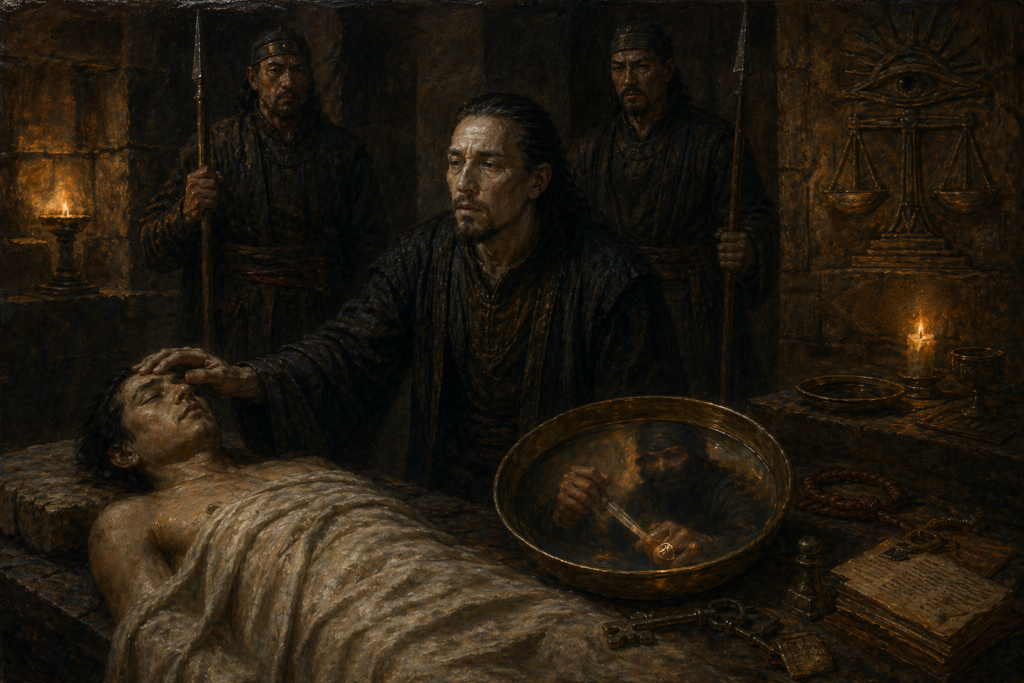
The dead do not answer questions; this legacy spell replays the final sights and sounds left in the body.
Final Vision is a third-party legacy necromancy spell from Crime and Punishment (Atlas Games, 2003). It lets the caster touch a corpse and replay the victim’s final sensory moments backwards from the instant of death. It is not an official D&D 5e / 2014 or D&D 5.5e / 2024 spell.
The nearest modern investigative spell is Speak with Dead, but the two spells are fundamentally different. Speak with Dead lets a corpse answer a limited number of questions; Final Vision instead replays recorded sight and sound and does not contact the victim’s mind or soul.
Quick Rules Reference
- 5.5e / 2024: no direct official Final Vision spell.
- 5e / 2014: no direct official Final Vision spell.
- Closest modern spell: Speak with Dead, which questions a corpse rather than replaying its senses.
- Legacy source: Crime and Punishment, Atlas Games, 2003.
- Legacy effect: touch one corpse and replay one additional round of its final sensory experience for each round you concentrate.
- Legacy duration: concentration, up to 1 round per caster level.
- Key limit: each casting starts again at death; repeated castings do not reach farther back.
- During the vision: the caster is unaware of present surroundings and is flat-footed under the legacy rules.
Rules
Final Vision by Edition
5.5e / 2024 — No Direct Official Final Vision
The 2024 rules do not contain an official Final Vision spell. Do not use the previous 3rd-level conversion on this page as though it were core 2024 rules.
Closest official spell: Speak with Dead
| Level | 3rd-level Necromancy |
|---|---|
| Range | 10 feet |
| Duration | 10 minutes |
| Questions | Up to five |
Speak with Dead lets a corpse answer questions using what it knew in life. It does not replay the victim’s senses and is not the same spell.
5e / 2014 — No Direct Official Final Vision
The 2014 Basic Rules likewise contain no direct Final Vision spell.
The nearest core investigative option is Speak with Dead, which allows up to five questions over 10 minutes but does not provide a sensory replay of the victim’s last moments.
Final Vision — Legacy d20 Rules
| School | Necromancy |
|---|---|
| Level | Cleric 3, God’s Eye 2, Inquisitor 1, Necromancer 2 |
| Casting Time | 1 action / 1 standard action |
| Components | V, S |
| Range | Touch |
| Target | One dead creature |
| Duration | Concentration, up to 1 round/level |
| Saving Throw | None |
| Spell Resistance | No |
Touch a corpse and relive its final sensory moments. The first round reveals the victim’s final round of life; each additional round of concentration moves one round farther backward.
You experience the scene through the victim’s eyes and ears but use your own observation skills to notice details. The effect is a recorded experience: it does not contact the victim’s mind, soul, motives or memories beyond what can be seen or heard.
Every casting begins again at the moment of death, so repeated castings cannot push the vision farther into the past.
While viewing the replay, the caster is unaware of present surroundings and is flat-footed under the original rules.
Original Source — Crime and Punishment (2003)
Author: Keith Baker
Publisher: Atlas Games
Series: Campaign Style
Publication: 2003
The original spell is a legacy investigative necromancy effect. The rules above preserve its central function without presenting it as official modern D&D material.
What Changed?
- The invented 5.5e / 2024 conversion has been removed.
- Modern D&D now points to Speak with Dead only as the nearest official investigative alternative.
- The legacy sensory-replay identity is preserved: Final Vision replays sight and hearing rather than asking questions.
- The original third-party provenance is now explicit instead of being hidden inside a legacy tab.
- No fake Pathfinder-specific rewrite is presented: this is treated as legacy d20 material unless a campaign explicitly converts it.
Why This Spell Is Dangerous in the World
The Final Vision spell makes murder harder to hide, but not impossible. It turns the dead into evidence and forces killers to think carefully about what their victims see and hear before death.
An assassin who knows this spell exists may strike from behind, cover the victim’s eyes, kill in darkness, use silence, send a disguised servant, destroy the body, raise the corpse as undead, or arrange for the victim to see only a false culprit. In sophisticated courts, murder becomes a contest not only of violence but of stagecraft.
Temples of justice may treat Final Vision as sacred testimony. Tyrants may use it as an instrument of state power. Criminal guilds may train apprentices in methods of defeating it. Necromancers may prize it because the dead often reveal what the living have been bribed, frightened, or enchanted into concealing.
Yet the spell is not perfect truth. It shows evidence, not explanation. It may reveal the hand that held the knife while leaving the hidden patron untouched.
Best Uses
Investigating murder: The spell can reveal the killer, the weapon, the final conversation, the place of death, or a clue the victim never understood.
Testing false testimony: Living witnesses may lie, misremember, or protect themselves. The corpse’s final senses can expose contradictions.
Battlefield inquiry: A priest or scout can learn how a patrol died, what ambushed them, or whether an enemy force passed nearby.
Courtroom evidence: A magistrate may rely on a trusted caster to report what the dead saw and heard, though interpretation remains dangerous.
Dungeon exploration: The corpse of a previous explorer may reveal a trap, password, hidden door, monster, or safe route.
Tactics
Cast Final Vision only when the caster can be protected. During the vision, the caster is vulnerable, distracted, and unable to respond properly to danger.
Before casting, examine the body and the scene. Note the corpse’s position, wounds, clothing, direction of collapse, nearby objects, and possible sightlines. The spell is most useful when combined with ordinary investigation.
The caster should decide what details to watch for before entering the vision: faces, voices, accents, symbols, uniforms, weapons, doors, spell effects, passwords, or the direction of the fatal blow. This helps the DM present the scene clearly without turning the spell into automatic exposition.
DM Notes
Run Final Vision as strong evidence, not a full solution. The spell should reveal what the victim truly saw and heard, but nothing beyond that.
If the killer was visible, show the killer. If the victim heard a name, let that matter. If the victim died without seeing the attacker, show the confusion: a shadow crossing the wall, a sudden wound, a cup falling from the hand, a familiar voice behind them, a door closing, or a symbol glimpsed too late.
The best mysteries use the spell to open a new question. The vision may reveal the hired blade, not the noble who paid for it. It may show the guard who opened the gate, not the power that compelled him. It may reveal the monster that killed the victim, but not the cult that released it.
Do not have every villain automatically counter the spell. Let it be powerful when the story supports it. Save deliberate countermeasures for assassins’ guilds, corrupt courts, prepared necromancers, and enemies who know divine investigators are coming.
Good Combinations
- Gentle Repose: Preserves the corpse long enough for a proper examination.
- Zone of Truth: Helps compare living testimony against what the dead actually saw or heard.
- Speak with Dead: Complements Final Vision by allowing questions, though the corpse’s answers may be limited.
- Detect Magic: Reveals whether necromancy, illusion, corpse-tampering, or death-magic may have affected the body.
- Locate Object: Useful if the vision reveals a distinctive weapon, mask, ring, seal, key, or stolen item.
- True Seeing: May help interpret magical disguises or illusions visible within the vision, at the DM’s discretion.
Using This Spell in Your Game
Use Final Vision when death should leave a serious trace without removing mystery. It gives players a reason to care about bodies, burial customs, crime scenes, timing, and who reaches the corpse first.
In an investigation, the spell can provide the first reliable clue. In a political campaign, it may expose the murderer while concealing the patron. In a horror game, it lets the caster experience the victim’s final terror without requiring spectacle. In a divine campaign, it makes justice intimate and costly: the caster must look through another creature’s dying eyes.
Adventure hooks naturally follow from the spell. A corpse is stolen before the temple inquisitor arrives. A murdered witness was blinded before death. A battlefield contains one dead soldier who saw the enemy commander. A noble court suppresses the result of a vision because the truth would start a war.
Spellcasting Culture and Worldbuilding Hooks
In some cities, Final Vision is part of legal procedure. A temple examiner touches the dead before burial or cremation, while sworn scribes record every sight and sound the caster reports. In such places, the spell may be surrounded by strict law, ritual cleansing, and severe punishment for false reporting.
Elsewhere, the spell is feared as a trespass against the dead. Families may refuse it. Death-priests may permit it only in cases of murder, treason, sacrilege, or unlawful execution. Some cultures insist that a caster who witnesses a death-memory must later make offerings for the soul whose final moment they entered.
Assassins’ guilds treat Final Vision as a professional hazard. Their training emphasizes masks, darkness, distance, false voices, intermediaries, and corpse removal. More ruthless killers use undeath or corpse-burning not as cruelty, but as evidence control.
Keep this reference growing
If this page helped with your reading or game, you can support its upkeep or explore the curated books.
Explore the Bookshop — epics, classics and stories behind imagined worlds.