
e Charcoal
Charcoal
A blackened stick of burnt wood used for marking, sketching, rubbing, and rough writing, charcoal is one of the simplest and most useful tools for leaving a visible trace where ink, paint, or knife-cutting would be slower, costlier, or less convenient.
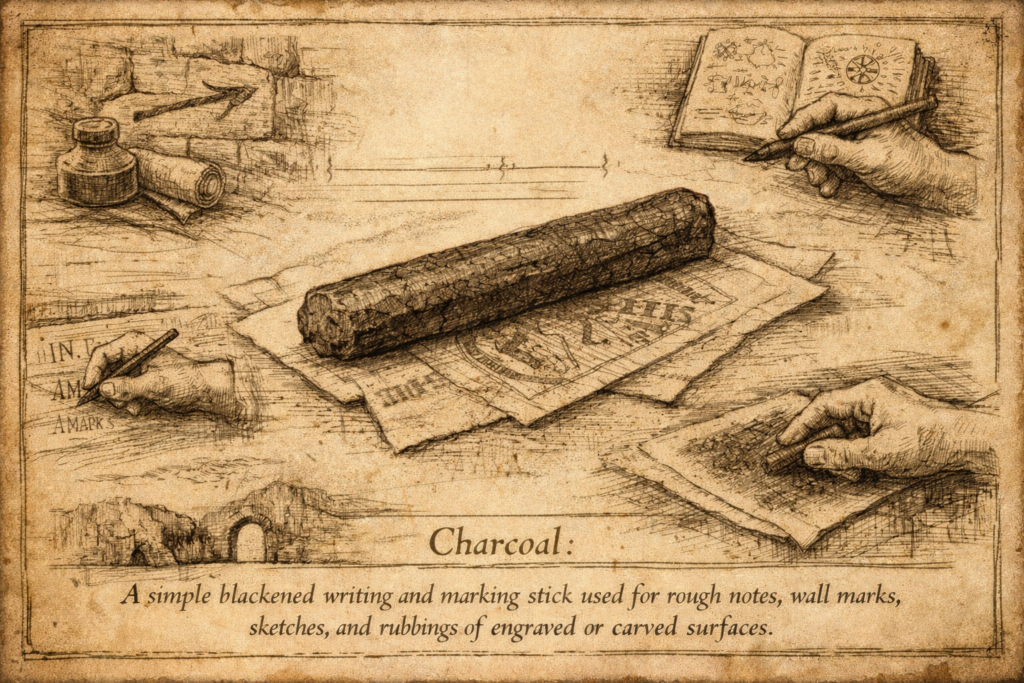
Charcoal belongs to the world of quick signs and temporary marks. It is found in the satchel of a scribe, the pouch of a delver, the apron of a mason, the case of a wizard, the hand of a child, and the kit of anyone who has needed to leave directions on stone, note a count on timber, sketch a sigil in haste, copy an engraving, or blacken a page with rough lines instead of careful ink. For the learned and the magical alike, it is often the fastest way to test a symbol, mark a surface, or copy a sign before committing it to ink. It is cheap, messy, and endlessly practical.
Overview
Charcoal is a simple writing and marking material made from wood that has been burned in a controlled way until it becomes light, black, and easily transferred to another surface. It is useful for marking floors and walls, writing on paper or parchment, sketching, and making rubbings of carvings, engravings, or other impressed markings.
Unlike ink, it requires no bottle, no quill, and little preparation. Unlike chalk, it works well on paper and parchment as well as stone and timber. Its marks are bold and immediate, though easily smeared or erased. That makes it especially useful for temporary notes, field work, copying, and practical signs rather than formal documents meant to last.
Description
A stick of charcoal is light in the hand, black to the touch, and brittle enough to snap if pressed too hard. The best pieces are evenly burned, leaving a firm but smooth mark without crumbling too quickly. Poorer ones break easily, leave uneven streaks, or shed grit and dust with every use. Good charcoal leaves a dark, soft line that catches quickly on rough surfaces, while poorer sticks crumble, scratch, or break into interrupted marks where a steady one is needed.
Its great advantage is versatility. A single stick can be used to mark a passage wall, note a count on a board, sketch a face or symbol, darken the edges of a rubbing, or write a quick warning where ink would be inconvenient. On parchment or paper it gives a soft, dark line; on rough stone or timber it leaves a broader, grain-catching mark. It is also useful for taking rubbings, where paper is pressed over an engraved or incised surface and the charcoal worked across it until the hidden design appears.
Because it is so easily handled, charcoal often sits halfway between tool and household leftover. In poorer places, a usable stick may simply be taken from the hearth. In more careful trades, good-quality pieces are selected, bundled, and kept dry for deliberate work.
Why This Item Matters
Charcoal matters because not every mark in the world needs to be permanent.
It is the tool of quick record, practical warning, copied symbol, rough map, first sketch, and working memory. It lets people think on surfaces, leave information behind, and reveal details that might otherwise go unseen. Its greatest value often lies not in writing something new, but in showing what is already there: worn inscriptions, carved signs, maker’s marks, and hidden details too faint to read by eye alone.
That makes it valuable not because it is rare, but because it does many small jobs well.
Failure, Smear, and Fragility
Its usefulness comes with obvious weaknesses.
Charcoal smears. Water spoils it. A sleeve, boot, or careless hand may blur a mark beyond recognition. What is written in charcoal must often be read soon or recopied later. A stick carried badly can snap in a pouch, blacken everything around it, or be reduced to dust before it is needed.
This makes it excellent for temporary use and poor for anything that must endure weather, travel, or rough handling without care.
Value in the World
Charcoal is nearly universal wherever people build fires, burn wood, keep records, or mark work.
It appears in kitchens, workshops, scriptoria, guardrooms, warehouses, schools, quarries, mines, and ruined places where explorers must leave a path behind them. In learned use, it is a practical tool for drafts, diagrams, and rubbings. In labouring use, it marks counts, measures, loads, and cuts. In dangerous places, it leaves signs that may save lives.
Because it is cheap and familiar, it also crosses class boundaries easily. A scholar, a mason, and a thief may all carry it, though for very different reasons.
Trade, Craft, and Common Variants
The simplest charcoal is little more than a suitable stick taken from a fire and saved. Better grades are made deliberately from selected wood and burned with more care to give a cleaner, steadier line. Good charcoal is usually drier, darker, less gritty, and slower to crumble. The listed base price reflects a basic usable stick; cleaner, broader, or more carefully prepared pieces usually cost a little more.
A bundle meant for rubbing carved stone is often broader and more reliable than ordinary writing charcoal, while better artist’s sticks are chosen for smoother line, deeper black, and cleaner handling.
Common variants include:
- hearth charcoal, cheap and irregular
- writing charcoal, cleaner and better suited to paper or parchment
- marking charcoal, thicker pieces for stone, timber, and walls
- artist’s charcoal, chosen for smooth line and richer black
- rubbing charcoal, broad, reliable sticks preferred for copying carved or engraved surfaces
Using It in Your Game
Charcoal is most useful when you want the world to leave traces and receive them.
It is ideal for:
- marking explored passages
- leaving warnings or directions
- copying symbols and inscriptions
- sketching suspects, maps, or heraldry
- making quick field notes without ink
- taking rubbings from tombs, ruins, seals, and carved stone
It is also one of those excellent humble tools that makes competent characters feel competent.
Adventure and Worldbuilding Hooks
- A ruined corridor is found covered in old charcoal arrows, some of them contradictory.
- A rubbing taken from a weathered tomb slab reveals details invisible to the naked eye.
- A child’s charcoal sketch turns out to be the best likeness anyone has of a wanted fugitive.
- A scholar’s field notes are lost, but charcoal outlines still remain on the stones where he worked.
- A trapped expedition marks its route with charcoal signs that later searchers must learn to read.
- A forged rubbing made in charcoal is used to support a false claim of ancestry or ownership.
Charcoal 5.5
Charcoal, Pathfinder
Charcoal 3.5
Charcoal
Adventuring Gear
Base Cost: 1 cp
Weight: —
A stick of charcoal can be used for marking floors and walls, writing on paper or parchment, sketching, and making rubbings of engravings or similar markings.
Creating a good-quality rubbing usually takes 1 minute per sheet of paper.
In an emergency, it can also be burned as fuel, though a single stick provides only a trivial amount of heat.
Common Prices
- Hearth charcoal: free to 1 cp
- Writing charcoal: 1 cp
- Marking charcoal: 1–2 cp
- Artist’s charcoal: 2–3 cp
- Rubbing charcoal: 1–2 cp
Charcoal
Base Price 1 cp; Weight —
A stick of charcoal is useful for marking floors and walls, writing on paper or parchment, sketching, and making rubbings of engravings or similar markings.
Producing a good-quality rubbing usually requires 1 minute per sheet of paper.
In a pinch, it can also be burned for a small amount of heat.
Common Market Prices
- Hearth charcoal: free to 1 cp
- Writing charcoal: 1 cp
- Marking charcoal: 1–2 cp
- Artist’s charcoal: 2–3 cp
- Rubbing charcoal: 1–2 cp
Charcoal
A stick of charcoal is useful for marking floors and walls, writing on paper or parchment, and making rubbings of engravings or other markings.
A good-quality rubbing generally takes 1 minute per sheet of paper.
In a pinch, it can even be burned to stay warm.
Base Cost: 1 cp
Common Prices
- Hearth charcoal: free to 1 cp
- Writing charcoal: 1 cp
- Marking charcoal: 1–2 cp
- Artist’s charcoal: 2–3 cp
- Rubbing charcoal: 1–2 cp
Keep this reference growing
If this page helped with your reading or game, you can support its upkeep or explore the curated books.
Explore the Bookshop — epics, classics and stories behind imagined worlds.