
Ornate Sword Hilt – Decorative Sword Handle and Status Weapon Fitting
Ornate Sword Hilt – Decorative Sword Handle and Status Weapon Fitting
A decorated hilt turns a sword from a weapon into a public claim: of rank, inheritance, oath, patronage, or dangerous vanity.
Overview
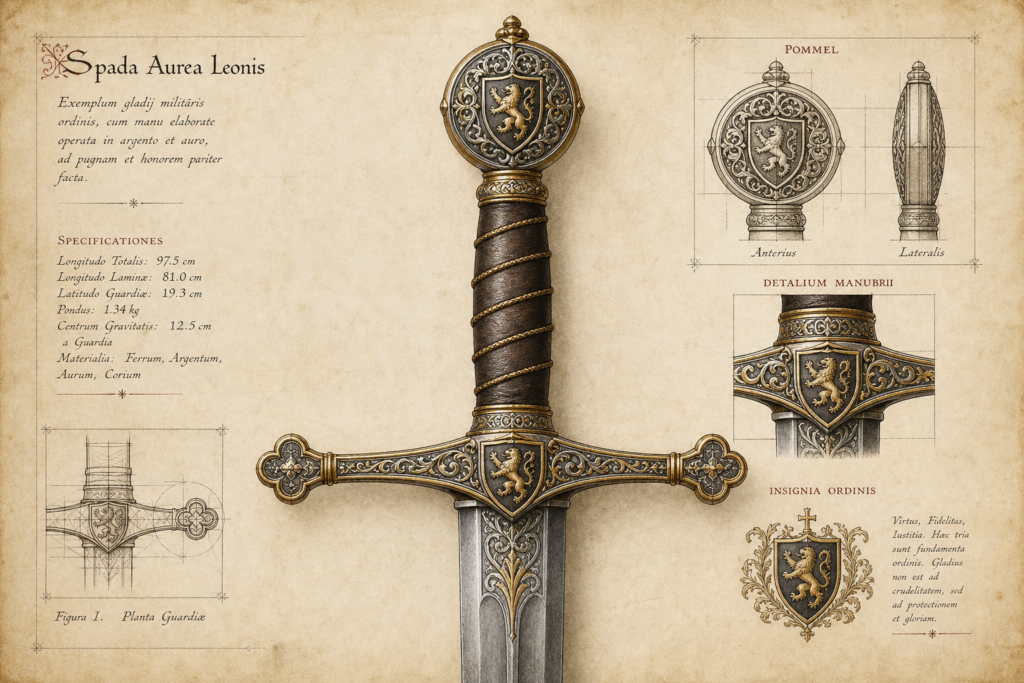
An Ornate Sword Hilt is a decorated fitting added to a sword’s grip, guard, pommel, and visible metalwork. It may be inlaid with silver or gold filigree, chased with heraldic marks, engraved with vows, wrapped in dyed leather, set with enamel, or worked with small plaques of horn, bone, ivory, bronze, or polished stone.
It does not make the sword sharper, stronger, faster, or easier to use. Its value is social and narrative. An ornate hilt marks wealth, office, household service, battlefield reward, sacred duty, noble inheritance, guild honour, or personal pride. It is the part of the sword people notice while the blade is still sheathed.
Physical Description
A practical ornate hilt keeps the sword usable. The grip may be bound in fine leather or twisted wire. The pommel may carry a family beast, city mark, oath-ring, household knot, sunburst, moon disc, maker’s seal, or sacred emblem. The guard may be etched, gilded, silvered, or shaped more elegantly than a common battlefield blade.
The decoration should not ruin the weapon. A serious fighting sword cannot have a grip so smooth, bulky, jeweled, or fragile that it becomes unreliable in the hand. Court swords and ceremonial blades may be more elaborate, but an adventurer’s ornate hilt should still look capable of surviving rain, mud, blood, saddle travel, and sudden violence.
Why This Item Matters
An ornate hilt matters because it changes how the sword is read before it is drawn.
A plain sword says the bearer is armed. An ornate hilt suggests the bearer belongs to someone, has served someone, has wealth worth stealing, carries a name worth recognising, or has killed someone important enough to keep the weapon.
In play, this item is useful when identity matters. A guard may recognise a household mark. A rival may know the sword was stolen. A noble may treat the bearer as a person of rank. A thief may target the weapon before the purse. A defeated enemy’s hilt may be worth more as proof of victory than as scrap.
Edition Tabs
Ornate Sword Hilt 5.5e / 2024
Ornate Sword Hilt Pathfinder / 3.5e
Ornate Sword Hilt 3.0
Ornate Sword Hilt 5.5e / 2024
Adventuring gear, weapon fitting
Cost: Usually +25 gp to +500 gp added to the cost of the sword
Weight: No meaningful change
Applies To: Most swords, subject to culture and craftsmanship
Rarity: Common among nobles, officers, temple champions, wealthy duelists, decorated household guards, and successful mercenary captains
An ornate sword hilt is a decorative weapon fitting. It does not change the sword’s damage, properties, mastery, attack rolls, damage rolls, or magical nature.
When the hilt’s workmanship, heraldry, inscription, or materials are relevant, a creature examining the sword can usually learn something about its owner, maker, culture, or claimed allegiance with a suitable Intelligence check.
Suggested DCs:
DC 10: Recognise that the hilt is costly, professional, or above ordinary battlefield quality.
DC 13: Identify common noble, guild, military, civic, temple, clan, or mercenary symbols.
DC 15: Recognise a specific regional style, workshop mark, household device, campaign award, or military order.
DC 18: Notice alteration, false gilding, replaced fittings, erased heraldry, disguised ownership, or copied decoration.
DC 20+: Identify a famous sword, lost lineage mark, royal workshop, forbidden cult device, stolen heirloom, or forged provenance.
A character proficient with smith’s tools, jeweller’s tools, leatherworker’s tools, History, Investigation, or another relevant proficiency may gain advantage on the check if that proficiency clearly applies.
Ornate Sword Hilt Pathfinder / 3.5e
Weapon fitting
Cost: Usually +25 gp to +500 gp added to the cost of the sword
Weight: No meaningful change
Craft: Craft (weaponsmithing), Craft (jewellery), Craft (leatherworking), or another appropriate Craft skill
An ornate sword hilt is a decorative addition to a sword. It grants no enhancement bonus, attack bonus, damage bonus, special material benefit, or weapon special quality.
When the hilt’s decoration, heraldry, maker’s mark, material, or workmanship matters, a character may attempt an appropriate Appraise, Craft, Knowledge, or Profession check.
Suggested DCs:
DC 10: Determine that the hilt is costly or well made.
DC 15: Identify common heraldry, regional style, military marks, civic badges, temple signs, or recognised workshop features.
DC 20: Detect forgery, replaced fittings, altered ownership marks, false gilding, or signs that the hilt has been added to disguise the sword’s origin.
DC 25: Recognise a rare dynastic mark, famous maker, sacred order, lost house, old campaign prize, or historically important blade.
The ornate hilt may increase the sword’s resale value, ransom value, or social significance, but it should not improve the sword’s combat statistics.
Ornate Sword Hilt 3.0
The Quintessential Paladin
Author Alejandro Melchor
Series Quintessential Series
Publisher Mongoose Publishing
Publish date 2002
Inlaid with silver or gold filigree, the ornate sword handle is another status symbol that merely improves the look of the sword while sheathed.
Cost and Value Guidance
The prices below are practical campaign ranges, not universal values. An ornate sword hilt may cost more or less depending on material, workmanship, local taste, maker reputation, and political or religious significance.
- Modest Silvered Ornate Sword Hilt: +25 to +50 gp. Suitable for minor officers, prosperous mercenaries, young nobles, guild champions, and successful duelists.
- Fine Filigree Ornate Sword Hilt: +75 to +150 gp. Suitable for knights, sworn household guards, decorated veterans, civic champions, and formal presentation swords.
- Noble or Dynastic Ornate Sword Hilt: +200 to +500 gp. Includes complex heraldry, rare materials, fine engraving, enamel, silverwork, goldwork, or recognisable workshop quality.
- Ceremonial or Heirloom Ornate Sword Hilt: 500 gp or more. This is no longer just equipment. It is a ransom piece, relic, inheritance object, political proof, or adventure hook.
The hilt’s value should be judged separately from the blade. A poor blade may have an expensive hilt. A deadly blade may be deliberately plain.
How It Is Used
An ornate sword hilt is used to display identity while the sword remains sheathed. It belongs in courts, tourneys, oath ceremonies, noble halls, command tents, funerary processions, temple armouries, mercenary companies, and negotiations where everyone is armed but no one has yet drawn steel.
It can also serve as evidence. A hilt can identify a corpse, prove a defeated knight’s capture, expose a stolen weapon, mark membership in an order, confirm a patron’s reward, or reveal that a supposed noble is carrying a device he has no right to bear.
Failure, Risk, and Misuse
The danger of an ornate hilt is attention.
A decorated sword may make the bearer look wealthy enough to rob, important enough to challenge, or arrogant enough to punish. It may also create false assumptions. A common sellsword carrying a noble hilt might be mistaken for a knight, thief, bastard heir, deserter, assassin, or murderer.
Poor decoration can make the sword worse in practical terms even if the rules do not model it. Loose wire, raised jewels, bad balance, fragile guard-work, and smooth polished grips are signs of vanity over function. A serious weaponsmith refuses to make a beautiful hilt that ruins the weapon.
Trade, Craft, and Common Forms
An ornate sword hilt is usually commissioned, inherited, gifted, stolen, or added to make a plain blade look more important than it is. Most examples differ by material, workmanship, symbol, and owner, not by separate rules.
Common details include silver wire, gold filigree, engraved guards, enamelled pommels, dyed leather grips, maker’s marks, household devices, victory inscriptions, and religious or civic symbols. A practical hilt remains secure in the hand. If the decoration makes the grip slippery, fragile, badly balanced, or uncomfortable, it is bad craftsmanship, not superior equipment.
The hilt’s meaning is often more important than its cost. A cheap copied emblem can get a liar through a gate. A genuine noble hilt can identify a corpse. A famous maker’s mark can make an otherwise ordinary sword worth stealing. A family device can turn a battlefield trophy into a political insult.
Most ornate sword hilts should use the same rules. Their value is in recognition, pride, fraud, ransom, inheritance, and danger.
Adventure and Worldbuilding Hooks
The Borrowed Blade:
A minor noble arrives at court wearing a sword with a hilt everyone recognises, but the family it belongs to claims the weapon was buried with their dead heir. The noble insists it was a gift. The grave has not yet been opened.
The Hilt Without a Blade:
A jewelled sword hilt is found in a pawnshop, separated from its original blade. The pawnbroker says it came from a travelling soldier. The city guard says the missing sword was last seen in the hand of a murdered magistrate.
The False Household Mark:
Someone is selling plain swords fitted with copied noble hilts. The fraud lets criminals pass as retainers, enter guarded houses, and collect debts in another family’s name. The real household wants the workshop found before the next victim starts a blood feud.
Historical Context
Decorated sword hilts are historically sound. Surviving swords and sword fittings show that weapons could be practical objects and status objects at the same time. Precious metals, engraved guards, decorated pommels, fine leather, wire binding, and symbolic markings all have real historical parallels.
For a useful historical comparison, see this Metropolitan Museum of Art sword from around 1400, made with steel, silver, copper alloy, and leather. It shows how decorated sword fittings could belong to real martial objects rather than only ceremonial display pieces.