
Spring-Loaded Wrist Sheath – Adventuring Gear
A concealed forearm sheath fitted with tiny gears and a wound spring, made to snap one hidden object into the wearer’s hand before anyone nearby understands what has changed.
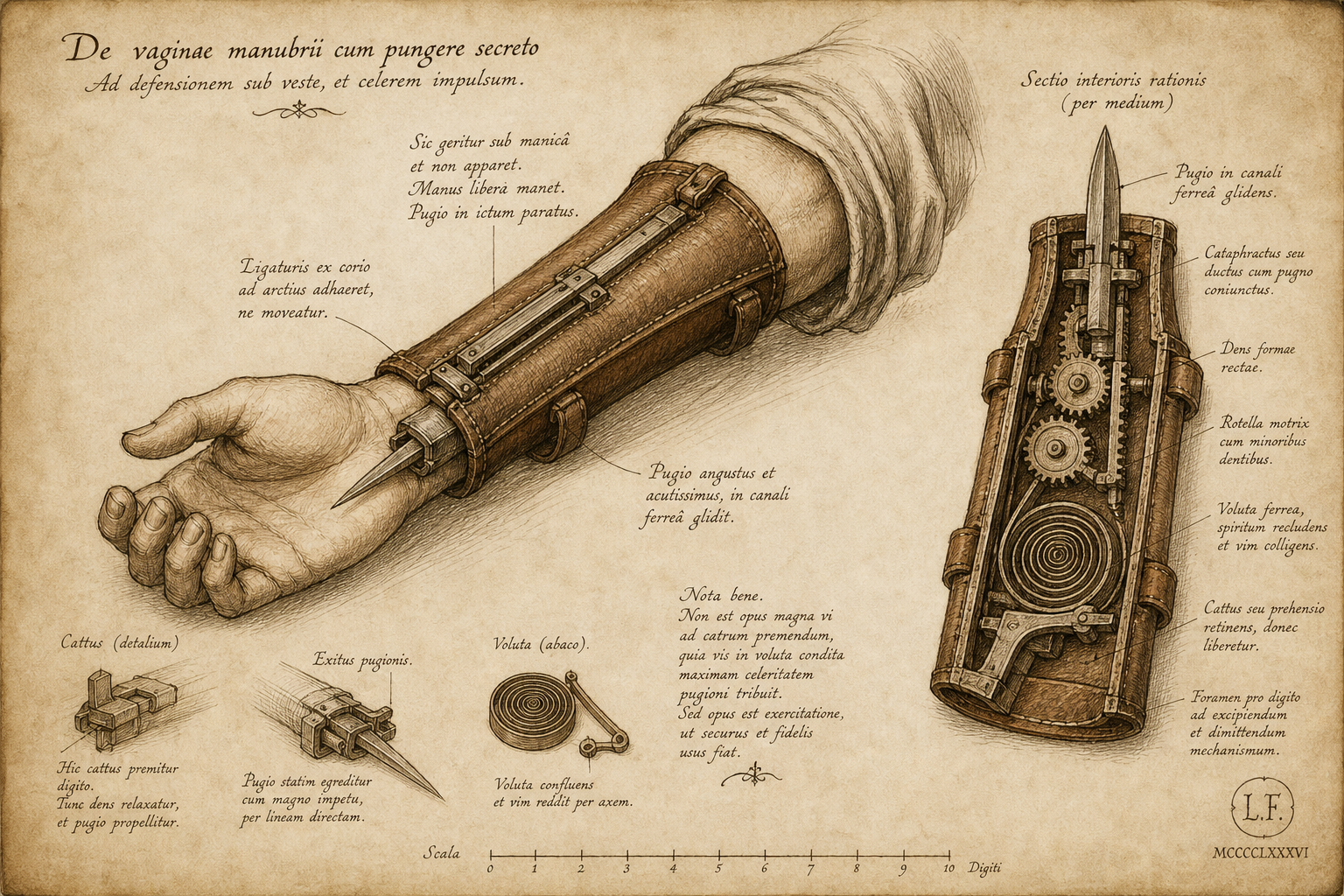
Overview
A spring-loaded wrist sheath is a refined concealed sheath worn beneath a sleeve, glove-cuff, bracer, or forearm wrap. It does not fire a blade, launch a dart, or turn the wearer into a walking trap. Its purpose is simpler and more useful: it puts one prepared item into the hand quickly.
The sheath is used by spies, knife-fighters, smugglers, assassins, court agents, bodyguards, thieves, messengers, and prisoners who expect to be searched. A dagger is the obvious choice, but the device is just as useful for a key, wand, poison vial, coded message, lockpick case, signet token, or small alchemical item.
Once used, the sheath must be reset by cranking its tiny mechanism back into place. That makes it a tool for one decisive moment, not a repeatable combat trick.
Physical Description
A spring-loaded wrist sheath consists of a fitted forearm brace, leather straps, a narrow item channel, a wound spring, small gears, and a release catch. Better examples sit flat against the arm and make almost no sound when armed. Poor examples rattle, pinch the wrist, snag on sleeves, or release too sharply.
The item is usually made by locksmiths, artificers, armourers, or discreet city craftsmen who understand small mechanisms. A good sheath must be fitted to the wearer. A stolen one may still work, but it may sit awkwardly, chafe, or reveal itself beneath clothing.
Why This Item Matters
The spring-loaded wrist sheath changes the first moment of danger. It lets a prepared character bring one hidden object into hand without reaching for a belt, pouch, scabbard, or boot.
That makes it valuable in courts, prisons, taverns, negotiations, ambushes, and searches at guarded doors. It is also incriminating. A person caught wearing one at a feast, trial, peace meeting, temple rite, or council chamber has not merely carried a weapon. They have carried a hidden plan.
Edition Tabs
Spring-Loaded Wrist Sheath 5.5e / 2024
Spring-Loaded Wrist Sheath Pathfinder 1e / 3.5e
Spring-Loaded Wrist Sheath 5.5e / 2024
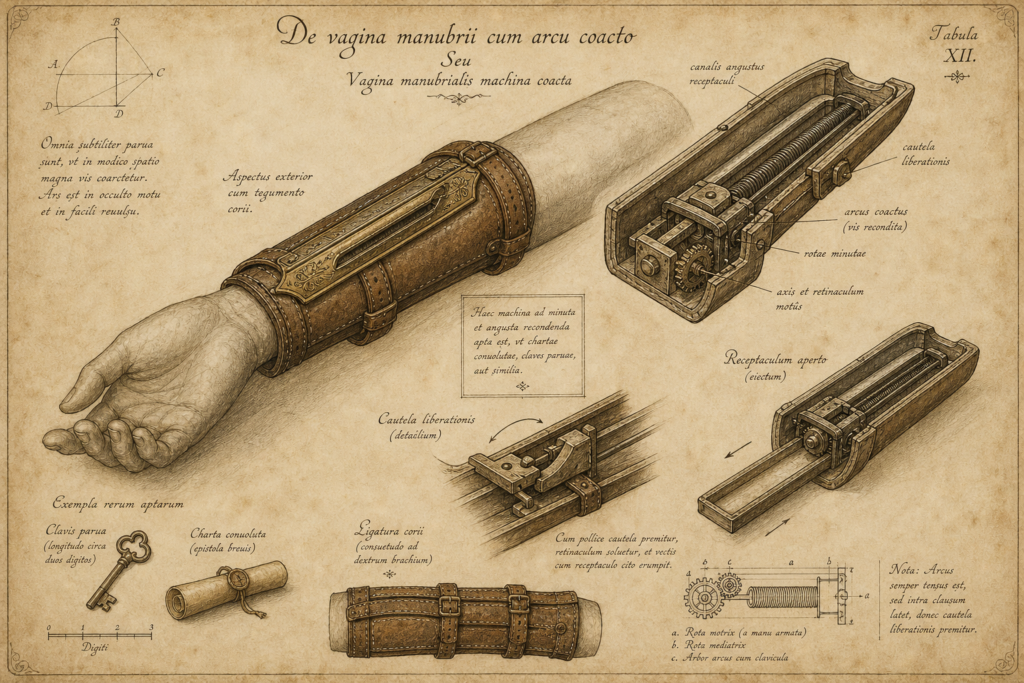
Adventuring Gear
Cost: 5 gp
Weight: 1 lb.
Capacity: One dagger, wand, vial, key, dart, lockpick case, narrow scroll tube, signet token, or similarly sized object.
While wearing a loaded and readied spring-loaded wrist sheath, you can release the stored item into your hand as a Bonus Action.
Loading and readying the sheath takes an Action outside immediate pressure. In combat, or in another dangerous situation, resetting the mechanism requires your Action and may be impossible if the arm is bound, pinned, heavily obstructed, or being closely restrained.
The sheath does not activate, throw, fire, or attack with the item. It only places the item in your hand.
Concealment
A spring-loaded wrist sheath can be hidden beneath suitable clothing. A creature searching the wearer may detect it with a Wisdom (Perception) or Intelligence (Investigation) check, usually opposed by the wearer’s Dexterity (Sleight of Hand).
| Situation | Suggested DC |
|---|---|
| Poorly hidden or partly visible | 10 |
| Hidden beneath normal sleeves | 13 |
| Professionally fitted beneath suitable clothing | 15 |
| Careful physical search | Searcher has advantage or DC reduced by 5 |
Jammed Release
Do not roll for ordinary use. The item should work when properly loaded and worn.
A check is only needed if the wearer is grappled, restrained, soaked, injured, falling, wearing unsuitable clothing, or using a damaged or cheap sheath.
Suggested check: DC 10 Dexterity check.
On a failure, the item catches and is not drawn. On a failure by 5 or more, the item drops at the wearer’s feet or the mechanism jams until reset.
Spring-Loaded Wrist Sheath Pathfinder 1e / 3.5e
Adventuring Gear
Cost: 5 gp
Weight: 1 lb.
This item works like a standard wrist sheath, except that releasing an item from it is a swift action.
Preparing the sheath for this use requires cranking the tiny gears and springs into place. This is a full-round action that provokes attacks of opportunity.
The sheath can hold one dagger, wand, vial, key, dart, lockpick case, narrow scroll tube, signet token, or similarly sized object.
The sheath does not activate, throw, fire, or attack with the item. It only delivers the item into the wearer’s hand.
Concealment
A spring-loaded wrist sheath is usually hidden beneath a sleeve, bracer, glove-cuff, or wrapped forearm. Finding it during a search may require a Perception check opposed by the wearer’s Sleight of Hand, or a fixed DC if the wearer is not actively concealing it.
| Situation | Suggested DC |
|---|---|
| Poorly hidden or partly visible | 10 |
| Hidden beneath normal clothing | 15 |
| Professionally fitted beneath suitable clothing | 20 |
| Careful physical search | Searcher gains a +5 bonus |
Use in Combat
A spring-loaded wrist sheath is strongest before the fight fully begins. Once discharged, it is difficult to reset safely in melee. Resetting it takes a full-round action and provokes attacks of opportunity, so most users rely on it for one prepared draw.
Original Source : Pathfinder Companion: Adventurer’s Armory
Use in Play
A spring-loaded wrist sheath is useful when the hidden item matters more than carrying capacity.
A rogue may conceal a dagger after being told to surrender visible weapons. A court agent may hide a signet token, writ, or poison vial beneath a formal sleeve. A duelist may keep a backup blade for the moment after being disarmed. A wand-user may hide a last resort where a captor expects empty hands. A messenger may carry a coded slip where a belt pouch would be searched first.
The item is strongest when chosen for a specific purpose before the scene begins.
Good Items to Carry
Suitable items include:
- Dagger
- Wand
- Poison vial
- Antitoxin
- Key
- Lockpick case
- Scroll tube
- Coded message
- Signet token
- Small alchemical item
- Dart or throwing knife
The sheath should not hold bulky, fragile, flexible, or awkwardly shaped objects. It is a concealed quick-draw device, not a hidden backpack.
Failure, Risk, and Misuse
The main risks are inspection, noise, bad fit, and bad timing.
A cheap sheath may click when armed. A poorly fitted one may show beneath a sleeve. A guard who knows court tricks may search the forearm rather than the belt. A character who releases the item too soon reveals the secret. A character who waits too long may find their wrist pinned, bound, or under a gauntlet.
The device should feel clever, not miraculous. It gives one fast hidden draw. It does not bypass all searches, all restraints, or all common sense.
Trade, Craft, and Common Variants
Most variants differ by fit, concealment, and workmanship, not by stronger rules. A spring-loaded wrist sheath must be made or adjusted for the object it is meant to carry, but that does not usually change its game statistics.
Street Sheath: Rough, cheap, and sometimes noisy. Used by cutpurses, alley blades, smugglers, and informants. It may cost 3–5 gp, but a poor example can rattle, snag, or jam if neglected.
Standard Sheath: The normal adventuring model, built to hold one dagger, wand, vial, key, dart, lockpick case, narrow scroll tube, signet token, or similarly sized object. It costs 5 gp.
Court Sheath: Slim, quiet, and fitted beneath fine sleeves, gloves, bracers, or formal clothing. Used by spies, noble agents, courtesans, diplomats, and bodyguards. It usually costs 10–25 gp, depending on secrecy, craftsmanship, and how well it is disguised.
A basic sheath is enough for most adventurers. Better versions should be quieter, better fitted, or harder to notice, not mechanically stronger unless the campaign deliberately supports specialist spy gear.
Value in the World
In the wrong place, a spring-loaded wrist sheath is treated as evidence of treachery. Carrying one into a noble feast, temple council, peace negotiation, guild hearing, or royal court may be enough to justify arrest.
In criminal markets, it is valued because it gives one hidden option at the decisive moment. In military use, it is too delicate for rank-and-file soldiers but useful for scouts, infiltrators, prisoner escorts, and agents passing through hostile gates.
Adventure and Worldbuilding Hooks
The Unbroken Seal:
At a border feast, every guest’s visible weapon is peace-bound with ribbon, wax, and witnessed oath before entering the hall. When an envoy dies from a narrow blade wound, every seal remains intact. The killing weapon was never on a belt, and accusing the wrong house could restart the war the feast was meant to end.
The Locksmith’s Saints:
A dead locksmith’s ledger records twelve spring-loaded wrist sheaths, each fitted for a different object: a dagger, a key, a wand, a narrow tube, and several entries written under saints’ names. One buyer is a criminal already hanged. One is a magistrate. One is a priest who swears the order was for a relic, not a weapon.
The Hand That Surrendered:
A captured rebel captain kneels, drops his sword, and offers both hands for binding before the city gate. An old soldier notices the unnatural stiffness of one sleeve, but calling it out may trigger the very movement he fears. The captain is not trying to escape. He is trying to reach someone in the watching crowd before the rope goes round his wrists.
Historical Context
The spring-loaded wrist sheath is fantasy adventuring gear, but it belongs to a believable craft tradition of hidden compartments, small locks, catches, springs, and concealed metal mechanisms. It should feel like the work of a discreet locksmith, armourer, or artificer rather than a mass-produced weapon.
A useful historical comparison is the Metropolitan Museum of Art’s medieval Gothic iron lock. Its entry notes that some small locks were compound objects with mechanisms concealed from view.