
 Buy me a coffee
Boot Sheath | Backup Dagger Gear
Boot Sheath | Backup Dagger Gear
A blade in the boot is carried for the moment when the sword is gone, the belt is empty, and one small edge can still matter.
Overview
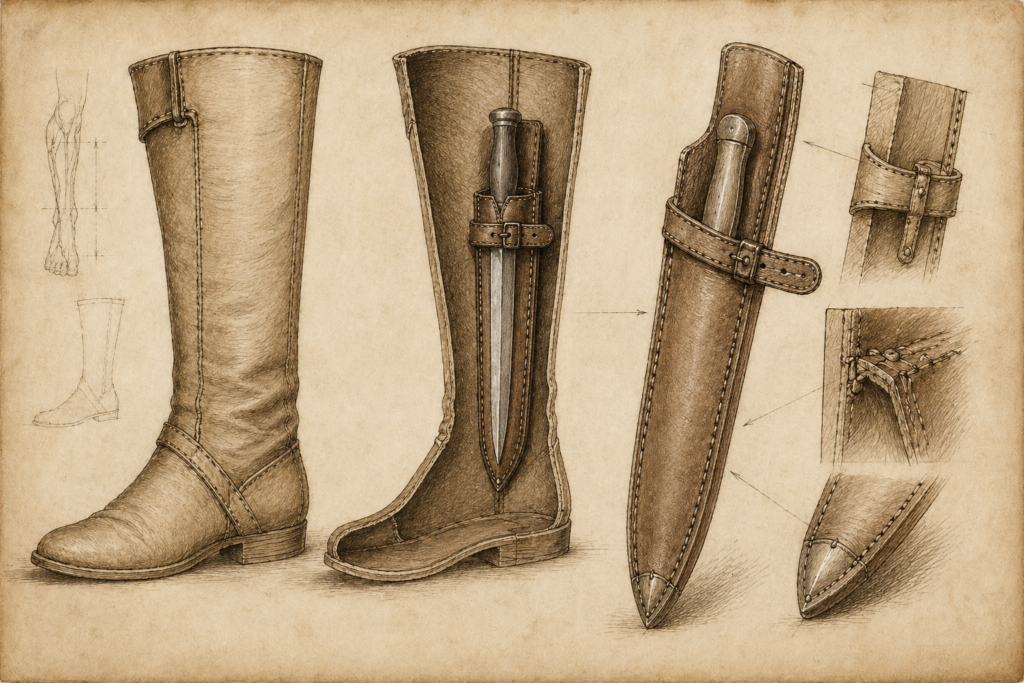
A boot sheath is a leather scabbard sewn or fitted against the inner wall of a tall boot. It is made to hold a dagger, knife, narrow throwing blade, bodkin, spike, or similarly small weapon in a place separate from the wearer’s belt, pack, and main scabbard.
Adventurers use boot sheaths because weapons are lost, dropped, taken, trapped beneath bodies, caught in packs, surrendered at doors, or impossible to draw in cramped quarters. A blade at the boot is not a replacement for a sword or axe, but it may still be reachable when the main weapon is gone.
Its first purpose is access. Concealment is a useful but unreliable side effect. A boot sheath can hide a small weapon from casual sight, especially beneath a cloak, long tunic, mud, or travelling gear, but it should not be treated as protection against a serious search. Its real value is redundancy: one more blade, kept in one more place.
Physical Description
A boot sheath is usually fitted along the inner calf or ankle of a tall leather boot, between the boot leather and the wearer’s leg. The simplest version is a narrow leather sleeve stitched into place. Better versions include a reinforced tip, waxed thread, a small retaining strap, and a softened backing to prevent bruising.
Most boot sheaths are made for slim daggers and knives. A broad blade, heavy pommel, or bulky hilt makes the weapon uncomfortable to carry, harder to draw, and easier to notice. The boot must also be deep enough to hold the weapon safely. A short boot may carry a small knife, but it cannot properly hide or secure a full dagger.
A poor boot sheath chafes, shifts, or tears loose. A good one can be worn through a day’s travel without constant pain, though the wearer remains aware of the blade’s weight and stiffness.
Why This Item Matters
The boot sheath turns a small blade into a last-resort tool. It matters when a character is climbing, crawling, seated, grappled, knocked down, trapped in a tunnel, fighting in a ship’s hold, or trying to cut bonds with whatever can still be reached.
It also changes scenes of surrender and captivity. A character may appear less armed than they truly are, but the item is not interesting because it fools every guard. It is interesting because it gives the character one more possible action when the scene has already gone wrong.
The boot sheath works best when treated as practical preparedness rather than perfect concealment. It gives a character another option, not a guaranteed escape.
Editions Tabs
Boot Sheath 5.5e / 2024
Boot Sheath Pathfinder 1e / 3.5e
Boot Sheath 3.0
Boot Sheath 5.5e / 2024
Adventuring gear, modification
Cost: 1 gp
Weight: Negligible
Installation Time: About 30 minutes for a plain fitting; longer for comfortable or well-disguised work
Capacity: One dagger, knife, narrow throwing blade, spike, or similarly small weapon
Requirement: A suitable tall boot
A boot sheath is fitted inside a tall boot and holds one small weapon as a last-resort blade. The boot must be deep enough, and the weapon must be narrow enough, to carry it safely.
A weapon carried in a boot sheath is usually hidden from casual sight unless the hilt protrudes, the wearer’s clothing exposes the boot, or the sheath creates an obvious bulge. A creature that visually inspects the wearer can notice the weapon with a successful DC 20 Wisdom (Perception) check.
A creature that physically searches the wearer’s legs or boots usually finds the boot sheath automatically unless the search is especially careless, obstructed, or limited by circumstance. If a check is needed, use DC 10 Wisdom (Perception) or DC 10 Intelligence (Investigation).
Drawing the weapon usually uses the same free object interaction a character would use to draw a weapon, provided the wearer can reach the boot. If the wearer is restrained, prone, seated awkwardly, climbing, crawling, grappled, or trying to draw the weapon unnoticed, the DM may require a DC 10–15 Dexterity (Sleight of Hand) check.
A boot sheath cannot carry a weapon larger than the boot can reasonably contain. It is suitable for a dagger, small knife, narrow spike, or similar item, not a shortsword, handaxe, mace, club, or bulky tool.
Pathfinder 1e / 3.5e
Adventuring gear
Price: 1 gp
Weight: Negligible
Installation Time: About 30 minutes for a plain fitting; longer for comfortable or well-disguised work
Capacity: One dagger, knife, narrow throwing blade, spike, or similarly small weapon
Requirement: A suitable tall boot
A boot sheath is fitted inside a tall boot and holds one small weapon as a last-resort blade. The sheath is recessed deeply enough that the weapon remains within the boot, provided the boot is long enough to contain it.
The hidden weapon creates an unavoidable bulge, stiffness, or altered line in the boot. A creature can notice this through visual inspection with a successful DC 20 Spot check. In Pathfinder 1e, use DC 20 Perception instead.
A creature that physically searches the wearer’s legs or boots usually finds the boot sheath automatically unless the search is especially careless, obstructed, or incomplete. If a check is needed, use DC 10 Search in 3.5e or DC 10 Perception in Pathfinder 1e.
Drawing a weapon from a boot sheath is normally treated as retrieving a stored item or drawing a hidden weapon. A character attempting to draw the weapon while seated, prone, grappled, climbing, crawling, or under observation may need a Sleight of Hand check or an appropriate action as determined by the GM.
Boot Sheath
Ultimate Equipment Guide II
Author Greg Lynch, J. C. Alvarez
Publisher Mongoose Publishing
Publish date 2005
The boot sheath is something no good adventurer should be without. A boot sheath is a simple device that can be added to any existing boot in about half an hour. Intended to hold small weapons like daggers and knives, a boot sheath is simply a sheath sewn to the inside of a boot leg.
It is recessed deeply enough into the boot that the weapon it is intended to carry is also concealed within the boot, provided, of course, that the boot is deep enough to accommodate it. There is an unavoidable bulge in the side of a boot when a weapon is stowed in a boot sheath, which is difficult but not impossible to notice (Spot skill check DC 20). The price given below is the cost for adding a sheath to an existing boot.
Boot Sheath: 1 gp
How It Is Used
A boot sheath is carried by people who cannot afford to depend on one weapon in one place. Scouts, sailors, rogues, messengers, bodyguards, bounty hunters, caravan guards, spies, assassins, and cautious adventurers all have reason to keep a small blade close to the boot.
Its uses are practical. A boot knife can cut rope, slice bindings, pry at a loose board, finish a creature at arm’s length, threaten a captor, or serve when a larger weapon is impossible to draw. It is especially useful in cramped spaces, after a fall, during a grapple, or when a character’s main gear has been lost or tangled.
In formal places, the boot sheath becomes more dangerous. A guest who surrenders a sword but keeps a knife in the boot may be prudent, desperate, or treacherous. The same item that saves a life in a dungeon may be treated as proof of murderous intent in a noble hall.
Failure, Risk, and Misuse
A boot sheath is only as reliable as its fitting. A badly made one can rub the leg raw, snag on clothing, loosen during travel, or let the weapon shift at the worst possible moment. A sharp blade without proper lining may eventually cut through the leather or injure the wearer.
Its concealment is limited. The sheath may pass casual sight, but a real search of the legs or boots should usually find it. If discovered in a court, prison, temple, guildhall, or military camp, a hidden boot knife may be treated more seriously than an openly worn blade. An honest traveller may carry a belt knife. A hidden knife asks uncomfortable questions.
The item also has strict physical limits. It cannot safely carry a large weapon, a broad blade, a heavy hilt, a fragile vial, a noisy tool, or anything too bulky to sit naturally against the leg.
Value in the World
The listed 1 gp price represents the cost of adding a plain boot sheath to an existing tall boot. It does not include the boot or the weapon.
Although the work may be quick for a skilled leatherworker, the price is not merely payment for stitching. It covers shaping the sheath to a specific blade, reinforcing the boot, fitting the weapon where it can be reached, and the discretion involved in making gear intended to carry a hidden blade.
In mercenary camps, border towns, pirate ports, caravan markets, and adventuring settlements, the 1 gp price is reasonable. In stricter cities, noble courts, temples, military compounds, and heavily policed towns, the same work may cost more, require the right contact, or be refused entirely.
Trade, Craft, and Common Variants
- Plain Boot Sheath: The standard version, sewn into an existing tall boot. It costs 1 gp and holds one suitable small weapon.
- Matched Pair: A sheath in each boot. This usually costs 2 gp before any adjustment for better workmanship. Carrying two boot weapons may make the wearer’s gait or boot shape easier to notice.
- Soft-Lined Boot Sheath: A better-fitted sheath with smoother leather, padding, and reinforced stitching. It usually costs 3–5 gp and is more comfortable for long travel.
- Noble Concealment Sheath: Built into expensive riding boots or court boots, often disguised by folded leather, tooling, or decorative seams. These usually cost 10 gp or more, not including the boots themselves.
- Quick-Draw Boot Sheath: Designed for easier access rather than perfect concealment. It may make the weapon easier to draw in a tense scene, but it should also be easier to notice.
Using a Boot Sheath in Your Game
A boot sheath is most useful in adventures where equipment position matters. It fits wilderness travel, dungeon crawling, shipboard fighting, climbing, crawling, tavern brawls, prison scenes, formal weapon surrender, and any situation where a character wants one last small tool within reach.
For players, it rewards preparation without replacing the main weapon. The blade in the boot might cut a rope, free a wrist, threaten a captor, or give a fallen character one more chance.
For GMs, the cleanest ruling is simple: the boot sheath is a secondary weapon location first and a concealment device second. A casual glance may miss it. A serious physical search usually finds it. The item is most satisfying when it opens a risky possibility rather than automatically solving the scene.
Adventure and Worldbuilding Hooks
- The Last Knife: The party’s weapons are scattered after a fall into an underground river. One character still has a dagger in a boot sheath.
- The Court Search: A noble household permits ceremonial weapons but forbids hidden ones. A discovered boot sheath turns a diplomatic visit into an accusation.
- The Cobbler of Quiet Steel: A local cobbler is famous among scouts, sailors, spies, and duelists for making boot sheaths that can be worn through hard travel.
- The Wrong Prisoner: A condemned prisoner is found with a boot knife, but insists someone planted it there to justify execution.
- The Tunnel Fight: A warrior crawling through a collapsed passage cannot draw a sword, but can reach the blade hidden in the boot.
- The Assassin’s Error: A hired killer hides the blade well, but the boot itself is too new, too stiff, and too clean for the disguise.
Balance and Economy
The boot sheath is balanced because it offers redundancy, close-at-hand utility, and limited concealment. It does not increase damage, improve attack rolls, or reliably defeat searches. Its usefulness depends on the situation.
The 1 gp cost is appropriate for a plain modification to an existing tall boot. The price represents fitting, reinforcement, access, and discretion, not simply half an hour of ordinary cobbler labour.
More expensive versions should improve comfort, access, concealment, or social disguise, but they should not make the sheath impossible to detect. The original DC 20 notice difficulty remains a good baseline for visual detection, while a careful physical search should usually find the item.
Reference and Inspiration
For historical context on medieval leather footwear and construction, see Norfolk Museums’ article on early shoes from 1250–1799: Early shoes: 1250–1799.