
Winter Blanket – Adventuring Gear for Cold Weather Travel
Winter Blanket – Adventuring Gear for Cold Weather Travel
A heavy fur blanket made for cold nights, poor shelter, and hard travel.
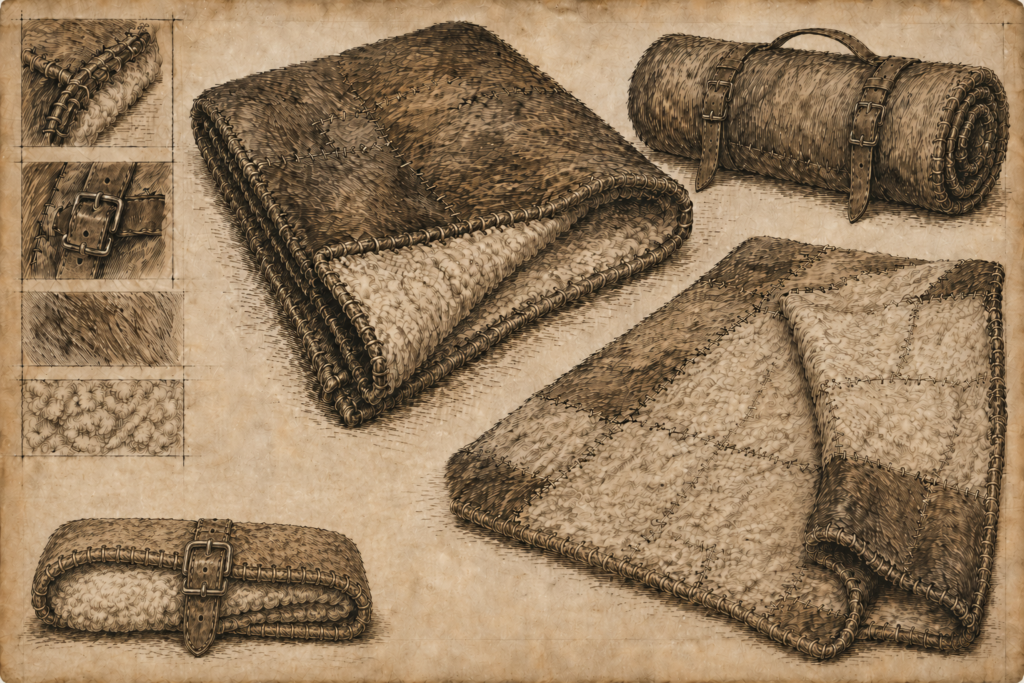
Overview
A Winter Blanket is a thick fur blanket large enough to cover one person. Travellers rarely notice it when they have one, but they miss it quickly when the weather turns.
On the road, a Winter Blanket helps a character sleep through cold weather, rest on hard ground, and recover warmth after rain, snow, river crossings, night watches, or long marches. It is common among soldiers, drovers, pilgrims, hunters, messengers, caravan guards, trappers, and anyone else who expects to sleep away from a hearth.
For adventurers, a Winter Blanket is not glamorous. It is not treasure, armour, or magic. It is the difference between a prepared camp and a miserable one.
Physical Description
A Winter Blanket is usually made from fur, fleece, hide, or heavy layered wool. The outer side is often rougher and more weather-resistant, while the inner side is softer and better suited for sleeping. Better examples are stitched around the edge, backed with linen or wool, and treated with smoke, fat, wax, or oil to resist damp.
Common materials include sheepskin, goat fleece, wolf fur, bear hide, felted wool, or mixed hides sewn together from whatever local hunters and herders can provide. A used blanket may smell of smoke, wet wool, horse sweat, pine resin, and cold earth.
A Winter Blanket can be rolled and tied to a pack, strapped behind a saddle, folded inside a bedroll, or laid beneath a cloak for extra warmth.
Why This Item Matters
The Winter Blanket gives cold-weather travel practical weight without adding complicated rules. It makes camps, marches, watches, and wilderness rests feel more grounded.
It also separates prepared characters from careless ones. A party carrying proper bedding, shelter, and fire-making supplies should feel better equipped than one trying to sleep in wet clothes on frozen ground.
A Winter Blanket is useful for roleplay as well as survival play. It can be shared, stolen, traded, inherited, repaired, or given away. In hard country, that can matter as much as a weapon.
Edition Tabs
Winter Blanket 5.5e / 2024
Winter Blanket Pathfinder 1e / 3.5e
Winter Blanket Pathfinder 1e / 3.5e
Adventuring Gear
Cost: 5 sp
Weight: 3 lb.
This is a fur blanket large enough for one person.
A Winter Blanket provides basic warmth and comfort during cold nights, wilderness travel, and poor sleeping conditions. It is not armour, does not replace cold weather clothing, and does not provide full protection from severe environmental cold on its own.
At the GM’s discretion, a character sleeping or resting under a Winter Blanket in ordinary cold conditions gains a +2 circumstance bonus on Fortitude saves made to avoid nonlethal damage from cold weather. This bonus applies only while the blanket is in use and reasonably dry.
The bonus does not apply against magical cold, cold damage from attacks, immersion in freezing water, severe arctic exposure, or any situation where the blanket is soaked, packed away, lost, or otherwise unusable.
Winter Blanket 5.5e / 2024
Adventuring Gear
Cost: 5 sp
Weight: 3 lb.
A Winter Blanket is a heavy fur, fleece, hide, or wool blanket large enough for one Small or Medium creature.
When used during a Short Rest or Long Rest in cold but non-extreme conditions, a Winter Blanket can help a creature rest comfortably and avoid ordinary exposure at the DM’s discretion, especially when combined with shelter, dry clothing, a bedroll, or a fire.
A Winter Blanket does not grant resistance to cold damage. It does not protect against magical cold, severe arctic conditions, immersion in freezing water, or exposure where proper shelter is impossible.
A Winter Blanket can be used as improvised bedding, padding for fragile goods, a covering for supplies, a simple curtain, or a crude wrap for an injured or unconscious creature.
Camp Use and Character Detail
A Winter Blanket does not need special handling. Its value is in what it says about preparation, hardship, and the kind of journey a character expects to survive.
In play, it works best as part of the camp scene rather than as a tactical tool. A rolled blanket on a saddle marks a traveller used to sleeping rough. A smoke-stained army blanket suggests old service. A patched fur blanket may point to poverty, exile, long roads, or practical thrift. A fine lined blanket may reveal wealth in a place where wealth should have been hidden.
A Winter Blanket can also carry story. It might be inherited, stolen, marked with a household stitch, traded for food, wrapped around a rescued prisoner, or left behind with the dead. In cold country, the important question is rarely how to use it. The question is who still has one when night falls.
Loss, Damage, and Replacement
A ruined Winter Blanket is usually not worth repairing unless it has personal, military, or cultural value. If it is soaked, burned, infested, torn beyond use, fouled by blood or sickness, or lost in mud or floodwater, most travellers discard it and buy, barter, or steal another when they can.
That does not make it disposable in the moment. Losing a Winter Blanket during a winter march, mountain crossing, siege camp, or refugee flight can still matter before replacement is possible. The danger is not that the blanket is precious. The danger is needing it before another can be found.
Value in the World
A Winter Blanket is common gear in cold regions, frontier settlements, military camps, caravan routes, and upland communities. It may be sold by furriers, tanners, shepherds, innkeepers, army suppliers, travelling merchants, and monastery stores.
Quality varies widely. A cheap blanket may be thin, stiff, badly cured, or patched with scrap hide. A good blanket may last for years and be worth repairing rather than replacing. A fine fur blanket can be a practical luxury, a dowry item, a veteran’s keepsake, or a valuable trade good.
In harsh country, stealing someone’s Winter Blanket is not a harmless theft. It may leave the victim exposed, sleepless, and vulnerable before the next day begins.
Trade, Craft, and Common Variants
Most Winter Blankets are made by furriers, tanners, shepherds, household weavers, or travelling craftsmen. The best examples balance warmth, durability, and resistance to damp. Prices vary by region, season, material, workmanship, and access to livestock or hunting grounds.
Traveller’s Patch Blanket: 2 sp; 3 lb.
A much-repaired blanket made from old cloth, scrap hide, worn wool, or salvaged fur. It is cheap, serviceable, and rarely attractive. Poor pilgrims, refugees, beggars, porters, and desperate travellers often carry blankets like this.
Felted Wool Blanket: 3 sp; 3 lb.
A practical wool blanket made for quantity rather than prestige. It is common among soldiers, caravans, labourers, drovers, and town households. It is less impressive than fur, but easier to produce and easier to replace.
Military Winter Blanket: 5 sp; 3 lb.
A plain, standardized blanket made for hard use. It may be marked with the sign of a company, city, lord, temple, guild, or military storehouse. Many are rough, smoky, and heavily used, but they are valued because they are reliable.
Goat-Fleece Blanket: 5 sp; 3 lb.
A rough, durable blanket common in mountain country and hard pastoral regions. It is not especially soft, but it stands up well to travel, pack use, and poor weather.
Sheepskin Blanket: 1 gp; 4 lb.
A warm, heavy blanket common in pastoral regions. It is more comfortable than most wool or goat-fleece blankets, but bulkier to carry. A good sheepskin blanket may serve a traveller for years.
Wolf-Fur Blanket: 5 gp; 5 lb.
A frontier blanket favoured by hunters, scouts, trappers, and warriors who value both warmth and reputation. It is often worth more for its material, story, and appearance than for any practical advantage over a well-made sheepskin blanket.
Bear-Hide Blanket: 10 gp; 8 lb.
A very warm, bulky, and prestigious blanket. Bear-hide blankets are often found in noble hunting lodges, chieftains’ halls, northern households, or among wealthy travellers who can afford comfort and weight. They are not convenient for every journey, but they make a strong impression.
These variants do not need separate rules unless the campaign tracks cold, encumbrance, trade goods, or regional markets closely. They are mainly useful for local colour, character identity, and equipment lists that feel tied to culture and climate.
Keep this reference growing
If this page helped with your reading or game, you can support its upkeep or explore the curated books.
Explore the Bookshop — epics, classics and stories behind imagined worlds.