
e Oar
Oar
A long wooden blade for driving a small craft through water, this plain, hard-worked tool belongs to rivers, lakes, marshes, coasts, and all the places where a boat must answer to human strength instead of sail.
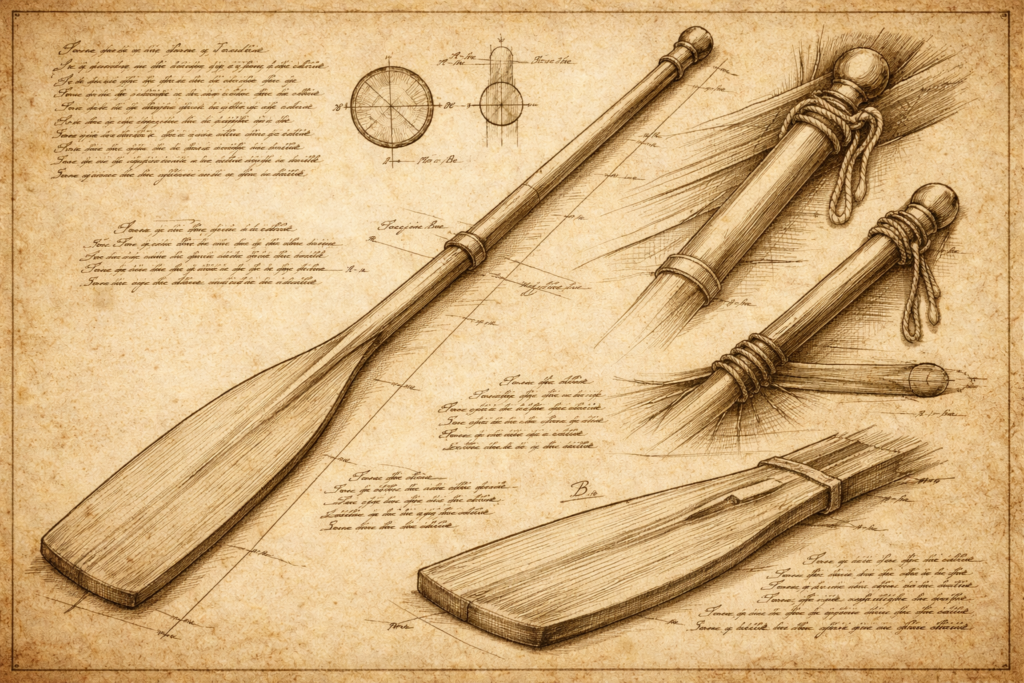
It is easy to overlook until one is missing. Then the absence is felt at once: the boat drifts badly, turns poorly, grounds where it should have cleared, or leaves its crew circling helplessly in current or wind. For fishers, ferrymen, rivermen, marsh folk, soldiers, raiders, and travellers alike, this is not an accessory but part of the craft itself. It is the difference between motion and waiting.
Overview
This is a replacement tool for any boat or other vessel driven by rowing. It is a long shaft fitted with a broad blade, made to pull against the water and move or steer a craft by human effort. Some are built for narrow riverboats, some for broader ferry craft, and some for light coastal vessels, but all serve the same purpose: to turn strength into movement on the water.
Unlike many tools, it belongs less to the individual than to the boat. It is bought, repaired, replaced, and judged according to the craft it serves.
Description
Most examples are made of wood, shaped from strong, flexible timbers able to withstand repeated strain without snapping. The shaft must be smooth enough for a firm grip and even stroke, while the blade must be broad enough to bite the water properly without becoming too heavy in return. Better-made versions are well balanced, cleanly finished, and strong along the grain. Poor ones warp, split, twist in the hands, or tire the rower faster than they should.
This tool may be plain and workmanlike or carefully finished according to the craft and the owner. River ferries often favour durable, easily replaced examples. Fishing boats may keep worn, rehandled ones that have served for years. War boats, patrol craft, or proud household vessels may carry matched sets made to a common length and weight.
Why This Item Matters
This tool matters because water does not forgive helplessness.
A lost pack can be mourned later. A broken mast may still leave hope of drifting ashore. But the loss of one of these can become immediate danger: missed landings, smashed hulls, exposed crossings, or helpless drift into reeds, rocks, surf, or enemy reach.
It is one of those ordinary tools that quietly carries more importance than its plain appearance suggests.
Failure, Risk, and Water
It is simple, but it fails in simple ways.
Wood swells, cracks, or rots if neglected. Shafts weaken under strain. Blades split when driven too hard against current or stone. A badly matched replacement may fit the boat poorly, throw off the rowers’ rhythm, or leave the craft pulling unevenly. Even a sound one becomes dangerous in exhausted hands, when poor timing, panic, or bad water turn labour into confusion.
For that reason, experienced boatmen inspect their gear with the same practical suspicion they give rope, hull seams, and mooring knots.
Value in the World
This rowing blade is as common as the waters that require it, though its form changes from place to place.
On rivers and lakes it is a tool of work: ferries, fishing boats, barges, and marsh skiffs all depend upon it. Along coasts, it shares that place with sail, becoming the means to launch through surf, land quietly, or move when wind fails. In reed-choked wetlands, narrow craft rely on it as much for control as for speed. In military use, matched examples mean discipline, rhythm, and the ability to force a vessel where it must go regardless of wind.
Because it belongs to the boat, it also reveals something about the craft and those who use it. A patched and rehandled example speaks of long use and thrift. A well-balanced new one suggests a cared-for vessel. A missing spare on a dangerous crossing suggests either poverty or foolishness.
Trade, Craft, and Common Variants
They are made by carpenters, boatwrights, river craftsmen, and any settlement accustomed to keeping working boats in service. The simplest are straightforward to make, but a good one is more than shaped timber. It must be balanced well, sized to the craft, and durable under repeated strain.
Common variations include:
- river oars, lighter and suited to narrow craft
- ferry oars, heavier and built for steady work
- coastal oars, made to endure wet salt conditions and rougher handling
- spare ship’s boat oars, kept for launches, skiffs, and tenders
- war-boat oars, matched in length and weight for coordinated rowing
Using It in Your Game
It matters whenever boats are more than scenery.
It becomes important in crossings, pursuits, landings, storms, marsh travel, river journeys, smuggling runs, military movement, and wreck scenes. It also gives texture to the difference between a boat that is merely present and one that is actually ready for use.
For players, it is the kind of item that feels trivial until the exact moment it becomes essential.
Adventure and Worldbuilding Hooks
- A ferry is stranded because one cracked blade snapped in the current and no proper replacement can be found nearby.
- A stolen boat is recognised not by its hull, but by a distinctive repaired oar still aboard.
- A marsh guide refuses to travel without a spare, having once lost a craft to hidden current and soft mud.
- A patrol boat’s matched rowing gear shows military discipline long before its banner becomes visible.
- A dead boatman is found drifting with one hand still closed around a broken shaft.
- A poor fishing family carves replacements from salvaged timber after flood or war has stripped the shore bare.
Oar 5.5
Oar, Pathfinder
Oar 3.5
Oar
Adventuring Gear
Cost: 2 gp
Weight: 10 lb.
A long wooden rowing blade used with an oared craft, an oar allows a boat to be rowed or steered by hand.
This item is typically purchased as a replacement for a lost, broken, or missing piece of rowing gear on a vessel that uses rowing for movement or control.
Oar
Price 2 gp; Weight 10 lbs.
This long wooden blade is used to row or steer an oared craft by hand.
It is typically bought as a replacement for a lost, broken, or missing piece of rowing gear on a vessel that depends on rowing.
Oar
This is a replacement oar for an oared craft.
Weight: 10 lb.
Keep this reference growing
If this page helped with your reading or game, you can support its upkeep or explore the curated books.
Explore the Bookshop — epics, classics and stories behind imagined worlds.