
Wandermeal Rations: Durable Halfling Trail Food
Wandermeal Rations: Durable Halfling Trail Food
A hard halfling trail-cake that keeps a traveller alive long after proper food has run out.
Overview
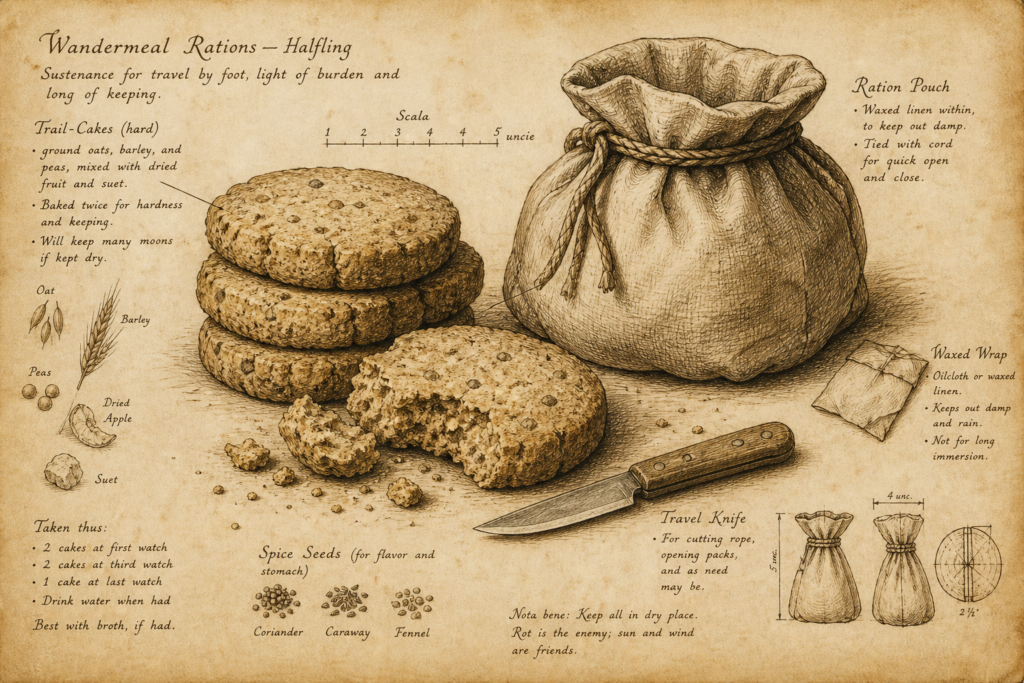
Wandermeal is a dense, spice-laced ration cake made from flour, water, and a halfling road recipe older than many caravan routes. It keeps for months when stored dry, survives rough travel, and fills the belly better than its plain ingredients suggest.
It is not a luxury. It is the food packed when delay, bad weather, closed roads, or hostile country might leave a traveller with nothing else.
Halfling caravans, messengers, scouts, pilgrims, river traders, and poor soldiers value wandermeal because it remains edible after softer bread, fruit, cheese, and cooked provisions have failed. A pouch of wandermeal can carry someone across empty miles, through rain-swollen roads, or through country where a cooking fire would be foolish.
Its virtue is endurance. Its danger is dependence.
Physical Description
Wandermeal Rations are pressed into flat, palm-sized cakes, hard enough to rap against wood. The surface is dry, cracked, and usually dusted with flour, salt, or spice. Better cakes smell faintly of toasted grain, pepper, cumin, fennel, or dried herbs.
When broken, wandermeal snaps rather than crumbles. Travellers commonly soften it in water, broth, ale, thin stew, or melted snow. Eaten dry, it is slow, thirsty work.
Why This Item Matters
Wandermeal Rations extend survival without solving hunger completely. That makes it useful in play: it lets characters push farther while placing a quiet clock on long journeys, sieges, shipwrecks, lost expeditions, and forced marches.
It should feel practical, clever, and slightly grim—not magical, heroic, or comfortably nourishing.
Edition Tabs
Wandermeal Rations 5.5e / 2024
Wandermeal Rations, Pathfinder 1e / 3.5e
Wandermeal Rations 5.5e / 2024
Rations, Wandermeal (1 day)
Cost: 3 sp
Weight: 1 lb
Effect: Wandermeal functions as standard rations and keeps for months if stored dry.
If a creature eats wandermeal as its only meaningful food for more than 7 consecutive days, it must make a Constitution saving throw at the end of each additional day.
Save DC: 15 + 1 for each day beyond the first week.
On a failed save, the creature gains the Poisoned condition until it completes a long rest after eating a proper meal containing varied nourishment.
A proper meal resets the consecutive-day count.
Wandermeal Rations, Pathfinder 1e / 3.5e
Rations, Wandermeal (1 day)
Cost: 3 sp
Weight: 1 lb
Effect: Wandermeal functions as trail rations and keeps for months if stored dry.
If a creature eats wandermeal as its only meaningful food for more than 7 consecutive days, it must make a daily Fortitude save at the end of each additional day.
Save DC: 15 + 1 for each day beyond the first week.
On a failed save, the creature is sickened. The sickened condition ends 1 day after the creature eats a proper meal containing varied nourishment.
A proper meal resets the consecutive-day count.
Original Source : Pathfinder Companion: Adventurer’s Armory
Use in Play
Wandermeal Rations belongs in expeditions where food is a real pressure.
It is ideal for scouts avoiding campfires, couriers riding hard, caravans crossing bad country, soldiers on thin supply, and adventurers trapped underground, snowbound, shipwrecked, or cut off from foraging.
A few days of wandermeal should not matter. The item becomes interesting only when the party starts asking whether they can survive another week on it.
Failure, Risk, and Misuse
Wandermeal sickness is not poison. It is the body failing on a diet too narrow to sustain it properly.
The eater becomes sour-stomached, weak, irritable, and unfocused. The belly is filled, but the body is not truly fed.
That is the point of the item: it buys time, not safety.
Value in the World
Wandermeal is prized by halfling caravan families, road wardens, drovers, smugglers, military quartermasters, and anyone who has learned not to trust the next village, ferry, inn, or harvest.
In good times, it is emergency stock. In bad times, it becomes more valuable than coin.
A hungry settlement may trade generously for a crate of wandermeal, but no wise healer lets the old, young, sick, or wounded live on it for long.
Trade, Craft, and Common Variants
Most wandermeal variants differ by recipe, storage, and regional preference. They should not become stronger rules versions.
Caravan Bake: The standard halfling road cake. Hard, plain, reliable, and made to survive months in a pack.
Spiced Wandermeal: Made with stronger pepper, cumin, fennel, coriander, or dried herbs. Easier to endure after several days, but no more nourishing.
Sea-Dry Wandermeal: Baked especially hard for damp holds, riverboats, marsh roads, and coastal travel. It keeps well when wrapped properly, but is nearly inedible unless soaked.
These variants use the same mechanics unless the campaign tracks food quality closely.
Adventure and Worldbuilding Hooks
The Last Good Crate:
A snowbound village has enough wandermeal to stay alive for another week, but not enough proper food to recover from it. The reeve must decide who gets the last varied provisions: children, the sick, the watch, or the travellers who might still reach help.
The Bitter Road:
A halfling caravan crosses a dead pass that should have killed them. They arrive alive, sick, and unwilling to open one sealed wagon. Their stores show they had enough wandermeal. What they lacked was anything else.
Spoiled by Design:
A shipment of wandermeal sent to a border fort has been cut with a cheap filler. It still fills the belly, but the sickness comes days early. Someone wants the garrison weak when the attack begins.
Historical Context
Wandermeal is fantasy equipment, but it reflects a long tradition of hard travel rations such as ship’s biscuit (also called hardtack). These were simple mixtures of flour, water, and sometimes salt, baked hard and dried to survive long journeys without spoiling. Medieval and early modern travellers, soldiers, and sailors relied on such food because it could endure months of storage and rough transport, though it was often so hard it had to be soaked before eating. For a historical example of how such rations were used and prepared, see the Royal Museums Greenwich article on ship’s biscuit.
Keep this reference growing
If this page helped with your reading or game, you can support its upkeep or explore the curated books.
Explore the Bookshop — epics, classics and stories behind imagined worlds.