
Helmet Candle – Hands-Free Light
Helmet Candle – Hands-Free Light
A cheap candle fixed to a helmet fitting keeps both hands free, but turns the wearer into a walking target in the dark.
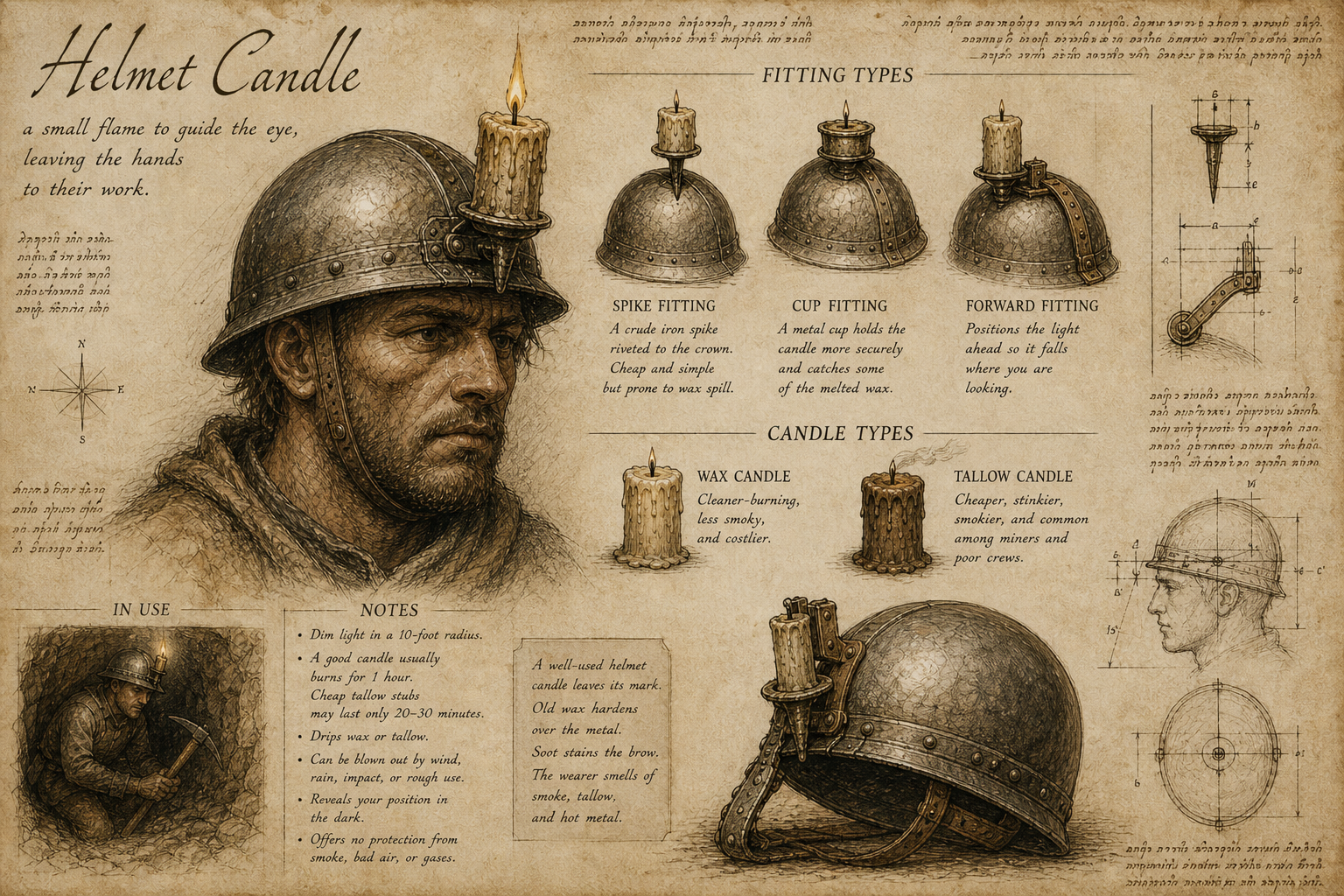
Overview
A helmet candle is not a lantern strapped to armour. It is poor, practical darkness gear: enough light to work by, not enough light to feel safe.
Used by miners, sappers, sewer workers, night guards, and poorly equipped delvers, it consists of a short candle fixed onto a spike, socket, or small metal cup attached to a helmet. It burns weakly, drips wax or tallow, smokes in close air, and makes the wearer easy to see.
Its value is simple: the wearer can climb, dig, carry tools, hold a shield, or keep a weapon ready without holding a torch.
Physical Description
The simplest version is a candle pushed onto a short iron spike riveted to the crown or brow of a helmet. Better versions use a shallow cup or clamp to hold the candle more securely and catch some of the melting wax.
A well-used helmet candle leaves its mark. Old wax hardens over the helmet rim. Soot stains the brow. The wearer smells of smoke, tallow, and hot metal.
Why This Item Matters
A helmet candle solves one problem while creating another.
It frees the hands, but sacrifices stealth. It gives enough light to see the next step, the next rung, or the next face in a tunnel — while advertising exactly where the wearer is.
Helmet Candle 5.5e / 2024 Version
Helmet Candle, Pathfinder 1e
Helmet Candle 5.5e / 2024 Version
Adventuring Gear
Cost: 2–5 cp for a crude spike fitting; up to 1 sp from a town smith; 5 sp–1 gp for a better cup or forward fitting
Weight: +1 lb to the helmet
Candle Cost: 1 cp each
Effect:
While lit, a helmet candle sheds dim light in a 10-foot radius. The wearer keeps both hands free.
Lighting, replacing, or securing a candle requires an action. Strong wind, heavy rain, falling, being knocked prone, or taking a hard blow may extinguish the flame. A DC 10 Dexterity saving throw is a fair baseline when the flame is at risk.
A good candle usually burns for 1 hour. Cheap tallow stubs may last only 20–30 minutes.
Visibility: In darkness, a lit helmet candle reveals the wearer’s position. Creatures that can see the light can usually target or track the wearer even if they cannot see details beyond the light’s radius.
A helmet candle does not protect the wearer from smoke, bad air, firedamp, or underground gases.
Helmet Candle, Pathfinder 1e
Adventuring Gear
Cost: 2–5 cp for a crude spike fitting; up to 1 sp from a town smith; 5 sp–1 gp for a better cup or forward fitting
Weight: +1 lb
Candle Cost: 1 cp each
Effect:
A lit helmet candle provides shadowy illumination in a 10-foot radius and leaves the wearer’s hands free.
Lighting or replacing the candle is a standard action. In strong wind, rain, violent movement, or combat disruption, the GM may require a DC 10 Reflex save to keep the candle lit.
A good candle usually burns for 1 hour. Cheap tallow stubs may last only 20–30 minutes.
Visibility: In darkness, a lit helmet candle reveals the wearer’s position. Creatures that can see the light can usually target or track the wearer even if they cannot see details beyond the light’s radius.
A helmet candle does not protect the wearer from smoke, bad air, firedamp, or underground gases.
Original Source: Pathfinder Companion, Adventurer’s Armory
Use in Play
The helmet candle is useful when the party needs light but cannot spare a hand.
It helps while climbing ladders, digging through rubble, fighting with shield and weapon, carrying stretchers, hauling rope, working locks, or moving through mines and drains.
Its weakness matters just as much. In darkness, the wearer is usually the first person seen.
Failure, Risk, and Misuse
A helmet candle fails in simple, ugly ways.
Wax or tallow may drip into the wearer’s eyes or onto equipment. Smoke can reveal movement in still air. The flame may gutter out during a climb, crawl, fall, or melee. In cramped spaces, the candle can brush against hanging cloth, dry straw, cobwebs, or powder.
It should never feel as safe as a lantern. It is a compromise.
Value in the World
Helmet candles are common among people who work underground or in darkness and cannot afford better equipment. They are associated with labour, siege work, poverty, and necessity rather than status.
A noble might use one in an emergency. A miner owns one because darkness is part of the job.
Trade, Craft, and Common Variants
Most helmet candles differ by fitting, not by rules.
Spike Fitting: A crude iron spike fixed to the helmet. Cheap, easy to replace, and prone to wax spill. Typical Cost: 2–5 cp if done as a rough field or workshop job; up to 1 sp in a town smithy.
Cup Fitting: A small metal cup or socket holds the candle base more securely and catches some melted wax. Typical Cost: 5 sp–1 gp depending on quality.
Forward Fitting: Mounted on the brow or front crown so the light falls where the wearer is looking. Typical Cost: usually included with better-made cup fittings; otherwise +2–5 sp over a basic spike.
- Wax Candle: Cleaner-burning, less smoky, and more suitable for wealthier users.
- Tallow Candle: Cheaper, stinkier, smokier, and common among miners, sappers, labourers, and poor crews.
These variants use the same rules unless the campaign tracks equipment quality closely.
Adventure and Worldbuilding Hooks
The Wrong Light:
A rescue party sees a helmet candle moving deep inside a collapsed mine. The owner was buried three days ago, and the flame is heading away from the blocked shaft, not toward it.
The Sapper’s Mark:
A breached castle wall is found with fresh candle wax on the stones beneath it. No torch marks, no footprints, and no fallen tools remain — only the sign that someone worked there hands-free in the dark.
The Tax on Flame:
A city begins charging miners and sewer workers for every candle used underground. The guilds call it theft; the magistrates call it fire control. When the first unpaid crew goes missing below the streets, both sides need outsiders.
Historical Context
The helmet candle is a fantasy solution to a real problem: how to work in darkness while keeping both hands free. In medieval mines and tunnels, workers typically used tallow candles or small oil lamps, placing them in cracks in the rock, on ledges, or in simple holders rather than carrying them.
These lights were cheap, smoky, and short-lived, but effective enough for close work. For general background on the materials and use of candles in pre-modern settings, see the Encyclopaedia Britannica article on candles.
Keep this reference growing
If this page helped with your reading or game, you can support its upkeep or explore the curated books.
Explore the Bookshop — epics, classics and stories behind imagined worlds.