
Tribal Standard | War Banner Rules
Tribal Standard | War Banner Rules
A tribal standard is a war-flag, oath-marker, and portable symbol of shared identity, carried into danger so warriors can see what they are fighting beneath.
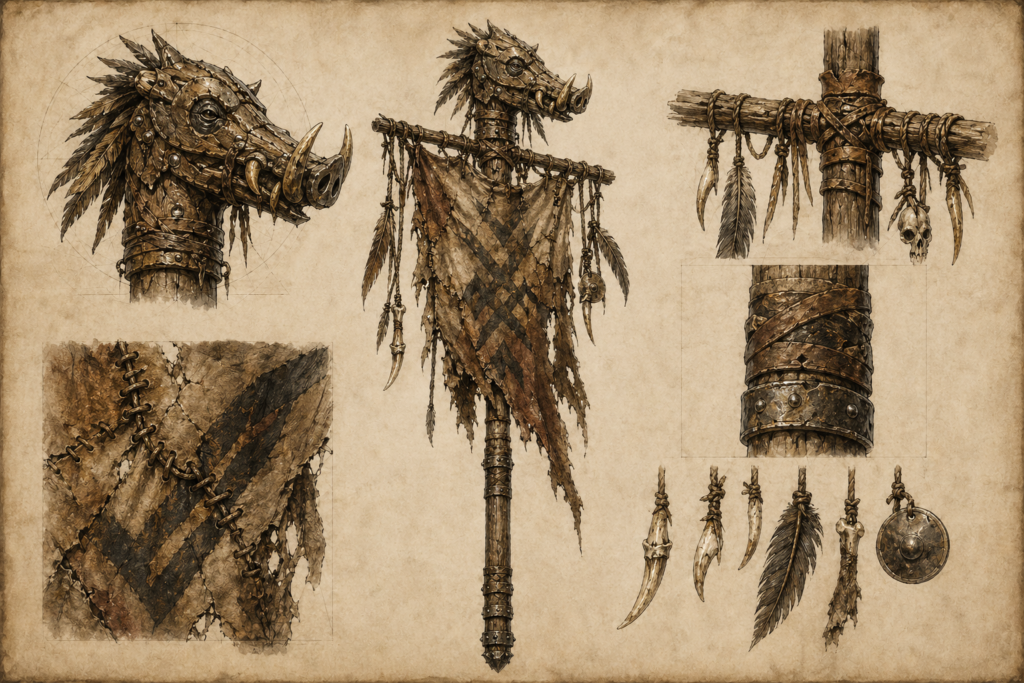
Overview
A Tribal Standard is the visible heart of a tribe, clan, or warband. It may be a hide banner, dyed cloth, trophy-pole, carved clan sign, bone-hung spear, or towering flag marked with the colours and victories of its people.
Its power is public. Warriors look for it through smoke, dust, rain, and fear. While it stands, the tribe has not broken. If it falls, the meaning is immediate: the enemy has struck not only a bearer, but the honour and courage of the whole host.
Physical Description
A Tribal Standard is usually mounted on a sturdy 15-foot pole. It is too large to be a personal pennant and too important to be ordinary decoration.
The pole may be ash, oak, black pine, bone-reinforced timber, or iron-shod wood. The banner itself might be stitched from hide, wool, linen, scaled leather, monster-skin, or layered trophies. Its finial often carries the group’s most sacred or feared sign: a carved beast-head, clenched fist, broken crown, boar tusk, wolf jaw, ancestral skull, iron moon, or clan totem.
A proper standard is built to be seen. It rises over shield walls, marks the centre of a warband, and gives scattered warriors something to rally toward.
Edition Tabs
Tribal Standard 5.5e / 2024
Tribal Standard, Pathfinder 1e / 3.5e
Tribal Standard 5.5e / 2024
Adventuring Gear, War Standard
Loot Value 50 gp
Weight 10 lb.
Pole Length 15 feet
Hands Required One hand to carry; two hands may be needed to raise, recover, or brace it in difficult conditions
A Tribal Standard represents a specific tribe, clan, warband, or sworn kin-group. When carried openly by a member of that group, it steadies those who fight beneath it.
While a creature belonging to the represented group is within 60 feet of the standard and can see it, that creature gains a +1 bonus to saving throws against being frightened.
The standard must be carried in one hand by a member of the represented group. It provides no benefit if it is merely displayed, hung from a wall, planted unattended, carried as loot, or borne by someone outside the group.
If the standard is brought low, defiled, destroyed, or captured, members of the represented group take a –1 penalty to attack rolls and a –1 penalty to saving throws against being frightened for 1 hour.
The penalty ends early if the group reclaims a captured standard and it is again carried openly by one of its members.
Running the Standard at the Table
A standard is “brought low” when its symbolic defeat is obvious to the people it represents. Do not apply the penalty just because the bearer ducks under a doorway, lowers it briefly to pass through a gate, or sets it down respectfully in camp.
Good triggers include:
The bearer is slain and the standard falls in mud, blood, or open view.
An enemy deliberately tears, burns, tramples, or fouls the banner.
The standard is seized and visibly carried away.
The pole is broken in battle and the banner collapses.
The standard is displayed upside down, mocked, or used as a trophy.
The key question is: did the group see its honour fall?
Tribal Standard, Pathfinder 1e / 3.5e
Loot Value 50 gp
Weight 10 lb.
Category Adventuring Gear
Source Advanced Race Guide
A Tribal Standard is mounted on a sturdy 15-foot pole and bears the colours, signs, trophies, and oath-marks of a specific tribe.
As long as members of the represented tribe are within 60 feet of the standard and can see it, they gain a +1 morale bonus on saving throws against fear effects.
The standard must be carried in one hand by a member of the tribe to have any effect. It provides no bonus if it is hung on a wall, draped over a throne, planted unattended, stored in a wagon, or carried by someone outside the tribe.
If the standard is brought low, defiled, destroyed, or captured, members of the tribe take a –1 penalty on attack rolls and a –1 penalty on saving throws against fear effects for 1 hour.
Examples of being brought low include the bearer dropping it in mud, the pole being snapped, the banner being trampled, the cloth being deliberately fouled, or an enemy seizing it as a trophy.
If the tribe reclaims a captured standard, the penalties end immediately and the standard’s normal bonus is restored, provided it is again being carried by a member of the tribe.
How a Tribal Standard Is Used
A Tribal Standard gives a battle a visible centre.
Warriors rally beneath a wolf-jaw banner daubed in red ochre. A hill clan follows a raven-marked pole hung with iron bells. A raiding host forms around a hide standard as arrows fall. A defeated tribe risks everything to recover a captured banner before the enemy can parade it through the gates.
The item works best when the standard is part of the encounter. Put it on the battlefield. Give it a bearer. Let enemies notice it. Let archers shoot at it. Let champions try to seize it. Let player characters decide whether to protect, capture, ransom, return, or defile it.
A Tribal Standard should create decisions, not just modifiers.
Failure, Risk, and Misuse
A Tribal Standard is useful because it is visible. That also makes it vulnerable.
The standard bearer may become a priority target. The pole is awkward in tunnels, dense woods, narrow streets, siege ladders, ship decks, broken ruins, and low-roofed halls. Strong wind, mud, crowded melee, mounted charges, and collapsing terrain can all make carrying the standard difficult.
The standard should not work from a backpack, wagon, storage chest, or folded bundle. If it is wrapped, hidden, dragged, or carried without recognition, it provides no benefit. Its power comes from being seen and trusted.
A captured standard is not just lost equipment. It is leverage. Enemies may ransom it, hang it upside down, display it above a gate, nail it to a shield, burn it before prisoners, or use it to provoke a reckless counterattack.
Trade, Craft, and Value
A Tribal Standard is not normally bought or sold. It is made by the tribe, clan, warband, or sworn host it represents, using materials that matter to that people: dyed hide, woven cloth, carved timber, bronze plates, feathers, oath-knots, bones, teeth, old spearheads, battle honours, sacred marks, or relics of former chiefs.
The listed loot value represents its material value if taken as spoils, not its true worth to the tribe. To enemies, a captured Tribal Standard may be a trophy, ransom piece, bargaining counter, insult, or proof of victory. To the tribe, it may be an ancestral trust, war relic, sacred sign, symbol of rightful command, and public proof that the people still stand together.
Possessing another tribe’s standard is dangerous. Displaying it, selling it, defiling it, or refusing to return it can provoke raids, blood feud, hostage-taking, formal challenge, or open war. Returning a captured standard, especially with honour, may end a feud or create a debt that no coin could buy.
A stranger cannot make the standard work by carrying it. Its power comes from recognition, belonging, and public meaning. It inspires only those who know it as their own.
Craft and Common Forms
A Tribal Standard is built according to the tribe’s materials, customs, victories, losses, and sacred history. It is not a commercial product.
One standard may be a hide banner painted with a wolf-jaw mark. Another may be a pole hung with oath-knots, feathers, bronze plates, enemy teeth, old spearheads, or the hair-braids of former chiefs. A coastal tribe might bind shells, shark teeth, salt-stained cloth, and carved driftwood to the pole. A mountain clan might use black wool, horn, iron rings, and weather-darkened timber.
The construction should suit its purpose. A battle-carried standard needs a strong pole, secure fastenings, visible markings, and cloth or hide tough enough to survive rain, wind, smoke, mud, and rough handling. Some standards are richly worked and heavy with relics, making them better suited to ritual display than fast movement. Others are plain, repaired many times, and clearly built to survive the road.
These differences should rarely change the rules. They exist to show who made the standard, what the tribe values, and why losing it matters.
Using a Tribal Standard in Your Game
Use a Tribal Standard when morale should have a physical object on the battlefield.
The standard gives both sides something to fight over. The bearer is no longer just another enemy. The banner is a target, a prize, a rallying point, and a possible turning point.
It works especially well in encounters involving orcs, goblinoids, giants, beastfolk, raiding clans, hill tribes, nomadic warbands, oath-bound companies, and other groups whose identity is carried openly into battle. It can also give a fight a clear objective beyond killing every enemy.
Good uses include:
Protecting a standard during a retreat.
Capturing a standard to break enemy morale.
Returning a standard to win peace or favour.
Defiling a hated standard to provoke war.
Using a false standard to frame another group.
Recovering a fallen standard before the enemy claims it.
Adventure and Worldbuilding Hooks
- The Captured Standard: A tribe refuses negotiation while its ancestral standard hangs above a rival chief’s hall. Recovering it may prevent a massacre, but the rival tribe claims it was won fairly in battle.
- The False Banner: Raiders attack under the standard of a neighbouring clan, hoping to provoke a blood feud. The stitching is wrong, the trophies are too new, and the pole was cut from the wrong forest.
- The Standard Bearer’s Oath: A dying warrior refuses to retreat until the fallen standard is raised again. The party must decide whether to save the bearer, seize the banner, or use the moment to break the enemy line.
Historical Context
Tribal Standard is a fantasy equipment item, but it draws on a rougher battlefield tradition than formal heraldry. Tribal war-signs did not need to be neat cloth banners. They could be poles, animal emblems, trophy markers, sacred objects, carved signs, hide banners, or metal symbols carried where warriors could see them.
For a tribe or warband, such a standard is not decoration. It is the public body of the group’s courage, ancestry, victories, griefs, and honour. Its bearer stands where the fighting is thick because the standard must be seen. If it falls, is seized, or is fouled, the loss is not private. Everyone knows the tribe’s sign has been brought low.
This makes the Tribal Standard closer to a war-sign, trophy pole, or sacred battle emblem than a heraldic flag. Its meaning comes from recognition and possession. The tribe fights harder while it stands, and may raid, ransom, bargain, or go to war to recover it if enemies take it as a trophy.
For a useful historical parallel, see Pre-Construct Archaeology’s article on The Norfolk Boar Standard, which discusses an Iron Age boar-headed standard mounted high on a pole as a visible battlefield or crowd focal point associated with strength, protection, ferocity, and group identity.
Keep this reference growing
If this page helped with your reading or game, you can support its upkeep or explore the curated books.
Explore the Bookshop — epics, classics and stories behind imagined worlds.