
Shifting Paint | Alchemical Hidden Message
A reactive alchemical pigment that reveals different images under changing light, shadow, warmth, or cold.
Overview
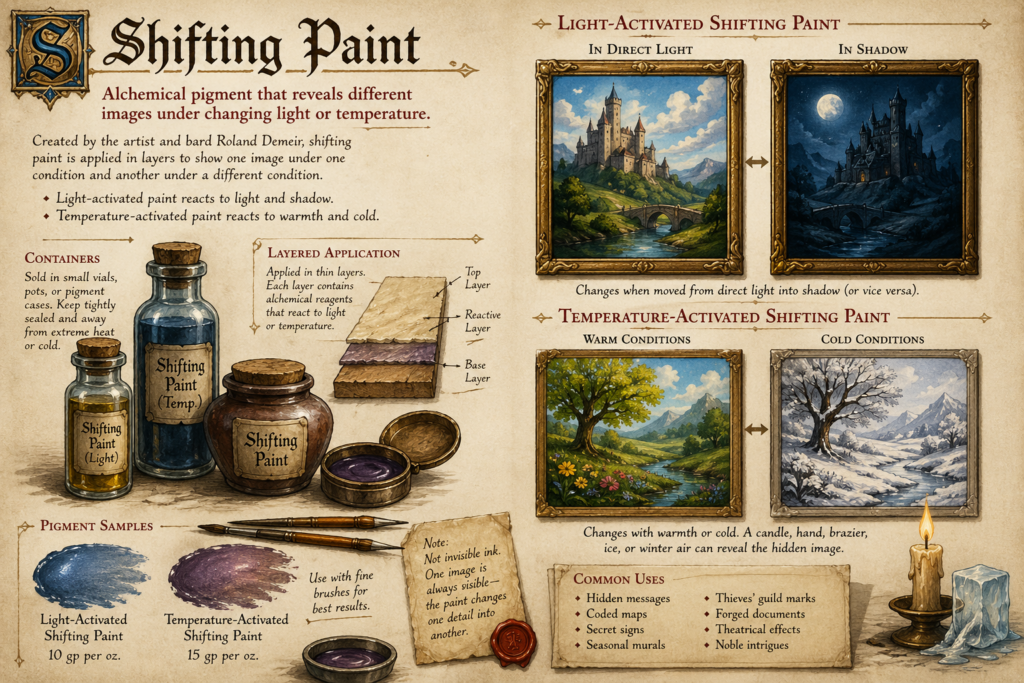
Shifting Paint is an alchemical artist’s pigment that changes its visible appearance when exposed to a specific environmental trigger. A painted surface may show one image in direct light and another in shadow, or one version in warmth and another in cold.
Unlike invisible ink, Shifting Paint does not usually make a surface blank. It changes one visible detail into another. A hidden message must therefore be disguised inside an ordinary image, pattern, border, map, sign, or decorative surface.
This makes Shifting Paint valuable to artists, spies, nobles, temples, thieves’ guilds, mapmakers, stage performers, and adventurers. It can turn a portrait into a confession, a landscape into a map, a guild sign into a warning, or a decorative border into a hidden route.
Physical Description
Shifting Paint is sold in small sealed glass vials, ceramic pots, wax-stoppered tubes, or shellacked pigment cases. When wet, it resembles high-quality artist’s paint with a faint metallic or pearlescent sheen. Once dry, the alchemical effect is usually subtle until the proper trigger is applied.
There are two common varieties.
Light-Activated Shifting Paint: Changes appearance depending on whether the painted surface is exposed to direct light or shadow.
Temperature-Activated Shifting Paint: Changes appearance depending on warmth or cold in the surrounding air or surface.
A finished work made with Shifting Paint often appears ordinary at first glance. Careful inspection, deliberate testing, or accidental exposure to the right condition may reveal the second image.
Why This Item Matters
Shifting Paint turns decoration into information.
It is less secure than magical message systems because its triggers are common. A lantern, shutter, candle, brazier, cold wind, warm hand, or bowl of ice may be enough to reveal the hidden state. That weakness is also what makes the item useful in play. Players can discover its secrets through observation, experimentation, and environmental problem-solving rather than relying only on spellcasting.
Used well, Shifting Paint rewards curiosity. It makes lighting, temperature, paintings, maps, signs, and rooms matter.
Edition Tabs
Shifting Paint 5.5e / 2024
Shifting Paint, Pathfinder 1e / 3.5e
Shifting Paint 3.0
Shifting Paint 5.5e / 2024
Adventuring Gear, Alchemical Pigment
Cost: 10 gp per ounce for light-activated paint; 15 gp per ounce for temperature-activated paint
Weight: Negligible per ounce
Use: Painting, marking, coded art, hidden signs, altered maps, theatrical effects
Application: One ounce covers a small detailed image, a handful of symbols, a map detail, a signboard mark, or about 1 square foot of simple painted surface at the DM’s discretion.
Shifting Paint is an alchemical pigment that changes visible details when exposed to a specific environmental trigger.
When applied by a creature proficient with Painter’s Supplies, Calligrapher’s Supplies, Alchemist’s Supplies, or another appropriate tool chosen by the DM, the paint can create a two-state image. One version appears under ordinary conditions, while the second appears when the proper trigger is present.
Varieties
| Type | Cost | Trigger | Common Use |
|---|---|---|---|
| Light-Activated Shifting Paint | 10 gp per oz. | Direct light or shadow | Day/night scenes, hidden symbols, coded wall art |
| Temperature-Activated Shifting Paint | 15 gp per oz. | Warmth or cold | Seasonal images, warning marks, heat-revealed messages |
Creating a Shifting Image
A creature applying Shifting Paint makes an ability check using an appropriate tool proficiency. Intelligence or Dexterity is usually appropriate.
| Task | Suggested DC |
|---|---|
| Simple changing symbol or mark | DC 10 |
| Clear two-state decorative image | DC 13 |
| Subtle hidden message or concealed object | DC 15 |
| Complex layered artwork, map, or coded scene | DC 18 |
On a success, the shifting image works as intended. On a failure, the two layers are misaligned, blurred, obvious, incomplete, or unreliable. A failed attempt may still produce a usable but flawed image at the DM’s discretion.
Discovering Shifting Paint
A creature examining a painted surface can suspect the presence of Shifting Paint with a successful Intelligence (Investigation) or Wisdom (Perception) check.
| Clue | Suggested DC |
|---|---|
| Obvious shimmer, odd brushwork, or mismatched surface | DC 10 |
| Professional but detectable layered pigment | DC 15 |
| Expertly hidden shifting detail | DC 18 |
| Masterwork concealed message | DC 20 |
A creature proficient with Painter’s Supplies or Alchemist’s Supplies has advantage on the check if it can closely inspect the surface.
Revealing the Hidden Image
The hidden state is usually revealed automatically if the correct trigger is applied.
Light-activated paint may change when the surface is moved from direct light into shadow, exposed to bright lantern light, covered with a cloth, revealed under moonlight, or placed in a sharply different lighting condition.
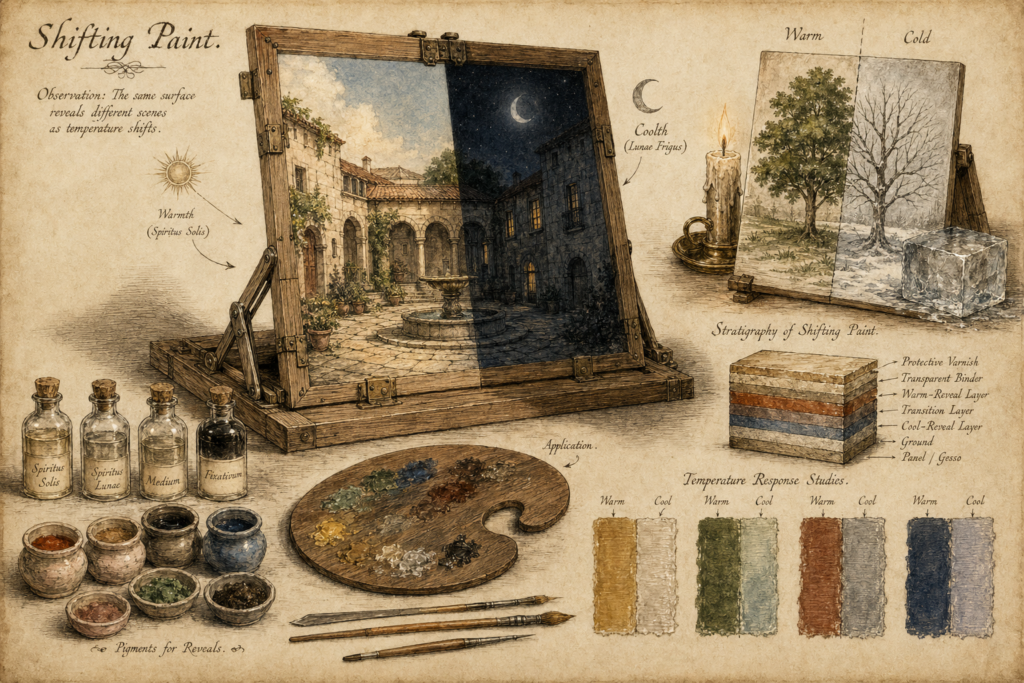
Temperature-activated paint may change when warmed by a candle, brazier, hand, heated stone, sunlight, or spell effect, or when chilled by ice, winter air, cold water, or magical cold.
The DM decides how strong the condition must be. A small symbol may respond to candlelight or a warm hand, while a large mural may require broader illumination, stronger heat, or sustained cold.
Limits
Shifting Paint is not invisible ink. It changes one visible detail into another rather than making a blank surface appear.
Shifting Paint does not create motion, sound, illusion, magical disguise, or independent animation.
Shifting Paint does not protect a message from anyone who discovers or guesses the trigger.
The paint can be scraped, washed, burned, painted over, or chemically damaged like other fine pigments, though doing so may also damage the object beneath it.
Shifting Paint, Pathfinder 1e / 3.5e
Adventuring Gear, Alchemical Item
Cost: 10 gp per oz. light-activated; 15 gp per oz. temperature-activated
Weight: —
Craft: Craft (alchemy) or Craft (painting)
Shifting Paint is an alchemical pigment that reveals different painted details under different environmental conditions. It is normally applied in layers, allowing one image to appear under one condition and a second image to appear under another.
Light-Activated Shifting Paint
Light-activated Shifting Paint changes depending on whether the painted surface is exposed to direct light or shadow. It is often used to create a day and night version of the same image, reveal an emblem under torchlight, or hide a detail that appears only when the painting is covered or placed in darkness.
Cost: 10 gp per ounce.
Temperature-Activated Shifting Paint
Temperature-activated Shifting Paint changes depending on warmth or cold. It is often used to show seasonal changes, heat-revealed warnings, cold-revealed symbols, or subtle details that appear when a room is warmed or chilled.
Cost: 15 gp per ounce.
Applying Shifting Paint
Applying Shifting Paint to create a functional two-state image requires a Craft check.
| Task | Craft DC |
|---|---|
| Simple mark, sign, or symbol | DC 10 |
| Clear two-state painting | DC 15 |
| Concealed message or subtle hidden object | DC 20 |
| Complex map, coded mural, or masterwork scene | DC 25 |
A failed check wastes half the paint used and produces an imperfect result. The image may blur, reveal both layers at once, shift unevenly, or fail to conceal the intended detail.
Detecting Shifting Paint
A character inspecting a painted surface may notice the alchemical layering with a successful Perception check. A character with ranks in Craft (alchemy), Craft (painting), or Profession (artist) may use that skill instead.
| Condition | DC |
|---|---|
| Crude or obvious application | DC 10 |
| Professional application | DC 15 |
| Subtle concealed message | DC 20 |
| Masterwork hidden detail | DC 25 |
Applying the correct trigger usually reveals the hidden state automatically.
Game Use
Shifting Paint is useful for hidden messages, coded maps, secret signs, temple warnings, noble intrigues, stage effects, and puzzle objects. It is not secure against careful investigation because its triggers are common and easily reproduced.
Shifting Paint 3.0
Ultimate Equipment Guide II
Author Greg Lynch, J. C. Alvarez
Publisher Mongoose Publishing
Publish date 2005
Shifting paint is another alchemical creation of Roland Demeir, the famed artist and bard. It shares some properties with harmonic paint, but was not specifically designed to carry and convey a hidden message. Shifting paint is intended to be applied in layers, and comes in two varieties, one of which reacts to light while the other reacts to temperature. Using the light-reacting paint, an artist paints two separate scenes on the same canvas, one of which is visible when the painting is exposed to direct light, the other becoming visible when the painting is placed in shadow. Most often, it is used to create a day and a night scene of the same subject.
Shifting paint that reacts to temperature, on the other hand, responds to the ambient temperature in the room and is often used to paint the same scene in different seasons of the year, showing the leaves on a tree change or snow piling up in the winter scene where wildflowers bloomed in the summer scene. Such changes can be forced by placing a source of heat or cold near the painting.
Shifting paint is sometimes used to convey a hidden message, but it is far less secure than harmonic paint, which requires a specific musical note as its trigger to change. Those using shifting paint to carry a message will often make the message very subtle, such as an object appearing the background of the subject in one scene where it does not exist in the other scenes.
Shifting Paint (light-activated): 10 gp per oz.
Shifting Paint (temperature-activated): 15 gp per oz.
How Shifting Paint Is Used
Artists use Shifting Paint to create works that reward a second look. A landscape may become the same valley in winter. A castle painted beneath a bright sky may become a moonlit ruin. A noble portrait may show a crown in daylight and a dagger in shadow.
Spies and criminals use Shifting Paint for hidden signals. A painted flower may gain a single red petal when chilled. A harmless hunting scene may reveal a meeting place under direct lantern light. A guild mark may appear only when the room is dark.
Adventurers use it for marked routes, false maps, treasure clues, warnings, and identification signs. A dungeon wall painted with faded vines might reveal a skull when exposed to torchlight. A shield device may show its true allegiance only in winter cold.
Failure, Risk, and Misuse
Shifting Paint is fragile security. Its trigger is not private, and anyone who experiments with light, shadow, heat, or cold may discover the hidden state.
The paint can also reveal secrets at the wrong time. A noble family symbol may appear when servants open the shutters. A hidden map may reveal itself beside a hearth. A coded sign may show during a winter storm. A forged artwork may betray itself under inspection.
Poor application creates further problems. The two images may blur together, shift unevenly, or make the hidden detail too obvious.
Value in the World
Shifting Paint sits between art, alchemy, espionage, and theatre.
Nobles commission it for clever portraits, seasonal murals, and hidden family symbols. Temples and cults use it to conceal sacred signs. Thieves’ guilds mark doors and safehouses with it. Scholars use it to compare diagrams. Stage performers use it to create dramatic transformations before an audience.
Because it requires no spellcasting, Shifting Paint is easier to obtain than magical writing, but it is still a specialist material. It is most common in wealthy cities, artistic courts, alchemical workshops, spy networks, and major trade centres. In poorer settlements, even a small vial may attract attention.
Trade, Craft, and Common Variants
- Gallery Paint: Fine pigment used for portraits, murals, devotional panels, and decorative screens.
- Signal Paint: Stronger, simpler paint designed for symbols, arrows, warning marks, and covert signs.
- Mapmaker’s Shifting Paint: Used to mark seasonal routes, hidden roads, flood paths, secret doors, changing borders, or routes visible only under certain conditions.
- Theatrical Shifting Paint: Designed for stage backdrops, masks, props, and performance transformations.
- Forgery-Grade Shifting Paint: Restricted or illegal in some cities because it can alter documents, seals, paintings, heraldic displays, and contracts.
Using Shifting Paint in Your Game
Shifting Paint works best when the players can discover it through play.
Use it when a clue should feel physical, clever, and fair. The trick should be visible in hindsight: a painting placed beside a shuttered window, a map stored near a hearth, a mural in a cold crypt, or a sign that matters only after the lantern is raised.
Good uses include:
A painting that changes when the shutters are closed.
A treasure map that reveals a second route when warmed over a candle.
A noble portrait that displays a hidden sigil only in moonlight.
A temple mural that changes with the season.
A false sign that misleads anyone who reads it under the wrong light.
A coded guild mark that appears only when chilled.
A contract whose hidden clause appears near a fire.
A dungeon clue hidden inside a decorative border.
Shifting Paint is especially useful because it gives non-spellcasters something meaningful to notice. Rogues, artists, investigators, alchemists, courtiers, and cautious adventurers can all interact with it.
Adventure and Worldbuilding Hooks
- The Winter Message: A painting in a warm manor looks harmless, but when carried into the snow it reveals a murder confession.
- The False Heir: A royal portrait displays a different heraldic device in candlelight, suggesting the subject belonged to another bloodline.
- The Thieves’ Gallery: A city’s safehouses are marked with tiny painted birds that only appear in shadow.
- The Changing Map: A coastal chart shows one set of islands in sunlight and another under moonlight.
- The Painted Warning: A dungeon mural reveals a warning only when the party extinguishes its torches.
- The Forged Treaty: A peace agreement contains hidden temperature-reactive clauses that appear when the parchment is warmed.
Keep this reference growing
If this page helped with your reading or game, you can support its upkeep or explore the curated books.
Explore the Bookshop — epics, classics and stories behind imagined worlds.