
Bowling Set — Medieval Ten-Pin Tavern Game and Entertainment Gear
Bowling Set — Medieval Ten-Pin Tavern Game and Entertainment Gear
A Bowling Set is a simple ten-pin game of ball, pins, balance, luck, and uneven ground, used for tavern contests, camp amusements, village fairs, and wagers between bored travellers.
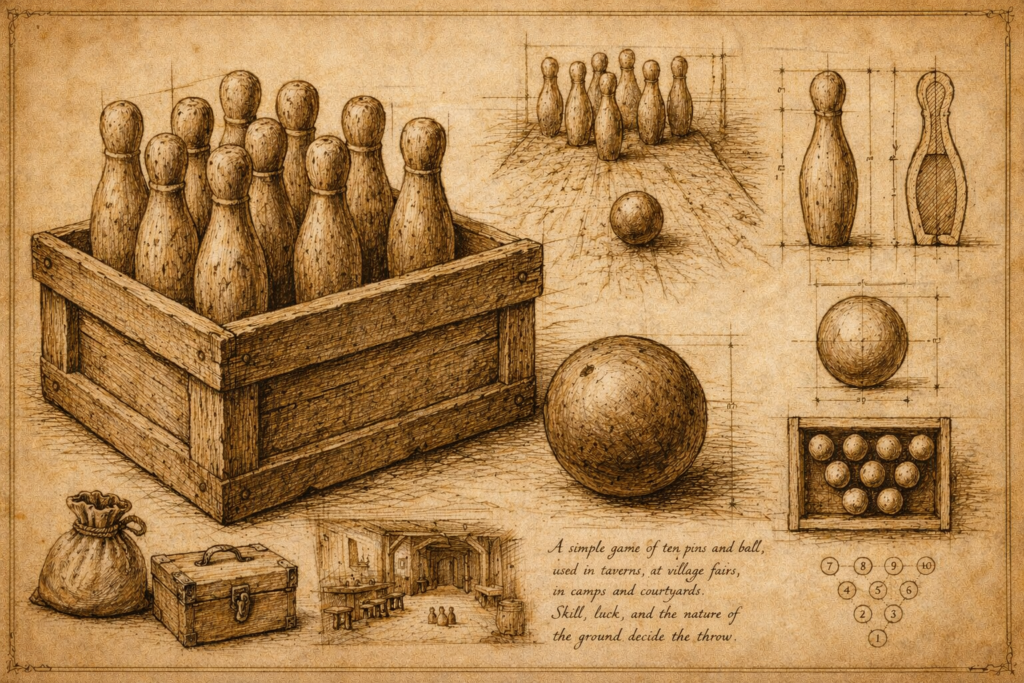
A Bowling Set consists of ten pins and a ball, usually made from wood, bone-weighted wood, shaped stone, or another durable local material. The game is simple: set the pins upright, roll the ball, and see how many fall. In practice, it is rarely so clean. The ball may be slightly uneven, the pins may be chipped, and the playing surface may slope, dip, or catch the roll at the worst possible moment.
This makes a bowling set less a test of strength than a test of touch, patience, and local knowledge. A player who knows the crooked board, sunken tavern floor, or dusty lane beside the stable may outperform a stronger stranger who simply throws hard.
A bowling set is entertainment rather than adventuring gear, but it belongs naturally in inns, barracks, fairs, caravan camps, noble courtyards, ship crews, guild halls, and roadside taverns where people have time, drink, and something to wager.
Description
A bowling set normally includes ten pins, one ball, and a simple carrying sack, crate, or wrapped cloth. Cheap sets are rough, irregular, and loud when dropped onto stone or packed earth. Better sets have matched pins, smoother surfaces, and a ball shaped well enough to roll true on a decent lane.
The pins are usually short, sturdy, and slightly weighted at the base. The ball may be solid wood, shaped stone, or a polished hardwood sphere. In poorer places, the pieces are rarely perfect. That imperfection is part of the game.
Why the Item Matters
A bowling set gives a settlement texture. It turns a tavern from a room with ale into a place where people gather, boast, cheat, laugh, and remember old grudges.
In play, a bowling set creates easy social scenes. Characters can gamble, impress locals, challenge a guard, distract a crowd, settle a minor dispute, or win information from someone who talks more freely after losing three rounds and two cups of ale.
Failure, Risk, and Limitations
A bowling set is not a weapon, even if an angry player may try to use the ball as one. The set is heavy, awkward, and not worth carrying through a dungeon unless the characters have a specific reason.
The game also depends heavily on space. A proper lane needs a long, reasonably clear surface. Indoors, that may mean a tavern hall, stable passage, guild floor, or cellar corridor. Outdoors, packed earth, flat stone, a ship deck, or a courtyard may serve, though wind, mud, slope, and gravel all affect the roll.
Value in the World
Bowling sets are most common where people gather often enough to play: taverns, military camps, guild houses, fairs, and larger villages. A cheap set may be no more than crude pins and a lopsided ball. A fine set may be polished, painted, weighted, and stored in a fitted wooden case.
A travelling entertainer, gambler, or innkeeper may carry a bowling set because it earns money slowly but reliably. One good contest can draw a crowd, loosen purses, and turn strangers into rivals before the night is over.
Trade, Craft, and Common Variants
- Rough Bowling Set, 5 sp: A cheap set with irregular pins and an uneven ball. It is playable, but every throw is partly at the mercy of the surface.
- Common Bowling Set, 2 gp: A practical tavern or camp set with ten serviceable pins and a usable ball.
- Weighted Tavern Bowling Set, 5 gp: A sturdier set made for repeated public use. The pins are better balanced, and the ball rolls more reliably on a prepared floor.
- Fine Bowling Set, 10 gp: A polished and carefully matched set, suitable for a guild hall, wealthy inn, noble household, or professional gambler.
Using a Bowling Set in Your Game
Use a bowling set when you want a scene to feel social, local, and physical. It gives characters something to do while gathering rumours, waiting for a contact, passing time in a barracks, or joining a village feast.
A bowling match can be resolved narratively, by opposed Dexterity checks, by a gaming proficiency check, or by whatever system you use for gambling and tavern contests. Irregular sets, bad floors, drunken players, and local tricks should matter more than perfect sporting rules.
Optional Rules for Using a Bowling Set
A bowling set can be used for tavern games, fairground contests, camp amusements, gambling challenges, or quick social encounters.
- Basic Play: Each player makes three rolls. For each roll, make a Dexterity check to guide the ball.
- Standard Lane: DC 10.
Bad Lane: DC 12–15 if the floor is uneven, muddy, sloped, crowded, poorly lit, or deliberately crooked. - Scoring: On each roll, roll 1d10 for the number of pins knocked down. Add +2 on a successful Dexterity check, or +4 if the check result is 15 or higher. The result cannot exceed 10 pins.
- Winning: Add together the results of all three rolls. The highest total wins.
- Spotting Cheating: A character may attempt a Wisdom or Intelligence check, usually DC 13, to notice a loaded ball, crooked pins, false lane, or sleight of hand. A relevant gaming proficiency, Profession gambler, Perception, Sense Motive, Sleight of Hand, or Deception-style skill may apply depending on the system.
- Gambling Stakes: Typical wagers range from 1 cp to 1 sp in a poor tavern, 1 sp to 1 gp in a busy inn, and much higher in a noble household, guild hall, or gamblers’ den.
- Improvised Weapon: A bowling ball can be used as an improvised weapon at the GM’s discretion, but it is heavy, awkward, and not designed for combat.
Bowling Set 5.5e / 2024
Bowling Set Pathfinder 1e
Bowling Set
Gaming Set / Entertainment Gear
Cost: 5 sp–10 gp
Weight: 15 lb.
A bowling set includes ten pins and one ball. It can be used for tavern games, contests, gambling, and social encounters.
A character proficient with gaming sets may add their proficiency bonus to ability checks made to play, judge, cheat at, or run a bowling game. Dexterity is usually used for careful rolling, Wisdom for judging an uneven lane, Charisma for showmanship or hustling, and Intelligence for spotting tampered pins or loaded balls.
A bowling ball may be used as an improvised weapon at the DM’s discretion, but the set is not designed for combat.
Bowling Set
Source: Adventurer’s Armory / Ultimate Equipment
Price: 5 sp–10 gp
Weight: 15 lb.
Category: Entertainment
This simple ten-pin game is often complicated by irregularities in the ball, the pins, and the playing field.
Adventure and Worldbuilding Hooks
- The Crooked Lane: A tavern’s famous bowling lane always favours locals. The floor is not just uneven; something beneath it shifts when strangers play.
- The Gambler’s Ball: A polished bowling ball is loaded with a hidden weight, and the owner has used it to cheat half the district.
- The Ten Missing Pins: A village fair cannot begin because the ceremonial bowling pins have been stolen. Each pin bears the mark of one old family, and the theft is not as harmless as it looks.
- The Barracks Champion: A bored soldier knows the password the party needs, but will only talk after a fair game, an unfair game, or a bribe disguised as a wager.
For rules and historical context, see Archives of Nethys bowling set rules and Britannica’s overview of ninepins as a medieval European bowling game.
Keep this reference growing
If this page helped with your reading or game, you can support its upkeep or explore the curated books.
Explore the Bookshop — epics, classics and stories behind imagined worlds.