
e Clay Mug or Tankard
Clay Mug or Tankard
A simple clay drinking vessel, the clay mug or tankard is one of the most familiar pieces of household and roadside ware, made for ale, water, broth, and all the ordinary drinks of daily life.
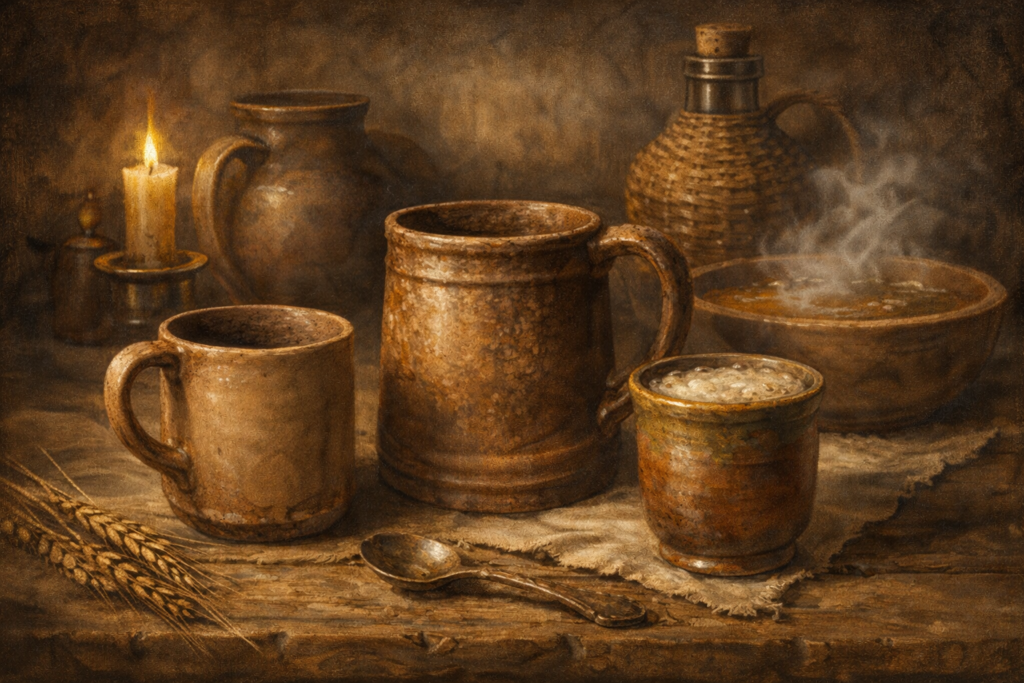
Few objects are more common than a clay cup in the hand, or more quickly missed when the shelf is empty. It sits on tavern tables, household ledges, market stalls, monastery benches, ferrymen’s kits, and campfire stones. It is neither precious nor durable enough to inspire much admiration, yet it is used constantly. A clay mug or tankard belongs to the world of meals, pauses, gossip, thirst, and work done badly without a drink close by.
Overview
The Clay Mug or Tankard is a basic drinking vessel made from fired clay. It is intended for daily use and commonly holds ale, watered wine, cider, broth, milk, or plain water. Some are simple mugs without a lid, while others are broader tankards with a more substantial body or handle, but both serve the same practical purpose: to hold a drink in a form easy to carry, pass, and set down.
It is not fine tableware. It is common ware, meant to be used often, replaced cheaply, and broken without ceremony.
Description
Most examples are made from coarse fired clay, shaped by hand or wheel and baked hard enough for repeated use. Some are plain and rough, with only the slightest lip and a stubby handle. Others are glazed, darkened by smoke, or marked with simple lines, stamped patterns, or the potter’s sign.
A vessel of this sort is heavier than wood and less costly than metal. It holds heat and coolness reasonably well, though it is easily chipped if struck and may crack if treated carelessly. Better-made pieces have smoother lips, thicker firing, and more even walls. Poorer ones feel gritty, uneven, or slightly warped in the hand. A rough-fired mug may feel chalky at the rim and cool against the palm, while a glazed tankard sits smoother and heavier, better suited to repeated tavern use.
In most places, this is the drinking ware of the ordinary table: serviceable, familiar, and never far from replacement.
Why This Item Matters
This item matters because daily life is built from repeated small uses.
Not every object in the world should feel rare, ingenious, or dramatic. Some things matter because they are always there. A clay mug or tankard helps anchor the world in meals, inns, kitchens, watch posts, work camps, and all the places where people stop long enough to drink.
That quiet presence gives it value.
Failure, Breakage, and Use
Clay is useful, but it is never forgiving.
Dropped on stone, it may chip or shatter. Heated too quickly, it may crack. Poor firing leaves weak spots. A vessel carried on the road may survive years of careful use or die in a single careless moment. This is part of its place in the world: it is cheap enough to own, common enough to replace, and fragile enough to remind the user that everyday goods wear out.
A fine metal cup might last a lifetime. A clay one often lasts until the next hard floor.
Value in the World
The clay mug or tankard is nearly universal wherever pottery is made.
It appears in village homes, roadside inns, monasteries, taverns, guardhouses, ferries, kitchens, and camps. In prosperous towns, even humble wares may be neatly glazed or lightly decorated. In poorer places, they are rougher and thicker, valued more for price than beauty. A household may own a shelf of unmatched clay cups accumulated over years, while a tavern keeps stacks of sturdy ones for constant use and frequent loss.
Because it is so common, it also reveals small things about place and class. A neat glazed tankard in a market town says something different from a chipped brown mug in a rural alehouse, though both serve the same purpose. The cup set before a guest often says as much about a household as the drink poured into it.
Trade, Craft, and Common Variants
These vessels are made by potters wherever decent clay and firing are available. The simplest are among the most ordinary products of the kiln. Better ones may be glazed, shaped with cleaner handles, or made with thicker walls to survive harder use. The listed base price reflects a common example; sturdier, glazed, or better-finished pieces usually cost somewhat more.
Tavern pieces are usually thicker, plainer, and made to survive rough handling, while household cups are more likely to show small preferences of shape, glaze, and local taste.
Common variants include:
- plain mugs, simple and cheap
- handled tankards, broader and easier to grip
- glazed drinking cups, better sealed and easier to clean
- tavern ware, thick and made to survive rough handling
- household cups, lighter and more varied in finish
- monastic ware, sturdy, undecorated, and made for repeated communal use
Using It in Your Game
This is the kind of item that helps make a setting feel inhabited.
A drink served in clay feels different from one served in silver. A chipped mug on a windowsill says something about the household. A tavern shelf full of mismatched tankards makes a room feel used, not staged. Small objects like this are often the best way to make travel, rest, conversation, and ordinary places feel real.
Adventure and Worldbuilding Hooks
- A chipped tankard in a roadside inn bears the faded mark of a monastery destroyed years ago.
- A tavern keeper recognises a traveller by the particular way he asks for a drink in clay rather than pewter.
- A messenger arrives carrying a sealed clay mug that holds not ale, but a hidden document inside its false base.
- A poor household’s last unbroken cup becomes an oddly meaningful object during famine or siege.
- A potter’s district is thrown into trouble when bad clay from a riverbank produces a season of cracking wares.
- A tankard passed around a campfire becomes the vessel of an oath, insult, or reconciliation.
Clay Mug or Tankard 5.5
Clay Mug or Tankard, Pathfinder
Clay Mug or Tankard 3.5
Clay Mug or Tankard
Adventuring Gear
Base Cost: 2 cp
Weight: —
Capacity: 1 pint or 1 lb.
A simple drinking vessel made of fired clay, suitable for ale, water, broth, and similar liquids.
It can hold up to 1 pint of liquid or 1 pound of material.
Common Prices
- Plain mug: 1–2 cp
- Handled tankard: 2–3 cp
- Glazed drinking cup: 3–4 cp
- Thick tavern ware: 2–4 cp
- Household cup: 1–3 cp
- Monastic ware: 2–3 cp
Clay Mug or Tankard
Base Price 2 cp; Weight —; Capacity 1 pint or 1 lb.
This simple fired-clay mug or tankard is used for daily drinking.
It can hold up to 1 pint of liquid or 1 pound of contents.
Common Market Prices
- Plain mug: 1–2 cp
- Handled tankard: 2–3 cp
- Glazed drinking cup: 3–4 cp
- Thick tavern ware: 2–4 cp
- Household cup: 1–3 cp
- Monastic ware: 2–3 cp
Clay Mug or Tankard
A clay mug or tankard.
Base Cost: 2 cp
Capacity: 1 pint or 1 lb.
Common Prices
- Plain mug: 1–2 cp
- Handled tankard: 2–3 cp
- Glazed drinking cup: 3–4 cp
- Thick tavern ware: 2–4 cp
- Household cup: 1–3 cp
- Monastic ware: 2–3 cp
Keep this reference growing
If this page helped with your reading or game, you can support its upkeep or explore the curated books.
Explore the Bookshop — epics, classics and stories behind imagined worlds.