
e Belt Pouch
Belt Pouch
A small pouch worn at the belt, this simple container is one of the most ordinary and necessary pieces of everyday equipment, keeping the small things of life close at hand, secure, and ready.
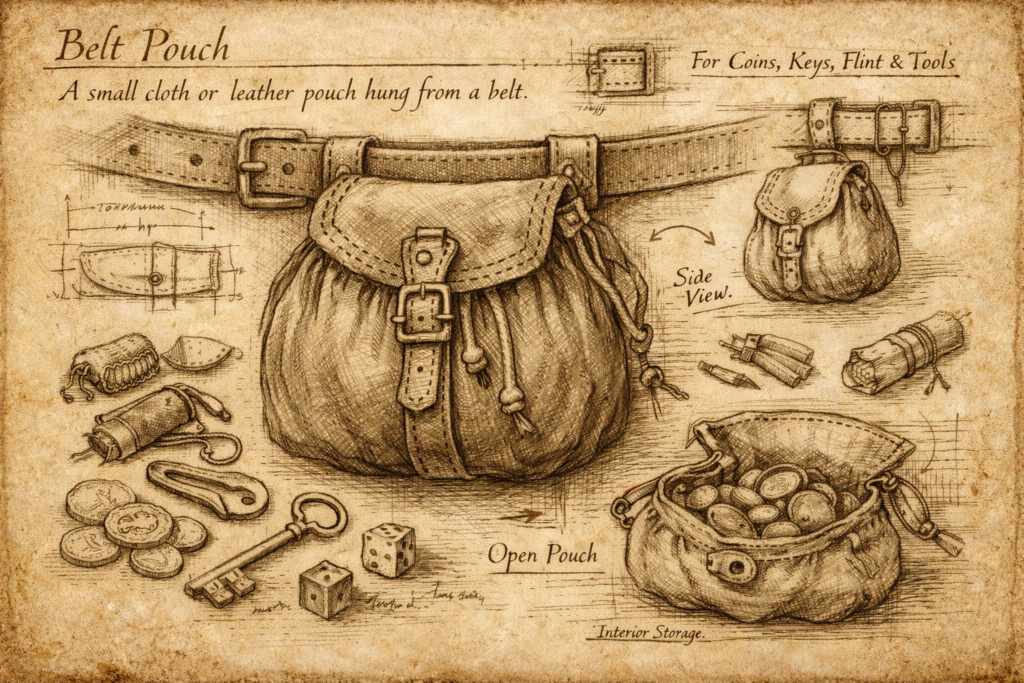
Few items are handled more often and noticed less than this pouch. It carries the coins, keys, wax, hooks, flint, seals, herbs, dice, notes, and scraps that gather around a life in motion. For soldiers, merchants, pilgrims, thieves, labourers, and travellers alike, it matters not because it is rare or ingenious, but because it is constantly useful. A good one saves time, reduces fumbling, and keeps what matters nearest to the body.
Overview
This small personal container is made to hang from a belt, cord, or waist strap. Most are made from soft leather or sturdy cloth, with a flap, tie, thong, toggle, or simple fastening to keep the contents from spilling. It is the sort of item almost everyone owns in one form or another, whether as a traveller’s utility pouch, a money pouch, a workman’s carry-bag, or a householder’s daily pocket substitute.
Its purpose is not to carry much, but to carry the right things. It keeps small, frequently used items close at hand without forcing the wearer to search through packs, sacks, or larger baggage.
Description
A typical example is made from soft leather, thick cloth, or both. Leather versions are usually tougher, more weather-resistant, and better suited to travel. Cloth versions are cheaper, lighter, and more common among the poor, though they wear out faster and offer less protection against wet.
Most are deliberately plain in shape: a small rounded or rectangular bag with a fold-over flap and a simple means of fastening it closed. Better-made examples may include reinforced seams, lined interiors, waxed leather, stitched loops for attachment, or hidden inner folds meant to keep coins and small tools from falling free.
The best are judged less by appearance than by use. A good pouch opens easily, closes securely, hangs comfortably, and does not spill its contents when the wearer bends, runs, or mounts a horse.
Why This Item Matters
This item matters because most lives are made of small repeated actions.
Paying, unlocking, measuring, lighting, sealing, counting, binding, cutting, and storing all depend on keeping the right little things within reach. This pouch does that quietly and constantly. Like many good equipment items, it helps the world feel lived in because it solves a real, ordinary problem well.
Failure, Risk, and Loss
It is convenient, but never foolproof.
Cheap stitching splits. Weak ties come loose. Wet cloth sags. Leather cracks if neglected. A badly made pouch may spill its contents at the worst moment, while an overfilled one becomes awkward, conspicuous, and slow to search. It also invites a familiar danger: what sits nearest the hand often sits nearest the thief.
For that reason, experienced travellers and cautious townsfolk alike learn that what is kept in such a pouch should be useful, but not ruinous to lose.
Value in the World
This kind of pouch is nearly universal, though never quite identical everywhere.
In prosperous towns, examples may be dyed, lined, stamped, or fitted with neat closures. In poorer regions, they are often plain cloth bags tied to a cord. Among merchants, scribes, money-handlers, and tax collectors, one may be a sign of trade and habit. Among soldiers and travellers, it is part of a working belt alongside knife, cup, purse, or hooks. Among thieves, it is something both carried and watched.
Because it is so common, it reveals class and occupation in small, useful ways. A noble’s purse, a pilgrim’s relic pouch, a mason’s nail pouch, and a herbalist’s ingredient pouch may all share the same basic form while differing greatly in material, wear, and contents.
Trade, Craft, and Common Variants
These pouches are made by leatherworkers, cloth-workers, saddlers, cobblers, and any household with enough skill to sew a practical bag. The simplest forms are cheap and common. Better-made ones cost more not because they hold more, but because they last longer, resist weather better, and sit more securely at the belt.
Common variants include:
- coin pouches, smaller and tighter, meant for money alone
- tool pouches, broader and easier to open quickly
- hidden pouches, worn beneath outer clothing
- work pouches, sturdier and less elegant, meant for nails, awls, chalk, or flint
- herb or component pouches, lined or partitioned for small loose materials
Using It in Your Game
This pouch is useful whenever you want equipment to feel immediate and physical.
It helps distinguish what a character keeps close from what is buried in a backpack or left on a pack animal. It also adds texture to scenes of travel, theft, market exchange, capture, flight, or searching the dead. What sits inside says something about the person carrying it.
For players, it naturally becomes the place for coins, keys, notes, small tools, spell components, dice, tokens, and all the minor objects that matter constantly but are rarely stored well anywhere else.
Belt Pouch 5.5
Belt Pouch, Pathfinder
Belt Pouch 3.5
Belt Pouch
Adventuring Gear
Cost: 1 gp
Weight: 1/2 lb.
Capacity: 1/5 cubic ft. or 10 lb.
A belt pouch is a small cloth or leather container worn at the waist. It is used to carry small, frequently needed items such as coins, keys, flint, wax, herbs, notes, or tools.
A belt pouch can hold up to 10 pounds of items, to a maximum volume of 1/5 cubic foot.
Belt Pouch
Price 1 gp; Weight 1/2 lb.; Capacity 1/5 cu. ft. or 10 lbs.
A belt pouch is a small pouch made of soft cloth or leather and worn at the belt. It is typically used to carry small personal items that must remain ready to hand.
A belt pouch can hold up to 10 pounds of material or 1/5 cubic foot of contents.
Belt Pouch
This small cloth or leather pouch is worn at the belt and used to carry coins, small tools, or other frequently handled items.
A belt pouch holds up to 10 pounds of material or 1/5 cubic foot of contents.
Weight: 1/2 lb.
Keep this reference growing
If this page helped with your reading or game, you can support its upkeep or explore the curated books.
Explore the Bookshop — epics, classics and stories behind imagined worlds.