
 Buy me a coffee
Sticking Boots for 5.5e, Pathfinder, and 3.5
Soft leather climbing boots with patterned gripping soles that hold where ordinary footwear slips, sticking boots are specialist gear for wet stone, slick timber, algae-smeared walls, and all the treacherous surfaces that turn a hard climb into a deadly one.
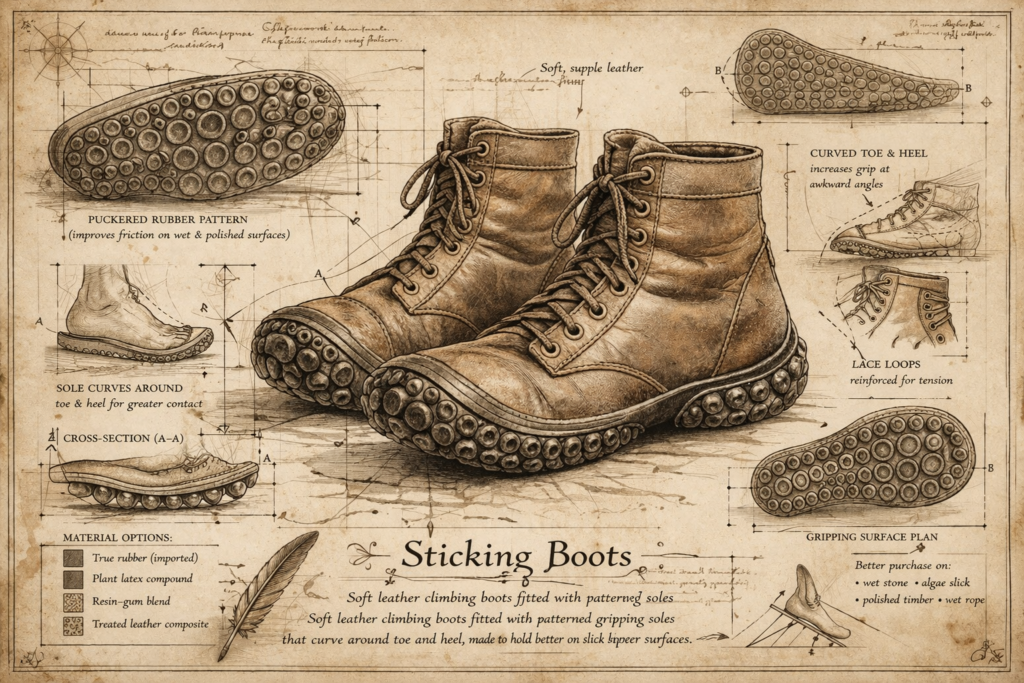
Most boots are made to endure road, mud, brush, and cold. These are made for something narrower and more dangerous: surfaces that seem climbable until hand and foot actually meet them. A mason’s wet wall, a river-worn stair, a rain-dark cliff face, a ship’s slick rigging, a cave shaft filmed with moisture—these are the places that justify their cost. They are not magical, and they do not let a wearer cling unnaturally to stone. What they do is simpler and more believable: they improve purchase where ordinary soles would slide.
Overview
Sticking Boots are specialised climbing footwear made from soft, highly supple leather and fitted with unusual gripping soles. Unlike ordinary boots, the sole curves upward around the toe and heel, increasing the area of contact and helping the wearer hold at awkward angles during a climb. The surface itself is moulded in puckered patterns resembling the underside of an octopus tentacle, giving the boots both their distinct appearance and their practical value.
They are not universal climbing wonders. In ordinary conditions they are simply well-made boots. Their real worth appears on wet, polished, or slime-slick surfaces, where the patterned sole grips better than plain leather and reduces the danger of a treacherous ascent.
Description
A pair of Sticking Boots is usually made from fine, flexible leather shaped to fit close around the foot and ankle without becoming stiff or heavy. The upper must remain supple enough to allow careful movement, balance, and precise foot placement. The remarkable part is the sole: a dark, resilient material formed into a gripping surface that wraps not only beneath the foot but partly around the toe and heel.
In the finest pairs, this material is true rubber or something close to it, obtained through long trade from hot and humid lands where latex-rich plants can be harvested in quantity. Such soles are rare, costly, and prized. Elsewhere, craftsmen may use local equivalents made from treated plant gums, resins, flexible compounds, or other specialist mixtures. These can work well enough, but the best imported material is generally considered superior.
The gripping surface is marked with rows of puckered cups or ridges, often compared to the underside of an octopus limb. The design is not decorative. It improves friction on damp, polished, and slime-slick surfaces where flat leather or hobnailed footwear would fail.
A well-made pair of Sticking Boots feels strange at first to those used to ordinary boots. The contact is softer, quieter, and more deliberate. On hazardous climbs, that difference is exactly what makes them valuable. On ordinary ground, however, they remain serviceable rather than ideal. Some wearers find them slightly draggy underfoot, less pleasant for long road travel, and a little awkward on quick pivots or hurried marching. They are specialist boots, not perfect everyday footwear.
Why This Item Matters
These boots matter because one of the most dangerous truths of climbing is simple: a surface does not need to be steep to be deadly. It only needs to be slick.
That gives them a strong place in the world. They are not broad “better boots.” They solve a specific and recurring problem. Like many good equipment items, they make a setting feel more real because they answer a practical need with a practical design.
Failure, Risk, and False Confidence
Sticking Boots do not make the wearer spider-like, and they do not abolish danger.
They help on treacherous surfaces; they do not replace strength, judgement, rope, or skill. A climber can still tire, panic, misjudge a hold, or trust a rotten handgrip that no boot could save. There is also the danger of false confidence. Because they truly help in the conditions for which they were made, the wearer may be tempted to trust them too far in situations they were never meant to master.
Their usefulness also has limits. Mud can clog the pattern. Grit can wear the surface. Long hard use can smooth the sole until the advantage is much reduced. A fine pair neglected becomes merely an expensive pair of boots.
Value in the World
They are not common road gear. They belong to narrow circles of use.
They are most likely to appear among climbers, scouts, thieves, roof-runners, delvers, riggers, sailors who work wet spars, quarry folk, and anyone whose livelihood depends on keeping footing where others lose it. In many regions they are known more by reputation than by sight. A city may have only one maker, a few imported pairs, or a single professional who swears by them and refuses to work without them.
Their materials also hint at long trade and specialised craft. The best sole material is not available everywhere, and shaping it properly is beyond an ordinary cobbler. A pair therefore suggests not only money, but access: to trade, to craft knowledge, or to circles of work where failure on wet stone has taught the value of proper gear.
Trade, Craft, and Common Variants
A proper pair requires both a skilled bootmaker and someone who understands the shaping and fixing of the sole. The leather must remain flexible, the fit close, and the sole secure enough not to peel away under strain. Inferior versions often fail where they matter most, either through weak attachment, poor patterning, or gripping material too stiff, too smooth, or too brittle to do its work properly.
Common variants include:
- mason’s sticking boots, made for wet stone and scaffold work
- sailor’s sticking boots, shaped for slick deck, rope, and spar
- roof-runner’s boots, lighter and closer-fitted for urban climbing
- cave boots, made to endure damp rock and muddy footing
- high-ankled climbing boots, offering more support at the cost of some flexibility
Using Them in Your Game
They are most useful when climbing conditions matter more than simple verticality.
They shine on wet walls, slick cavern stone, rain-dark roofs, algae-smeared steps, damp battlements, and shipwork in bad weather. They are also a good way to make specialised equipment feel meaningful without becoming magical. A character who owns them tells you something immediately: this is someone who expects difficult footing and prepares for it.
They also create a believable tradeoff. In the conditions they were made for, they are excellent. Outside those conditions, they are simply good boots with a slightly unusual feel, not a universal answer to movement or climbing.
Adventure and Worldbuilding Hooks
- A professional wall-climber refuses a commission until a worn pair can be resoled by the only craftsman he trusts.
- A dead smuggler found below a wet cliff still wears one sticking boot, the other missing higher up the ascent.
- A ship’s rigger claims a rival sabotaged his boots before storm work.
- A distant trader offers rare sole material fit only for specialists who know its value.
- A burglar’s unusual footprints on a rain-slick roof reveal training beyond that of an ordinary thief.
- A quarry master keeps one prized pair locked away for the most dangerous stone-face on the site.
Sticking Boots 5.5
Sticking Boots. Pathfinder
Sticking Boots 3.5
Sticking Boots
Adventuring Gear
Cost: 75 gp
Weight: 2 lb.
These soft leather boots are fitted with specially shaped gripping soles that wrap around the toe and heel, helping the wearer keep purchase on slippery climbing surfaces.
While wearing them, you ignore the usual –5 penalty imposed on checks made to climb a slippery surface.
In ordinary climbing conditions, they function as high-quality climbing boots but grant no additional special benefit.
Sticking Boots
Price 75 gp; Weight 2 lbs.
These soft leather boots are fitted with patterned gripping soles that curve around the toe and heel, helping the wearer keep footing on slick surfaces.
When worn, they negate the –5 penalty on Climb checks imposed by slippery surfaces.
In other climbing conditions, they function only as well-made climbing boots and provide no further special bonus.
Sticking Boots
These supple leather boots are fitted with curved gripping soles designed to gain purchase on slick surfaces.
When worn while climbing, they negate the –5 penalty on Climb checks imposed by slippery surfaces.
In most other conditions, they function as ordinary but well-made climbing boots.