
 Buy me a coffee
Floating Girdle Guide for D&D, Pathfinder, and Fantasy RPGs
A ring of sealed air-pouches worn about the waist, the floating girdle is an ungainly but life-saving piece of seafaring gear, valued wherever rough water, wrecked decks, and sudden drowning are ordinary hazards of life.
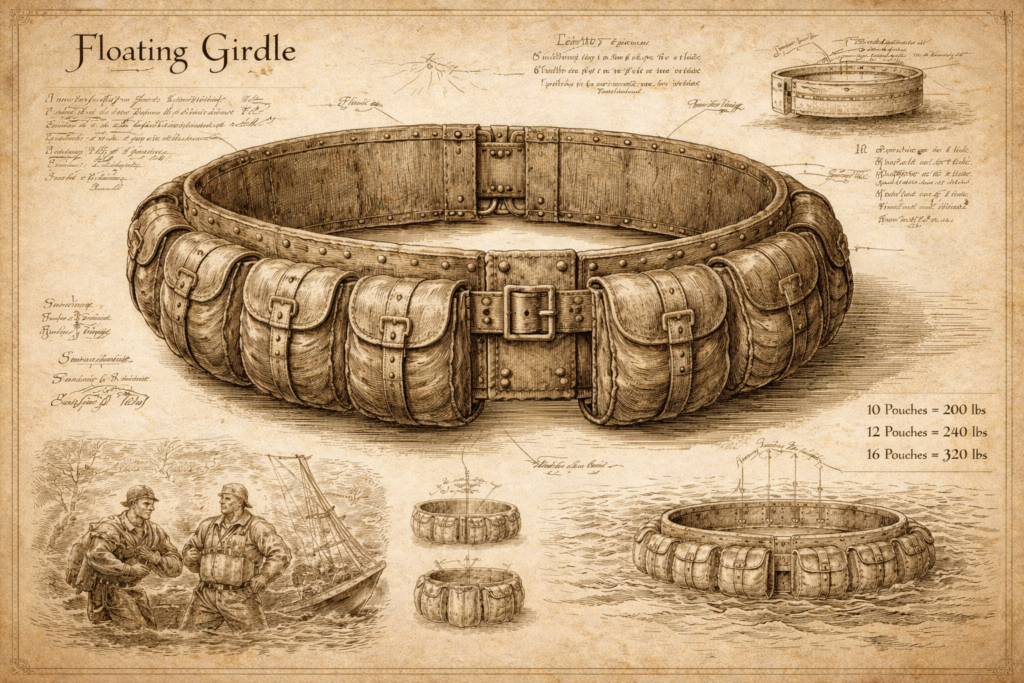
They say a man who falls into the sea at night is already dead—he simply has not stopped breathing yet. That is not always true. Some are found at dawn still drifting where the black water left them, alive only because a broad leather girdle full of trapped air kept their heads above the waves long enough for light, rope, or mercy to reach them. The floating girdle is not elegant, and no one wears it for pride, but along dangerous coasts it is respected in the way all proven things are respected.
Overview
The Floating Girdle is not made for comfort, elegance, or display. It is made to keep a body above water.
Bulky, awkward, and faintly ridiculous on land, it becomes a far more respectable thing when a sailor is pitched overboard in darkness or a fisherman is swept from a boat in heavy surf. In ports, on river craft, aboard fishing vessels, and among all those who work where one bad wave can mean death, the floating girdle is valued as plain, practical defence against drowning.
It is not a marvel, nor a treasure in the usual sense. It is better than that. It is a thing made because the sea kills.
Description
A floating girdle is a broad leather belt worn around the waist, usually about a foot deep from top to bottom and projecting outward from the body by roughly six inches. It scarcely resembles a normal girdle except in where it is fastened. Once worn, it forms a ring of padded compartments around the torso, useful rather than graceful, and too cumbersome to be mistaken for ordinary dress.
Its body is made from a series of sealed pouches, usually between eight and sixteen depending on the size of the wearer for whom it was made. Each pouch is formed of leather fitted over a thin rubber lining and sealed shut during manufacture, trapping air within. Though these compartments resemble pockets, none of them can be opened and none can be used to carry anything. They exist solely to hold air and preserve buoyancy.
The quality of the workmanship matters greatly. A floating girdle made well is dependable enough for repeated use at sea. A poor one is dangerous, for a leaking pouch is not merely shoddy craft but a theft of the wearer’s last margin of survival.
Why This Item Matters
The floating girdle changes the shape of danger.
It turns a fall overboard from instant loss into a struggle that can still be seen, reached, and answered. It gives shipboard combat, storms, wrecks, and river crossings a wider range of outcomes than simple disappearance beneath the water. It also tells players something important about the world: this is a place where practical survival matters, where not every answer is magical, and where ordinary tools can carry the weight of life and death.
Failure, Risk, and the Sea
A floating girdle keeps a person afloat. It does not keep that person safe.
Cold water, panic, exhaustion, broken limbs, crashing surf, undertow, and whatever waits beneath the surface remain as dangerous as ever. A man kept alive by a girdle may still die before help reaches him. That is part of what gives the item its weight. It does not conquer the sea. It merely gives the sea less of an advantage.
Value in the World
The floating girdle is the sort of object that reveals the character of a coast. Where it is common, people live with the expectation that men go into the water and do not always come back out. A port that sells them openly is a port shaped by hard weather, rough crossings, and practical seamanship. A fishing village that makes them locally is a place with generations of learned caution behind it.
In poorer communities, a good floating girdle may be treated as valuable property, repaired carefully and handed down within a family or issued only to trusted crew. In richer ports, merchants, captains, and shipowners buy them in quantity, not out of kindness but because experienced hands are costly to replace.
The floating girdle also suggests long trade routes and specialised craft traditions. The use of sealed rubber linings and dependable air chambers implies materials and methods not found everywhere. In one region it may be ordinary dockside equipment. In another it may be a costly foreign curiosity from southern coasts or distant island peoples long accustomed to treacherous water.
Most importantly, it helps make a setting feel lived in. Not every useful thing in a fantasy world must be magical. Some objects exist because necessity is older and harsher than sorcery.
Trade, Craft, and Common Variants
The base cost of a floating girdle is modest, but the final price rises with the number of pouches and the quality of construction. The more weight it must support, the more carefully it must be made. Wealthy merchants, captains, and officers often commission larger girdles capable of keeping both man and gear afloat. Poorer sailors settle for smaller, cheaper versions, trusting to luck, swimming skill, or quick rescue.
Quality matters greatly. Cheap imitations, badly sealed pouches, or inferior linings turn a life-saving device into false confidence. In reputable ports, girdle-makers with proven skill command good prices, and mariners who know the sea generally pay them without complaint.
Not all floating girdles are identical. Some are reinforced for armoured marines and shipboard guards. Others are cut smaller for fishermen, pilots, and riverfolk who need freer movement while working. Southern and island-made versions are often said to have better sealing and more reliable balance in rough water, making them prized imports in harsher northern ports.
Using the Floating Girdle in Your Game
The floating girdle is useful for making travel and seafaring feel real.
It works especially well in campaigns involving dangerous voyages, pirate attacks, boarding actions, wrecks, storms, fishing settlements, maritime trade, river travel, marsh coasts, and island routes.
It can also serve as a quiet sign of culture. A crew that all wear floating girdles tells the party something before a word is spoken: these are people who know water, respect it, and expect it to kill the careless.
For adventurers, it is the sort of purchase that seems unnecessary until the exact moment it becomes unforgettable.
Adventure and Worldbuilding Hooks
- A shipmaster refuses to sail during storm season unless all passengers wear floating girdles.
- Bodies from a wreck are identified by the distinctive girdles that kept some afloat longer than others.
- A southern coastal people are known for a superior style of floating girdle that foreign merchants eagerly seek.
- Smugglers commission dark, close-fitted versions for night landings in reefs and hidden coves.
- A harbour scandal erupts after counterfeit girdles fail during a storm and dozens drown.
- A party preparing for a sea journey must decide whether the cost and inconvenience are worth the chance of survival.
Floating Girdle
Floating Girdle, Pathfinder
Floating Girdle 3.5
Floating Girdle
Adventuring Gear
Cost: 5 gp, plus 15 gp per pouch
Weight: 2 lb., plus 1 lb. per pouch
A floating girdle is a broad leather belt fitted with sealed air-pouches that keep the wearer buoyant in water.
A floating girdle has between 8 and 16 pouches. Each pouch supports 20 pounds of total weight. To determine whether the girdle can keep a creature afloat, add together the weight of the wearer, clothing, armor, weapons, and carried gear.
If the girdle’s total capacity equals or exceeds the total weight it supports, the wearer floats at the surface and does not sink under normal conditions. The wearer can remain afloat without checks merely to stay above water, though waves, currents, heavy surf, exhaustion, cold, and similar hazards still apply as normal.
If the total weight exceeds the girdle’s capacity, the girdle cannot keep the wearer safely afloat on its own, though the DM may allow partial buoyancy in borderline cases.
Because of its bulk, a floating girdle is awkward on land and during tight movement. While wearing it, the wearer has disadvantage on Dexterity (Acrobatics) checks made to squeeze through narrow spaces, climb rigging quickly, or perform similar movements where the girdle’s size would interfere.
Common 5.5 Sizes
- 8 pouches: 160 lb. capacity, 125 gp
- 10 pouches: 200 lb. capacity, 155 gp
- 12 pouches: 240 lb. capacity, 185 gp
- 16 pouches: 320 lb. capacity, 245 gp
5.5 Notes
This version keeps the item mundane, useful, and easy to run. It prevents simple drowning after an unexpected fall, but it does not remove the danger of storms, combat in water, freezing seas, or being dragged below the surface.
Floating Girdle
The floating girdle, though it is worn like a belt, serves none of the normal purposes of such an item. It does not hold one’s breeches up, nor can it be used for storage, lacking anything resembling a useful pocket or pouch. The floating girdle is in fact one big mass of pouches, but none of them are accessible, having been sealed shut at the time of the item’s creation.
The girdle is fashioned of leather, one full foot from top to bottom, and extends outward six inches from the body in all directions, making it a rather cumbersome piece of clothing. The girdle has from eight to 16 pouches, depending on the size of the person for whom it is intended, which are also made of leather around a thin rubber shell. Sealed inside is nothing but air.
The girdle is all but useless on land, but it is not truly intended to be worn on shore. Rather, it is meant to be worn at sea, to keep the wearer safe should he find himself unexpectedly flung overboard into the sea. The floating girdle is naturally buoyant, and will keep the character wearing it afloat indefinitely, provided he does not weigh too much for the girdle to support. Each sealed pouch of the floating girdle can support 20 pounds independently. Therefore, a girdle with ten pouches can support a 200-pound man. The weight of any equipment carried also counts against the capacity of the floating girdle.
Cost: 5 gp + 15 gp for each pouch
Floating Girdle
Price 5 gp + 15 gp per pouch; Weight 2 lbs. + 1 lb. per pouch
This broad leather girdle is fitted with sealed air-pouches made from leather and thin rubber lining. Though it appears to be covered in pouches, none can be opened or used to store items. The girdle is intended solely to provide buoyancy in water.
A floating girdle contains 8 to 16 pouches, depending on the size and construction of the item. Each pouch supports 20 pounds. If the combined weight of the wearer and all carried gear does not exceed the girdle’s total capacity, the wearer gains a +10 circumstance bonus on Swim checks made to stay afloat and can remain afloat automatically while taking no strenuous action in calm or open water.
In rough water, storm conditions, or combat, normal Swim checks may still be required at the GM’s discretion, but the girdle continues to provide its bonus so long as it remains intact and the wearer does not exceed its support limit.
If the wearer’s total weight exceeds the girdle’s capacity, the girdle provides no automatic flotation, though the GM may allow a reduced circumstance bonus in near-capacity cases.
Because of its awkward bulk, a floating girdle imposes a –2 penalty on Swim checks made to dive, swim underwater, or perform complex underwater manoeuvres. It is made to keep a person up, not help them descend or move efficiently beneath the surface.
Common Pathfinder Sizes
- 8 pouches: 160 lb. capacity, 125 gp
- 10 pouches: 200 lb. capacity, 155 gp
- 12 pouches: 240 lb. capacity, 185 gp
- 16 pouches: 320 lb. capacity, 245 gp
Pathfinder Notes
This version works best as practical gear that improves flotation rather than replacing the Swim skill outright. That keeps it useful, believable, and worth buying without turning every water hazard into a trivial obstacle.