
Wing Cloak | Gliding Cloak for Tower Couriers
Wing Cloak | Gliding Cloak for Tower Couriers
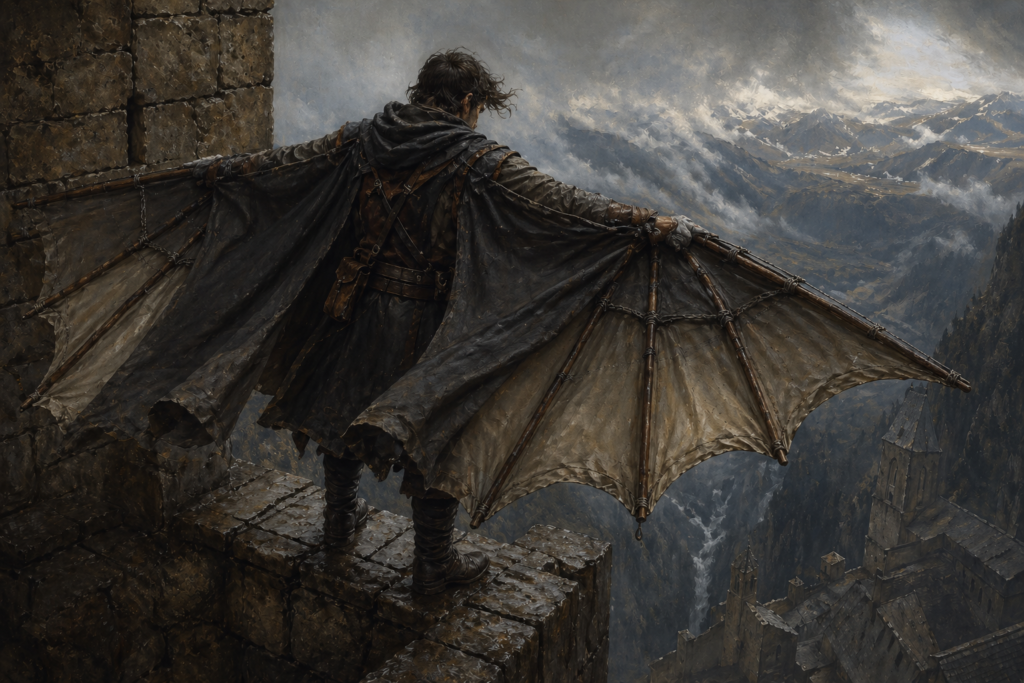
A fine cloak hides a ribbed wooden frame within its seams, turning a falling body into a brief, trembling shape upon the wind.
Overview
A Wing Cloak is not a cloak of flight. It is more frightening than that.
It is a fitted piece of specialist gliding equipment made for people who work where falling is a daily danger: tower couriers, roof-runners, cliff guides, riggers, scouts, smugglers, shrine messengers, and thieves. Folded, it resembles a fine traveller’s cloak of silk, treated linen, or other light cloth. Opened, its hidden ribs lock into place and pull the fabric into a shallow wing.
The wearer does not soar. They fall with discipline.
A Wing Cloak belongs to people who live near height, not to creatures that already own the sky. True fliers, winged beings, and creatures with reliable magical flight usually have little need for it. Its users are those who cannot fly, but are desperate, trained, or reckless enough to trust craft and wind for one controlled descent.
A Wing Cloak must be fitted to the wearer’s size, gear, and expected load. A poorly fitted cloak is not a bargain. It is a beautiful way to die.
Physical Description
A Wing Cloak is made from very light cloth reinforced with hidden ribs of ash, yew, cane, hornwood, or another flexible material. Fine cord runs through the lining. Small pegs, pins, or toggles lock the frame open when the wearer spreads the cloak into its wing shape.
When folded, the ribs lie flat along the shoulders, back, and inner edges of the garment. A well-made Wing Cloak can pass as elegant travel wear until touched. A poor one creaks, bulges at the seams, or sits too stiffly on the shoulders.
When opened, the cloak stops looking like clothing. Its fabric draws taut. Its ribs tremble. The wearer’s arms and shoulders become part of the frame, and the whole body must work with the fall.
A damaged Wing Cloak is easy to spot: warped ribs, loose seams, softened cloth, stretched cords, missing pins, frayed anchor-points, or a sour bend in the frame where it no longer opens evenly.
Why This Item Matters
The Wing Cloak gives height consequence.
It does not remove the danger of falling. It makes falling a choice. A character with a Wing Cloak can leap from a burning tower, drop from a cliff path, escape a surrounded rooftop, or cross part of a ravine by trusting the wind. The question is not “can I fly?” The question is “do I dare jump?”
That makes the item valuable for play. It creates decisions, not just bonuses.
It also has strong world identity. A Wing Cloak implies cliff cities, courier guilds, tower-runners, mountain shrines, airship crews, rooftop spies, storm-watchers, and rulers who are very aware that walls are less final when some citizens can glide.
The Wing Cloak is disciplined falling for people who cannot afford to fall.
Wing Cloak 5.5e / 2024
Wing Cloak Pathfinder 1e / 3.5e
Wing Cloak 3.0
Wing Cloak 5.5e / 2024
Adventuring Gear, Specialist Equipment
Cost: 1,200 gp
Weight: 1 lb.
Use: Requires two free hands
Requirement: The cloak must be fitted to the wearer and load.
A Wing Cloak must be fitted to its wearer’s size, gear, and expected load. A standard Wing Cloak can safely carry one Small or Medium wearer with light gear. It cannot be used while wearing heavy armour, carrying a heavy load, bearing another creature, or carrying bulky equipment that prevents the cloak from opening properly. Larger or heavier users require a custom-built Wing Cloak, usually at much greater cost.
While wearing a fitted Wing Cloak, you can use a Bonus Action to unfold or fold its hidden frame, provided you have two free hands.
When you begin falling while the cloak is unfolded, you can use your Reaction to control the descent. Make a DC 15 Dexterity (Acrobatics) check.
On a success, you take no falling damage from the fall, provided you have at least 20 feet of open space below you and enough room for the cloak to spread.
On a failure, the cloak catches badly. You still fall, but if the cloak is not broken, you reduce the fall damage by half.
If you have at least 40 feet of open space below you and succeed on the check, you may also glide. For every 20 feet you descend, you may move up to 5 feet horizontally. This movement cannot be used to climb, hover, gain altitude, or remain airborne after the descent ends.
The Wing Cloak cannot be used if you are restrained, if your arms are pinned, if you do not have two free hands, if the space is too narrow for the cloak to open, if the cloak is not fitted to your current load, or if the DM judges that your armour, pack, shield, carried gear, or body position prevents safe deployment.
Fragile Frame: A Wing Cloak has AC 10 and 5 hit points. While it has fewer than 5 hit points but at least 1 hit point, it is damaged: ribs are split, cords are loosened, seams are torn, or the frame opens unevenly. A damaged Wing Cloak can still be used, but the Dexterity (Acrobatics) check DC increases to 25.
If the Wing Cloak is reduced to 0 hit points, it is broken and cannot be used to slow a fall or glide until repaired.
Using It Under Threat: If you unfold or use a Wing Cloak while within a hostile creature’s reach, that creature may make an opportunity attack if the DM judges that the action exposes you, delays your escape, or gives the enemy a clear chance to strike the cloak or wearer.
Wing Cloak Pathfinder 1e / 3.5e
Adventuring Gear
Price: 1,200 gp
Weight: 1 lb.
A Wing Cloak must be fitted to the wearer’s size, gear, and expected load. A standard Wing Cloak can safely carry one Small or Medium wearer with light gear. It cannot be used while wearing heavy armour, carrying a heavy load, bearing another creature, or carrying bulky equipment that prevents the cloak from opening properly. Larger or heavier users require a custom-built Wing Cloak, usually at much greater cost.
Folding or unfolding the struts into wing form is a move action. Readying or using the cloak requires two hands and provokes an attack of opportunity.
When the cloak is shaped into a wing, the wearer may make a DC 15 Fly check while falling. On a success, the wearer falls safely from any height without taking falling damage, as if affected by feather fall.
While falling, the wearer may make an additional DC 15 Fly check to glide. On a success, the wearer moves 5 feet horizontally for every 20 feet fallen. This movement cannot be used to gain altitude, hover, or fly.
Fragile Frame: A Wing Cloak has hardness 0 and 5 hit points. While it has fewer than 5 hit points but at least 1 hit point, it is damaged, and the Fly check DCs to use it increase by +10. If reduced to 0 hit points, it is broken and cannot be used until repaired.
Natural Fliers: Creatures with a natural fly speed rarely need a Wing Cloak. They may wear one as clothing, ceremonial gear, disguise, or emergency equipment if their wings or flight magic are suppressed, but the item is mainly built for people who cannot fly on their own.
Wing Cloak 3.0
Source Advanced Race Guide
This strange piece of equipment only works for sylphs and similar creatures, whose light, airy bodies can be borne upon the winds. Looking like a fine silk traveller’s cloak, a wing cloak is secretly reinforced with a series of wooden struts that, when locked into place, stretch the cloak’s fabric into a rudimentary wing.
Arranging the struts into a wing or reversing the change is a move action. When the cloak is shaped into a wing, the wearer can make a DC 15 fly check to fall safely from any height without taking falling damage, as if using feather fall. When falling, the wearer may make an additional DC 15 fly check to glide, moving 5 feet laterally for every 20 feet she falls. Readying and using a wing cloak requires two hands and provokes an attack of opportunity. A wing cloak has hardness 0 and 5 hit points. If the wing cloak is broken, the fly DCs to use it increase by +10.
How a Wing Cloak Is Used
A Wing Cloak belongs in scenes where the ground is far below and the obvious path is gone.
A courier leaps from a bell tower rather than die on the stair. A cliff guide drops into a mountain gust to cross a broken trail. A thief escapes a palace roof by gliding to a neighbouring balcony instead of climbing down into the guards. A sailor falls from torn rigging and opens the cloak before the deck rushes up. A shrine-messenger carries offerings between high sanctuaries where bridges cannot survive winter storms.
The item is most interesting when there is no perfect landing. The wearer may survive the fall and still crash through a roof, skid across slate, strike a tree, land among enemies, or tear the cloak on a spearhead.
The Wing Cloak should solve one danger and create another.
Failure, Risk, and Misuse
A Wing Cloak is not forgiving equipment.
A failed use should usually produce a hard, messy consequence rather than instant death. The character trusted a fragile wing; the table should feel that choice.
Good consequences include:
- Hard Landing: The wearer lands prone, drops an item, or takes bruising impact despite avoiding the worst of the fall.
- Torn Cloth: The cloak works once, then becomes broken.
- Bad Drift: The wearer avoids falling straight down but lands in a worse place.
- Clipped Wing: A branch, spear, chimney, mast, roof beam, scaffold pole, or battlement catches the cloak.
- Panic Descent: The wearer survives but cannot choose the exact landing point.
- Frame Shock: One rib snaps on landing, making future checks harder until repaired.
The cloak should not function in every situation. It should fail, become impossible to deploy, or risk immediate damage in cramped shafts, dense interiors, tangled forests, collapsing tunnels, burning rooms, narrow alleys, or places full of ropes, beams, banners, poles, and hanging debris.
Trade, Craft, and Common Variants
Most Wing Cloak variants differ by fitting, concealment, reinforcement, and intended terrain. They should not become a ladder of stronger rules. A better Wing Cloak may be tougher, better hidden, or better suited to harsh weather, but it should not turn controlled falling into true flight.
Courier’s Wing Cloak: The standard practical model, built for messengers, rooftop runners, scouts, and tower couriers. It is light, plain, quick to unfold, and meant to be repaired in the field.
Typical Cost: 1,200 gp.
Mountain Wing Cloak: Reinforced at the shoulders, seams, and rib sockets for cliff paths, stone scrapes, cold wind, and rough landings. It is slightly heavier and less elegant, but better suited to harsh terrain.
Typical Cost: 1,300–1,500 gp.
Concealed Wing Cloak: Made to pass as noble travel wear, diplomatic clothing, or a fine city cloak until unfolded. Its extra cost comes from hidden joinery, better tailoring, and disguise, not better gliding power.
Typical Cost: 1,600–2,000 gp.
Waxed or damp-weather versions exist in cliff ports, rigging yards, and airship docks, but they are usually local adaptations rather than separate adventuring models. Larger, reinforced, or unusual-load Wing Cloaks must be custom fitted and priced separately; they are bulkier, harder to conceal, and still should not function safely with heavy armour or a heavy load.
Training cloaks are used on low towers, scaffold frames, rope courses, and sloped practice grounds, but they are not normally sold as reliable adventuring gear. A cheap or badly fitted Wing Cloak should be treated as dangerous, not as a bargain.
Value in the World
A Wing Cloak is expensive because it must work at the worst moment of the wearer’s life.
The buyer is not paying for cloth. They are paying for balance, fit, hidden joinery, exact rib tension, strong stitching, safe deployment, and repeated testing. A cloak that opens half a heartbeat too slowly, pulls unevenly, or twists in the wind can turn a survivable drop into a fatal one.
In cities, Wing Cloaks belong to couriers, tower messengers, spies, thieves, rooftop scouts, riggers, cliff-workers, and nobles who want escape routes ordinary guards cannot follow. In mountain regions, they are used by cliff guides, shrine messengers, storm-watchers, scouts, and travellers who know when the wind is safe enough to trust.
Among true fliers, the item is usually beneath practical notice. Among people who work at height but cannot fly, it is a prized and dangerous craft: a way to borrow one breath of the sky without owning it.
Rulers often restrict Wing Cloaks near prisons, palace roofs, treasury towers, military signal platforms, and cliff fortresses. A Wing Cloak is not a weapon, but it changes what walls mean.
Cost and Availability
A standard adventuring Wing Cloak costs 1,200 gp. This is the baseline price for a reliable, fitted cloak that can be used in dangerous conditions by one Small or Medium wearer with light gear.
Higher prices are justified when the cloak is more durable, better fitted, weather-resistant, easier to conceal, made by a famous wingwright, sized for an unusual wearer, or built for a specific dangerous environment.
Lower prices are only justified for training cloaks, damaged cloaks, old guild surplus, or locally common versions in cliff cities, tower-guild communities, aerial courier hubs, or mountain trade routes. A cheap Wing Cloak should be suspicious. This is life-preserving equipment; bad workmanship kills people.
Heavy-load or armour-capable Wing Cloaks should not be normal adventuring gear. If allowed, they should be custom, bulky, expensive, difficult to conceal, and still unable to grant true flight.
Using a Wing Cloak in Your Game
Use the Wing Cloak when you want vertical space to matter.
Before the character jumps, make the situation clear: the drop, the available room, the wind, the landing ground, enemy reach, carried weight, armour, and whether the cloak has enough space to open. The item is most exciting when the player understands the risk and chooses it anyway.
The cleanest table ruling is:
In open air, with both hands free, a fitted cloak, and enough space, a Wing Cloak can save a wearer from a fall.
In cramped, tangled, burning, narrow, wet, overloaded, unfitted, or obstructed conditions, it cannot.
Do not overcomplicate the fitting requirement. If the cloak was not made for the wearer’s size and load, it can still be worn as clothing, but it cannot safely function as a wing unless refitted, rebuilt, or magically altered.
Do not give the Wing Cloak to natural fliers as a routine upgrade. For a creature that already has a fly speed, the item is mostly redundant unless flight has been suppressed, the creature is injured, the cloak is ceremonial, or the character is deliberately passing as a non-flying mortal.
Adventure and Worldbuilding Hooks
The Tower Courier: A messenger glides from a besieged tower and crashes near the party with a sealed message. The cloak is ruined, the enemy saw the landing, and the message cannot wait.
The Fatal Demonstration: A noble patron dies during a public Wing Cloak display. The official explanation is bad wind, but the snapped strut shows a clean cut.
The Prison Without a Roof: A cliffside prison has no outer wall because escape means falling to death. Someone has smuggled in a Wing Cloak, but it was fitted for another body and another load.
The Counterfeit Wingmaker: Cheap Wing Cloaks flood the market after several successful courier runs. Then people start dying. The maker copied the look of the frame, not the balance.
Balance and Economy Check
The Wing Cloak is useful but narrow.
It does not grant flight. It does not replace fly, levitate, or reliable magical travel. It does not help much in ordinary dungeon corridors. It shines in vertical environments and becomes risky anywhere cramped, smoky, crowded, wet, unstable, overloaded, or obstructed.
The 1,200 gp price is reasonable if Wing Cloaks are specialist fitted equipment. In a campaign with cliff cities, aerial courier guilds, high mountain trade, or tower-running professions, cheaper local versions may exist, but they should remain fragile and limited.
The item should feel expensive because the buyer is not purchasing cloth. They are purchasing one chance not to die.
Historical Context
The Wing Cloak is fantasy equipment, but it belongs beside a real medieval fascination with artificial wings, wind, descent, and the dangerous dream of human flight.
A useful historical parallel is Eilmer of Malmesbury, an 11th-century monk remembered for attempting a gliding flight from Malmesbury Abbey using wing-like apparatus. The story is not a direct model for the Wing Cloak, but it gives the item the right medieval pressure: ingenuity, risk, pride, height, wind, and the difference between surviving a descent and truly mastering flight.
For a useful historical reference, see the Athelstan Museum article “Eilmer The Flying Monk”.
Keep this reference growing
If this page helped with your reading or game, you can support its upkeep or explore the curated books.
Explore the Bookshop — epics, classics and stories behind imagined worlds.