
Fireshield Cloak | Alchemical Fire Protection
Fireshield Cloak | Alchemical Fire Protection
A soaked Fireshield Cloak steams before it burns, giving its wearer a few desperate breaths inside a place that should already have killed them.
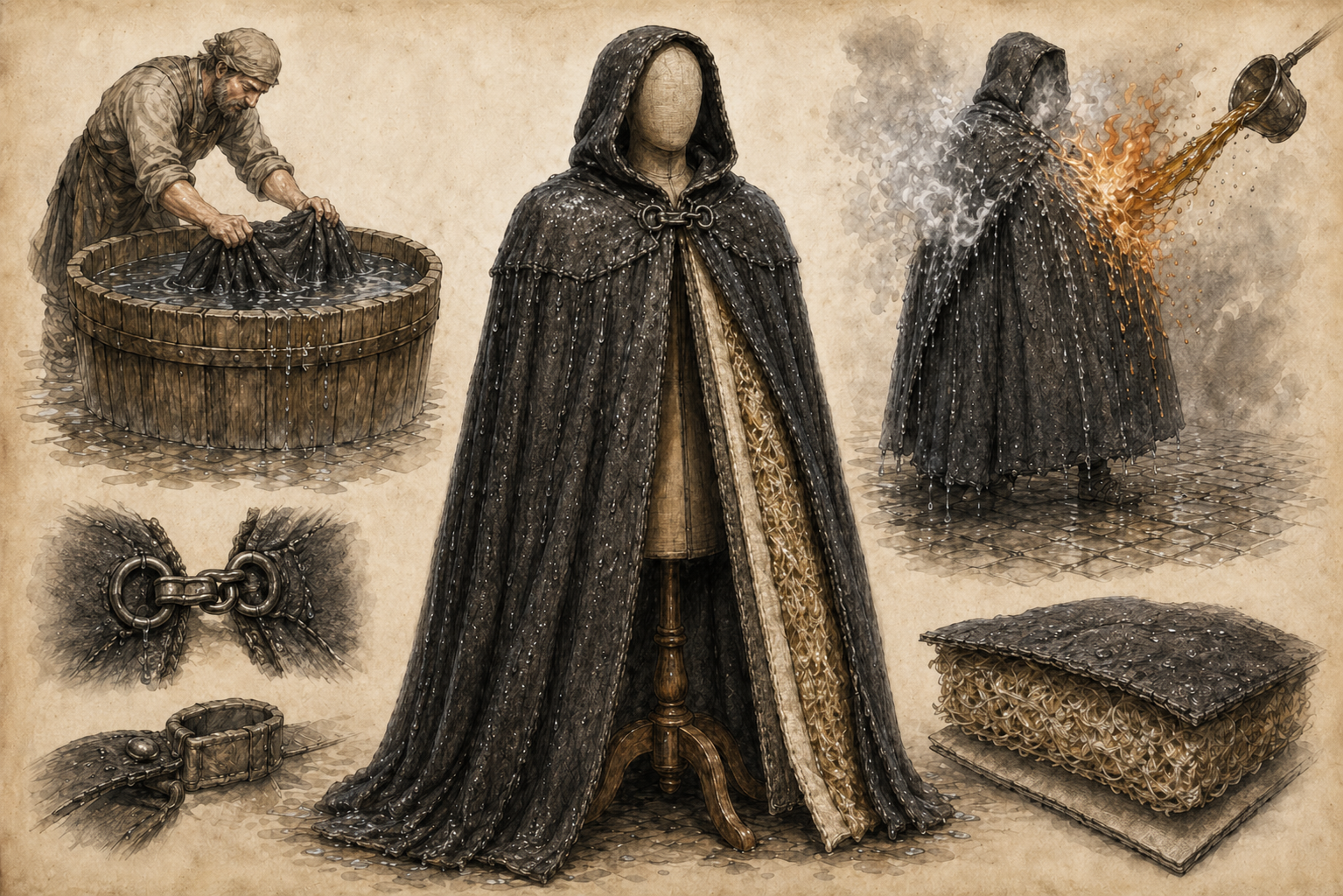
A Fireshield Cloak is not a graceful magic cloak. It is a practical, unpleasant, lifesaving piece of fire-survival gear. Adventurers, fire-watch crews, shipboard officers, siege engineers, miners, and poor monster hunters use it when they expect flame and cannot afford permanent magical protection.
Dry, it behaves like a heavy cloak and does nothing special. Once soaked, its hidden absorbent layer holds an extraordinary amount of water. That stored water absorbs heat before the wearer does, letting the cloak blunt fire damage for a limited time. The cost is obvious: it becomes heavy, wet, slow to wear, and steadily less useful as it dries.
That is what makes the Fireshield Cloak good. It is not passive protection. It is a deliberate choice.
Quick Use
Soak the cloak in water for 1 minute. While Soaked, it protects against magical, mundane, and alchemical fire. After 10 hours or two significant fire exposures, it becomes Damp.
While Damp, it protects only against mundane and alchemical fire. After 5 more hours or one significant fire exposure, it becomes Dry.
While Dry, it grants no special protection.
Physical Description
A Fireshield Cloak is made from two layers of tightly woven wool with a thick inner core of alchemically treated plant fibre. The absorbent core may be flax, hemp, marsh reed, sea-grass, or similar material steeped in mineral salts and binding agents.
Most examples are broad, hooded, and long enough to wrap across the shoulders and upper body. Better versions include reinforced shoulder seams, a quick-release clasp, and a heavy hem that helps the wet garment hang properly instead of twisting around the wearer.
A dry Fireshield Cloak weighs 3 lb.
A fully soaked Fireshield Cloak weighs 23 lb.
Why This Item Matters
A Fireshield Cloak matters because it makes fire playable in a more interesting way.
It rewards foresight. If the party knows they are entering a burning archive, a siege breach, a forge hall, a trapped furnace chamber, or a ship at risk of fire, the cloak gives them a reason to prepare. If they are surprised, it may still be dry and useless.
That is much better than a flat passive bonus. The item creates tension, planning, and trade-offs. Someone has to carry the weight. Someone has to soak it. Someone has to decide when the protection is worth the inconvenience.
Fireshield Cloak 5.5e / 2024
Pathfinder 1e / 3.5e
Fireshield Cloak 3.0
Fireshield Cloak 5.5e / 2024
Adventuring Gear, Alchemical Garment
Cost: 150 gp
Weight: 3 lb. dry; 23 lb. soaked
Preparation: 1 minute immersed in water
Use: Worn cloak
A Fireshield Cloak has three conditions: Soaked, Damp, and Dry.
Dry
A Dry Fireshield Cloak grants no special protection.
Soaking the Cloak
If immersed in water for 1 minute, the cloak becomes Soaked.
If the cloak is thoroughly drenched but not fully immersed, the DM may rule that it becomes Damp instead.
Soaked
A Soaked Fireshield Cloak protects against magical, mundane, and alchemical fire.
While Soaked, when the wearer takes fire damage from an effect that rolls damage dice, reduce the fire damage by 1 per die rolled, to a minimum of 1 damage per die.
For fire damage that does not use damage dice, reduce the fire damage by 1 for every 5 points of fire damage or part thereof.
A Soaked Fireshield Cloak remains Soaked for up to 10 hours in ordinary conditions. After that, it becomes Damp.
The cloak also becomes Damp after it protects the wearer from two significant fire exposures. A significant fire exposure is any fire effect that would normally deal damage, such as a fire spell, dragon breath, burning oil, alchemical flame, a fire trap, or a dangerous passage through active flames.
Minor sparks, candle flames, brief heat, smoke, and harmless proximity to ordinary fire do not count as significant fire exposures.
Damp
A Damp Fireshield Cloak no longer protects against magical fire, but it still protects against mundane and alchemical fire, including burning oil, torches, pitch, burning debris, sparks from a forge, and similar hazards.
Use the same damage reduction rule as above.
A Damp Fireshield Cloak remains Damp for up to 5 hours in ordinary conditions. After that, it becomes Dry.
The cloak also becomes Dry after it protects the wearer from one significant mundane or alchemical fire exposure.
Destruction
If the wearer suffers a single extreme fire exposure while the cloak is already partly spent, the cloak may be ruined after resolving the damage. Examples include dragon breath, a powerful fire spell, immersion in burning oil, standing inside a furnace wash, or being trapped in a fully involved burning room.
A ruined Fireshield Cloak has its absorbent core scorched, split, steamed out, or burned through. It no longer provides fire protection until replaced. Repair is usually impractical unless the campaign treats alchemical tailoring as readily available.
Wearing a Soaked Fireshield Cloak
While wearing a Soaked Fireshield Cloak, the wearer has disadvantage on:
- Dexterity (Acrobatics) checks
- Dexterity (Stealth) checks that rely on quiet or graceful movement
- Strength (Athletics) checks made to climb
- Strength (Athletics) checks made to swim
The cloak imposes no special penalties while Dry. A Damp cloak is uncomfortable, but usually not enough to justify a separate penalty.
Heat and Harsh Conditions
In strong sun, near a forge, in a desert, inside a burning building, or in similar severe heat, the DM may halve the time each condition lasts.
Pathfinder 1e / 3.5e
Cloak, Fireshield
Price: 150 gp
Weight: 3 lb. dry; 23 lb. soaked
Craft: Craft (alchemy) DC 25
A Fireshield Cloak has three conditions: Soaked, Damp, and Dry.
Dry
A Dry Fireshield Cloak grants no special protection.
Soaked
Immersing the cloak in water for 1 minute makes it Soaked.
While Soaked, the cloak reduces fire damage from magical, mundane, and alchemical sources by 1 point per die of fire damage rolled, to a minimum of 1 point of damage per die.
For effects that deal fire damage without dice, reduce the damage by 1 point for every 5 points of fire damage or part thereof.
A Soaked cloak remains Soaked for up to 10 hours in ordinary conditions. After that, it becomes Damp.
The cloak also becomes Damp after it protects the wearer from two significant fire exposures. A significant fire exposure is any fire effect that would normally deal damage, including a fire spell, breath weapon, burning oil, alchemical flame, fire trap, or dangerous passage through active flames.
Damp
While Damp, the cloak no longer protects against magical fire, but it still reduces damage from mundane and alchemical fire using the same rule.
A Damp cloak remains Damp for up to 5 hours in ordinary conditions. After that, it becomes Dry.
The cloak also becomes Dry after it protects the wearer from one significant mundane or alchemical fire exposure.
Destruction
If the wearer suffers a single extreme fire exposure while the cloak is already partly spent, the cloak may be destroyed after the attack is resolved.
Encumbrance and Use
While wearing a Soaked Fireshield Cloak, the wearer takes a –2 penalty on Acrobatics, Climb, Escape Artist, Stealth, and Swim checks. This is a circumstance penalty from the cloak’s weight and bulk.
A Dry cloak grants no penalty. A Damp cloak is clammy and awkward, but not enough to justify a separate rules penalty in most campaigns.
Fireshield Cloak 3.0
Ultimate Equipment Guide II
Author Greg Lynch, J. C. Alvarez
Publisher Mongoose Publishing
Publish date 2005
A fireshield cloak, though it is a potentially lifesaving device, is also a cumbersome and troublesome item to wear. Regardless, many adventurers, particularly those without the financial and magical resources to acquire a sorcerous means of resisting the searing heat of fires, both magical and mundane, swear by these cloaks, and maintain that the time and trouble required to keep them operating correctly is a very small price to pay for the protection they provide.
When purchased, a fireshield cloak is almost as light as a normal cloak, but it is also useless as a protective measure against fire damage. In order for it to serve its purpose, a fireshield cloak must be immersed in water. The cloak itself is made of two layers of fine wool, between which is a thick layer of alchemically infused plant fibre, which is able to absorb and hold an amazing amount of water without substantially altering the bulk of the cloak, though naturally the weight increases.
When filled with water (a process that takes about one full minute of immersion), the fireshield cloak weighs a full 23 pounds, 20 of which are water. As soon as it is removed from the water, the fireshield cloak begins to dry out, losing about one pound of weight every hour.
When full, the fireshield cloak offers the wearer a significant amount of protection against fire damage, reducing any incoming fire damage by one point per die of damage (with a minimum of one point of damage per die). Therefore, a fireball spell that would normally deal 5d6 points of fire damage instead deals 5d6-5 points of damage to the wearer of a fireshield cloak.
This protection remains active until the cloak has lost about half the water it carries (roughly ten hours from the point it was filled), after which time the cloak is no longer able to protect against the intense heat of magical fire. The cloak will continue to protect the user against normal and alchemical fire for roughly another five hours, after which time the fireshield cloak is too dry to offer the wearer any protection whatsoever.
Protecting the wearer against fire-based attacks also causes the cloak to dry out prematurely. For every die of damage reduced by the fireshield cloak, one ‘pound’ of water is evaporated from it. In the above example of a 5d6 fireball, the cloak would lose five pounds of water protecting its wearer against the attack. If the wearer of a fireshield cloak sustains a single fire attack which does more dice of damage than the cloak has water remaining, the cloak is destroyed.
Cloak, Fireshield: 150gp; 3 lb.
How a Fireshield Cloak Is Used
A Fireshield Cloak belongs in scenes where fire is expected.
Characters soak one before entering a burning house, crossing a firelit barricade, opening a furnace chamber, descending into a smoke-filled mine, working near unstable alchemical stores, or boarding a ship where flame is a greater danger than steel.
It is most useful when a party has warning and time. If the danger is sudden, the cloak may still be packed, dry, or only partly prepared.
That is exactly how it should work.
Failure, Risk, and Misuse
A Fireshield Cloak is not a clean answer to fire.
When soaked, it is heavy and awkward. It drips, slows movement, and becomes miserable in cold weather. Stored wet, it can mildew, rot, smell foul, or lose effectiveness. In freezing conditions it may become stiff, icy, and actively dangerous.
It is also conspicuous. A soaked adventurer leaves wet footprints. A cloaked intruder dripping across polished floors is not subtle. Someone preparing a Fireshield Cloak before entering a hall is openly signalling that they expect fire.
The cloak should not make a wearer effectively immune to dragon breath, lava, furnace interiors, prolonged immolation, or standing inside magical fire round after round. It reduces damage. It does not make flame safe.
Trade, Craft, and Common Variants
Most Fireshield Cloak variants differ by cut, reinforcement, storage, and intended user rather than by stronger rules. The same basic alchemical principle remains: wool, absorbent fibre, water, and enough inconvenience to make the protection costly.
- Fire-Watcher’s Cloak: A plain civic model kept in towers, mills, bakeries, dockyards, storehouses, bathhouses, and crowded timber districts. It is usually ugly, smoke-stained, and built for quick access rather than comfort.
- Siege Cloak: A reinforced military version used by sappers, engineers, assault troops, and gate crews working near burning pitch, heated metal, fire arrows, smoke, and collapsing structures. It has stronger shoulder seams, heavier fastenings, and a quick-release clasp.
- Shipboard Fireshield Cloak: A salt-weathered version stored near pumps, water barrels, deck crews, and cargo holds. It is valuable because fire at sea spreads quickly, traps people below deck, and can destroy the only safe ground available.
- Forge Cloak: A shorter, closer-cut version used by smiths, glassworkers, foundry hands, artificers, and furnace keepers who need brief protection from heat and sparks without loose cloth catching on tools, wheels, bellows, or frames.
These variants usually use the same rules. If the campaign tracks quality, a rough civic version might cost 100–125 gp, a standard adventuring Fireshield Cloak costs 150 gp, and a reinforced siege, shipboard, or forge version might cost 175–200 gp.
Value in the World
A Fireshield Cloak is too expensive for most labourers but far cheaper than reliable magical protection.
That makes it a believable item for guilds, ship crews, city watch stores, siege trains, temple treasuries, alchemists, monster hunters, and adventurers who face fire often enough to justify the trouble.
In a timber-built city, it is civic gear. In a volcanic region, it is travel gear. In war, it goes to the person expected to run toward the fire rather than away from it.
Using This Item in Your Game
Use a Fireshield Cloak when you want fire to stay dangerous while still rewarding preparation.
It works especially well in adventures involving burning buildings, arson, alchemical sabotage, forge complexes, mine fires, salamander halls, siege warfare, smoke-filled tunnels, and shipboard disasters.
The best question this item creates is not “how much damage does it reduce?” The best question is “who wears it, and how much protection is left when it matters most?”
Adventure and Worldbuilding Hooks
- The Burning Archive: A city archive catches fire, and the party has only one usable Fireshield Cloak. Someone must go inside before the records are lost.
- The Sabotaged Stores: A garrison’s Fireshield Cloaks fail during a fire attack because their absorbent cores were fraudulently replaced. The disaster points to corruption, sabotage, or treason.
- The Dry Cisterns: A forge collapse traps workers behind smoke and flame, but the rescue cloaks are useless because the cisterns have been emptied. The first problem is not the fire. It is getting water.
Historical Context
A Fireshield Cloak is fantasy equipment, but its material logic is sound. Wool resists flame better than many common fibres, and water absorbs heat before flesh does. A soaked woollen protective cloak is not a historical item in this exact form, but it is a believable alchemical extension of real pre-modern materials and methods.
For useful background on the material side of the item, see the International Wool Textile Organisation article A Closer Look at Wool’s Flame Resistance.
Keep this reference growing
If this page helped with your reading or game, you can support its upkeep or explore the curated books.
Explore the Bookshop — epics, classics and stories behind imagined worlds.