
Wing Paint: Flying Mount Markings and Sky Camouflage
Wing Paint: Flying Mount Markings and Sky Camouflage
Wing Paint is aerial livery: a battlefield language painted beneath a flying mount’s wings, where only those below can read it.
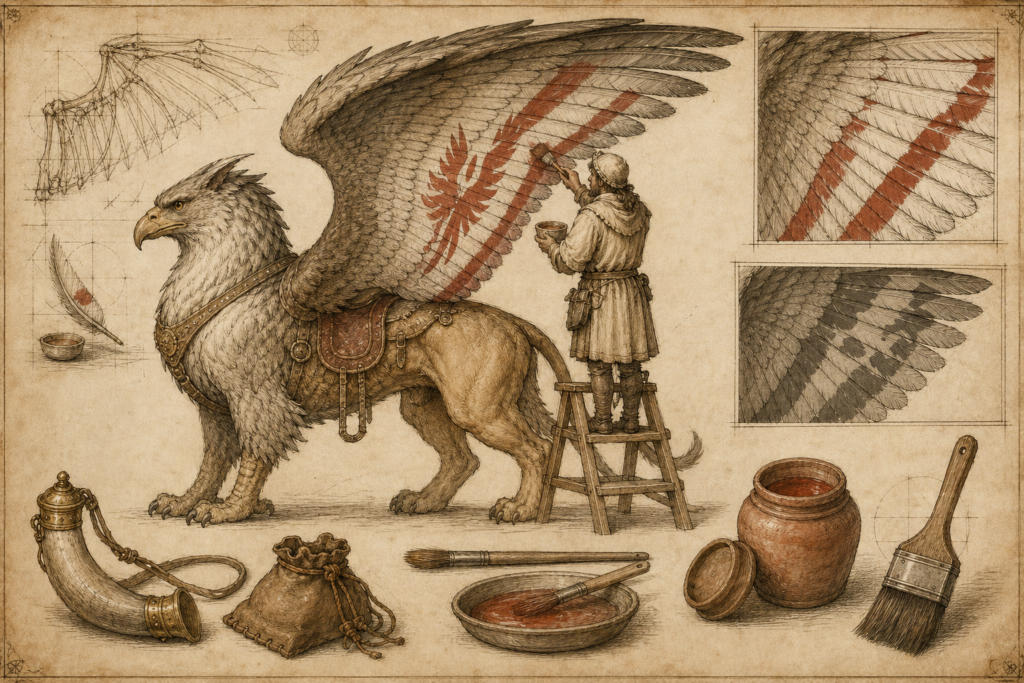
Overview
Wing Paint is a water-based pigment made for griffons, pegasi, hippogriffs, rocs, giant eagles, wyverns, dragons, and other winged mounts. It is brushed onto the underside of the wings, where soldiers, tower guards, scouts, and watchers on the ground can see it as the creature passes overhead.
It is not merely decoration. Wing Paint is how the sky identifies itself.
A crimson bar beneath a griffon’s wing may tell a city gate not to loose arrows. A white temple mark may declare a courier sacred. A blackened wyvern may pass overhead at night as little more than a moving absence. A noble’s device may rally troops below — or tell every enemy archer exactly where to aim.
The item’s first purpose is recognition. In battle, a soldier may have only moments to decide whether the winged shape above is an allied scout, a commander’s mount, a temple messenger, an enemy raider, or a hungry thing from the hills. A clear mark can prevent a fatal mistake.
Its second purpose is concealment. Scouts and raiders may darken a mount’s underside before a night flight, paint it pale blue for a clear sky, or use dull grey before crossing clouded highlands. This does not make the creature invisible, but it can make a high-flying mount much harder to pick out from below.
Good Wing Paint is light, flexible, harmless, and easy to wash away. Poor paint cracks, cakes in feathers, irritates membranes, stains scales, or makes the mount resist being handled.
Price: 1 gp per pint
Weight: Negligible per pint when carried; no meaningful weight once applied
Type: Adventuring gear, mount equipment, alchemical pigment
Use: Identification, battlefield recognition, sky camouflage, ceremonial display
Physical Description
Wing Paint is sold in stoppered clay jars, waxed leather pouches, wooden pigment pots, or sealed horn containers. Common colours include white, black, red, ochre, blue, green, dull grey, and yellow. Wealthier riders may commission brighter mineral colours, clan mixtures, temple pigments, or carefully matched sky tones.
The paint is thin enough to brush across feathers, hide, scales, or wing membrane without stiffening the wing. Feathered mounts are usually painted with broad, soft brushes along the underside of the primary feathers. Leathery-winged mounts require thinner coats so the pigment does not crack when the wing flexes.
A pint is enough for a small symbol, stripe, or recognition mark on a Large flying mount. Full underside camouflage usually requires several pints, especially on Huge or larger creatures.
Why Wing Paint Matters
Wing Paint makes aerial movement readable.
On the ground, a flying creature is often seen only from below: a shape, a shadow, a flash of wing, a rider briefly visible against cloud or sun. Wing Paint turns that glimpse into information. It tells watchers who has come, who claims the sky, who should be welcomed, and who should be feared.
That visibility has a cost. A famous crest beneath a griffon’s wings may lift the courage of soldiers below, but it also exposes the rider’s identity. A temple mark may open one city’s gates and invite another city’s arrows. A stolen stripe can let a smuggler pass a harbour tower. A badly chosen camouflage colour can make a scout easier to see than if the wings had been left bare.
Wing Paint is most interesting when trust depends on distance. From the ground, no one can inspect a rider’s face, papers, or intentions. They see the wings first. Sometimes the wings lie.
Edition Tabs
Wing Paint 5.5e / 2024
Wing Paint, Pathfinder 1e / 3.5e
Wing Paint 3.0
Wing Paint 5.5e / 2024
Adventuring Gear, Mount Equipment
Cost: 1 gp per pint
Application Time: 10 minutes for simple markings; 30 minutes or more for full underside camouflage
Removal: Washed away with water and a few minutes of work
Typical Coverage: One pint covers a clear symbol, stripe pattern, or heraldic device on a Large flying mount. Full underside camouflage usually requires 2–4 pints for a Large mount, and more for Huge or larger creatures.
Identification Markings
When a flying mount bears clear Wing Paint markings, creatures on the ground have advantage on checks made to identify the mount’s rider, allegiance, unit, household, temple, guild, or command group, provided they already know what the marking represents.
This does not reveal unknown information. A guard who has never seen the sign of the Ash-Feather Riders does not automatically know its meaning.
Camouflage Markings
A flying mount painted to match the sky is harder to notice from the ground when the colour suits the conditions.
When viewed from below against an appropriate background, observers take the following penalties to Wisdom (Perception) checks made to notice the mount:
| Paint Use | Condition | Perception Penalty |
|---|---|---|
| Black underside | Night sky | −6 |
| Pale blue underside | Clear daylight sky | −4 |
| Dull grey underside | Clouded sky | −4 |
These penalties apply only when the mount is high enough for underside camouflage to matter and is not giving itself away through loud noise, obvious shadow, magical light, rider movement, formation flying, or a mismatched background.
A black-painted griffon crossing a bright dawn sky gains no benefit. A blue-painted pegasus flying low over dark woodland gains little or none. A grey-painted wyvern crossing broken cloud at height may gain the full benefit.
Poor Application
If Wing Paint is applied carelessly, too thickly, or with unsuitable pigment, the DM may call for a DC 10 Wisdom (Animal Handling) check to keep the mount calm and cooperative. On a failure, the paint is smeared, incomplete, badly placed, or must be redone.
Wing Paint, Pathfinder 1e / 3.5e
Price: 1 gp per pint
Weight: —
Craft: Craft (alchemy) or Craft (painting) DC 10 for ordinary colours; DC 15 for stable camouflage mixtures or precise heraldic work
Application Time: 10 minutes for simple markings; 30 minutes or more for full underside camouflage
Wing Paint is a water-based pigment used to mark the underside of a flying mount’s wings. It is harmless to the mount, does not interfere with flight when properly applied, and washes away with water.
Recognition
A creature viewing the mount from below gains a +2 circumstance bonus on checks to identify the mount’s rider, allegiance, heraldic device, military company, temple, clan, or owner if the observer is familiar with the sign.
Camouflage
If Wing Paint is used to match the mount’s underside to the sky, creatures on the ground take a penalty on Spot checks to notice the mount:
| Paint Use | Condition | Spot Penalty |
|---|---|---|
| Black underside | Night sky | −6 |
| Sky-blue underside | Clear daylight sky | −4 |
| Dull grey underside | Clouded sky | −4 |
These penalties apply only when the mount is seen from below against an appropriate sky. They do not apply if the mount is silhouetted, flying low, making obvious noise, carrying visible lights, or crossing a background that does not match the paint.
Wing Paint 3.0
Ultimate Equipment Guide II
Author Greg Lynch, J. C. Alvarez
Publisher Mongoose Publishing
Publish date 2005
The only problem with a flying mount is the difficulty allies on the ground might have in distinguishing friend from foe, particularly in the rush and chaos of battle. Wing paint is a simple and inexpensive way to solve the problem. Wing paint is a water-based pigment that comes in a variety of colours, and is used primarily to paint a symbol or heraldic device on the bottom side of a flying mount’s wings, proclaiming the rider’s identity to everyone on the ground.
Wing paint is harmless to the mount, will not interfere with the operation of even delicate plumage, and washes away with water. Wing paint is also commonly used for camouflage. Those who wish to pass unnoticed overhead may paint the entire underside of their mount black to match the night sky, sky blue to match the daylight heavens or even dull grey to blend in with the clouds above. This use of wing paint imposes a -6 penalty to all Spot skill checks to those on the ground to notice a mount painted in this fashion against the night sky, and a -4 against a daylight or clouded sky.
Wing Paint: 1gp per pint
How Wing Paint Is Used
Wing Paint belongs wherever flight meets war, watchfulness, ceremony, or secrecy.
A city marks its courier griffons with bright bands so tower guards know not to loose arrows. A noble’s hippogriff bears the red crescent of its house beneath both wings. A temple messenger paints a white sun-disc under a giant eagle’s feathers before crossing disputed hills. A night raider blackens a wyvern’s underside before descending toward a harbour chain. A scout paints grey cloud-bars beneath a pegasus before flying over enemy roads.
The item creates a useful decision at the table: be seen clearly and risk being targeted, or hide your identity and risk being mistaken for an enemy.
Failure, Risk, and Misuse
Wing Paint can create as much danger as it prevents.
A badly copied emblem may start a diplomatic incident. A stolen marking may let raiders pass as friendly scouts. A bright crest may make a commander easier to target. A careless camouflage job may fail because the rider chose the wrong colour for the weather. A mount with damaged feathers, tender wing membranes, or sensitive skin may refuse the paint entirely.
The paint also depends on trust. If enemy forces learn a city’s wing markings, they can imitate them. If too many companies use similar colours, ground troops may hesitate at exactly the wrong moment.
Trade, Craft, and Common Variants
Most Wing Paint variants should not create stronger rules. They differ by colour, purpose, culture, and sky condition.
- Heraldic Wing Paint: Bright pigment used for crests, clan signs, noble devices, civic marks, temple symbols, and military command colours.
- Scout’s Wing Paint: Duller mixtures made for blue sky, grey cloud, dusk, or night. It is practical rather than decorative.
- Ceremonial Wing Paint: Used in triumphs, sacred processions, coronations, funerary flights, seasonal rites, and public oaths. It may contain more expensive mineral colours or powdered shell, but it usually uses the same rules.
- Training Paint: Cheap, washable colour used by handlers to mark young mounts, flight schools, messenger routes, and mock battles.
These variants should change story, recognition, and availability, not create a ladder of better bonuses.
Using Wing Paint in Your Game
Wing Paint works best when the sky is part of the encounter.
Use it when ground troops must decide whether to fire. Use it when a disguised aerial scout tries to pass overhead. Use it when a famous rider wants to be seen. Use it when a raiding mount is visible only as a dark shape against moonlit cloud. Use it when a battlefield has multiple flying creatures and no one wants to waste a spell on the wrong target.
The camouflage penalty should not become automatic invisibility. Ask three questions:
Does the colour match the background?
Is the mount high enough for underside camouflage to matter?
Is there some other giveaway, such as noise, shadow, formation, firelight, or rider movement?
If the answers favour the rider, apply the penalty. If not, reduce it or ignore it.
Adventure and Worldbuilding Hooks
- False Colours at the Gate:
A winged courier is cleared to cross the city walls because the underside of its wings bears the governor’s colours. The rider is dead in the saddle, the message tube is missing, and someone else is already inside the city using the same paint scheme. - The Rain Muster:
A lord’s flying scouts are due to assemble before a campaign, but hard rain has blurred half the wing markings into near-identical streaks. Tempers rise, orders are delayed, and one rider uses the confusion to join the muster under colours that are not his own. - The Widow’s Griffin:
An old war griffin is brought out of retirement for a ceremonial flight, and when its wings are cleaned, the original campaign colours show through beneath years of newer paint. Veterans recognise them at once, because those were the colours worn during a massacre everyone was ordered to forget.
Historical Context
Wing Paint is a fantasy mount item, but its closest historical parallel is battlefield recognition. Medieval warriors used heraldry, livery badges, painted shields, standards, clothing colours, and decorated horse equipment to make allegiance visible in dangerous, crowded conditions.
In a campaign with flying mounts, Wing Paint carries that same principle into the sky. It lets soldiers below recognise who is passing overhead before arrows, spells, or panic decide the matter. For useful historical background, see the Metropolitan Museum of Art’s note on heraldic emblems on medieval objects and horse equipment.
Keep this reference growing
If this page helped with your reading or game, you can support its upkeep or explore the curated books.
Explore the Bookshop — epics, classics and stories behind imagined worlds.