
Enclosed Saddle – Underwater Riding Gear for Aquatic Mounts
A sealed riding chamber for air-breathing riders mounted on vast aquatic beasts.
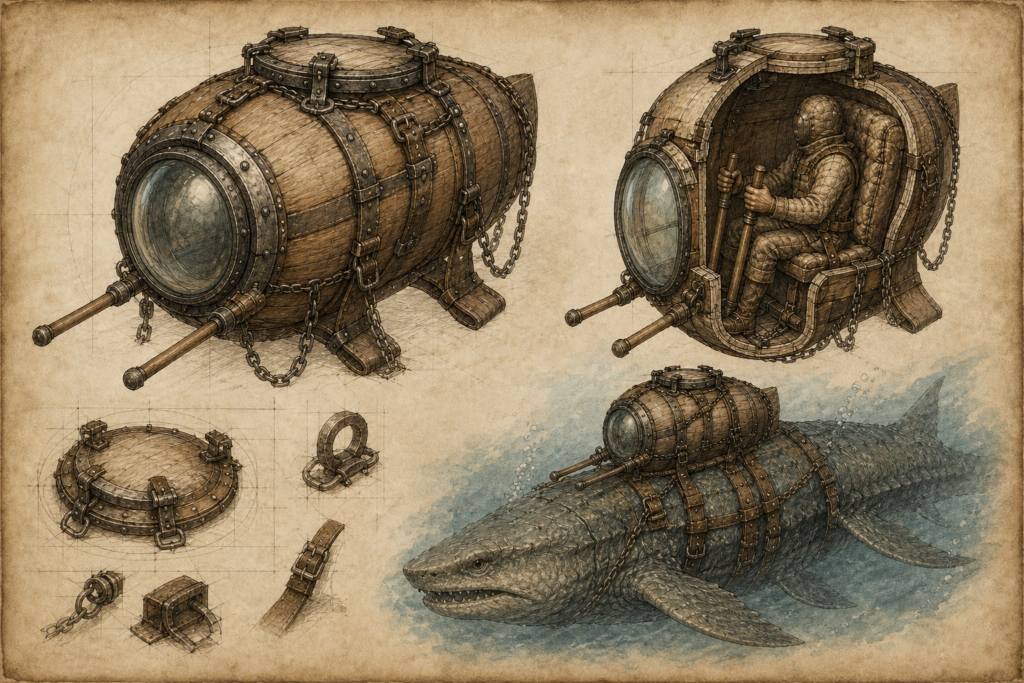
An enclosed saddle is not ordinary tack. It is a cramped pressure chamber of wood, ceramic, glass, leather, chain, and steel, built for a rider who intends to descend beneath the sea while strapped to the back of something vast enough to kill ships.
In the coastal courts, pearl houses, sea-temples, and monster-stables of the world, an enclosed saddle is a mark of wealth, audacity, and very poor survival instincts. It lets an air-breathing rider command a huge aquatic mount below the surface, but it does not make the sea safe. The rider has air for only a few hours. The mount must be trained. The view is narrow. The hatch can jam. The seals can fail. If the creature panics, dives too deep, or turns against its handler, the rider is not mounted in glory. The rider is trapped inside a coffin with a window.
Overview
The enclosed saddle exists to solve one dangerous problem: how does a surface-born rider command a sea creature without drowning?
The answer is crude, expensive, and frightening. The saddle is a sealed chamber mounted onto a specially fitted harness. A rider enters through a narrow top hatch while the aquatic mount is at the surface, clamps the chamber shut from inside, and directs the creature through signal rods, harness pressure, and trained responses. Once submerged, the rider breathes the air trapped inside the chamber and peers through a thick forward glass.
This is not a comfortable invention. It is a diving bell turned into a saddle, a private submersible reduced to a beast-harness, and a military coffin entrusted to leather straps and animal obedience. It belongs to a world where rulers ride dragon turtles, pearl princes survey drowned cities, sea-witches send servants into black trenches, and desperate envoys descend to undersea courts without knowing whether they will be allowed to surface again.
The enclosed saddle should feel rare. It is not found in common stables. It is built by engineers, shipwrights, glassworkers, leatherworkers, monster-handlers, and alchemists who understand pressure, breath, panic, and the strength of enormous things.
Physical Description
An enclosed saddle is a bulky sealed chamber built from shaped hardwood, ceramic pressure plates, riveted steel bands, thick glass, treated leather, waxed seals, chain reinforcement, and a complicated harness of straps, belly-bands, clamps, buckles, and tension lines.
Its exact shape depends on the mount. A dragon turtle fitting is broad, heavy, and built to grip shell ridges or reinforced harness points. A giant shark fitting is narrower and more streamlined, designed to reduce drag while still giving the rider some control. A giant ray fitting spreads its weight over a wider frame and is often used for surveying reefs, wrecks, and drowned ruins. A saddle built for one species cannot simply be moved to another. Refitting one is usually closer to rebuilding it.
The rider enters through a narrow hatch on the top. Inside are a moulded padded seat, foot braces, handholds, signal grips, emergency tools, and enough space for one Medium rider to sit in a hunched, controlled posture. The forward window is small and thick. It gives direction, not freedom. A rider can see what lies ahead, but not the whole battlefield, not the creature’s flanks, and not everything moving in the dark water.
Two signal rods extend from the front of the chamber. They are not weapons. They are pressure rods, steering rods, or harness levers used to communicate with the trained mount. Their purpose is to press, shift, tug, and signal; not to stab enemies.
The hatch is secured by clamps, wedges, locking pins, leather gaskets, and a final rope or leather lashing. The lashing is not the main seal. It is an old monster-handler’s safeguard, added because clever sea-creatures, hostile spellcasters, and sabotage-minded rivals may know how to spring a catch or force a mechanism. A crude tied lashing can sometimes defeat a clever magical or mechanical interference precisely because it is not a lock.
Why This Item Matters
The enclosed saddle makes underwater monster-riding possible without making it easy.
That is the key. It should never become a casual underwater travel coupon. It is an answer to a problem, but it creates new problems as soon as it is used. The rider can breathe, but only for a time. The rider can command the mount, but only imperfectly. The rider is protected from water, but not from pressure, fear, darkness, sabotage, predators, or the terrible fact that the mount is alive.
At the table, this item turns an aquatic journey into a scene with stakes. Every descent has a clock. Every command matters. Every leak changes the mood. Every glimpse through the forward glass can become important: a temple shape in the silt, pale eyes beyond the reef, a severed harness strap drifting past the window, the dark bulk of the mount turning when the rider did not order it to turn.
The enclosed saddle is not valuable because it removes danger. It is valuable because it lets characters reach danger that would otherwise remain impossible.
Enclosed Saddle 5.5e / 2024
Enclosed Saddle Pathfinder 1e / 3.5e
Enclosed Saddle 3.0
Enclosed Saddle 5.5e / 2024
Adventuring Gear, Vehicle Harness
Cost: 1,500 gp; 2,000–3,500 gp for reinforced, noble, military, or deep-survey fittings
Weight: 625 lb.
Capacity: One Medium or smaller rider
Mount Requirement: Huge or larger aquatic creature, specially fitted and trained
Depth Limit: 600 feet
Air Supply: Up to 3 hours for one Medium rider
Object Statistics: AC 15; Damage Threshold 10; 50 hit points; immunity to poison and psychic damage
An enclosed saddle is a sealed riding chamber fitted to a Huge or larger aquatic mount. It must be custom-built for a specific kind of creature. A mount can carry an enclosed saddle only if it is large and strong enough to bear the saddle’s weight without seriously impairing its movement.
A rider enters the saddle while the mount is at the surface and seals the hatch from inside. While sealed inside, the rider can breathe the air held within the chamber for up to 3 hours. After that time, the rider begins suffocating unless the saddle is opened, replenished, or supplied by magic or another source of breathable air.
Fitting the Saddle
An enclosed saddle is made for one kind of mount. A saddle built for a dragon turtle does not fit a giant shark. A saddle built for a giant ray does not fit a sea serpent.
Refitting an enclosed saddle to a different but broadly similar mount requires appropriate tools, skilled labour, and at least several days of work. Refitting it to a very different body type may cost half the saddle’s price or more, at the DM’s discretion.
A poorly fitted saddle imposes disadvantage on checks made to control the mount and may cause the saddle to shift, leak, or tear loose during violent movement.
Controlling the Mount
While inside an enclosed saddle, the rider has limited control over the mount. The rider uses signal rods, harness pressure, and trained cues to direct the creature’s movement.
Every meaningful command requires a DC 15 Wisdom (Animal Handling) check.
Use this check when the rider commands the mount to:
- dive;
- surface;
- turn sharply;
- hold position;
- approach danger;
- pursue a target;
- retreat;
- enter combat;
- pass through a narrow space;
- resist panic, pain, or predatory instinct.
On a successful check, the mount follows the command as well as its training and nature allow.
On a failed check, the mount responds poorly. It may hesitate, continue its previous movement, turn too wide, dive too far, surface too early, expose the saddle to danger, or act according to instinct. A failed check should usually create delay, danger, or tactical disadvantage rather than instant death.
If the mount is injured, frightened, magically compelled, starving, enraged, or not properly trained, the DM may increase the DC to 18 or 20.
The signal rods are not weapons and cannot be used to make attacks.
Poor Visibility and Confinement
A rider inside an enclosed saddle sees the outside world through a narrow forward glass. The rider has disadvantage on Wisdom (Perception) checks that rely on sight outside the saddle unless the target is directly ahead and clearly visible.
The rider cannot make normal melee attacks from inside the saddle. The rider can speak, use small hand-held objects, read simple instruments, drink from a flask, handle a small slate or map, and cast spells that require only verbal components. Spells with somatic or material components may be impossible unless the DM decides the cramped chamber allows them.
A rider inside the saddle has total cover from outside attacks unless the attack specifically targets the saddle, enters through a breach, or affects the interior by magic or another special means.
Air Supply
The enclosed saddle holds enough breathable air for one Medium rider for up to 3 hours.
A Small rider may extend this to 4 hours. Two Small riders, or one Medium rider accompanied by a familiar-sized creature, reduce the air supply at the DM’s discretion. A Large rider cannot fit inside a standard enclosed saddle.
Fire, smoke, poison, panic, exertion, or certain spells may reduce the effective air supply. As a simple rule, heavy exertion, smoke contamination, or panic reduces the remaining air by one-third.
Pressure and Damage
An enclosed saddle can withstand pressure down to 600 feet.
Below that depth, the chamber begins to strain. For every 100 feet beyond 600 feet, the saddle takes 5 bludgeoning damage at the end of each minute unless protected by magic or exceptional engineering.
If the saddle is reduced to half its hit points or fewer while underwater, it begins leaking. A leaking saddle loses 30 minutes of air for every 10 minutes spent underwater. The rider may also suffer disadvantage on checks that require calm concentration while water sprays, pools, or hammers into the chamber.
If the saddle is reduced to 0 hit points, it breaks open, floods, and no longer protects the rider.
Emergency Opening
Opening the hatch underwater is possible but dangerous. A rider can open the hatch from inside as an action if the hatch is not jammed, magically held, or externally blocked. Doing so floods the chamber immediately.
A jammed hatch can be forced open with a DC 18 Strength check. A damaged hatch mechanism can be repaired from inside with a DC 15 Dexterity check using appropriate tools, provided the rider can reach the damaged mechanism and has room to work.
If the saddle is sinking without its mount, the DM may call for repeated checks as the depth increases, the pressure builds, and the rider’s air runs out.
Enclosed Saddle Pathfinder 1e / 3.5e
Price: 1,500 gp; 2,000–3,500 gp for reinforced, noble, military, or deep-survey fittings
Weight: 625 lb.
Capacity: One Medium rider
Mount Requirement: Huge or larger aquatic creature, custom-fitted and trained
Depth Limit: 600 ft.
Air Supply: 3 hours for one Medium rider
Hardness: 10
Hit Points: 50
Craft: Craft (carpentry), Craft (leatherworking), Craft (armorsmithing), or Craft (engineering) DC 25
An enclosed saddle is a sealed riding chamber designed for an air-breathing rider mounted on a massive aquatic creature. It must be crafted for a specific species of mount. A saddle built for one kind of aquatic creature cannot normally be used on another without extensive refitting.
The rider enters the saddle while the creature is at the surface, closes the hatch, and directs the mount through signal rods connected to the harness and trained pressure points.
Fitting the Saddle
An enclosed saddle is custom-fitted. Using it on the wrong kind of mount is normally impossible without rebuilding the harness and altering the chamber’s balance.
A poorly fitted enclosed saddle imposes a –4 penalty on Ride checks made to control the mount. At the GM’s discretion, violent movement may cause a poorly fitted saddle to shift, leak, or tear loose.
Ride Checks
Directing the mount from within an enclosed saddle requires a DC 15 Ride check whenever the rider gives a meaningful command. This includes diving, surfacing, turning sharply, approaching danger, entering combat, pursuing a target, holding position, passing through a tight space, or retreating.
Failure means the mount responds poorly, slowly, or according to instinct. It does not automatically throw off the saddle or doom the rider unless the situation is already extreme.
If the mount is injured, frightened, untrained, magically influenced, or resisting the rider, the GM may increase the Ride DC to 20.
The signal rods are not weapons and cannot be used to attack.
Visibility and Confinement
The rider has a narrow field of vision through the forward glass and takes a –4 penalty on Perception checks relying on sight outside the saddle unless the target is directly ahead.
The rider cannot make normal melee attacks from inside the saddle. The rider can speak, manipulate small objects, and cast spells with verbal components. Spells requiring somatic or material components may be impossible inside the cramped chamber unless the GM rules otherwise.
Air and Leaks
An enclosed saddle carries enough air to sustain one Medium rider for up to 3 hours.
If the saddle is damaged to half hit points or fewer, it begins leaking. A simple rule is to remove 30 minutes of remaining air for every 10 minutes spent underwater after the leak begins.
If the saddle is destroyed, it floods and no longer protects the rider.
Depth Limit
The saddle is built to withstand pressure down to 600 feet. Below that depth, the GM may have the saddle take 5 points of damage per minute for every 100 feet beyond its safe limit, or may require appropriate Craft or Profession checks to prevent structural failure if the saddle has been specially reinforced.
Enclosed Saddle 3.0
Ultimate Equipment Guide II
Author Greg Lynch, J. C. Alvarez
Publisher Mongoose Publishing
Publish date 2005
This large and extremely odd-looking device is formed of wood, ceramic and steel, and sits atop a veritable web of leather straps and steel chains. There is a small window of thick glass in the front, and a narrow hatch on the top of the device. Inside is a padded seat, moulded to the curve of the bottom of the enclosed saddle. Two long rods that look like goads extend outward from the front of the saddle.
The enclosed saddle is too heavy for most aerial mounts, and too large for most land mounts (the smallest creature that could conceivably carry it is a mammoth). It is not intended for use in the air or on the ground, however. Rather, the enclosed saddle is designed for the use of an air-breathing rider who is mounted on an aquatic creature.
Due to the variations in aquatic creatures, the enclosed saddle must be crafted specifically for the species that is intended to carry it, be it a dragon turtle or a Huge shark. The rider enters the saddle when the creature is on the surface, closing the hatch behind him. The two goads extending from the front of the saddle allow the rider to direct his mount up, down and from side to side, though the level of control is significantly less than what riders would expect from a more conventional saddle.
To properly communicate any command to the mount, the rider must succeed at a Ride skill check (DC 15). The goads cannot be used as weapons. The enclosed saddle can withstand the pressure of depths up to 600 feet. Between the inevitable leaks and the finite air supply, an enclosed saddle can sustain a Medium size individual for up to three hours. The hatch is held closed by several clamps and, most improbably, a rope tie, added to the design in order to foil attempts by hostile undersea creatures to pop the hatch open from afar with a knock spell. An enclosed saddle has a hardness of ten and 50 hit points.
Enclosed Saddle: 500 gp; 625 lb.
How the Enclosed Saddle Is Used
The enclosed saddle belongs in scenes where underwater travel should be possible but never comfortable.
A coastal prince descends on the back of a trained dragon turtle to inspect the offerings left at a drowned shrine. A pearl-house factor rides a giant ray over reefs and wrecks, marking sites for divers who will follow later. A sea-witch’s servant guides a monstrous shark through flooded caverns where no surface boat can go. A royal envoy enters one to reach an undersea court, knowing that diplomacy becomes harder when one’s air can be counted in hours.
Monster-handlers use enclosed saddles to direct enormous creatures without being exposed to the water. Naval scouts use them to approach harbours from below. Ruin-seekers use them to search drowned cities. Assassins, smugglers, and war-captains use them because few guards watch the seafloor.
The item should not feel convenient. Every descent should carry tension: air, pressure, obedience, visibility, and the fear of being trapped.
Failure, Risk, and Misuse
The enclosed saddle is strongest when its dangers are practical and visible.
A cracked viewing glass reduces sight and starts a slow leak. A damaged hatch refuses to open at the surface. A panicked mount dives when the rider is trying to rise. A predator ignores the chamber and bites through the straps. A rival loosens a gasket before a ceremonial descent. A sea-creature with long clever fingers works at the hatch lashing while the rider watches from inside.
The most frightening failure is not instant death. It is delay. The mount is still moving. The chamber is still sealed. The air is becoming harder to breathe. Something outside has noticed the leak.
Trade, Craft, and Example Fittings
An enclosed saddle is not bought off a rack. Each working model is fitted to one specific kind of mount and adjusted for the rider’s intended use. The following are examples of how an enclosed saddle might be shaped, not separate rules variants.
Dragon Turtle Fitting: Broad, heavily chained, and built to grip shell ridges or reinforced harness points. A fitting like this is usually commissioned by rulers, sea-temples, temple fleets, monster-stables, or very wealthy undersea envoys.
Giant Shark Fitting: Narrower and more streamlined, with fewer projecting parts. It is uncomfortable, dangerous, and built for speed. Raiders, hunters, assassins, and brutal handlers favour this kind of arrangement.
Giant Ray Fitting: Wide, flatter, and better suited to observation. Pearl houses, reef wardens, drowned-city surveyors, and undersea scouts often prefer this style because it gives steadier movement over reefs and wrecks.
War Fitting: Reinforced with heavier bands, extra straps, a protected viewing slit, and stronger hatch hardware. It is harder to break, but heavier, more expensive, and more difficult to escape from in an emergency.
Survey Fitting: Built with better viewing glass, measuring cords, slate boards, sample hooks, and external storage cages. It is made for wrecks, reefs, ruins, trenches, and submerged roads rather than battle.
These fittings should normally use the same core rules. A better-made enclosed saddle may be more reliable, more comfortable, or better suited to a specific mount, but it should not remove the item’s defining limits: air, depth, poor visibility, mount obedience, pressure, and the danger of being sealed inside.
Value in the World
An enclosed saddle is not ordinary tack. A functioning model must include the sealed chamber, pressure-tested hatch, reinforced viewing glass, leather gaskets, clamps, locking pins, internal bracing, mount-specific harnessing, control fittings, and enough skilled labour to make the whole device survive underwater use.
For that reason, a working enclosed saddle costs 1,500 gp when fitted to one specific Huge aquatic mount. Reinforced, noble, military, or deep-survey fittings usually cost 2,000–3,500 gp, depending on the quality of the glass, pressure seals, armour bands, interior fittings, and complexity of the mount’s body.
The true expense is not only the saddle. It is the mount, the training, the handlers, the dockside lifting gear needed to fit the chamber, and the craftsmen capable of repairing it after each descent.
A working enclosed saddle may be stored in a temple boathouse, monster-stable, naval fortress, pearl-house vault, shipyard crane-house, or sea-lord’s private armoury. Its presence tells the players something important: someone here goes beneath the sea, commands monsters, or expects war from below.
Using the Enclosed Saddle in Your Game
Use the enclosed saddle when underwater travel should be possible but still frightening.
It works well for dangerous negotiations, drowned ruins, undersea scouting, monster-mounted chases, sabotage scenes, ceremonial descents, naval warfare, sunken treasure recovery, and missions where the rider is protected from water but not from isolation.
The party may trust the saddle more than the mount, or the mount more than the saddle. Either way, something can go wrong.
The best enclosed saddle scenes should involve choices. Does the rider keep descending with only an hour of air left? Does the party cut the saddle free to save the mount? Does the rider open the hatch underwater to escape a sinking chamber? Does the mount obey the command to surface when something larger is passing overhead?
Do not use the enclosed saddle as a simple underwater travel coupon. Its limitations are the point.
Adventure and Worldbuilding Hooks
The Siege from Below: A harbour fortress is being attacked from underwater. Scouts report a giant shark bearing an enclosed saddle beneath its dorsal harness, carrying a saboteur who can approach chains, piers, sluice gates, and ship keels unseen. The party must stop the rider without simply killing the mount and sinking the evidence.
The Drowned Road Survey: A pearl house hires the party to guard a survey team mapping an ancient submerged road. The enclosed saddle lets one rider direct a giant ray over the route, but each descent reveals newer cuts in the stone, fresh offerings tied to mile markers, and signs that something still uses the road from below.
The Rival’s Bad Fitting: A noble house rushes an enclosed saddle into use before it has been properly fitted to its mount. During a political descent to an undersea shrine, the harness begins to slip. The party must choose whether to save the rider, calm the wounded beast, recover the offering, or prevent the rival house from blaming the disaster on sabotage.
Historical Context
The enclosed saddle is fantasy equipment, but its closest historical cousin is the early diving bell: a rigid chamber used to carry breathable air below the water. For a useful visual and technical reference, see the Science Museum Group’s collection entry for a model of Halley’s diving bell. In a campaign world, the enclosed saddle takes that same pressure-chamber idea and turns it into monstrous riding gear for dragon turtles, giant sharks, sea serpents, and other vast aquatic mounts.
Keep this reference growing
If this page helped with your reading or game, you can support its upkeep or explore the curated books.
Explore the Bookshop — epics, classics and stories behind imagined worlds.