
Keros Oil – Alchemical Firebreather’s Oil
Keros Oil – Alchemical Firebreather’s Oil
A bitter alchemical firebreather’s oil used to spit a brief, dangerous flash of flame across an open light.
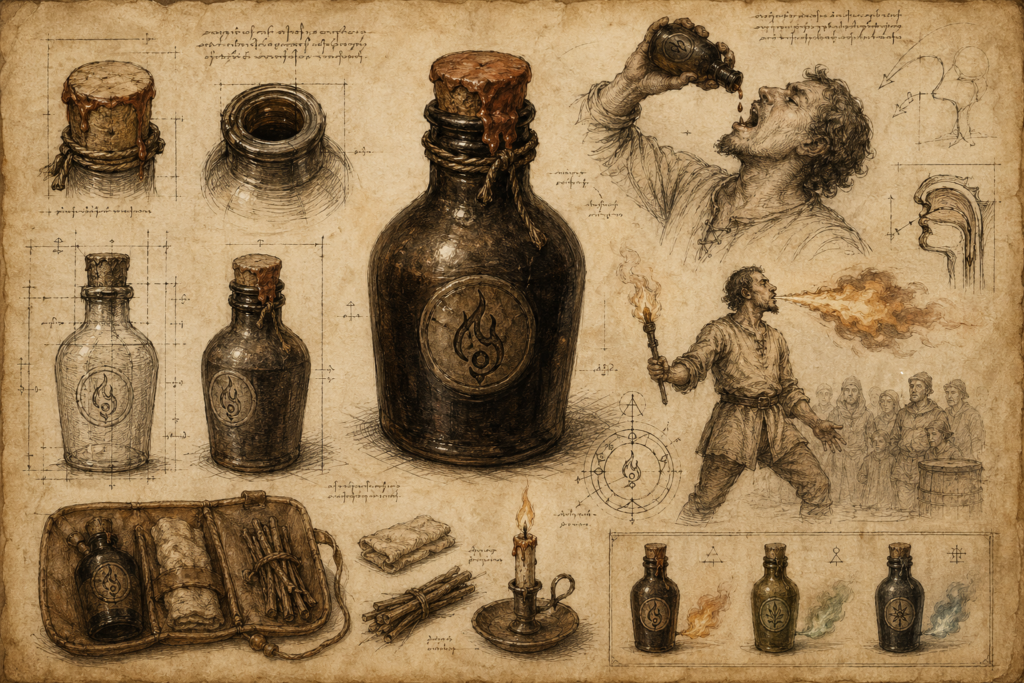
Overview
Keros Oil is a bitter alchemical fuel used by firebreathers, rogues, and false wonder-workers to spit a sudden flash of flame across an open light. It is harder to ignite than common oil, but once dispersed it burns quickly and vanishes almost at once.
This is not battlefield oil. It does not soak floors, feed lanterns, or cling to enemies like alchemist’s fire. Keros Oil is a close-range trick: theatrical, intimidating, and hazardous. Used well, it can make a guard flinch, silence a tavern, sell the illusion of sorcery, or give a cornered character one ugly surprise at arm’s length.
A standard bottle contains enough Keros Oil for 10 mouthfuls.
Physical Description
Keros Oil is usually kept in a small dark glass or glazed ceramic bottle sealed with waxed cork. The liquid is thin, harsh-smelling, and unpleasantly bitter.
Professional firebreathers carry it in padded cases with candles, tindertwigs, slow matches, treated cloths, powders, and other stage tools. Careless users keep it in reused medicine flasks or perfume bottles, which is how accidents happen.
Why Keros Oil Matters
Keros Oil gives non-spellcasters a small but memorable fire trick. Its value is not damage. Its value is timing.
A sudden breath of flame can turn attention, break confidence, expose a trick, or buy a second of hesitation. The danger is part of the item: Keros Oil is cheap because it is crude, short-ranged, and risky to use.
Edition Tabs
Keros Oil 5.5e / 2024
Keros Oil Pathfinder 1e / 3.5e
Keros Oil 3.0
Keros Oil 5.5e / 2024
Adventuring Gear, Alchemical Item
Cost: 5 gp
Weight: Negligible
Uses: 10 mouthfuls per bottle
Crafting: Alchemist’s Supplies, DC 15, at the DM’s discretion
As an Action, you take a mouthful of Keros Oil and spit it across an open flame within your reach, creating a brief burst of fire. Make a ranged attack against one creature within 5 feet of you. On a hit, the target takes 1d3 fire damage.
You must have access to an open flame, such as a candle, torch, tindertwig, lantern flame, burning brand, or similar source.
If the d20 for the attack roll is a 1, you mishandle the burning oil. You take 1d6 fire damage and are Poisoned until the end of your next turn as smoke, heat, and bitter fuel overwhelm you.
A bottle of Keros Oil contains 10 uses.
Handling Keros Oil
If the bottle is already in hand, taking a mouthful is part of the Action used to breathe fire. If the bottle is packed away, stoppered, hidden, or carried in a pouch, the DM may require the character to draw or ready it first.
Keros Oil Pathfinder 1e / 3.5e
Alchemical Item
Cost: 5 gp
Weight: —
Craft: Craft (alchemy) DC 15
Uses: 10 mouthfuls per bottle
Also known as firebreather’s oil, Keros Oil is harder to ignite than common oil but burns quickly at a low temperature.
You may spit a mouthful of Keros Oil past an open flame, such as a candle, tindertwig, or torch, to create a brief burst of fire. If used to attack, this is a ranged touch attack with a maximum range of 5 feet. On a hit, the target takes 1d3 points of fire damage.
If you roll a 1 on the attack roll, you accidentally inhale or swallow some of the burning fuel. You take 1d6 points of fire damage and are nauseated for 1 round.
A bottle of Keros Oil holds enough liquid for 10 mouthfuls. Taking a mouthful from the bottle is a standard action. The Rapid Reload feat reduces this to a move action.
Keros Oil 3.0
Source Adventurer’s Armory
Also known as firebreather’s oil, this bitter liquid is harder to ignite than common oil but burns quickly at a low temperature, making it ideal for exotic performers. You may spit a mouthful of keros oil past an open flame (such as a candle, tindertwig, or torch) to ignite it, creating a brief burst of fire. If you use it to attack, the attack is a ranged touch attack with a maximum range of 5 feet that deals 1d3 points of fire damage.
If you roll a 1 on your attack roll, you accidentally inhale or swallow some of the burning fuel; you take 1d6 points of fire damage and are nauseated for 1 round. A bottle of keros oil holds enough for 10 mouthfuls; taking a mouthful from the bottle is a standard action (the Rapid Reload feat reduces this to a move action).
Create: Craft (alchemy) DC 15
How Keros Oil Is Used
Keros Oil belongs in scenes where fire is theatre, threat, or misdirection.
A firebreather may hold a crowd’s attention while an accomplice works the room. A rogue may make a pursuer hesitate at a doorway. A false magician may fake elemental power. A desperate adventurer may use it when cornered, disarmed, or trying to buy a second to escape.
It is strongest in cramped, public, or theatrical spaces where a handspan of flame can feel like a threat, a miracle, or a warning.
Failure, Risk, and Misuse
Keros Oil should feel dangerous in play. It is held in the mouth, used near flame, and projected at very short range.
Strong wind, rain, smoke, drunkenness, violent movement, grappling, panic, or poor lighting may make the trick harder or more dangerous at the GM’s discretion. A character using Keros Oil carelessly near curtains, straw, dry timber, manuscripts, spilled alcohol, or powder stores may create problems beyond the listed damage.
Keros Oil does not continue burning on a target. It does not create a pool of fire. It does not replace alchemist’s fire, dragon breath, or a spell. Its effect is a single flash: bright, frightening, painful, and gone.
Value in the World
Keros Oil appears wherever dangerous spectacle is tolerated: travelling fairs, tavern acts, feast-hall entertainments, street performances, court displays, and underworld confidence games.
Authorities tolerate it unevenly. A city may allow licensed performers to use it in public squares but forbid it in inns, stables, granaries, ships, libraries, shrines, and crowded wooden districts. Possessing a bottle is not always criminal, but using one at the wrong time can quickly become arson, assault, or public endangerment.
Trade, Craft, and Common Variants
Most Keros Oil is sold in small stoppered bottles containing 10 mouthfuls. The standard bottle costs 5 gp. More expensive versions do not increase combat damage; they change how cleanly the oil burns, how impressive the flame looks, or how suitable it is for public performance.
Common Keros Oil:
The standard version described in the rules above. It is bitter, smoky, inexpensive, and good enough for tavern performers, reckless adventurers, and travelling entertainers.
Cost: 5 gp per bottle.
Refined Keros:
A cleaner grade used by professional firebreathers, court entertainers, and established theatrical troupes. It produces less smoke, has a less punishing taste, and gives a brighter, more controlled flame. It does not change the attack or damage rules, but it is more acceptable for indoor performance and wealthy patrons.
Cost: 15 gp per bottle.
Coloured Keros:
Keros Oil treated with alchemical salts or mineral additives so the flame briefly flares blue, green, red, violet, or another unusual colour. It is used for festivals, staged wonders, coded displays, and false miracles. It otherwise follows the normal Keros Oil rules.
Cost: 15 gp per bottle.
Other differences, such as noble packaging, smuggled bottles, concealed flasks, or labelled signal sets, are presentation and use-case rather than separate alchemical variants.
Using Keros Oil in Your Game
Keros Oil works best as a risky utility item, not a reliable combat tool. Its range is too short and its damage too low to dominate a fight, but its visual impact is strong.
Use it for performers, thieves, stage magicians, duelists with dirty tricks, tavern brawls, riot scenes, travelling fairs, and fake supernatural displays. It can also help distinguish a character who relies on nerve, misdirection, and preparation rather than magic.
For balance, keep the 5-foot range, low damage, and mishap on a natural 1. Those limits are what make Keros Oil interesting rather than merely efficient.
Adventure and Worldbuilding Hooks
- The Last Mouthful: A firebreather collapses after a performance, badly burned from the inside. The troupe blames a rival, the alchemist blames improper use, and the patron wants the matter buried before the feast guests start talking.
- The Closed Theatre: A town bans fire acts after a wooden playhouse burns during a crowded performance. The surviving actors claim the doors were barred from outside.
- The Witness Flare: During a street act, the sudden flame lights the face of someone hiding in the crowd: a runaway heir, escaped prisoner, disgraced priest, missing spouse, or assassin waiting for a signal.
Historical Context
Keros Oil is performance alchemy. It belongs to the world of travelling players, market-day entertainers, feast-hall spectacles, carnival dangers, and courtly marvels.
In a high-medieval campaign, it can sit beside juggling knives, trained animals, puppetry, sleight of hand, coloured smoke, mechanical stage tricks, and controlled alchemical displays. The Metropolitan Museum of Art’s discussion of medieval fools and jesters is a useful real-world reference point for entertainers who moved between street performance, courtly service, social licence, and public spectacle. Keros Oil gives firebreathers and false magicians a rules-backed place in that same performance culture without turning them into spellcasters.