
Tar Bomb – Incendiary Weapon for Ships and Sieges
Tar Bomb – Incendiary Weapon for Ships and Sieges
A burning lump of pitch and rope, made to stick to decks, rigging, shields, and men.
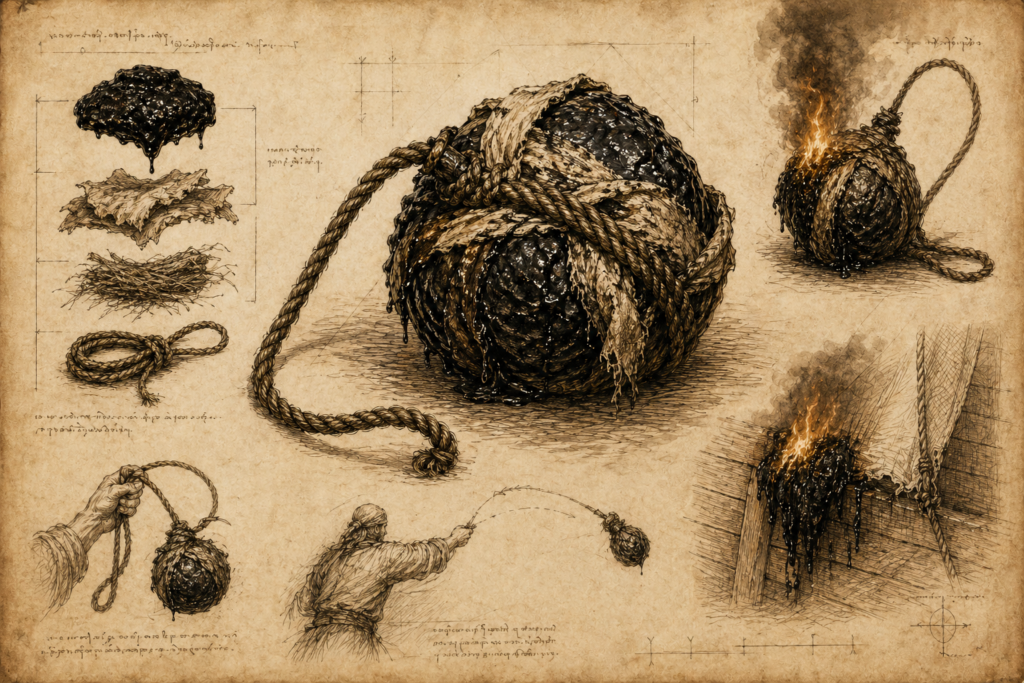
Overview
A Tar Bomb is a crude incendiary weapon made from pitch, tar, cordage, scrap fibre, and a throwing rope. It is not a refined alchemical flask or a clean military firepot. It is a sailor’s weapon: cheap, ugly, smoky, and frightening because it clings to whatever it strikes.
Its purpose is simple. It carries fire onto a target and keeps it there.
Tar Bombs are most useful in shipboard combat, dockside raids, sieges, warehouse fights, and attacks on wooden structures. On bare stone or wet earth, they are unimpressive. On a deck crowded with rope, sailcloth, oil, pitch, timber, and panicked crewmen, they can change the whole fight.
Physical Description
A Tar Bomb is usually a compact lump of tar, pitch, rag, rope fibre, and scrap cloth, roughly the size of a clenched fist to a small melon. It is bound around a length of cord or rope, which acts as both handle and throwing aid. Better-made versions are wrapped around a core of knotted hemp, tow, straw, wool waste, or thin splints so the burning mass holds together in flight.
Before use, it is black, greasy, and difficult to store cleanly. Crews keep Tar Bombs in buckets, sand trays, oiled cloth, or covered crates away from sparks and lanterns. Even unlit, they stain hands, packs, decks, and clothing.
Once lit, a Tar Bomb burns with foul smoke and clinging heat. It does not explode. It spatters, slumps, sticks, and keeps burning until scraped away, smothered, doused, or magically extinguished.
Why This Item Matters
The Tar Bomb gives non-magical crews and low-level combatants access to dangerous fire without turning every sailor into an alchemist. Its value is not raw damage. Its value is pressure.
A lit Tar Bomb forces decisions. Someone has to stamp out the sail, drop the burning shield, abandon the ladder, cut loose the rope, or stop fighting long enough to keep the deck from catching.
That makes it stronger as an encounter tool than as a simple damage item. It works best when the battlefield has something worth burning.
Edition Tabs
Tar Bomb 5.5e / 2024
Tar Bomb, Pathfinder 1e / 3.5e
Tar Bomb 5.5e / 2024
Adventuring Gear, Incendiary Weapon
Cost: 2 gp
Weight: 2 lb.
Range: 10/30 ft.
Use: Utilize action
Damage: 1d4 fire damage
Save DC: 13 Dexterity saving throw
As a Utilize action, you can light and throw a Tar Bomb at a creature or object within range. Make a ranged attack against the target. You are proficient with this attack if you are proficient with improvised weapons or alchemist’s supplies. At the DM’s discretion, proficiency with water vehicles may also apply when using a Tar Bomb in shipboard combat.
On a hit, the target takes 1d4 fire damage. If the target is a creature or flammable object, it also begins burning. A burning target takes 1d6 fire damage at the end of each of its turns.
A creature can use an action to scrape away, smother, or beat out the burning tar, ending the ongoing fire with a successful DC 13 Dexterity saving throw. An adjacent creature can use its action to attempt this saving throw on the target’s behalf.
The flames end automatically if the target is fully submerged in water, affected by suitable magic that extinguishes fire, deprived of air, covered with enough sand or wet canvas, or if the burning material is cut loose and thrown clear.
Shipboard and Siege Use
Tar Bombs are most dangerous when they strike materials that can keep burning after the first impact.
When a Tar Bomb hits an unattended flammable object, the object takes the normal initial fire damage. If the object is made of or covered in dry rope, sailcloth, canvas, thatch, pitch, tar, dry timber, loose straw, oil-soaked cloth, or similar material, it begins burning unless the surface is too wet, too small, too solid, or too quickly smothered to sustain flame.
A burning object takes 1d6 fire damage at the end of each round until extinguished. If no one deals with the fire, it may spread after 3 rounds to one nearby flammable object or section of surface, such as an adjacent rope coil, sail, crate, plank section, ladder, mantlet, hatch cover, cargo stack, or patch of thatch.
Use the following guidance:
Easy to ignite: dry sailcloth, rope coils, thatch, straw, loose canvas, oil-soaked cloth, pitch-smeared wood, tarred rigging.
Possible to ignite: wooden decking, crates, shields, ladders, siege mantlets, dry doors, wagon beds, wooden palisades.
Hard to ignite: wet timber, green wood, packed earth, treated leather, damp canvas, rain-soaked rope, heavy doors, thick ship beams.
Will not normally ignite: stone, metal, soaked ground, submerged objects, bare mud, fresh snow, or objects already being actively doused.
A creature adjacent to the burning object can use an action to beat out, scrape away, smother, cut loose, or douse the fire. This ends the fire with a successful DC 13 Dexterity check or an appropriate tool check, such as alchemist’s supplies, carpenter’s tools, mason’s tools, smith’s tools, water vehicles, or another proficiency suited to the situation.
In shipboard combat, a spreading fire should usually threaten one local section first, not the entire vessel at once. Good targets include a sail, a rope coil, a hatch cover, a cargo stack, a siege ladder, a mantlet, a small roof section, or a patch of deck. A full ship, tower, barn, or gatehouse should only be at serious risk if the fire is ignored, fed by wind, or reaches stored pitch, oil, dry hay, ammunition, or other highly flammable supplies.
The fire should not spread through stone, wet ground, soaked timber, or heavy structural beams in a single round. A Tar Bomb creates a local crisis first. It becomes a disaster only when the situation feeds it.
Lighting a Tar Bomb
Lighting a Tar Bomb requires a free hand and access to an open flame, such as a torch, brazier, lantern flame, burning brand, or existing fire.
Under normal conditions, lighting and throwing a Tar Bomb are part of the same Utilize action. In poor conditions, the DM may require a check before the Tar Bomb can be lit safely.
- Use DC 10 Dexterity for awkward but manageable conditions, such as darkness, cramped footing, a rocking deck, or light rain.
- Use DC 13 Dexterity for difficult conditions, such as strong wind, heavy rain, violent ship movement, nearby rushing water, melee pressure, or trying to light the Tar Bomb while climbing.
- Use DC 15 Dexterity for severe conditions, such as a storm-lashed deck, freezing rain, breaking surf, total darkness, or lighting it while restrained, prone, or under direct attack.
A character proficient with alchemist’s supplies, tinker’s tools, water vehicles, or another clearly relevant proficiency may add that proficiency bonus to the check if the situation fits.
On a failed check, the Tar Bomb does not light. If the check fails by 5 or more, the Tar Bomb is spoiled, dropped, burns down too quickly, or begins smoking in the character’s hand. The character can drop it safely as part of the failed action. If the character keeps hold of it, the Tar Bomb ignites at the end of the character’s turn and affects the holder as though struck by it.
Tar Bomb, Pathfinder 1e / 3.5e
Original Source: Pathfinder, Pirates of the Inner Sea.
Adventuring Gear, Incendiary Weapon
Cost: 2 gp
Weight: 2 lb.
Range Increment: 10 ft.
Damage: 1d4 fire damage
Extinguish DC: Reflex DC 15
Craft: Craft (alchemy) or Craft (shipwright) DC 15
Lighting a Tar Bomb is a move action. Throwing it is a standard action. A Tar Bomb is treated as a thrown weapon for range and attack penalties. It does not deal splash damage.
Make a ranged touch attack against a creature or object. On a hit, the target takes 1d4 points of fire damage. If the target is a creature or flammable object, it catches fire, taking 1d6 points of fire damage each round until the flames are extinguished.
The target, or an adjacent creature, can attempt to extinguish the flames as a full-round action with a successful DC 15 Reflex save.
Knocking the burning target into a body of water, fully submerging it, covering it with enough sand or wet canvas, cutting the burning material loose, or using appropriate magic to extinguish fire automatically ends the burning effect.
Shipboard and Siege Use
Tar Bombs are most dangerous when they strike materials that can keep burning after the first impact.
When a Tar Bomb hits an unattended flammable object, the object takes the normal initial fire damage. If the object is made of or covered in dry rope, sailcloth, canvas, thatch, pitch, tar, dry timber, loose straw, oil-soaked cloth, or similar material, it begins burning unless the surface is too wet, too small, too solid, or too quickly smothered to sustain flame.
A burning object takes 1d6 points of fire damage each round until extinguished. If no one deals with the fire, it may spread after 3 rounds to one nearby flammable object or section of surface, such as an adjacent rope coil, sail, crate, plank section, ladder, mantlet, hatch cover, cargo stack, or patch of thatch.
Use the following guidance:
Easy to ignite: dry sailcloth, rope coils, thatch, straw, loose canvas, oil-soaked cloth, pitch-smeared wood, tarred rigging.
Possible to ignite: wooden decking, crates, shields, ladders, siege mantlets, dry doors, wagon beds, wooden palisades.
Hard to ignite: wet timber, green wood, packed earth, treated leather, damp canvas, rain-soaked rope, heavy doors, thick ship beams.
Will not normally ignite: stone, metal, soaked ground, submerged objects, bare mud, fresh snow, or objects already being actively doused.
A creature adjacent to the burning object can attempt to beat out, scrape away, smother, cut loose, or douse the fire as a full-round action. This ends the fire with a successful DC 15 Reflex save, DC 15 Dexterity check, or appropriate skill check, such as Craft (alchemy), Craft (carpentry), Profession (sailor), Profession (siege engineer), or Use Rope, depending on the situation.
In shipboard combat, a spreading fire should usually threaten one local section first, not the entire vessel at once. Good targets include a sail, a rope coil, a hatch cover, a cargo stack, a siege ladder, a mantlet, a small roof section, or a patch of deck. A full ship, tower, barn, or gatehouse should only be at serious risk if the fire is ignored, fed by wind, or reaches stored pitch, oil, dry hay, ammunition, or other highly flammable supplies.
The fire should not spread through stone, wet ground, soaked timber, or heavy structural beams in a single round. A Tar Bomb creates a local crisis first. It becomes a disaster only when the situation feeds it.
Lighting a Tar Bomb
Lighting a Tar Bomb requires a free hand and access to an open flame, such as a torch, brazier, lantern flame, burning brand, or existing fire.
Under normal conditions, lighting a Tar Bomb is a move action and requires no check. In poor conditions, the GM may require a check before the Tar Bomb can be lit safely.
Use DC 10 for awkward but manageable conditions, such as darkness, cramped footing, a rocking deck, or light rain.
Use DC 15 for difficult conditions, such as strong wind, heavy rain, violent ship movement, nearby rushing water, melee pressure, or trying to light the Tar Bomb while climbing.
Use DC 20 for severe conditions, such as a storm-lashed deck, freezing rain, breaking surf, total darkness, or lighting it while grappled, prone, or under direct attack.
A character may attempt this as a Dexterity check, Reflex save, or relevant skill check, such as Craft (alchemy), Profession (sailor), Profession (siege engineer), or Use Rope.
On a failed check, the Tar Bomb does not light. If the check fails by 5 or more, the Tar Bomb is spoiled, dropped, burns down too quickly, or begins smoking in the character’s hand. The character can drop it safely as part of the failed action. If the character keeps hold of it, the Tar Bomb ignites at the end of the character’s turn and affects the holder as though struck by it.
How Tar Bombs Are Used
Tar Bombs belong in scenes where fire threatens the battlefield itself.
Pirates throw them onto enemy decks before boarding. Harbour guards drop them onto raiders climbing from boats. A militia hurls them at siege ladders. A saboteur uses one to burn a rope bridge after crossing it. Dockside criminals roll a lit Tar Bomb through a warehouse door to force enemies into the street.
The item is strongest when it creates a second problem during the fight. The enemy is not merely taking fire damage. The ship, ladder, cargo, sail, bridge, gate, or escape route is now in danger.
Failure, Risk, and Misuse
A Tar Bomb is dangerous before it ever leaves the thrower’s hand.
It may smoke too early, stain gear, foul a pack, burn down before use, or become useless if soaked. A poor throw can endanger allies. A careless throw in a wooden town, dry barn, crowded dock, forest camp, rope bridge, or ship’s hold can create a bigger problem than the original enemy.
The item should not punish every use with disaster. It should, however, make fire feel like a real choice rather than free damage.
Value in the World
Tar Bombs are common where ships are built, repaired, waterproofed, or burned. Tar, pitch, rope scrap, tow, sailcloth offcuts, straw, wool waste, and old cordage are easy to find in ports, shipyards, naval camps, and siege lines.
Most respectable authorities dislike them. Harbourmasters fear them. Captains store them carefully. Pirates, raiders, saboteurs, and desperate defenders value them because they are cheap and hard to ignore.
A city that allows Tar Bombs to be sold openly is probably lawless, militarised, corrupt, or expecting attack.
Trade and Craft
Tar Bombs are usually made in ports, shipyards, siege camps, and raider havens where pitch, tar, rope scrap, sailcloth offcuts, tow, straw, and old cordage are easy to find. They are rarely fine goods. A usable Tar Bomb needs to hold together in flight, burn long enough to matter, and stick to the target instead of scattering harmlessly.
A character can craft a Tar Bomb with access to pitch or tar, scrap fibre, cordage, and an open flame or workshop heat. Poor materials may still make a working bomb, but they increase the chance that it smokes too early, falls apart when thrown, or burns out before it catches.
Using Tar Bombs in Your Game
Use Tar Bombs when the location can burn.
They are ideal for ship battles, dockside ambushes, siege assaults, warehouse fights, pirate raids, sabotage missions, harbour defences, wooden forts, rope bridges, dry camps, and supply yards.
They are weak in empty terrain. If the fight has no flammable objects, no confined space, and no reason to fear spreading fire, the Tar Bomb becomes a minor damage item. Put it where flame changes the situation.
Adventure and Worldbuilding Hooks
The Fire That Must Look Accidental: A merchant hires the party to guard a cargo ship through dangerous waters. The real danger is already aboard: Tar Bombs have been hidden near the pitch stores so the ship will burn in a place where everyone will blame pirates. The cargo is overinsured, the books do not match, and someone expects profit from the loss.
The Burned Rigging Trial: A sailor is condemned for throwing a Tar Bomb during a boarding action that killed prisoners trapped below deck. He claims he acted on the captain’s order. The captain denies it. The party must uncover what happened and decide whether this is mutiny, murder, wartime necessity, or a deliberate cover-up.
The Black Rope in the Evidence Chest: A captured pirate’s Tar Bomb bears a maker’s knot used only by one royal dockyard. That means someone in the navy is supplying raiders. The crown wants the evidence buried, the pirates want their supplier protected, and the dockworkers fear the harbour guard will punish the wrong people unless the truth comes out.
Historical Context
Tar Bombs belong to the practical history of shipboard incendiaries: burning pitch, tar, tow, rope, resin, cloth, fire-pots, stinkpots, and other thrown or dropped weapons used to spread flame, smoke, panic, and confusion across wooden vessels.
They are especially suitable for pirate, privateer, harbour, and siege encounters. A Tar Bomb should feel like something made from shipyard materials rather than a secret formula: pitch scraped from stores, rope ends, sailcloth scraps, tow, straw, and a length of cord for swinging or throwing.
Wooden ships are dangerously vulnerable to fire because they carry canvas sails, tarred rope, pitch-treated fittings, dry cargo, and sometimes powder or other combustibles. For useful background on later shipboard fire and smoke weapons, see this discussion of stinkpots and burn injuries during the Golden Age of Piracy. For wider naval context, see Global Maritime History’s article on fire and fear in late seventeenth-century naval battles.
Keep this reference growing
If this page helped with your reading or game, you can support its upkeep or explore the curated books.
Explore the Bookshop — epics, classics and stories behind imagined worlds.