
Elemental Breath, Alchemical Gear
Elemental Breath, Alchemical Gear
A sealed vial of impossible air, opened only when the world has no breath left to give.
Overview
Elemental Breath is an alchemical vial that appears empty until the moment it is opened. Inside the glass is not liquid, smoke, or powder, but a trapped rush of elemental air held under a perfect seal.
When the vial is uncorked and inhaled, an air-breathing creature briefly no longer needs to breathe. For a handful of desperate moments, smoke, drowning, stale tomb air, choking vapour, and sealed chambers lose their most immediate threat.
Elemental Breath is not a substitute for long-term survival magic. It does not make a character safe underwater, protect against pressure, cleanse poison already in the body, or overcome every hazard in a hostile environment. Its value is narrower and more dramatic: it buys time when there should be no time left.
A single vial can decide who reaches the flooded lever, who survives the locked coffin, who enters the burning room, or who carries the rope through the drowned passage.
Physical Description
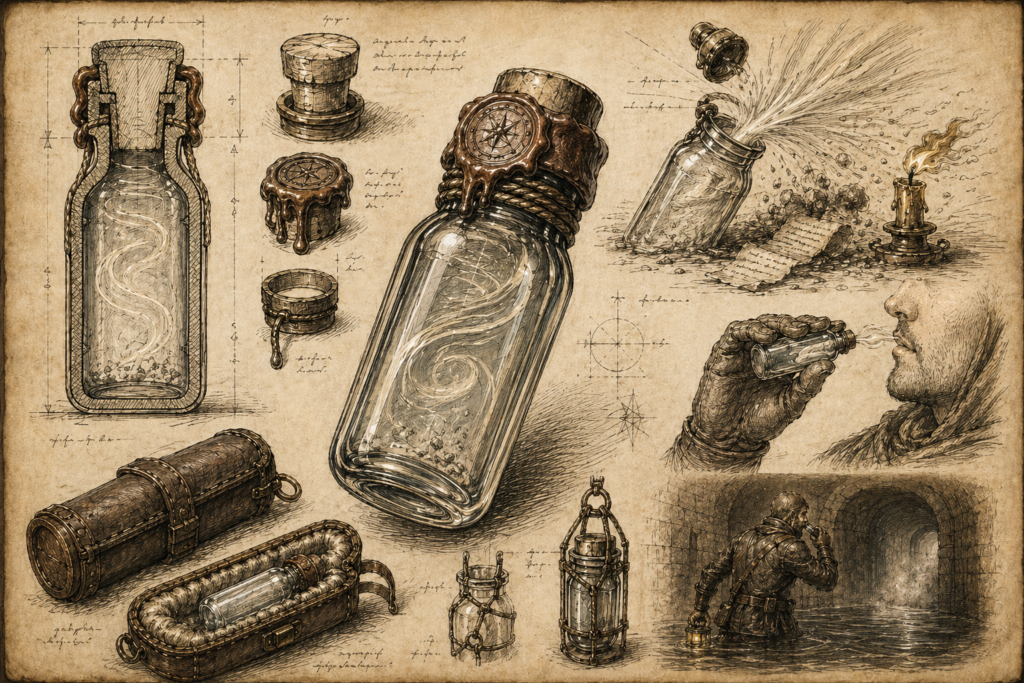
A vial of Elemental Breath usually looks empty. It is commonly made from clear glass, blue-green alchemical glass, blown crystal, or a thin reinforced vessel sealed with wax, resin, or a fitted stopper.
Close inspection may reveal that the vial is not truly empty. Dust may refuse to settle on it. Loose ash may stir when it passes nearby. A faint shimmer may cross the inside of the glass like heat over stone. The stopper may tremble slightly, as though the vial is holding back a tiny storm.
When opened, the effect is immediate. A short rush of cold, clean wind bursts from the mouth of the vial. Candle flames lean, cloak-edges lift, parchment flutters, and nearby dust is pushed aside. The breath must be inhaled at once, before the stored air escapes into the surrounding world.
Why Elemental Breath Matters
Elemental Breath matters because it turns suffocation from certain death into a short, dangerous countdown.
It does not remove the obstacle. It gives a character just enough time to do something meaningful before the danger returns. That makes it ideal adventuring gear. The item creates pressure rather than avoiding it.
A party with Elemental Breath can attempt a route that would otherwise be impossible, but only briefly. The submerged gate still has to be opened. The burning room is still full of heat and smoke. The sealed tomb may still be locked from the outside. The flooded stair may still be dark, cold, and full of things that do not need air.
Used well, Elemental Breath rewards planning. Used badly, it vanishes in a wasted gust.
Edition Tabs
Elemental Breath 5.5e / 2024
Elemental Breath Pathfinder 1e
Elemental Breath 5.5e / 2024
Adventuring Gear, Uncommon Alchemical Item
Cost: 80 gp
Weight: Negligible
Use: Consumable; inhaled as an action
Duration: 1 minute
A vial of Elemental Breath appears empty until opened. When uncorked, it releases a brief rush of clean elemental air.
As an action, an air-breathing creature can open and inhale the contents of the vial. For 1 minute, the creature does not need to breathe.
The vial must be inhaled on the turn it is opened. If it is opened and not inhaled before the end of that turn, the elemental air disperses and the item is wasted.
Elemental Breath does not let the creature breathe water, speak normally underwater, resist crushing pressure, ignore poisonous effects already suffered, or survive in hostile environments beyond the need to breathe. It only removes the creature’s need for air for the duration.
Elemental Breath Pathfinder 1e
Adventuring Gear, Alchemical Item
Price: 80 gp
Weight: —
Use: Inhaled as drinking a potion
Duration: 10 rounds
This vial at first seems to be empty, but when it is opened, a rush of wind issues forth from within.
When Elemental Breath is inhaled by an air-breathing creature, that creature does not need to breathe air for 10 rounds. Inhaling Elemental Breath is treated as drinking a potion.
A vial of Elemental Breath must be inhaled on the same round it is opened to gain its effect. If it is not inhaled during that round, the vial’s contents disperse and the item is wasted.
Elemental Breath only benefits creatures that breathe air. It does not grant the ability to breathe water, speak underwater, resist pressure, ignore poison already in the body, or survive other environmental hazards unless those hazards depend specifically on the need to breathe.
How Elemental Breath Is Used
Elemental Breath is emergency gear, not an exploration solution. It gives a creature a brief window in which breathing would otherwise be impossible, but it does not remove the rest of the danger.
A character might use it before entering a smoke-filled room, swimming through a short flooded passage, crawling into a sealed vault, escaping a burial trap, or crossing a chamber filled with choking vapour. In each case, the vial buys enough time to act, not enough time to relax.
The best use of Elemental Breath is deliberate preparation. A scout inhales it before diving through an underwater gate. A rescuer uses it before entering a burning inn. A thief saves it for the moment a tomb door seals shut. A prisoner hidden inside a chest relies on it until the chest is opened again.
Used badly, it is easy to waste. Opening the vial too early, dropping it, hesitating, or trying to pass it around after uncorking it releases the stored air into the room. Once opened, Elemental Breath is a one-breath chance.
Failure, Risk, and Misuse
Elemental Breath protects against the need to breathe. It does not make the user immune to the environment.
A character under its effect may still be blinded by smoke, burned by flame, battered by water, numbed by cold, crushed by pressure, harmed by contact poison, or trapped behind a sealed door. The item prevents suffocation for a short time, but the character must still deal with every other danger in the scene.
The strict timing also matters. The vial is not opened, shared, and passed around like a waterskin. It must be inhaled immediately. If the character opens it before they are ready, the item is lost.
This makes Elemental Breath most effective when the party has a plan. It is weaker in panic, confusion, or darkness, where one dropped vial can turn a rescue into a disaster.
Value in the World
Elemental Breath is valued wherever air becomes unreliable.
Harbour watches keep it for near-drownings. Mine crews use it during collapses and bad-air incidents. Tomb-breakers carry it into sealed chambers. Sewer workers prize it when old tunnels fill with foul vapour. Ship crews keep it near bilges, wreck-diving gear, and repair tools. Wealthy households may store a vial in case of fire.
It is also useful to less honest professions. Smugglers hide themselves in sealed cargo. Assassins cross smoke-filled rooms. Prisoners use it to survive coffins, chests, or airless hiding places. Thieves carry it when entering old vaults whose builders expected intruders to breathe.
For adventurers, Elemental Breath is the kind of item that may sit unused for months, then become priceless in a single round.
Trade, Craft, and Common Forms
Elemental Breath is usually sold as emergency alchemical gear. Divers, miners, tomb-breakers, sewer workers, ship crews, and underworld guides value it because it is small, portable, and usable by someone with no magical training.
Most vials are made with reinforced glass and a tightly sealed stopper. The important craft is not the visible container, but the seal. If the stopper leaks, cracks, dries, or is opened carelessly, the stored breath is lost. Good merchants therefore sell Elemental Breath in padded cases, waxed wrappings, or cord-bound capsules marked with the maker’s seal.
Common forms include:
- Diver’s Vial: Wax-sealed and tied with cord so it can be opened with wet hands.
- Miner’s Vial: Packed in a wooden or leather case to protect it from blows underground.
- Rescue Vial: Kept by temples, harbour watches, city guards, or wealthy households for fires, floods, and collapsed rooms.
- Tomb Vial: Sold to explorers and grave-robbers in small hard cases that can survive being dropped in stone passages.
- Disguised Vial: Hidden inside a perfume bottle, medicine ampoule, pilgrim charm, or hollow token for spies, smugglers, and prisoners.
These forms do not need different rules. They make the item feel practical and help explain who buys it, how it is carried, and why it survives until the moment it is needed.
Using Elemental Breath in Your Game
Elemental Breath works best when the danger is immediate, visible, and timed.
A flooded corridor becomes more tense when one character can reach the far grate but only has a minute to do it. A burning inn becomes more dramatic when the party can send one rescuer into the smoke. A sealed tomb becomes less of a dead end and more of a countdown. A poison-gas trap becomes a problem of movement, timing, and choice rather than a simple damage roll.
The item also creates party decisions. Who gets the vial? The strongest swimmer? The rogue who can open the submerged lock? The armoured fighter who cannot hold their breath for long? The unconscious prisoner? The character carrying the rope?
Avoid using Elemental Breath as a general-purpose underwater adventuring item. Its strength is urgency. It should not replace water breathing magic, diving equipment, or long-duration environmental preparation.
Adventure and Worldbuilding Hooks
- The Last Vial: A mine collapse has trapped workers beyond a pocket of foul air. The rescuers have one vial of Elemental Breath and several possible routes.
- The Flooded Reliquary: A sacred object lies in a submerged shrine chamber. The party has enough breath for one attempt, but not enough time to search carelessly.
- The Empty Bottle Murder: A noble is found suffocated in a locked room beside an opened vial of Elemental Breath. Someone made sure it was uncorked too early.
- The Smuggler’s Passage: A thieves’ route beneath the city includes a sealed crawlspace that can only be crossed with Elemental Breath.
- The Bad Batch: Several vials from the same alchemist have failed under pressure. The party must discover whether the cause is fraud, sabotage, or something wrong with the captured air itself.
Keep this reference growing
If this page helped with your reading or game, you can support its upkeep or explore the curated books.
Explore the Bookshop — epics, classics and stories behind imagined worlds.